This A1 Beginner retelling of Martina, la cucarachita keeps the plot clear for learners while still giving the story some atmosphere and momentum. Martina es una cucarachita muy bonita. Un día, Martina barre su casa.
This version teaches Spanish through English and includes clickable word help inside the story, full story audio, and lesson notes after the reading. It is free to use on Yak Yacker and is designed to feel natural, readable, and manageable for learners.
Martina es una muy . Vive en una .
Un día, Martina su casa. ¡ una !
Martina dice: -¡Qué ! ¡Voy a un regalo!
Ella va a la . Compra un para su cabeza.
Martina se pone el lazo. Se en un . -¡Qué estoy!
Martina quiere . Se en su ventana.
Pasa un . El gallo dice: -¡Martina, qué eres! ¿Te quieres casar conmigo?
Martina responde: -¿Cómo ? Quiero tu voz.
El gallo : -¡Quiquiriquííí!
Martina se . -¡Ay, no! Tu es muy . No me gusta. -El gallo se va.
Pasa un . El perro dice: -Martina, eres muy . ¿Te casas conmigo?
-¿Cómo ? -pregunta Martina.
El perro : -¡Guau, guau!
Martina dice: -Tu es muy . No me gusta. -El perro se va.
Pasa un . El gato dice: -Miau, Martina. Eres . Cásate conmigo.
-¿Cómo ? -pregunta Martina.
El gato : -¡Miaaauu! -y .
Martina dice: -Tu no es . No me gusta. -El gato se va.
Pasa un . El ratón es .
El ratón dice con una : -Martina, eres la cucarachita más bonita. ¿Te casas conmigo?
Martina la voz suave. Le .
Martina dice: -Tu voz es como una canción. Sí, me quiero .
Martina y el ratón se . .
Viven en la casita pequeña. Y , este cuento se ha acabado.
Martina is a very pretty little cockroach. She lives in a small house.
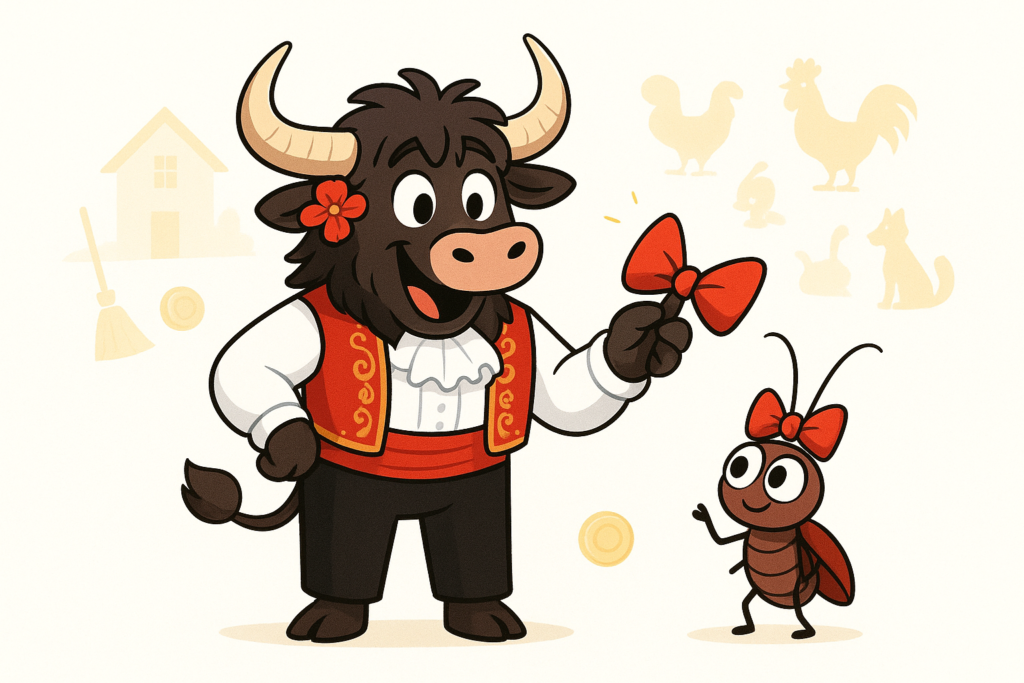
One day, Martina sweeps her house. She finds a gold coin!
Martina says: "What luck! I'm going to buy a gift!"
She goes to the store. She buys a red bow for her head.
Martina puts on the bow. She looks at herself in a puddle. "How pretty I am!"
Martina wants to get married. She sits at her window.
A rooster passes by. The rooster says: "Martina, how lovely you are! Do you want to marry me?"
Martina answers: "How do you sing? I want to hear your voice."
The rooster crows: "Cock-a-doodle-doo!"
Martina covers her ears. "Oh, no! Your song is too loud. I don't like it." The rooster leaves.
A dog passes by. The dog says: "Martina, you are very beautiful. Will you marry me?"
"How do you bark?" asks Martina.
The dog barks: "Woof, woof!"
Martina says: "Your bark is too noisy. I don't like it." The dog leaves.
A cat passes by. The cat says: "Meow, Martina. You are beautiful. Marry me."
"How do you meow?" asks Martina.
The cat meows: "Meooww!" and wags its tail.
Martina says: "Your meow is not soft. I don't like it." The cat leaves.
A mouse passes by. The mouse is small and gray.
The mouse says with a very soft voice: "Martina, you are the most beautiful little cockroach. Will you marry me?"
Martina listens to the soft voice. She likes it.
Martina says: "Your voice is like a song. Yes, I want to marry you."
Martina and the mouse get married. They dance all night.
They live happily in the small house. And that's the end of the story.
Let’s look at the important words from the story. You met a cute little cockroach, some animals, and everyday objects. These words will help you describe the world around you.
- cucarachita – little cockroach (cucaracha + -ita = tiny, cute version)
- moneda de oro – gold coin, lazo rojo – red bow, charco – puddle
- Animals: gallo (rooster), perro (dog), gato (cat), ratón (mouse)
- Sounds: quiquiriquí (cock‑a‑doodle‑doo), guau guau (woof woof), miau (meow)
Martina’s story is full of expressions you can use right away. These phrases help you react to surprises, give compliments, and say what you like or don’t like.
- ¡Qué suerte! – What luck!
- ¡Qué guapa estoy! – How pretty I am!
- ¿Te quieres casar conmigo? – Do you want to marry me?
- No me gusta. – I don’t like it.
The actions in the story are in the present tense. Spanish verbs change their endings depending on who is doing the action. Here are some patterns you saw.
- Regular -ar: comprar → (ella) compra, cantar → (él) canta, bailar → (ellos) bailan
- Regular -er: barrer → (ella) barre
- Regular -ir: vivir → (ella) vive
- A little irregular: querer → (ella) quiere, decir → (él/ella) dice
Now you can play with the story. Try retelling it with different animals and their sounds – maybe a pato (duck) that says cuac cuac, or a cerdo (pig) that says oinc oinc. The more you practise, the more natural your Spanish will feel. ¡Ánimo!
Martina, la cucarachita comes from an older public-domain story tradition and is best known as a public_domain_folk_tale_retelling. This Yak Yacker article is an original learner retelling based on public-domain source material, so the wording here is simplified for modern learners rather than copied from one old edition.
Older printings, translations, and retellings of this story can vary quite a bit. This version is adapted for A1 Beginner learners studying Spanish.
If you want to keep going, browse more in our Spanish section and review the A1 Spanish Vocabulary List. After that, try Spanish Gender Rules for Nouns and Adjectives for another useful next step.