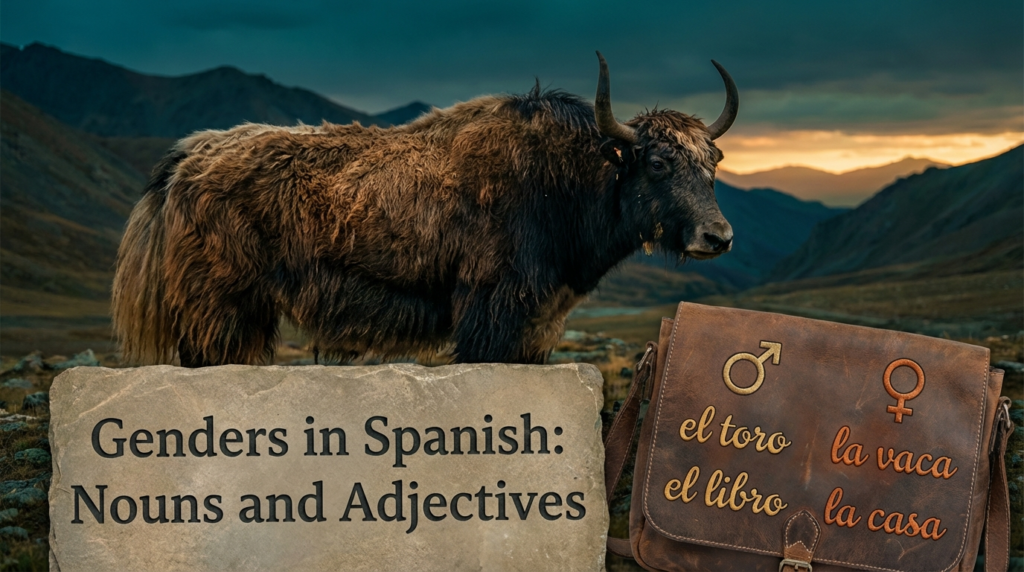
Spanish nouns come with a built-in label: masculine or feminine. It’s not about “male/female” in real life—Spanish just likes to sort words into two teams.
Good news: you don’t need to memorize every noun. Most of the time, you can guess correctly using endings and a few high-value rules. Then you’ll make adjectives match like a pro.
Yak Box: The One Sentence You Need
Nouns have gender, and the “helpers” around them (articles, adjectives, some pronouns) must match.
la casa bonita = the pretty house (feminine + feminine)
el carro bonito = the pretty car (masculine + masculine)
What “Gender” Means in Spanish
Spanish gender is mostly a grammar feature. Sometimes it lines up with people (like el hombre = man, la mujer = woman), but often it’s just… a rule the word follows.
When you learn a new noun, learn it with el or la. That tiny habit saves you from a thousand tiny mistakes.
Fast Gender Clues for Nouns
These clues are not perfect, but they’re ridiculously useful.
Usually Masculine: -o
English meaning: common masculine ending
el libro = the book
El libro es interesante. = The book is interesting.
Usually Feminine: -a
English meaning: common feminine ending
la casa = the house
La casa es grande. = The house is big.
Usually Feminine: -ción / -sión
English meaning: “-tion/-sion” nouns
la información = the information
La información es correcta. = The information is correct.
Usually Feminine: -dad / -tad
English meaning: “-ty” style nouns
la ciudad = the city
La ciudad es segura. = The city is safe.
Usually Masculine: -ma (Greek)
English meaning: many “-ma” nouns are masculine
el problema = the problem
El problema es serio. = The problem is serious.
Often Either: -ista
English meaning: same form for men/women
el/la dentista = the dentist
La dentista es muy amable. = The dentist (woman) is very kind.
Nouns That Break the Rules (Annoying, But Learnable)
Here are some “learn them once, benefit forever” exceptions—very common in everyday Spanish (including Mexico).
Keep building your Spanish
Choose a practical next step when you are ready.
| Noun (With Article) | English Meaning | Sentence You Can Copy |
|---|---|---|
| la mano | the hand | Me duele la mano. = My hand hurts. |
| el día | the day | El día está bonito. = The day is nice. |
| el mapa | the map | Necesito el mapa. = I need the map. |
| la foto | the photo | La foto está borrosa. = The photo is blurry. |
| el agua (singular) | the water | El agua está fría. = The water is cold. |
| las aguas (plural) | the waters | Las aguas están tranquilas. = The waters are calm. |
That el agua thing is a classic: some feminine nouns that start with a stressed “a” sound use el in the singular to avoid two “a” sounds in a row (el agua, not la agua). They’re still feminine, so adjectives stay feminine: el agua fría.
Articles and Other Gender Markers
Articles are your gender “flashlight.” Use them to identify (and remember) the noun’s team.
| Spanish | English Meaning | Example Sentence | Notes |
|---|---|---|---|
| el | the (masc., singular) | El carro está aquí. = The car is here. | Use with masculine nouns |
| la | the (fem., singular) | La llave está aquí. = The key is here. | Use with feminine nouns |
| los | the (masc., plural) | Los libros son nuevos. = The books are new. | Plural masculine |
| las | the (fem., plural) | Las casas son grandes. = The houses are big. | Plural feminine |
| un | a/an (masc., singular) | Quiero un café. = I want a coffee. | Indefinite article |
| una | a/an (fem., singular) | Quiero una tortilla. = I want a tortilla. | Indefinite article |
| este / esta | this | Este lugar es tranquilo. = This place is calm. Esta calle es peligrosa. = This street is dangerous. | Demonstratives match gender |
Adjectives: Make Them Match
Adjectives describe nouns. In Spanish, most adjectives agree with the noun in gender and number (singular/plural).
| Adjective Type | Pattern | English Meaning | Examples |
|---|---|---|---|
| Ends in -o | -o (masc.) / -a (fem.) | changes with gender | el carro rojo = the red car la camisa roja = the red shirt |
| Ends in -e | same for gender | one form for both | el café fuerte = the strong coffee la salsa fuerte = the spicy sauce |
| Ends in a consonant | often same for gender | one form for both | el coche azul = the blue car la bolsa azul = the blue bag |
Quick gut-check: if your noun starts with el, your adjective usually needs the masculine form. If it starts with la, your adjective usually needs the feminine form.
Adjectives That Change in Special Ways
Some adjectives ending in consonants do change for gender. These are worth learning because they’re common.
-or → -ora
English meaning: many “-er/-or” adjectives change
trabajador / trabajadora = hardworking
Mi papá es trabajador. = My dad is hardworking.
Mi mamá es trabajadora. = My mom is hardworking.
-ón → -ona
English meaning: often “big/strong/intense” vibes
grandón / grandona = kind of big / big-ish
Ese perro está grandón. = That dog is kind of big.
Esa casa está grandona. = That house is kind of big.
Nationalities
English meaning: where someone/something is from
mexicano / mexicana = Mexican
Mi amigo es mexicano. = My friend is Mexican.
Mi amiga es mexicana. = My friend (woman) is Mexican.
canadiense = Canadian (same form)
Mi vecina es canadiense. = My neighbor is Canadian.
When One Word Works for Any Gender
Some nouns for people don’t change form; the article shows gender. Handy and mildly unfair.
- el estudiante / la estudiante = the student
La estudiante es muy inteligente. = The student (woman) is very smart. - el artista / la artista = the artist
El artista es famoso. = The artist (man) is famous. - el/la joven = the young person
La joven está cansada. = The young woman is tired.
In real-life Mexican Spanish, you’ll also hear inclusive forms like amigues. It exists in some communities, but it’s not universal—stick to standard forms until you’re comfortable and know your audience.
Plurals: The Quick Upgrade
Plural is separate from gender, but they team up. Here’s the simple version:
- If a word ends in a vowel, add -s: casa → casas (houses)
- If a word ends in a consonant, add -es: hotel → hoteles (hotels)
Adjectives also go plural:
el taco delicioso → los tacos deliciosos = the delicious tacos
la salsa rica → las salsas ricas = the tasty salsas
Practice Time
Try these without overthinking. Your goal is speed + “sounds right.”
1) Pick El or La
- ____ problema
- ____ ciudad
- ____ mano
- ____ información
- ____ mapa
- ____ foto
2) Make The Adjective Match
- la casa (bonito) → ________
- el carro (nuevo) → ________
- la salsa (fuerte) → ________
- el café (fuerte) → ________
- las camisas (rojo) → ________
- los libros (interesante) → ________
Answer Key
1) El/La: el problema, la ciudad, la mano, la información, el mapa, la foto
2) Agreement: la casa bonita, el carro nuevo, la salsa fuerte, el café fuerte, las camisas rojas, los libros interesantes
Common Mistakes and Quick Fixes
- Mistake: Using la with every “-a” noun sound. Fix: Remember the stressed “a” rule: el agua fría (still feminine).
- Mistake: Forgetting the adjective changes. Fix: Say the noun + adjective out loud: la camisa roja feels smoother than la camisa rojo.
- Mistake: Guessing gender from meaning. Fix: Guess from ending first; meaning is unreliable.
- Mistake: Learning nouns without articles. Fix: Always learn “el/la + noun” together: la ciudad, el mapa.
Quick Reference Cheat Sheet
| If You See… | Usually | Try This | Copy Sentence |
|---|---|---|---|
| -o | Masculine | el | El libro es nuevo. = The book is new. |
| -a | Feminine | la | La casa es grande. = The house is big. |
| -ción / -sión | Feminine | la | La conversación es larga. = The conversation is long. |
| -dad / -tad | Feminine | la | La ciudad es bonita. = The city is pretty. |
| -ma (many) | Masculine | el | El problema es fácil. = The problem is easy. |
| Adjective ends in -o | Changes | -o / -a | La camisa roja. = The red shirt. |
| Adjective ends in -e | Same | no gender change | El café fuerte. = The strong coffee. |
Final Yak
If you only do one thing: learn nouns with el/la. Then let Spanish do the rest—your adjectives will “snap” into place instead of floating around awkwardly like a lost sock.
Mini goal for today: pick 10 nouns you use a lot (food, places, people) and write them as el/la + noun + adjective. Quick, useful, and way less painful than a giant list.
Reference List
Browse the full Yak Yacker reference list below. If a PDF is available for this page, the download button will appear under the table.
The original guide stays below, and now you can review the topic more actively with a quiz, the full reference table, and a free PDF download under the list.
If this topic helped, explore more in our Spanish learning section. it’s the easiest way to keep building related vocabulary without jumping around the web.
Quick Quiz
Think you can spot the gender of a noun from its ending? Give the quick quiz a go and see which rules have already settled into your brain.
Quiz data not found. No rows have values for both headword and meaning.
Browse the Full List
The Yak Yacker reference table below gives you meanings, examples where available for this list, and a free PDF download button below the table.
| Word | Type | Translation | Explanation |
|---|---|---|---|
| -a | Usually feminine | The table is big. | Many Spanish nouns ending in -a are feminine. |
| -ción | Feminine | The song is pretty. | Nouns ending in -ción are feminine. |
| -dad | Feminine | The city is old. | Nouns ending in -dad are feminine. |
| -e | Can be masculine or feminine | The student reads a lot. | Nouns ending in -e can be masculine or feminine. |
| -ista | Can be masculine or feminine | The artist sings very well. | Nouns ending in -ista can be masculine or feminine. |
| -ma | Often masculine | The problem is serious. | Many nouns ending in -ma are masculine. |
| -o | Usually masculine | The book is new. | Many Spanish nouns ending in -o are masculine. |
| -or | Usually masculine | The doctor works today. | Many nouns ending in -or are masculine. |
| -tad | Feminine | Freedom is important. | Nouns ending in -tad are feminine. |
| -umbre | Feminine | The custom is common. | Nouns ending in -umbre are feminine. |
| Adjectives must match noun gender | Agreement | The white shirt is pretty. | Adjectives usually change to match masculine or feminine nouns. |
| Always one gender | Always feminine | The hand is cold. | Some nouns are always one gender, no matter the ending. |
| Gender changes meaning | Different meaning by gender | Capital is money. | Some nouns change meaning when the gender changes. |
| Nouns ending in -a are usually feminine | Gender rule | The house is big. | Many Spanish nouns that end in -a use feminine articles. |
| Nouns ending in -aje are usually masculine | Gender rule | The trip was long. | Words ending in -aje usually take masculine articles. |
| Nouns ending in -ción are usually feminine | Gender rule | The song is pretty. | Words ending in -ción usually take feminine articles. |
| Nouns ending in -dad are usually feminine | Gender rule | The city is old. | Words ending in -dad usually take feminine articles. |
| Nouns ending in -ma are often masculine | Gender rule | The problem is serious. | Some words ending in -ma are masculine, especially words from Greek. |
| Nouns ending in -o are usually masculine | Gender rule | The book is new. | Many Spanish nouns that end in -o use masculine articles. |
| Nouns ending in -or are usually masculine | Gender rule | The doctor arrives late. | Many nouns ending in -or are masculine. |
| Nouns ending in -tad are usually feminine | Gender rule | Freedom is important. | Words ending in -tad usually take feminine articles. |
| Nouns ending in -umbre are usually feminine | Gender rule | The habit is old. | Words ending in -umbre usually take feminine articles. |
| People nouns can have masculine and feminine forms | Gender rule | My friend is a teacher. | Many job and person words change form for men and women. |
| Some nouns are always one gender | Gender rule | The hand is cold. | Some nouns do not follow a clear ending rule and must be memorized. |
| Some nouns change meaning with gender | Gender rule | The capital is high. | A few words have different meanings in masculine and feminine. |