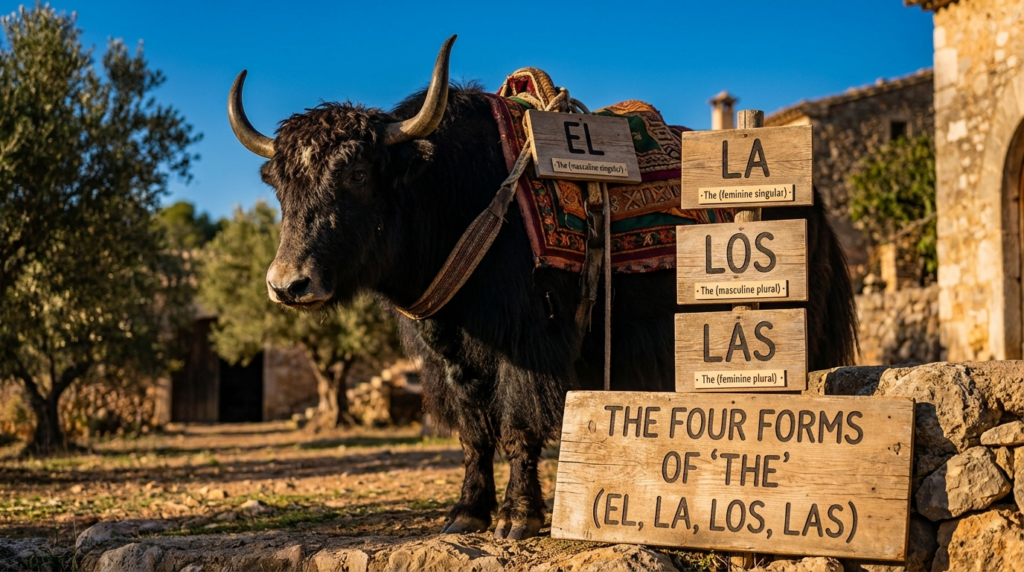
Yak Box: The One Rule That Explains Everything
Spanish “the” changes to match the noun. For the complete contrast with un, una, unos, and unas, review Spanish definite and indefinite articles.
- el = the (masculine, singular) — English meaning: “the”
- la = the (feminine, singular) — English meaning: “the”
- los = the (masculine, plural) — English meaning: “the”
- las = the (feminine, plural) — English meaning: “the”
Quick Map: Which “The” Do I Use?
| Singular | Plural |
|---|---|
| el + masculine noun | los + masculine nouns |
| la + feminine noun | las + feminine nouns |
Tip: The article and the noun are a team. If the noun is plural, the article must be plural too. If the noun is feminine, the article must be feminine too.
Visual Cards: The 8 Most Useful Bits
El
English meaning: the (masculine, singular)
Example: El libro está aquí. (The book is here.)
La
English meaning: the (feminine, singular)
Example: La casa es grande. (The house is big.)
Los
English meaning: the (masculine, plural)
Example: Los amigos llegan hoy. (The friends arrive today.)
Las
English meaning: the (feminine, plural)
Example: Las llaves están en la mesa. (The keys are on the table.)
Un / Una
English meaning: a / an (indefinite articles)
Example: Quiero un café y una dona. (I want a coffee and a donut.)
Al
English meaning: to the (a + el)
Example: Voy al trabajo. (I’m going to the work / I’m going to work.)
Del
English meaning: of the / from the (de + el)
Example: Es el carro del vecino. (It’s the neighbor’s car.)
El Agua Rule
English meaning: “the” can switch to el for sound reasons
Example: El agua está fría. (The water is cold.)
How To Pick El, La, Los, Las (With Real Nouns)
Step 1: Is The Noun Singular Or Plural?
Singular nouns usually end in nothing special (libro, casa, coche). Plural nouns often end in -s or -es (libros, casas, coches, papeles).
Step 2: Is The Noun Masculine Or Feminine?
Sometimes you can guess, but Spanish loves exceptions. Still, these patterns help a lot:
- Often masculine: nouns ending in -o (el libro, el carro)
- Often feminine: nouns ending in -a (la casa, la mesa)
- Common feminine endings: -ción / -sión (la información, la decisión)
- Common masculine endings: -ma (Greek origin) (el problema, el sistema)
Real-life tip: When you learn a noun, learn it with its “the.” Not “casa,” but “la casa.” Your brain likes ready-to-use combos.
The Sneaky Exception: “El” With Some Feminine Nouns
Some feminine nouns use el in singular when the noun starts with a stressed a- sound. This is mostly to avoid the double “a” sound (la agua feels clunky), so Spanish switches to el.
- el agua — English meaning: the water
Example: El agua está limpia. (The water is clean.) - el águila — English meaning: the eagle
Example: El águila vuela alto. (The eagle flies high.) - el alma — English meaning: the soul
Example: El alma de la canción es la letra. (The soul of the song is the lyrics.)
But they’re still feminine, so adjectives often stay feminine: el agua fría (the cold water), not el agua frío.
In plural, it goes back to normal feminine: las aguas (the waters).
Useful Phrases And Real-Life Sentences (Steal These)
- en la mañana — English meaning: in the morning
Example: Tomo café en la mañana. (I drink coffee in the morning.) - por la tarde — English meaning: in the afternoon
Example: Trabajo por la tarde. (I work in the afternoon.) - por la noche — English meaning: at night
Example: Leo por la noche. (I read at night.) - en el trabajo — English meaning: at work
Example: Estoy en el trabajo ahora. (I’m at work now.) - en la escuela — English meaning: at school
Example: Mi hijo está en la escuela. (My son is at school.) - en el baño — English meaning: in the bathroom
Example: El jabón está en el baño. (The soap is in the bathroom.) - en la mesa — English meaning: on the table
Example: Tus lentes están en la mesa. (Your glasses are on the table.) - en el carro — English meaning: in the car
Example: Dejé mi mochila en el carro. (I left my backpack in the car.) - los fines de semana — English meaning: on weekends
Example: Descanso los fines de semana. (I rest on weekends.) - a la izquierda — English meaning: to the left
Example: El banco está a la izquierda. (The bank is to the left.) - a la derecha — English meaning: to the right
Example: La farmacia está a la derecha. (The pharmacy is to the right.) - en los Estados Unidos — English meaning: in the United States
Example: Vivo en los Estados Unidos. (I live in the United States.)
Tables Of Words You Can Copy-Paste Into Your Brain
El: Masculine Singular “The”
| Spanish | English Meaning | Example 1 | Example 2 | Example 3 |
|---|---|---|---|---|
| el libro | the book | El libro es nuevo. | ¿Dónde está el libro? | Me gusta el libro. |
| el carro | the car | El carro no prende. | El carro está afuera. | Lavo el carro los sábados. |
| el teléfono | the phone | El teléfono está cargando. | Perdí el teléfono. | Necesito el teléfono ahora. |
| el café | the coffee | El café está caliente. | Quiero el café sin azúcar. | Huele rico el café. |
| el problema | the problem | El problema es el tiempo. | Ese es el problema. | Resolvimos el problema. |
La: Feminine Singular “The”
| Spanish | English Meaning | Example 1 | Example 2 | Example 3 |
|---|---|---|---|---|
| la casa | the house | La casa es pequeña. | Estoy en la casa. | La casa tiene patio. |
| la mesa | the table | La mesa está limpia. | Ponlo en la mesa. | Compré la mesa ayer. |
| la llave | the key | La llave no sirve. | ¿Traes la llave? | Encontré la llave. |
| la cuenta | the bill/check | La cuenta, por favor. | ¿Ya pagaste la cuenta? | Dividimos la cuenta. |
| la información | the information | La información es correcta. | No tengo la información. | Te mando la información. |
Los: Masculine Plural “The”
| Spanish | English Meaning | Example 1 | Example 2 | Example 3 |
|---|---|---|---|---|
| los amigos | the friends | Los amigos vienen mañana. | Salgo con los amigos. | Conozco a los amigos de Ana. |
| los libros | the books | Los libros son caros. | Guarda los libros. | Me prestaron los libros. |
| los niños | the kids | Los niños están jugando. | Cuida a los niños. | Los niños tienen hambre. |
| los tacos | the tacos | Los tacos están listos. | Me encantan los tacos. | ¿Dónde compraste los tacos? |
| los problemas | the problems | Los problemas pasan. | Hablamos de los problemas. | Solucionamos los problemas. |
Las: Feminine Plural “The”
| Spanish | English Meaning | Example 1 | Example 2 | Example 3 |
|---|---|---|---|---|
| las casas | the houses | Las casas son viejas. | Veo las casas desde aquí. | Compraron las casas juntas. |
| las llaves | the keys | Las llaves están aquí. | No encuentro las llaves. | Trae las llaves, porfa. |
| las fotos | the photos | Las fotos salieron bien. | Borra las fotos borrosas. | Subí las fotos anoche. |
| las preguntas | the questions | Las preguntas son fáciles. | Responde las preguntas. | ¿Tienes las preguntas? |
| las aguas | the waters | Las aguas están tranquilas. | Las aguas del río están frías. | Cuidan las aguas de la zona. |
Practice Time: Quick Drills (No Tears)
Drill 1: Choose The Correct “The”
Fill in with el / la / los / las:
- ___ casa
- ___ libros
- ___ problema
- ___ llaves
- ___ mesa
- ___ amigos
- ___ agua
- ___ fotos
Answers
la casa, los libros, el problema, las llaves, la mesa, los amigos, el agua, las fotos
Drill 2: Make It Plural
Change each one to plural (article + noun):
- el libro → ________
- la casa → ________
- el amigo → ________
- la foto → ________
Answers
los libros, las casas, los amigos, las fotos
Common Mistakes (And Quick Fixes)
- Mistake: Using el for everything.
Fix: Ask: “Is it feminine?” If yes, use la (or las if plural).
Example: la puerta (the door), not el puerta. - Mistake: Forgetting plural agreement.
Fix: If the noun ends in -s or -es, your article should too.
Example: los carros (the cars), not el carros. - Mistake: Saying la agua.
Fix: Use el with some feminine nouns that start with a stressed a- sound.
Example: el agua fría (the cold water). - Mistake: Confusing el with él.
Fix: el (no accent) = “the.” él (accent) = “he.”
Example: Él tiene el libro. (He has the book.)
Quick Reference Summary
| Form | Use | English Meaning | Fast Example |
|---|---|---|---|
| el | masculine singular | the | el perro (the dog) |
| la | feminine singular | the | la puerta (the door) |
| los | masculine plural | the | los perros (the dogs) |
| las | feminine plural | the | las puertas (the doors) |
Mini bonus: al = “to the” (a + el) and del = “of/from the” (de + el).
Example: Voy al cine. (I’m going to the movies.) / Vengo del trabajo. (I’m coming from work.)
Final Yak
If you can answer two questions—Is it masculine or feminine? and Is it singular or plural?—you can choose the correct Spanish “the” every time. And if you slip up? Congrats, you’re officially speaking Spanish like a real human.