
If you’ve ever stared at a word and thought, “Great, but what’s the opposite?”, this guide is for you. By the end, you’ll know more than 70 common Spanish opposite pairs, plus real-life phrases you can actually use in conversation, writing, or that one moment when you need to sound annoyingly fluent at a café.
We’ll stick to natural standard Latin American Spanish by default, and note regional differences only when they matter. For the basic grammar background on Spanish word order, see Spanish Word Order.
Small warning: not every English opposite pair works as a neat one-to-one Spanish pair. Spanish likes context. Of course it does. Languages love making simple things slightly interesting.
Quick Starter: What Counts As An Opposite?
In Spanish, opposites can be:
- adjectives: alto / bajo
- adverbs: antes / después
- verbs: subir / bajar
- nouns or ideas: éxito / fracaso
Sometimes the opposite is a direct pair. Sometimes it’s more like “the other side of the idea.” Spanish is practical that way, even if English sometimes wants a cleaner match.
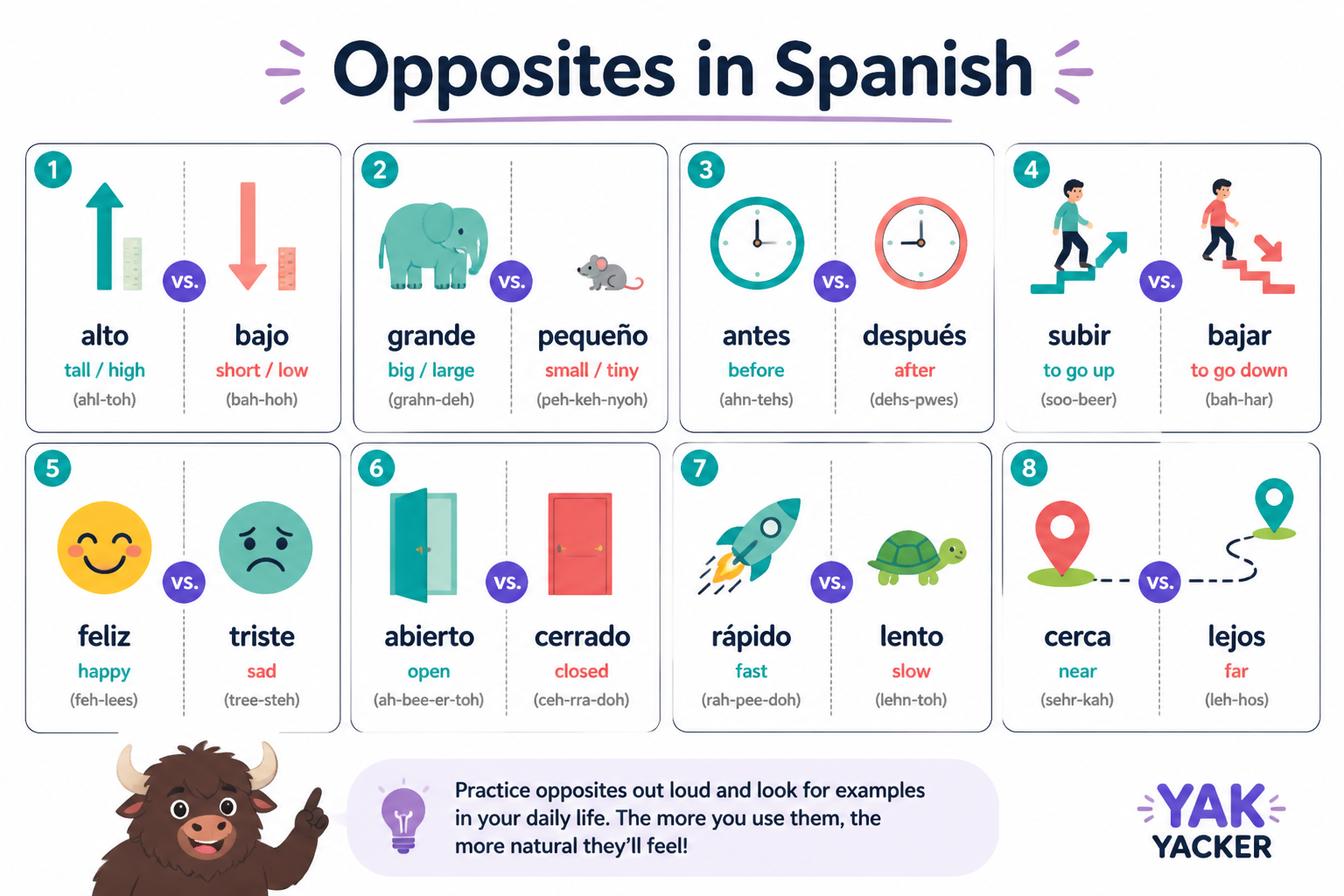
70+ Common Opposite Word Pairs In Spanish
Here are the most useful opposite pairs, grouped by topic so your brain doesn’t have to do all the heavy lifting at once.
| Spanish | Pronunciation | Meaning | Example Sentence | Translation | Learner Note |
|---|---|---|---|---|---|
| alto / bajo | AHL-toh / BAH-hoh | tall / short; high / low | Mi hermano es alto, pero yo soy bajo. | My brother is tall, but I’m short. | Alto can mean “high” too. |
| grande / pequeño | GRAHN-deh / peh-KEH-nyoh | big / small | La casa es grande, no pequeña. | The house is big, not small. | Pequeño is very common in daily speech. |
| nuevo / viejo | NWEH-voh / VYEH-hoh | new / old | Compré un teléfono nuevo. | I bought a new phone. | Viejo can also mean “old friend” in some contexts. |
| joven / viejo | HOH-ven / VYEH-hoh | young / old | Ella es joven y muy activa. | She is young and very active. | Viejo for people can sound blunt; be careful. |
| largo / corto | LAR-goh / KOR-toh | long / short | Este camino es largo. | This road is long. | Largo can also mean “lengthy” or “too long.” |
| ancho / estrecho | AHN-choh / eh-STREH-choh | wide / narrow | La calle es muy estrecha. | The street is very narrow. | Estrecho also means “close” in some relationships contexts. |
| limpio / sucio | LEEM-pyoh / SOO-syoh | clean / dirty | El baño está limpio. | The bathroom is clean. | Sucio can also mean “nasty” or “dirty-minded” depending on context. |
| lleno / vacío | YEH-noh / bah-SEE-oh | full / empty | El vaso está vacío. | The glass is empty. | Useful for containers, rooms, buses, and restaurants. |
| fuerte / débil | FWEHR-teh / DEH-beel | strong / weak | Mi señal de internet es débil. | My internet signal is weak. | Fuerte can also mean loud. |
| rápido / lento | RAH-pee-doh / LEHN-toh | fast / slow | Habla más lento, por favor. | Speak more slowly, please. | Very useful in real life. Very useful. |
| fácil / difícil | FAH-seel / dee-FEE-seel | easy / difficult | La tarea es difícil. | The assignment is difficult. | Difícil keeps the accent mark. |
| claro / oscuro | KLAH-roh / ohs-KOO-roh | light / dark | Me gusta el color claro. | I like the light color. | Claro also means “of course” or “clear.” |
| frío / caliente | FREE-oh / kah-lyen-TEH | cold / hot | El café está muy caliente. | The coffee is very hot. | Caliente can also mean “sexy” in slangy contexts. |
| seco / mojado | SEH-koh / moh-HAH-doh | dry / wet | Mis zapatos están mojados. | My shoes are wet. | Great weather word pair. |
| nuevo / usado | NWEH-voh / oo-SAH-doh | new / used | Prefiero comprar uno usado. | I prefer to buy a used one. | Common for cars, clothes, and gadgets. |
| barato / caro | bah-RAH-toh / KAH-roh | cheap / expensive | Ese restaurante es caro. | That restaurant is expensive. | Caro is usually about price, not feelings. |
| bueno / malo | BWEH-noh / MAH-loh | good / bad | Es un buen libro. | It’s a good book. | Buen is the short form before masculine singular nouns. |
| correcto / incorrecto | koh-RREHK-toh / een-koh-RREHK-toh | correct / incorrect | Tu respuesta es correcta. | Your answer is correct. | Good for school and work. |
| verdadero / falso | behr-dah-DEH-roh / FAHL-soh | true / false | Eso es falso. | That is false. | Useful in tests, news, and internet life. |
| abierto / cerrado | ah-BYEHR-toh / seh-RAH-doh | open / closed | La tienda está cerrada. | The store is closed. | Cerrado has a rolled-r sound in the middle. |
| encendido / apagado | en-sen-DEE-doh / ah-pah-GAH-doh | on / off | El celular está apagado. | The phone is off. | Very practical for devices. |
| subir / bajar | soo-BEER / bah-HAHR | go up / go down; raise / lower | Sube el volumen, por favor. | Turn up the volume, please. | Used constantly with stairs, prices, and volume. |
| entrar / salir | en-TRAHR / sah-LEER | enter / leave | Salimos a las ocho. | We leave at eight. | Salir is also “to go out” socially. |
| arriba / abajo | ah-RREE-bah / ah-BAH-hoh | up / down | La tienda está abajo. | The store is downstairs. | Often used with directions. |
| adentro / afuera | ah-DEN-troh / ah-FWEH-rah | inside / outside | Los niños juegan afuera. | The children play outside. | Very common in speech. |
| cerca / lejos | SEHR-kah / LEH-hos | near / far | Vivo cerca del centro. | I live near downtown. | Lejos can also mean “far away.” |
| izquierda / derecha | ees-KEHR-dah / deh-REH-chah | left / right | Gira a la derecha. | Turn right. | Classic travel vocabulary. |
| antes / después | AHN-tehs / dehs-PWEHS | before / after | Come antes de salir. | Eat before leaving. | Después often means “later” too. |
| temprano / tarde | tem-PRAH-noh / TAR-deh | early / late | Hoy llegué tarde. | Today I arrived late. | Tarde can also be “afternoon.” Context saves everybody. |
| siempre / nunca | SYEM-preh / NOON-kah | always / never | Ella siempre sonríe. | She always smiles. | Great for habits and routines. |
| mucho / poco | MOO-choh / POH-koh | much / little | No tengo mucho tiempo. | I don’t have much time. | Poco can also mean “few” or “a little.” |
| todo / nada | TOH-doh / NAH-dah | everything / nothing | No entiendo nada. | I understand nothing. | Watch the double-negative pattern in Spanish. |
| muchos / pocos | MOO-chohs / POH-kohs | many / few | Hay pocos asientos. | There are few seats. | Must agree in number. |
| sí / no | SEE / noh | yes / no | Sí, quiero ir. | Yes, I want to go. | Accent mark on sí matters. It means “yes.” |
| hombre / mujer | OHM-breh / moo-HEHR | man / woman | La mujer está trabajando. | The woman is working. | Simple, common, and essential. |
| padre / hijo | PAH-dreh / EE-hoh | father / son | Mi padre vive aquí. | My father lives here. | Hijo starts with a silent h. |
| madre / padre | MAH-dreh / PAH-dreh | mother / father | Mi madre cocina muy bien. | My mother cooks very well. | Family vocabulary is high-frequency gold. |
| amigo / enemigo | ah-MEE-goh / eh-neh-MEE-goh | friend / enemy | No somos enemigos. | We are not enemies. | Amigo is usually neutral and common. |
| ganar / perder | gah-NAHR / pehr-DEHR | win / lose | Perdimos el partido. | We lost the match. | Also useful for money and opportunities. |
| vender / comprar | ben-DEHR / kohm-PRAR | sell / buy | Quiero comprar pan. | I want to buy bread. | Basic shopping pair. |
| dar / recibir | dahr / reh-see-BEER | give / receive | Me dieron un regalo. | They gave me a gift. | Important for verbs with object pronouns. |
| prestar / pedir prestado | pres-TAR / peh-DEER pres-TAH-doh | lend / borrow | ¿Me prestas tu lápiz? | Can you lend me your pencil? | In Spanish, the same verb logic may differ from English. Sneaky little detail. |
| abrir / cerrar | ah-BREER / seh-RRAHR | open / close | Voy a cerrar la ventana. | I’m going to close the window. | Watch the rolled rr in cerrar. |
| ganar / perder | gah-NAHR / pehr-DEHR | win / lose | No quiero perder tiempo. | I don’t want to waste time. | Perder tiempo means “to waste time.” |
| recordar / olvidar | reh-kor-DAHR / ol-bee-DAHR | remember / forget | Siempre olvido las llaves. | I always forget the keys. | Olvidar is a very useful everyday verb. |
| subir / bajar | soo-BEER / bah-HAHR | go up / go down | El precio subió otra vez. | The price went up again. | Used with prices, stairs, and apps if your life is dramatic. |
| encender / apagar | en-sen-DEHR / ah-pah-GAHR | turn on / turn off | Apaga la luz, por favor. | Turn off the light, please. | Common with electronics and lights. |
| permitir / prohibir | pehr-mee-TEER / proh-ee-BEER | allow / forbid | Está prohibido fumar aquí. | Smoking is forbidden here. | Great for signs and rules. |
| entrar / salir | en-TRAHR / sah-LEER | go in / go out | ¿Puedo salir temprano? | Can I leave early? | Very flexible in real speech. |
| empezar / terminar | em-peh-SAR / tehr-mee-NAHR | start / finish | La clase empieza ahora. | The class starts now. | Empezar is more common in many regions than comenzar. |
| conocer / desconocer | koh-noh-SEHR / dehs-koh-noh-SEHR | know / not know; be familiar with / be unfamiliar with | No conozco esa calle. | I don’t know that street. | Conocer is for people, places, or things you know well. |
| saber / ignorar | sah-BEHR / eeg-noh-RAHR | know / not know; ignore | No sé la respuesta. | I don’t know the answer. | Ignorar can mean “not know” in formal contexts, but often means “to ignore.” |
| hacer / deshacer | ah-SEHR / dehs-ah-SEHR | do / undo | Voy a deshacer la maleta. | I’m going to unpack the suitcase. | DeshacerMore Spanish to explore |