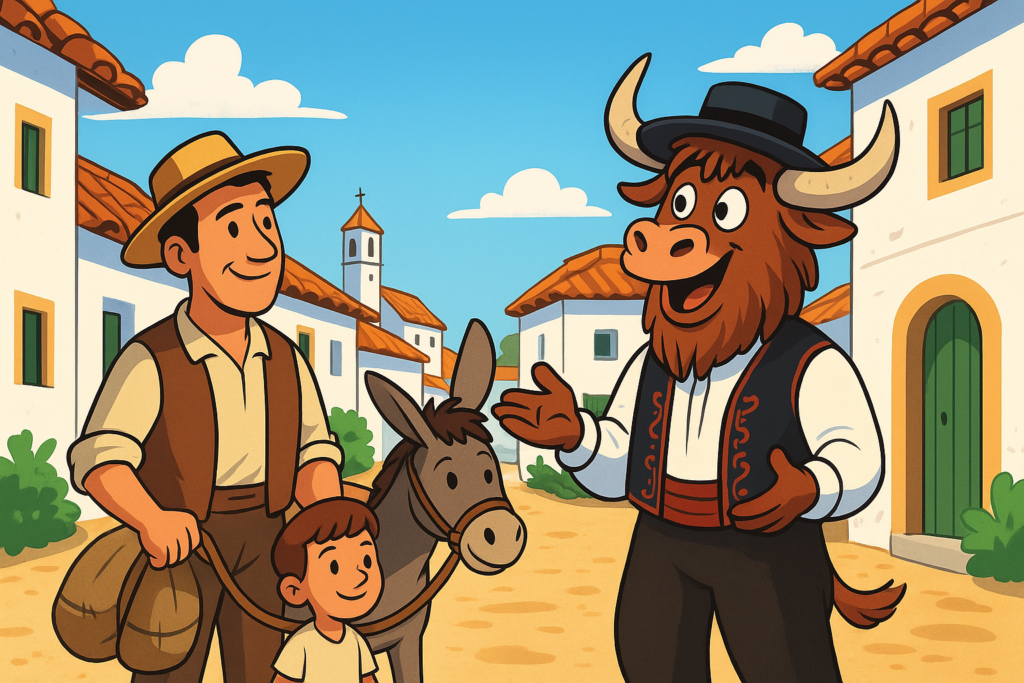
Welcome to this Yak Yacker graded reader! Today we bring you a classic Spanish fable about a father and son traveling with their donkey. As they walk to the market, everyone they meet has a different opinion. Should the son ride, or the father? Should they both walk? This funny and wise story comes from El conde Lucanor, a famous medieval Spanish book.
Our interactive version lets you read the simple Spanish text with clickable word translations. You can also listen to the audio of the story to practice your listening. We include lesson notes to help you understand key grammar and vocabulary. It's a free and enjoyable way to learn Spanish at the A2 elementary level.
Click through the story below, and remember: you'll never please everyone, but you can definitely improve your Spanish!
Había una vez un hombre y su hijo. Un día, decidieron ir al . Llevaron a su con ellos. Empezaron a caminar al lado del burro. Hacía y el camino era .
Pronto, encontraron a unas personas. Ellos dijeron: "¡Qué son! ¿Por qué ? Tienen un burro. ¡Uno de ustedes debe !" El hijo miró al padre y dijo: "Papá, ellos tienen razón. Voy a montar el burro." Y el hijo se en el burro.
Continuaron su camino. Después, vieron a otros . Un hombre mayor dijo: "¡Mira ese niño! Va muy en el burro, y su pobre padre camina. ¡Qué !" El hijo se sintió mal. "Papá, lo siento. Tú debes montar. Yo puedo caminar." Así que el padre montó en el burro y el hijo caminó a su lado.
Más adelante, unas mujeres estaban cerca del camino. Una de ellas exclamó: "¡Qué hombre más ! Él va descansando en el burro y el niño pequeño va andando. ¡El niño debe montar también!" El padre suspiró. Decidió que los dos . Entonces, ambos se subieron al burro.
El burro caminaba más ahora. Unos campesinos los vieron. "¡Pobrecito burro! ¡Dos personas encima! Es demasiado . ¡Lo van a !", gritaron. El padre y el hijo se miraron. "¿Qué podemos hacer?", preguntó el hijo.
Tuvieron una idea. "¡Vamos a al burro nosotros!", dijo el padre. las patas del burro y lo llevaron entre los dos. Pero era muy . El burro no estaba feliz. La gente se reía mucho.
Finalmente, llegaron al mercado. Pero estaban muy y el burro estaba . Se dieron cuenta de algo importante: "Es complacer a todos", dijo el padre. El hijo asintió. "Sí, papá. Debemos decidir lo que es mejor para nosotros."
Once upon a time, there was a man and his son. One day, they decided to go to the market. They brought their donkey along. They began walking beside the donkey. It was sunny and the road was long.
Soon, they met some people. They said, "How foolish you are! Why are you walking? You have a donkey. One of you should ride it!" The son looked at the father and said, "Dad, they are right. I'll ride the donkey." And the son got on the donkey.
They continued on their way. Later, they saw other travelers. An older man said, "Look at that boy! He is riding comfortably on the donkey, while his poor father walks. How disrespectful!" The son felt bad. "Dad, I'm sorry. You should ride. I can walk." So the father mounted the donkey and the son walked beside him.
Further ahead, some women were near the road. One of them exclaimed, "What a selfish man! He rests on the donkey while the little boy walks. The boy should ride too!" The father sighed. He decided they would both ride. So both got on the donkey.
The donkey walked more slowly now. Some peasants saw them. "Poor donkey! Two people on top! It's too much weight. You're going to kill him!" they shouted. The father and son looked at each other. "What can we do?" asked the son.
They had an idea. "Let's carry the donkey ourselves!" said the father. They tied the donkey's legs and carried him between them. But it was very difficult. The donkey was not happy. People laughed a lot.
Finally, they arrived at the market. But they were very tired and the donkey was angry. They realized something important: "It's impossible to please everyone," said the father. The son nodded. "Yes, Dad. We must decide what is best for us."
In this story, everyone has something to say. The people they meet are quick to share their thoughts, whether kind or critical. In Spanish, you can do the same with a few simple phrases.
Start with verbs like creer (to believe) or pensar (to think), or use the handy expression tener razón (to be right). These will help you voice your own opinions in everyday conversations.
- Creo que… – I believe that… (Creo que es una buena idea.)
- Pienso que… – I think that… (Pienso que deben descansar.)
- Me parece que… – It seems to me that… (Me parece que el burro está cansado.)
- Tiene(s) razón – You are right (El hijo dijo: «Papá, ellos tienen razón».)
The characters constantly suggest what others should do. To give advice in Spanish, you'll often use deber (should/must) or tener que (have to). Both are followed by an infinitive.
Deber is a bit softer, like a suggestion, while tener que feels more urgent. You'll also hear hay que to say what 'one must' do in general.
- Debes montar el burro. – You should ride the donkey. (advice)
- Tienes que decidir. – You have to decide. (stronger obligation)
- Hay que ser amable. – One must be kind. (general rule)
- ¿Qué podemos hacer? – What can we do? (using poder for possibility)
Not every opinion in the fable is friendly. Exclamations like ¡Qué tontos! (How foolish!) add drama. For more polite disagreement, you can simply say No estoy de acuerdo (I don't agree).
The story's final lesson—Es imposible complacer a todos (It's impossible to please everyone)—is a great advanced expression to keep in your pocket.
- ¡Qué falta de respeto! – What a lack of respect!
- No estoy de acuerdo. – I don't agree.
- Para mí, es mejor… – For me, it's better…
- Es imposible complacer a todos. – You can't please everyone.
You've seen how the father and son struggle with everyone's advice. Now, try using these phrases to express your own view. If you had been on that road, what would you have told them?
A great way to practice is to retell the story in your own words, sharing your opinion after each event. You'll find that giving advice and reacting in Spanish is both practical and fun.
- Think of a time you had to make a decision despite others' opinions. Describe it using deber or tener que.
- Use ¡Qué…! to react to a situation in your life—funny, surprising, or frustrating!
El hombre, su hijo y el burro comes from an older public-domain story tradition and is best known as a public_domain_story_retelling. This Yak Yacker article is an original learner retelling based on public-domain source material, so the wording here is simplified for modern learners rather than copied from one old edition.
Older printings, translations, and retellings of this story can vary quite a bit. This version is adapted for A2 Elementary learners studying Spanish.
If you want to keep going, browse more in our Spanish section and review the A2 Spanish Vocabulary List. After that, try Spanish Gender Rules for Nouns and Adjectives for another useful next step.