Step into the world of Don Quixote, a gentle knight with big dreams. In this famous tale, he mistakes windmills for giants and charges into an adventure filled with imagination and humor. Our A2-level retelling uses simple Spanish to bring this classic to life for elementary learners.
Every word is clickable for instant translations, and you can listen to the story with clear, slow audio from a native speaker. Handy lesson notes explain key grammar and vocabulary, so you learn naturally as you read. Best of all, it's completely free – just click, read, and enjoy!
Whether you're new to Spanish or refreshing your skills, this story makes practice feel like play. Don Quixote's courage (and silliness) will keep you smiling while your Spanish grows.
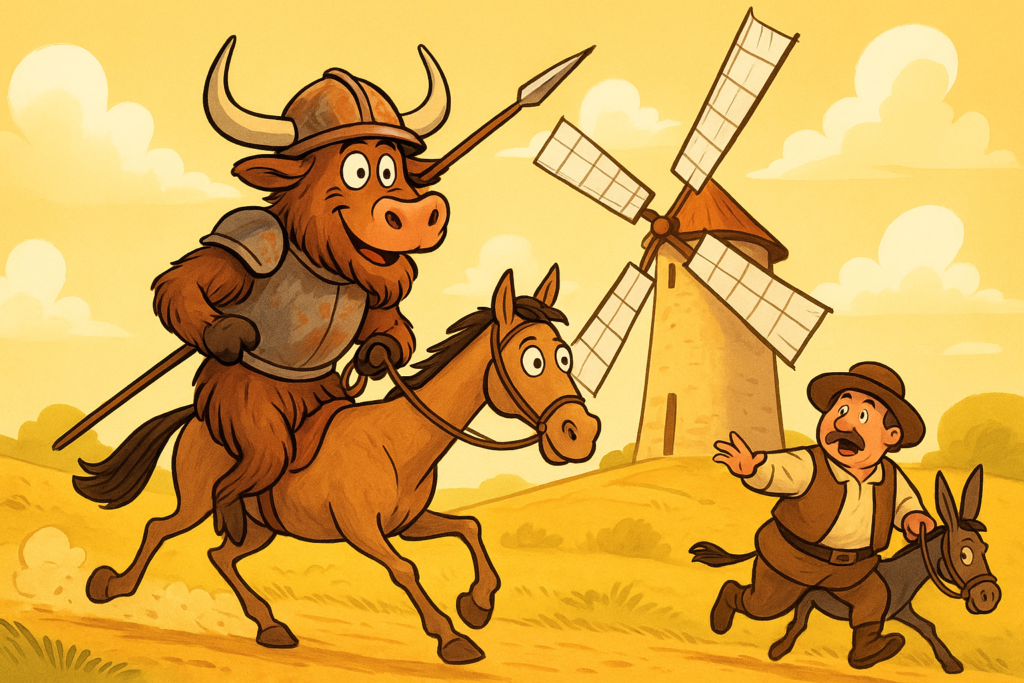
Don Quixote y Sancho Panza viajan por el campo. Es un día soleado. De repente, Don Quixote señala hacia adelante. '¡Mira, Sancho! ¡Allí hay gigantes!' dice él muy emocionado.
'No, señor. No son gigantes. Son molinos de viento,' responde Sancho. Pero Don Quixote no lo escucha. Él está convencido.
Don Quixote mira los molinos. 'Son gigantes con brazos largos. ¡Voy a luchar contra ellos!' dice. Sancho lo mira preocupado.
'¡Señor, no son gigantes! ¡Los brazos son aspas!' Pero Don Quixote ya está listo. Él levanta su lanza.
Don Quixote corre hacia el molino más cercano. '¡Aquí voy, gigante malvado!' grita. El viento mueve las aspas. El molino gira rápido.
La lanza golpea un aspa. Don Quixote y Rocinante . Sancho ellos. '¡Señor! ¿Está usted bien?' pregunta.
Don Quixote se levanta con . 'El mago Frestón los gigantes en molinos,' explica. Sancho lo ayuda a levantarse. No dice nada más.
Después, Don Quixote y Sancho continúan su camino. Don Quixote está un poco triste, pero feliz de ser caballero. Sancho piensa: 'Mi señor es valiente, pero está loco.'
Don Quixote and Sancho Panza travel through the countryside. It's a sunny day. Suddenly, Don Quixote points ahead. "Look, Sancho! There are giants!" he says excitedly.
"No, sir. They aren't giants. They're windmills," Sancho replies. But Don Quixote doesn't listen. He's convinced.
Don Quixote looks at the windmills. "They're giants with long arms. I'm going to fight them!" he says. Sancho watches him worriedly.
"Sir, they aren't giants! The arms are sails!" But Don Quixote is already ready. He raises his lance.
Don Quixote charges toward the nearest windmill. "Here I come, evil giant!" he shouts. The wind moves the sails. The windmill spins fast.
The lance hits a sail. Don Quixote and Rocinante fall to the ground. Sancho runs to them. "Sir! Are you all right?" he asks.
Don Quixote gets up with difficulty. "The magician Freston transforms the giants into windmills," he explains. Sancho helps him up. He says nothing more.
Afterwards, Don Quixote and Sancho continue on their way. Don Quixote is a little sad, but happy to be a knight. Sancho thinks: "My master is brave, but he's crazy."
This classic tale is full of useful words for describing adventures and everyday situations. Let's look at some key terms you met in the story.
Pay attention to how these words combine to paint a vivid picture. Seeing them in context helps you remember them better.
- el molino de viento - windmill
- el gigante - giant
- las aspas - sails (of a windmill)
- la lanza - lance (a knight's weapon)
You might have noticed that the story uses the present tense, even though it's about past events. In Spanish, this is very common when telling a story or joke to make it feel more immediate and alive.
Try retelling a simple event from your day using the present tense: 'Hoy voy al parque y veo a mi amigo.' It sounds more natural and engaging in conversation.
- Señala hacia adelante - He points forward (present tense for past)
- Responde Sancho - Sancho answers (historical present)
- El viento mueve las aspas - The wind moves the sails (action in the moment)
In the story, you saw several expressions with 'estar' to describe states and conditions. 'Estar' is often used for temporary situations or feelings, while 'ser' describes more permanent traits.
Notice how 'está convencido' (he is convinced), 'está listo' (he is ready), and 'está loco' (he is crazy) all show a condition at that moment. Compare that with 'es valiente' (he is brave), which uses 'ser' for a characteristic.
- Estar + adjective: preocupado, bien, triste, feliz
- Estar listo/a - to be ready (not ser listo, which means clever)
- Ser valiente - to be brave (permanent quality)
Great job! You've just traveled with Don Quixote and picked up some useful Spanish along the way. The best way to lock these words and structures into your memory is to use them yourself.
Try summarizing the story in your own words using the present tense. Pay attention to when you use 'ser' and 'estar', and challenge yourself to include some of the new vocabulary. ¡Buena suerte!
- Retell the story to a friend or write a short summary.
- Find another simple Spanish story and identify the present-tense narration.
- Practice 'estar' + adjective with your own daily emotions.
Don Quixote and the Windmills comes from the Spanish / Cervantes tradition and is best known as a public_domain_story_retelling. This Yak Yacker article is an original learner retelling based on public-domain source material, so the wording here is simplified for modern learners rather than copied from one old edition.
Older printings, translations, and retellings of this story can vary quite a bit. This version is adapted for A2 Elementary learners studying Spanish.
If you want to keep going, browse more in our Spanish section and review the A2 Spanish Vocabulary List. After that, try Spanish Gender Rules for Nouns and Adjectives for another useful next step.