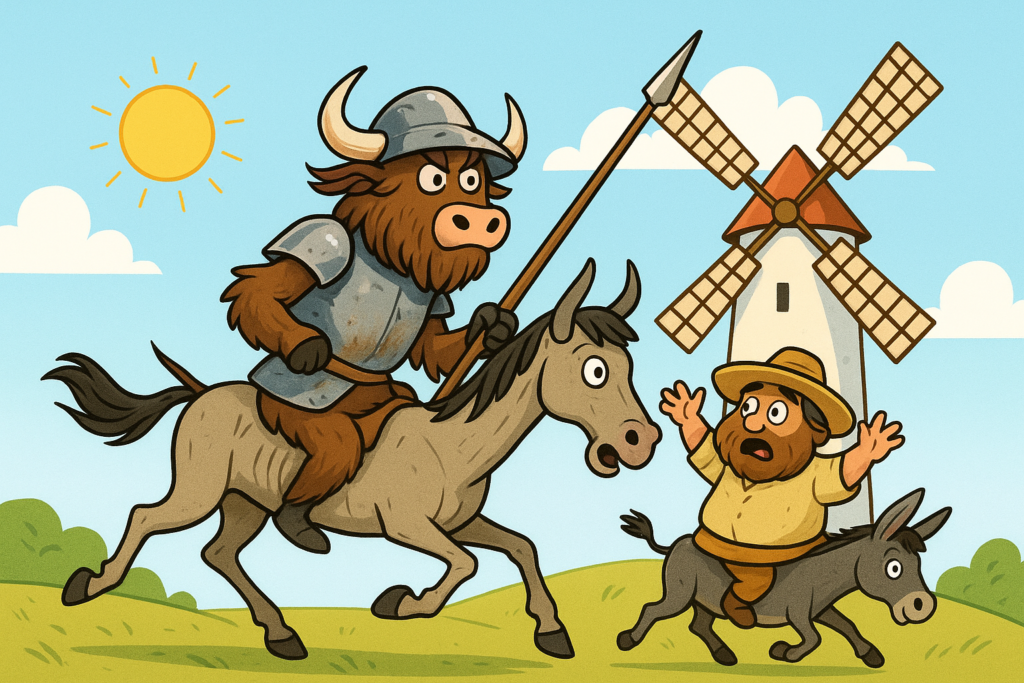
Welcome to our free B1 Spanish graded reader featuring the classic story of Don Quixote! In this retelling, you'll follow the adventures of the eccentric knight-errant Don Quixote and his loyal squire Sancho Panza as they roam the Spanish countryside. From tilting at windmills to mistaking inns for castles, the story is packed with humorous and dramatic moments perfect for intermediate learners.
How to use this story: read at your own pace, tap any word for an instant translation, and listen to native speaker audio to improve your pronunciation. Below the story, you'll find lesson notes and teaching tools to deepen your understanding of Spanish grammar and vocabulary – all completely free.
En un pueblo de La Mancha vivía un llamado Alonso Quijano. Le gustaba mucho .
Un día decidió caballero andante. Limpió una armadura vieja, le puso Rocinante a su caballo y eligió a una dama: .
Salió de su casa una mañana temprano . Imaginaba que era un .
Después de horas, vio una . -¡Es un castillo! -pensó. Le pidió al ventero que lo .
El ventero, , aceptó. Esa noche, Don Quijote en el patio.
Unos arrieros quisieron la armadura. Don Quijote ellos y los . El ventero lo armó caballero rápidamente.
Don Quijote regresó a casa, pero pronto buscó un : Sancho Panza. -Sancho, ven conmigo. Te haré -le prometió.
Sancho, un , le creyó. : Don Quijote en Rocinante y Sancho en un burro.
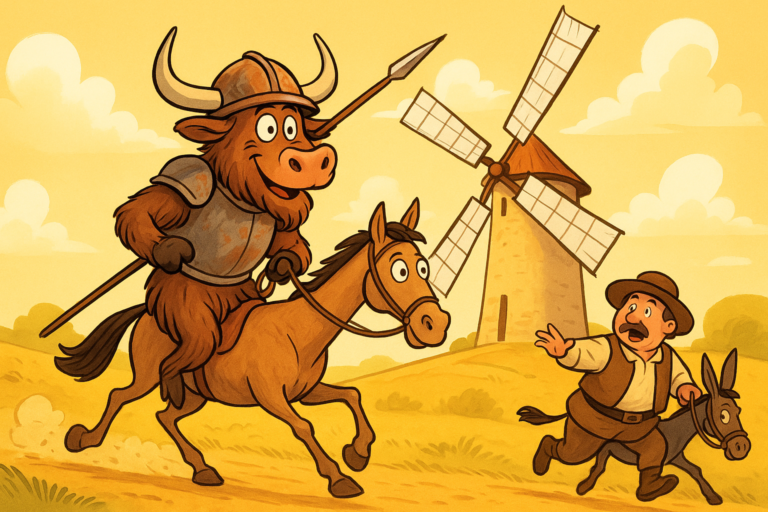
Un día vieron . -¡Mira, Sancho! -exclamó Don Quijote.
Sancho le dijo: -Su merced, esos no son gigantes, sino . Pero Don Quijote no le .
Arremetió contra un molino. El viento y lo junto con Rocinante.
Sancho . -Se lo dije, señor: eran molinos de viento -le dijo. Pero Don Quijote insistió en que un los había convertido en gigantes.
Vivieron muchas más aventuras. Don Quijote siempre veía las cosas de . rebaños de ovejas, a unos presos y atacó unos títeres.
Por fin, sus amigos lo llevaron de vuelta a casa. Don Quijote estaba . su locura y murió en paz.
Pero la gente lo recordó. Sus se hicieron famosas y su inspiró a muchos.
In a village in La Mancha lived a gentleman named Alonso Quijano. He loved reading books of chivalry.
One day he decided to become a knight-errant. He cleaned an old suit of armor, named his horse Rocinante, and chose a lady: Dulcinea del Toboso.
He left home early one morning without telling anyone. He imagined he was a true knight.
After riding for hours, he saw an inn. 'It's a castle!' he thought. He asked the innkeeper to dub him a knight.
The innkeeper, amused, agreed. That night, Don Quixote kept vigil over his armor in the courtyard.
Some muleteers tried to take his armor. Don Quixote fought them and won. The innkeeper hastily dubbed him a knight.
Don Quixote returned home, but soon sought a squire: Sancho Panza. 'Sancho, come with me. I'll make you governor of an island,' he promised.
Sancho, a simple peasant, believed him. They set off together: Don Quixote on Rocinante and Sancho on a donkey.
One day they saw windmills. 'Look, Sancho! Giants with long arms!' exclaimed Don Quixote.
Sancho said: 'Your worship, those are not giants but windmills.' But Don Quixote ignored him.
He charged at a windmill. The wind turned the sail and threw him to the ground along with Rocinante.
Sancho ran to help him. 'I told you, sir: they were windmills,' he said. But Don Quixote insisted an enchanter had turned them into giants.
They had many more adventures. Don Quixote always saw things differently. He fought flocks of sheep, freed prisoners, and attacked puppets.
Finally, his friends brought him back home. Don Quixote was tired and ill. He understood his madness and died in peace.
But people remembered him. His mad adventures became famous and his noble spirit inspired many.
The story of Don Quixote swirls with two past tenses that give Spanish narratives their richness: the pretérito indefinido for main events and forward-moving actions, and the imperfecto for descriptions, habits, and ongoing states. You saw this dance in lines like 'vivía un hidalgo' (ongoing situation) and 'decidió convertirse' (a specific decision that pushes the plot).
When you spot the indefinido, think of a camera clicking for a completed action: 'limpió', 'salió', 'vio'. The imperfecto, like 'imaginaba' or 'era', paints the background or shows how things used to be. Mastering this contrast lets your Spanish storytelling flow naturally.
- • 'Le gustaba mucho leer' (imperfecto) – a continual past liking, setting up his character.
- • 'Un día decidió convertirse' (indefinido) – the moment everything changed.
- • 'Siempre veía las cosas de manera diferente' (imperfecto) – his persistent habit of seeing things differently.
- • 'Arremetió contra un molino' (indefinido) – the dramatic, one-time charge.
Don Quijote's world is packed with vivid words that transport us to a time of knights and grand quests. 'Caballero andante' (knight errant), 'armadura' (armor), and 'escudero' (squire) belong to a medieval code that Quijote tries to live by. Even the verbs add drama: 'arremeter' (to charge), 'velar las armas' (to keep vigil over one's arms), and 'nombrar caballero' (to knight someone) are like stepping into an old tale.
Many of these terms are not everyday Spanish, but they enrich your understanding and may even pop up in modern metaphors or playful speech. Recognizing them gives you a deeper feel for the story’s humor and pathos.
- • 'Armar caballero' – to knight someone; 'El ventero lo armó caballero' shows a mock ceremony.
- • 'Velar las armas' – to keep a night vigil over weapons, a chivalric ritual.
- • 'Arremetió' – from arremeter, a forceful charge; Quijote 'arremetió contra un molino'.
- • 'Ínsula' – an old-fashioned word for island, used when promising Sancho a governorship.
Cervantes’ genius lies in how language itself mirrors the clash between Don Quijote’s fantasy and the real world. Notice the narration: 'Imaginaba que era un verdadero caballero' uses the imperfecto to underline his continuous illusion. When Sancho corrects him – 'esos no son gigantes, sino molinos de viento' – we get the plain truth. But Quijote’s response, 'un encantador los había convertido en gigantes,' introduces the past perfect to explain away the contradiction, keeping his dream alive.
As a storyteller, you can adopt these techniques: use descriptive imperfecto to set an emotional scene, the indefinido for key actions, and sprinkle in phrases like 'pensó' or 'le pareció que' to reveal a character’s distorted viewpoint.
- • Switch tenses to signal shifts between outer events and inner perception.
- • Verbs of thinking/saying ('pensar', 'decir') often introduce a character’s version of reality.
- • The word 'sino' (but rather) corrects a false impression, as in 'no son gigantes, sino molinos'.
- • Use 'parecer' ('le pareció que era un castillo') to show subjective vision.
Now it’s time to apply what you’ve captured from this classic. Try retelling a short episode from the story using a mix of the two past tenses – describe how it ‘was’ and then what ‘happened’. You might also invent a new adventure for Don Quijote: what ordinary thing would he mistake for something magical? Write a few sentences, and challenge yourself to include one or two chivalric vocabulary words.
Listening to or reading more excerpts of Don Quixote, even in simplified Spanish, will anchor these patterns. Notice how narrators shift tenses and how expressive terms create atmosphere.
- • Choose a short scene (the inn, the windmills) and write a paragraph using both pretérito indefinido and imperfecto.
- • Pick three new vocabulary items from the story and create a sentence for each.
- • Read aloud to feel the rhythm – the imperfecto often has a lingering, dreamy quality, while the indefinido feels punchy.
- • Imagine Quijote seeing a modern object (a car, a phone) – describe his misinterpretation in Spanish.
Don Quijote comes from an older public-domain story tradition and is best known as a public_domain_story_retelling. This Yak Yacker article is an original learner retelling based on public-domain source material, so the wording here is simplified for modern learners rather than copied from one old edition.
Older printings, translations, and retellings of this story can vary quite a bit. This version is adapted for B1 Intermediate learners studying Spanish.
If you want to keep going, browse more in our Spanish section and review the B1 Spanish Vocabulary List. After that, try Spanish Gender Rules for Nouns and Adjectives for another useful next step.