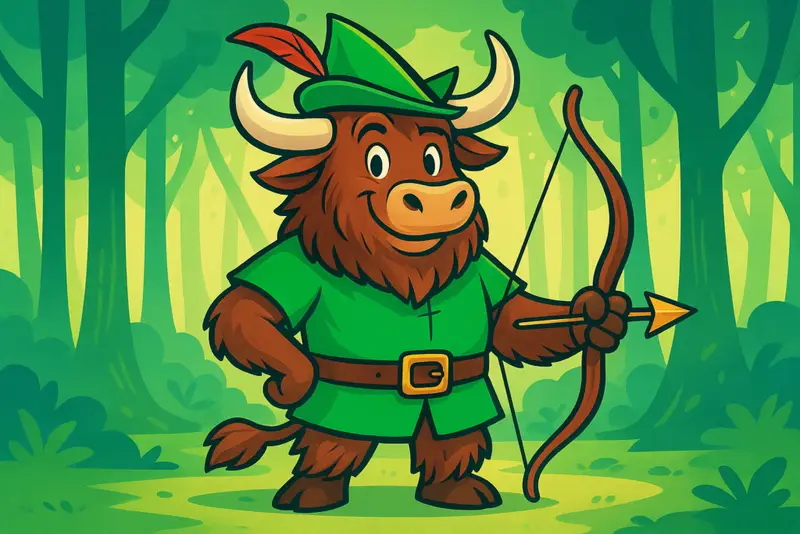
This A2 Elementary retelling of Robin Hood and the Golden Arrow keeps the plot clear for learners while still giving the story some atmosphere and momentum. In Sherwood Forest, Robin Hood and his Merry Men lived. They stole from the rich and gave to the poor.
This version is written for English-speaking learners and includes clickable word help inside the story, full story audio, and lesson notes after the reading. It is free to use on Yak Yacker and is designed to feel natural, readable, and manageable in English.
In Sherwood Forest, Robin Hood and his Merry Men lived. They and . The people loved them.
The Sheriff of Nottingham was very . He wanted to Robin Hood. So he made a . 'I will have a great ,' he said. 'The prize will be a golden arrow. Robin Hood loves archery. He will come!'
Robin Hood heard about the contest. His friend Little John said, 'Don't go! It's a .' But Robin . 'A trap? Maybe. But I love a good contest. And a golden arrow is a .'
Robin put on old gray clothes and a long white beard. He looked like a . Nobody knew him. He Nottingham town.
The contest was full of . They . The Sheriff watched. Then it was the old man's turn. He . The arrow flew . Right into the center!
The crowd . 'Who is that old man?' they asked. The Sheriff gave him the golden arrow. Then he looked . 'Wait! I know those eyes!' he shouted. 'That's Robin Hood!'
Robin ! His Merry Men were waiting. They the Sheriff's men with a cart. 'Catch me if you can!' Robin called. He jumped on a horse and to Sherwood Forest.
That night, the Merry Men laughed around the fire. 'The golden arrow is ours!' said Robin. 'And the Sheriff is still .' Little John smiled. 'We will always him.'
Robin Hood and his men lived in Sherwood Forest. They took money from rich people and gave it to poor people. Everyone liked them.
The Sheriff of Nottingham was mad. He wanted to catch Robin. He planned an archery contest with a gold arrow as prize. He thought Robin would come because he loves archery.
Robin heard about it. Little John warned him it was a trap. Robin didn't care. He wanted to compete and win the gold arrow.
Robin disguised himself: he wore old clothes and a fake white beard. People thought he was a poor old man. No one recognized him when he went to town.
Many archers competed. When it was the old man's turn, he shot perfectly and hit the center of the target.
Everyone cheered. The Sheriff gave him the prize but then recognized Robin's eyes and shouted his name.
Robin escaped. His friends blocked the guards with a cart. He hopped on a horse and fled to the forest.
They celebrated by the fire. Robin was happy they had the arrow and that the Sheriff was still angry. Little John said they would always trick him.
Let's look at some important words from Robin Hood's adventure. These will help you tell exciting stories too!
A contest is a fun competition-here, an archery contest with arrows. A trap is a tricky plan to catch someone. When the people loved Robin, they cheered loudly. And to outsmart means to trick someone with clever thinking.
- archery contest - a competition of shooting arrows
- golden arrow - a special arrow made of gold
- trap - a secret plan to catch a person
- outsmart - to win by being more clever
This story uses the past simple because everything happened in the past. We use it for finished actions. For regular verbs, just add -ed: walked, shouted, cheered. But many common verbs are irregular-you need to learn their forms!
Look at these examples from the text: live → lived, steal → stole, give → gave, run → ran. Notice how the verb changes? Practice saying them out loud.
- Regular: walk → walked, laugh → laughed, block → blocked
- Irregular: hear → heard, shoot → shot, ride → rode
- Use did + not for negatives: 'Don't go!' → He did not go.
- Questions: 'Who is that old man?' asked the crowd.
Robin's story is full of fun expressions you can use in everyday English. Learning these phrases makes your speaking feel more natural.
For example, when Robin says 'Catch me if you can!' it's a playful challenge. When Little John warns 'It's a trap,' he means something dangerous is hidden. And 'looked like' helps you describe appearances.
- "It's a trap!" - warning about a trick
- "Catch me if you can!" - a teasing challenge
- "He looked like a poor old man" - describing how someone appeared
- "We will always outsmart him" - promising to be clever
Now it's your turn! Think of another adventure for Robin Hood. Where does he go next? Does the Sheriff make a new plan? Use the past simple and the vocabulary from today to write a short story-three or four sentences is enough.
Remember, stories are more fun when you add details. What clothes does Robin wear? How do the people cheer? Your imagination makes the language yours!
Robin Hood and the Golden Arrow comes from the English / Robin Hood tradition tradition and is best known as a legend. This Yak Yacker article is an original learner retelling based on Traditional Robin Hood ballads/tales public domain, so the wording here is simplified for modern learners rather than copied from one old edition.
Older printings, translations, and retellings of this story can vary quite a bit. The original audience was usually kids/general, but this version is adapted for A2 Elementary learners studying English. Use traditional outlaw hero version; not modern films.
If you want to look into the source tradition, start with Project Gutenberg.
If you want to keep going, browse more in our English section and review the A2 English Vocabulary List. After that, try 1,200 English Phrases and Expressions for another useful next step.