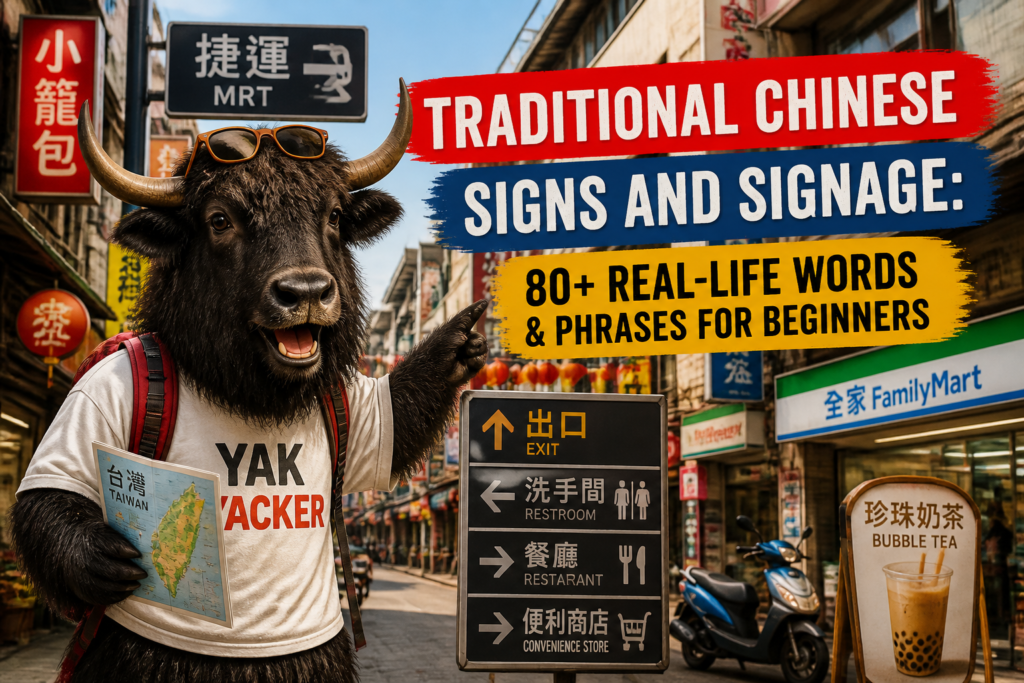
Ever stood in front of a sign in Taiwan and thought, “Well, that looks important, but I have absolutely no clue what it says”? Yep. Classic beginner moment.
For the broader learning path, visit our parent guide.
This guide gives you the most useful Traditional Chinese signs and signage words and phrases for real life: streets, transport, shops, toilets, rules, warning signs, and those tiny bits of text that quietly save your day. By the end, you’ll be able to read common signs without having to pretend you “already knew that.”
For a quick core-words refresher, you can also check the Traditional Chinese basic words and phrases page. And if you want to test yourself afterward, there’s a Traditional Chinese vocabulary test waiting to be mildly judgmental.
Also useful: signs are a great shortcut to daily life vocabulary. They show up everywhere, and unlike that one friend who “knows a little Mandarin,” they do not lie.
Core Signs Vocabulary You’ll See All The Time
Here are the most common sign words and phrases. These are the building blocks of getting around Taiwan without playing interpretive dance with a map.
| Traditional Chinese | Pinyin | Meaning | Example (ZH) | Example (Pinyin) | Translation (EN) |
|---|---|---|---|---|---|
| 標誌 | biāozhì | sign; symbol | 這個標誌很清楚。 | Zhège biāozhì hěn qīngchǔ. | This sign is very clear. |
| 招牌 | zhāopái | store sign; signboard | 這家店的招牌很醒目。 | Zhè jiā diàn de zhāopái hěn xǐngmù. | This shop’s signboard is very eye-catching. |
| 指示牌 | zhǐshìpái | directional sign | 請看前面的指示牌。 | Qǐng kàn qiánmiàn de zhǐshìpái. | Please look at the sign ahead. |
| 告示 | gàoshì | notice; posted announcement | 牆上貼了一張告示。 | Qiáng shàng tiē le yī zhāng gàoshì. | A notice was posted on the wall. |
| 公告 | gōnggào | official notice; public announcement | 學校公告今天停課。 | Xuéxiào gōnggào jīntiān tíngkè. | The school announced that classes are canceled today. |
| 路標 | lùbiāo | road sign | 這裡的路標很容易看懂。 | Zhèlǐ de lùbiāo hěn róngyì kàn dǒng. | The road signs here are easy to understand. |
| 方向 | fāngxiàng | direction | 你走錯方向了。 | Nǐ zǒu cuò fāngxiàng le. | You went in the wrong direction. |
| 入口 | rùkǒu | entrance | 入口在左邊。 | Rùkǒu zài zuǒbiān. | The entrance is on the left. |
| 出口 | chūkǒu | exit | 出口在那邊。 | Chūkǒu zài nà biān. | The exit is over there. |
| 往 | wǎng | toward; heading to | 往台北車站請搭這班車。 | Wǎng Táiběi Chēzhàn qǐng dā zhè bān chē. | For Taipei Main Station, please take this train/bus. |
| 通往 | tōngwǎng | lead to; connect to | 這條路通往夜市。 | Zhè tiáo lù tōngwǎng yèshì. | This road leads to the night market. |
| 前往 | qiánwǎng | go to; head to | 請前往二樓。 | Qǐng qiánwǎng èr lóu. | Please go to the second floor. |
| 禁止 | jìnzhǐ | forbidden; prohibited | 這裡禁止吸菸。 | Zhèlǐ jìnzhǐ xīyān. | Smoking is prohibited here. |
| 小心 | xiǎoxīn | be careful | 小心地滑。 | Xiǎoxīn dìhuá. | Careful: slippery floor. |
| 注意 | zhùyì | take notice; pay attention | 請注意安全。 | Qǐng zhùyì ānquán. | Please pay attention to safety. |
| 開放 | kāifàng | open; open to the public | 這個入口今天不開放。 | Zhège rùkǒu jīntiān bù kāifàng. | This entrance is not open today. |
Yak tip: if you can read 入口 and 出口, congratulations — you already avoided one of the most embarrassingly easy ways to walk the wrong way.
Transport And Street Signs
These are the signs that matter when you’re on the move: MRT stations, buses, roads, crossings, and that moment when you’re trying to figure out whether you should go upstairs, downstairs, or back outside like a confused duck.
| Traditional Chinese | Pinyin | Meaning | Example (ZH) | Example (Pinyin) | Translation (EN) |
|---|---|---|---|---|---|
| 車站 | chēzhàn | station | 我們在車站見面。 | Wǒmen zài chēzhàn jiànmiàn. | Let’s meet at the station. |
| 捷運站 | jiéyùn zhàn | MRT station | 捷運站離這裡不遠。 | Jiéyùn zhàn lí zhèlǐ bù yuǎn. | The MRT station is not far from here. |
| 公車站 | gōngchē zhàn | bus stop | 公車站就在前面。 | Gōngchē zhàn jiù zài qiánmiàn. | The bus stop is just ahead. |
| 月台 | yuètái | platform | 請到三號月台。 | Qǐng dào sān hào yuètái. | Please go to platform 3. |
| 車道 | chēdào | traffic lane | 請勿停在車道上。 | Qǐng wù tíng zài chēdào shàng. | Please do not park in the lane. |
| 人行道 | rénxíngdào | sidewalk | 請走人行道。 | Qǐng zǒu rénxíngdào. | Please walk on the sidewalk. |
| 斑馬線 | bānmǎxiàn | crosswalk | 請走斑馬線過馬路。 | Qǐng zǒu bānmǎxiàn guò mǎlù. | Please use the crosswalk to cross the road. |
| 紅綠燈 | hónglǜdēng | traffic light | 紅綠燈變綠了。 | Hónglǜdēng biàn lǜ le. | The traffic light turned green. |
| 右轉 | yòuzhuǎn | turn right | 前面路口右轉。 | Qiánmiàn lùkǒu yòuzhuǎn. | Turn right at the intersection ahead. |
| 左轉 | zuǒzhuǎn | turn left | 下一個路口左轉。 | Xià yí ge lùkǒu zuǒzhuǎn. | Turn left at the next intersection. |
| 直走 | zhí zǒu | go straight | 你一直走就會看到。 | Nǐ yìzhí zǒu jiù huì kàndào. | Keep going straight and you’ll see it. |
| 往前 | wǎng qián | forward; ahead | 請往前走。 | Qǐng wǎng qián zǒu. | Please walk forward. |
| 往後 | wǎng hòu | backward; to the back | 請往後站。 | Qǐng wǎng hòu zhàn. | Please stand back. |
| 單行道 | dānxíngdào | one-way street | 這裡是單行道。 | Zhèlǐ shì dānxíngdào. | This is a one-way street. |
台灣小提醒:捷運 is the word you will hear in Taiwan for the MRT. In some other places, people may say other terms, but in Taiwan, 捷運 is the everyday one.
Shop, Food, And Public Place Signs
If you can read the signs in shops, cafés, and public places, life gets much easier. You’ll know where to enter, where to pay, where to queue, and where not to accidentally wander into the staff-only zone. Tiny victory, huge payoff.
| Traditional Chinese | Pinyin | Meaning | Example (ZH) | Example (Pinyin) | Translation (EN) |
|---|---|---|---|---|---|
| 營業中 | yíngyè zhōng | open for business | 店門口寫著營業中。 | Diàn ménkǒu xiězhe yíngyè zhōng. | The shop door says it is open. |
| 休息中 | xiūxi zhōng | closed for rest; taking a break | 老闆現在休息中。 | Lǎobǎn xiànzài xiūxi zhōng. | The owner is taking a break now. |
| 結帳 | jiézhàng | pay; check out | 請到櫃檯結帳。 | Qǐng dào guìtái jiézhàng. | Please pay at the counter. |
| 櫃檯 | guìtái | counter; reception desk | 請先到櫃檯。 | Qǐng xiān dào guìtái. | Please go to the counter first. |
| 收銀台 | shōuyín tái | cashier counter | 收銀台在右邊。 | Shōuyín tái zài yòubiān. | The cashier counter is on the right. |
| 點餐 | diǎn cān | order food | 請在這裡點餐。 | Qǐng zài zhèlǐ diǎn cān. | Please order food here. |
| 外帶 | wàidài | to go; takeaway | 我要外帶。 | Wǒ yào wàidài. | I want takeout. |
| 內用 | nèiyòng | dine in | 這裡可以內用。 | Zhèlǐ kěyǐ nèiyòng. | You can dine in here. |
| 座位 | zuòwèi | seat; seating | 請自己找座位。 | Qǐng zìjǐ zhǎo zuòwèi. | Please find your own seat. |
| 等候區 | děnghòu qū | waiting area | 請在等候區排隊。 | Qǐng zài děnghòu qū páiduì. | Please queue in the waiting area. |
| 男廁 | nán cè | men’s restroom | 男廁在二樓。 | Nán cè zài èr lóu. | The men’s restroom is on the second floor. |
| 女廁 | nǚ cè | women’s restroom | 女廁在那邊。 | Nǚ cè zài nà biān. | The women’s restroom is over there. |
| 洗手間 | xǐshǒujiān | restroom; washroom | 洗手間在哪裡? | Xǐshǒujiān zài nǎlǐ? | Where is the restroom? |
| 樓梯 | lóutī | stairs | 請走樓梯上樓。 | Qǐng zǒu lóutī shàng lóu. | Please use the stairs to go upstairs. |
| 電梯 | diàntī | elevator | 電梯在旁邊。 | Diàntī zài pángbiān. | The elevator is next to it. |
Warning Signs And Rules
These signs are extremely common, and they are often written in a very direct style. That’s good news for learners. Even if you only catch one word, you may still get the point: don’t do the thing.
| Traditional Chinese | Pinyin | Meaning | Example (ZH) | Example (Pinyin) | Translation (EN) |
|---|---|---|---|---|---|
| 禁止吸菸 | jìnzhǐ xīyān | no smoking | 車站裡禁止吸菸。 | Chēzhàn lǐ jìnzhǐ xīyān. | No smoking in the station. |
| 請勿吸菸 | qǐng wù xīyān | please do not smoke | 這裡請勿吸菸。 | Zhèlǐ qǐng wù xīyān. | Please do not smoke here. |
| 禁止進入 | jìnzhǐ jìnrù | no entry | 前方禁止進入。 | Qiánfāng jìnzhǐ jìnrù. | No entry ahead. |
| 請勿進入 | qǐng wù jìnrù | please do not enter | 施工中,請勿進入。 | Shīgōng zhōng, qǐng wù jìnrù. | Under construction, please do not enter. |
| 施工中 | shīgōng zhōng | under construction | 這條路目前施工中。 | Zhè tiáo lù mùqián shīgōng zhōng. | This road is under construction right now. |
| 危險 | wēixiǎn | danger | 前面很危險。 | Qiánmiàn hěn wēixiǎn. | It’s dangerous ahead. |
| 小心地滑 | xiǎoxīn dì huá | caution: slippery floor | 雨天常看到小心地滑。 | Yǔtiān cháng kàn dào xiǎoxīn dì huá. | You often see “caution: slippery floor” on rainy days. |
| 請排隊 | qǐng páiduì | please queue | 買票請排隊。 | Mǎi piào qǐng páiduì. | Please queue to buy tickets. |
| 勿停車 | wù tíngchē | no parking | 這裡勿停車。 | Zhèlǐ wù tíngchē. | No parking here. |
| 禁止停車 | jìnzhǐ tíngchē | parking prohibited | 門口禁止停車。 | Ménkǒu jìnzhǐ tíngchē. | No parking at the entrance. |
| 請勿拍照 | qǐng wù pāizhào | no photography | 展覽區請勿拍照。 | Zhǎnlǎn qū qǐng wù pāizhào. | No photography in the exhibition area. |
| 請保持安靜 | qǐng bǎochí ānjìng | please keep quiet | 圖書館裡請保持安靜。 | Túshūguǎn lǐ qǐng bǎochí ānjìng. | Please keep quiet in the library. |
| 請勿觸摸 | qǐng wù chùmō | do not touch | 請勿觸摸展品。 | Qǐng wù chùmō zhǎnpǐn. | Please do not touch the exhibits. |
臺灣用法小點心:You’ll often see 請勿 on signs in Taiwan. It sounds a bit more formal and polite than a plain “no” sign. Same message, less yelling.
Useful Words For Reading Directional Signs
Directional signs are easier when you know a few key location words. These show up in buildings, malls, stations, schools, and anywhere with more than one floor and more than one person who is lost.
| Traditional Chinese | Pinyin | Meaning | Example (ZH) | Example (Pinyin) | Translation (EN) |
|---|---|---|---|---|---|
| 上面 | shàngmiàn | above; on top | 電梯在上面。 | Diàntī zài shàngmiàn. | The elevator is above. |
| 下面 | xiàmiàn | below; underneath | 洗手間在下面。 | Xǐshǒujiān zài xiàmiàn. | The restroom is downstairs. |
| 左邊 | zuǒbiān | left side | 入口在左邊。 | Rùkǒu zài zuǒbiān. | The entrance is on the left. |
| 右邊 | yòubiān | right side | 樓梯在右邊。 | Lóutī zài yòubiān. | The stairs are on the right. |
| 旁邊 | pángbiān | next to; beside | 便利商店在車站旁邊。 | B便利商店 zài chēzhàn pángbiān. | The convenience store is beside the station. |
| 裡面 | lǐmiàn | inside | 廁所在裡面。 | Cèsuǒ zài lǐmiàn. | The restroom is inside. |
| 外面 | wàimiàn | outside | 外面有指示牌。 | Wàimiàn yǒu zhǐshìpái. | There is a directional sign outside. |
| 對面 | duìmiàn | opposite | 超商在馬路對面。 | Chāoshāng zài mǎlù duìmiàn. | The convenience store is across the road. |
| 前面 | qiánmiàn | front; ahead | 前面就是出口。 | Qiánmiàn jiù shì chūkǒu. | The exit is right ahead. |
| 後面 | hòumiàn | back; behind | 後面有停車場。 | Hòumiàn yǒu tíngchēchǎng. | There is a parking lot behind. |
| 樓上 | lóu shàng | upstairs | 餐廳在樓上。 | Cāntīng zài lóu shàng. | The restaurant is upstairs. |
| 樓下 | lóu xià | downstairs | 書店在樓下。 | Shūdiàn zài lóu xià. | The bookstore is downstairs. |
Short Phrases You Can Memorize Fast
These are the signs you’ll actually repeat in your head while walking around. They’re short, common, and worth memorizing before your next trip, errand, or accidental detour into the wrong building.
| Traditional Chinese | Pinyin | Meaning | Example (ZH) | Example (Pinyin) | Translation (EN) |
|---|---|---|---|---|---|
| 請由此進入 | qǐng yóu cǐ jìnrù | please enter here | 請由此進入商場。 | Qǐng yóu cǐ jìnrù shāngchǎng. | Please enter the mall here. |
| 請由此離開 | qǐng yóu cǐ líkāi | please exit here | 活動結束後請由此離開。 | Huódòng jiéshù hòu qǐng yóu cǐ líkāi. | Please leave here after the event. |
| 開門 | kāimén | open the door | 請開門。 | Qǐng kāimén. | Please open the door. |
| 關門 | guānmén | close the door | 請關門。 | Qǐng guānmén. | Please close the door. |
| 請按鈴 | qǐng àn líng | please ring the bell | 到達後請按鈴。 | Dàodá hòu qǐng àn líng. | Please ring the bell after arriving. |
| 請刷卡 | qǐng shuākǎ | please tap card / swipe card | 進站請刷卡。 | Jìn zhàn qǐng shuākǎ. | Please tap your card to enter the station. |
| 請出示證件 | qǐng chūshì zhèngjiàn | please show ID | 入住時請出示證件。 | Rùzhù shí qǐng chūshì zhèngjiàn. | Please show ID when checking in. |
| 請先排隊 | qǐng xiān páiduì | please queue first | 買票請先排隊。 | Mǎi piào qǐng xiān páiduì. | Please queue first to buy tickets. |
| 請從這裡上去 | qǐng cóng zhèlǐ shàngqù | please go up from here | 請從這裡上去二樓。 | Qǐng cóng zhèlǐ shàngqù èr lóu. | Please go up to the second floor from here. |
| 請從這裡下去 | qǐng cóng zhèlǐ xiàqù | please go down from here | 請從這裡下去地下室。 | Qǐng cóng zhèlǐ xiàqù dìxiàshì. | Please go down to the basement from here. |
| 請依序進場 | qǐng yī xù jìnchǎng | please enter in order | 觀眾請依序進場。 | Guānzhòng qǐng yī xù jìnchǎng. | Audience members, please enter in order. |
Common Nuance And Pronunciation Notes
Some sign words are easy to mix up, especially when you’re moving fast and the sign is trying to boss you around in tiny font.
- 標誌 biāozhì means sign or symbol in a broad sense. It can be a road sign, a symbol, or a visual marker.
- 招牌 zhāopái usually means a shop signboard or the sign outside a business.
- 公告 gōnggào is more official than 告示 gàoshì.
- 請勿 qǐng wù sounds polite and formal. It is very common on public signs in Taiwan.
- 注意 zhùyì means “pay attention,” while 小心 xiǎoxīn means “be careful.”
- 一 changes tone depending on context. For example, 一樓 yī lóu is usually pronounced with first tone in this fixed phrase.
If you want to see how Taiwan labels public spaces and official information, the 臺灣教育部國語辭典 is a boring but excellent reference for word meanings and usage. Boring is good here. Boring means reliable.
Mini Practice: Can You Read The Sign?
Try these short translations. Don’t panic if you need to peek back up. That’s called learning, not cheating.
- 禁止吸菸 jìnzhǐ xīyān = no smoking
- 請排隊 qǐng páiduì = please queue
- 出口在右邊 chūkǒu zài yòubiān = the exit is on the right
- 施工中 shīgōng zhōng = under construction
- 請勿進入 qǐng wù jìnrù = please do not enter
- 洗手間在哪裡? Xǐshǒujiān zài nǎlǐ? = Where is the restroom?
- 請往前走 qǐng wǎng qián zǒu = please walk forward
- 捷運站在前面 Jiéyùn zhàn zài qiánmiàn = the MRT station is ahead
- 請先結帳 qǐng xiān jiézhàng = please pay first
- 這裡禁止停車 Zhèlǐ jìnzhǐ tíngchē = parking is prohibited here
Signs That Often Use The Same Words
Once you know a few sign words, you’ll start recognizing patterns. That’s where the magic happens. Not wizard magic. More like “I can finally get to the right MRT exit” magic.
| Sign Type | Common Words | What It Usually Means | Example |
|---|---|---|---|
| Traffic signs | 路標、方向、往、左轉、右轉、直走 | Directions and road guidance | 請直走後右轉。 |
| Station signs | 入口、出口、月台、捷運站、車站 | Where to enter, exit, and board | 請由出口 2 離開。 |
| Shop signs | 營業中、休息中、結帳、櫃檯、外帶、內用 | Opening status and service instructions | 內用請先到櫃檯點餐。 |
| Warning signs | 禁止、請勿、小心、注意、危險 | Rules and safety warnings | 請注意地滑。 |
| Public notices | 公告、告示、請依序、請排隊 | Instructions from staff or public authorities | 請依序入場。 |
Where These Words Show Up In Real Life
If you study or travel in Taiwan, these signs appear everywhere: MRT stations, bus stops, night markets, convenience stores, hospitals, schools, apartment buildings, and office lobbies. You’ll also see them in the kind of places where everyone is moving quickly and nobody wants to explain the obvious twice.
That makes signage one of the most useful “quiet skills” in language learning. It helps you move independently, ask better questions, and avoid getting trapped behind the wrong door like a very polite ghost.
For more location and travel vocabulary, see transportation vocab in Traditional Chinese. For business and shop-related words, business types in Traditional Chinese is a good next step. And if you want a broader beginner foundation, go back to Traditional Chinese basic words and phrases.
If you’re preparing for study or placement, you can also practice with the Traditional Chinese placement test. Tiny sign words can become very useful test vocabulary. Annoyingly efficient, really.
Quick Reference Summary
| Category | Must-Know Words |
|---|---|
| General signs | 標誌、招牌、指示牌、告示、公告、路標 |
| Directions | 入口、出口、往、前往、通往、方向、左轉、右轉、直走 |
| Transport | 車站、捷運站、公車站、月台、斑馬線、紅綠燈 |
| Shop signs | 營業中、休息中、櫃檯、收銀台、結帳、外帶、內用 |
| Safety signs | 禁止、請勿、小心、注意、危險、施工中、請排隊 |
| Restroom signs | 男廁、女廁、洗手間 |
Yak Takeaway: if you can read the basics of Traditional Chinese signage, you can move through real life with a lot more confidence. Start with 入口, 出口, 禁止, 請勿, and 請排隊, and suddenly the world stops looking like one giant mystery poster.