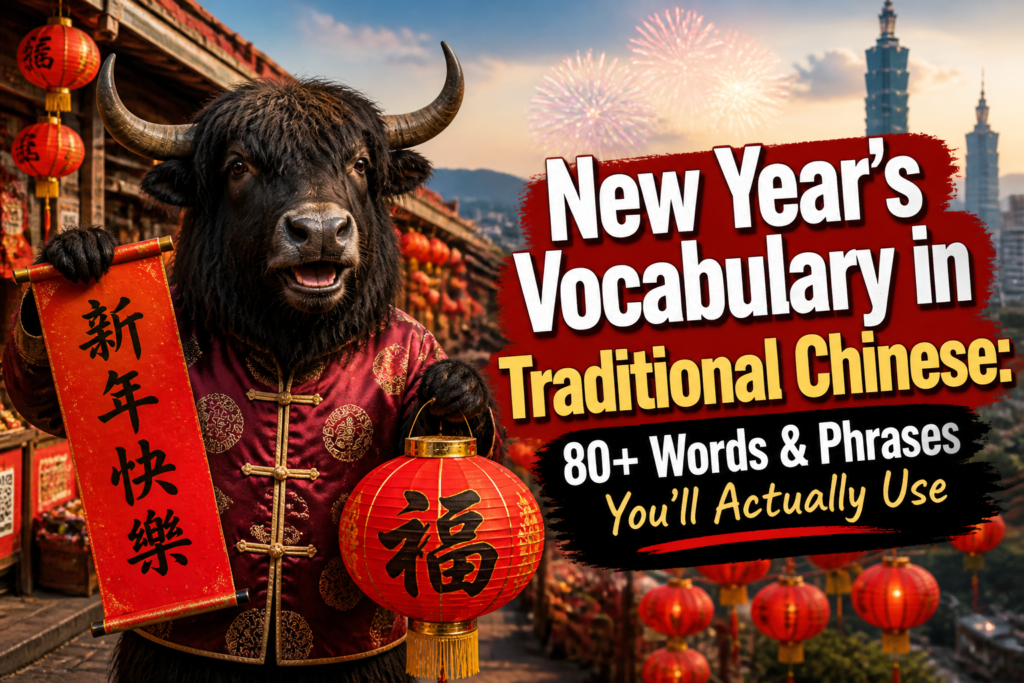
新年快樂(xīn nián kuài lè)is the classic greeting, but New Year talk in Traditional Chinese goes way beyond that. If you know the right words, you can greet people, talk about holiday plans, understand red envelopes, and survive the social minefield of family gatherings without accidentally sounding like a confused tourist in your own life.
For the broader learning path, visit our parent guide.
In Taiwan, “New Year” can mean 新年(xīn nián)for the solar calendar and 農曆新年(nóng lì xīn nián)for Lunar New Year. People also casually say 過年(guò nián), which literally means “to pass the year.” It sounds simple, but of course language never stays simple when everyone is buying fruit, cleaning the house, and pretending they don’t know how much they eat at reunion dinner.
This guide gives you practical New Year vocabulary in Traditional Chinese with pinyin, English meanings, and real example sentences. You’ll also find a few notes on Taiwan usage, because yes, vocabulary changes depending on whether you are talking about the calendar, the holiday, or the family chaos.
For a bigger holiday-specific list, you can also check the related guide on Lunar New Year vocabulary in Traditional Chinese. And if you want to test your level later, try the Traditional Chinese placement test or the Traditional Chinese vocabulary test.
Useful New Year Phrases
| Traditional Chinese | Pinyin | Meaning | Example (ZH) | Example (Pinyin) | Translation (EN) |
|---|---|---|---|---|---|
| 新年快樂 | xīn nián kuài lè | Happy New Year | 新年快樂! | Xīn nián kuài lè! | Happy New Year! |
| 恭喜發財 | gōng xǐ fā cái | Wishing you prosperity | 恭喜發財,紅包拿來。 | Gōng xǐ fā cái, hóng bāo ná lái. | Wishing you prosperity, now give me the red envelope. |
| 萬事如意 | wàn shì rú yì | May everything go as you wish | 祝你萬事如意。 | Zhù nǐ wàn shì rú yì. | I wish you all the best. |
| 心想事成 | xīn xiǎng shì chéng | May all your wishes come true | 新的一年,心想事成。 | Xīn de yì nián, xīn xiǎng shì chéng. | In the new year, may all your wishes come true. |
| 平安健康 | píng ān jiàn kāng | Peace and good health | 我只希望全家平安健康。 | Wǒ zhǐ xī wàng quán jiā píng ān jiàn kāng. | I only hope the whole family stays safe and healthy. |
| 新的一年 | xīn de yì nián | the new year | 新的一年要更努力。 | Xīn de yì nián yào gèng nǔ lì. | I need to work harder in the new year. |
| 年終獎金 | nián zhōng jiǎng jīn | year-end bonus | 大家都在等年終獎金。 | Dà jiā dōu zài děng nián zhōng jiǎng jīn. | Everyone is waiting for the year-end bonus. |
| 跨年 | kuà nián | New Year’s Eve countdown / to ring in the new year | 我們晚上去台北跨年。 | Wǒ men wǎn shàng qù Táiběi kuà nián. | We’re going to Taipei for New Year’s Eve. |
| 倒數 | dào shǔ | countdown | 大家一起倒數十秒。 | Dà jiā yì qǐ dào shǔ shí miǎo. | Everyone counted down ten seconds together. |
| 煙火 | yān huǒ | fireworks | 跨年夜有很多煙火。 | Kuà nián yè yǒu hěn duō yān huǒ. | There are lots of fireworks on New Year’s Eve. |
Everyday New Year Words You’ll Hear In Taiwan
| Traditional Chinese | Pinyin | Meaning | Example (ZH) | Example (Pinyin) | Translation (EN) |
|---|---|---|---|---|---|
| 過年 | guò nián | to celebrate the New Year / Lunar New Year holiday | 我們回南部過年。 | Wǒ men huí Nánbù guò nián. | We go back south to celebrate New Year. |
| 除夕 | chú xī | New Year’s Eve | 除夕晚上全家一起吃飯。 | Chú xī wǎn shàng quán jiā yì qǐ chī fàn. | The whole family eats together on New Year’s Eve. |
| 春節 | chūn jié | Spring Festival / Lunar New Year holiday | 春節期間很多店都休息。 | Chūn jié qī jiān hěn duō diàn dōu xiū xī. | Many stores are closed during the Spring Festival period. |
| 初一 | chū yī | the first day of the lunar new year | 初一我們要去拜年。 | Chū yī wǒ men yào qù bài nián. | On the first day, we need to visit and give New Year greetings. |
| 初二 | chū èr | the second day of the lunar new year | 初二通常會回娘家。 | Chū èr tōng cháng huì huí niáng jiā. | On the second day, people often return to the wife’s parents’ home. |
| 初三 | chū sān | the third day of the lunar new year | 初三有些人會在家休息。 | Chū sān yǒu xiē rén huì zài jiā xiū xī. | Some people rest at home on the third day. |
| 團圓飯 | tuán yuán fàn | reunion dinner | 團圓飯一定要吃得很熱鬧。 | Tuán yuán fàn yí dìng yào chī de hěn rè nào. | Reunion dinner has to feel lively. |
| 年夜飯 | nián yè fàn | New Year’s Eve dinner | 年夜飯通常很多道菜。 | Nián yè fàn tōng cháng hěn duō dào cài. | New Year’s Eve dinner usually has many dishes. |
| 拜年 | bài nián | to pay New Year visits | 我們早上去阿公阿嬤家拜年。 | Wǒ men zǎo shàng qù ā gōng ā mā jiā bài nián. | We go to Grandma and Grandpa’s house to give New Year greetings in the morning. |
| 紅包 | hóng bāo | red envelope with money | 小孩最期待拿紅包。 | Xiǎo hái zuì qī dài ná hóng bāo. | Kids look forward to getting red envelopes the most. |
| 壓歲錢 | yā suì qián | lucky money for children | 長輩會給小朋友壓歲錢。 | Zhǎng bèi huì gěi xiǎo péng yǒu yā suì qián. | Elders give lucky money to children. |
| 春聯 | chūn lián | Spring Festival couplets | 我們在門上貼春聯。 | Wǒ men zài mén shàng tiē chūn lián. | We put Spring Festival couplets on the door. |
| 福字 | fú zì | the character 福, meaning good fortune | 很多人會把福字倒著貼。 | Hěn duō rén huì bǎ fú zì dào zhe tiē. | Many people paste the 福 character upside down. |
| 守歲 | shǒu suì | to stay up for the new year | 小時候我們會守歲到半夜。 | Xiǎo shí hòu wǒ men huì shǒu suì dào bàn yè. | When we were kids, we stayed up until midnight for the new year. |
| 送舊迎新 | sòng jiù yíng xīn | bid farewell to the old and welcome the new | 這句話很適合年底氣氛。 | Zhè jù huà hěn shì hé nián dǐ qì fēn. | This phrase fits the year-end mood well. |
People, Family, And Holiday Relationships
| Traditional Chinese | Pinyin | Meaning | Example (ZH) | Example (Pinyin) | Translation (EN) |
|---|---|---|---|---|---|
| 長輩 | zhǎng bèi | elder; senior family member | 跟長輩說話要有禮貌。 | Gēn zhǎng bèi shuō huà yào yǒu lǐ mào. | You should be polite when speaking to elders. |
| 晚輩 | wǎn bèi | younger generation; junior family member | 長輩常常會包紅包給晚輩。 | Zhǎng bèi cháng cháng huì bāo hóng bāo gěi wǎn bèi. | Elders often give red envelopes to younger family members. |
| 親戚 | qīn qī | relative | 過年要見很多親戚。 | Guò nián yào jiàn hěn duō qīn qī. | You have to see many relatives during New Year. |
| 阿公 | ā gōng | grandpa; Taiwan usage | 我阿公很喜歡泡茶。 | Wǒ ā gōng hěn xǐ huān pào chá. | My grandpa likes making tea. |
| 阿嬤 | ā mā | grandma; Taiwan usage | 阿嬤準備了很多菜。 | Ā mā zhǔn bèi le hěn duō cài. | Grandma prepared a lot of dishes. |
| 大伯 | dà bó | father’s older brother | 大伯今天也來吃年夜飯。 | Dà bó jīn tiān yě lái chī nián yè fàn. | Dad’s older brother is also coming to New Year’s Eve dinner today. |
| 叔叔 | shū shu | father’s younger brother; uncle | 叔叔送我一個小禮物。 | Shū shu sòng wǒ yí gè xiǎo lǐ wù. | My uncle gave me a small gift. |
| 阿姨 | ā yí | aunt; older woman | 阿姨問我今年幾歲。 | Ā yí wèn wǒ jīn nián jǐ suì. | An aunt asked me how old I am this year. |
| 表哥 | biǎo gē | older male cousin through maternal side | 表哥在台北工作。 | Biǎo gē zài Táiběi gōng zuò. | My older cousin works in Taipei. |
| 表妹 | biǎo mèi | younger female cousin through maternal side | 表妹很會拍照。 | Biǎo mèi hěn huì pāi zhào. | My younger cousin is really good at taking photos. |
Food, Shopping, And Festival Things
| Traditional Chinese | Pinyin | Meaning | Example (ZH) | Example (Pinyin) | Translation (EN) |
|---|---|---|---|---|---|
| 年糕 | nián gāo | New Year cake | 年糕吃起來甜甜的。 | Nián gāo chī qǐ lái tián tián de. | New Year cake tastes sweet. |
| 湯圓 | tāng yuán | glutinous rice balls | 冬天和過年都常吃湯圓。 | Dōng tiān hé guò nián dōu cháng chī tāng yuán. | People often eat tangyuan in winter and at New Year. |
| 魚 | yú | fish | 年夜飯一定會有魚。 | Nián yè fàn yí dìng huì yǒu yú. | There will definitely be fish at New Year’s Eve dinner. |
| 年菜 | nián cài | New Year dishes | 這家餐廳有賣年菜。 | Zhè jiā cān tīng yǒu mài nián cài. | This restaurant sells New Year dishes. |
| 禮盒 | lǐ hé | gift box | 我買了一盒年節禮盒。 | Wǒ mǎi le yì hé nián jié lǐ hé. | I bought a holiday gift box. |
| 伴手禮 | bàn shǒu lǐ | souvenir gift; gift to take along | 回家前要先買伴手禮。 | Huí jiā qián yào xiān mǎi bàn shǒu lǐ. | Before going home, you should buy a gift to bring along. |
| 水果 | shuǐ guǒ | fruit | 過年常常會準備水果。 | Guò nián cháng cháng huì zhǔn bèi shuǐ guǒ. | People often prepare fruit for New Year. |
| 橘子 | jú zi | tangerine; mandarin orange | 橘子很適合過年送人。 | Jú zi hěn shì hé guò nián sòng rén. | Tangerines are great for New Year gifts. |
| 禮物 | lǐ wù | gift | 小孩收到禮物很開心。 | Xiǎo hái shōu dào lǐ wù hěn kāi xīn. | Children are happy when they receive gifts. |
| 折扣 | zhé kòu | discount | 過年前很多店在打折扣。 | Guò nián qián hěn duō diàn zài dǎ zhé kòu. | Many stores have discounts before New Year. |
| 買年貨 | mǎi nián huò | buy New Year goods | 我們下午去市場買年貨。 | Wǒ men xià wǔ qù shì chǎng mǎi nián huò. | We’re going to the market this afternoon to buy New Year goods. |
| 市場 | shì chǎng | market | 年節前市場特別擁擠。 | Nián jié qián shì chǎng tè bié yōng jǐ. | The market is especially crowded before the holiday. |
Traditions, Customs, And Lucky Words
| Traditional Chinese | Pinyin | Meaning | Example (ZH) | Example (Pinyin) | Translation (EN) |
|---|---|---|---|---|---|
| 吉祥 | jí xiáng | auspicious; lucky | 大家都喜歡吉祥話。 | Dà jiā dōu xǐ huān jí xiáng huà. | Everyone likes lucky sayings. |
| 吉祥話 | jí xiáng huà | lucky sayings | 過年要多說吉祥話。 | Guò nián yào duō shuō jí xiáng huà. | You should say more lucky phrases during New Year. |
| 招財進寶 | zhāo cái jìn bǎo | bring in wealth and treasure | 這四個字很常出現在春聯上。 | Zhè sì gè zì hěn cháng chū xiàn zài chūn lián shàng. | This four-character phrase often appears on couplets. |
| 財運 | cái yùn | wealth luck | 希望今年財運更好。 | Xī wàng jīn nián cái yùn gèng hǎo. | I hope my money luck is better this year. |
| 運氣 | yùn qì | luck | 今年運氣不錯。 | Jīn nián yùn qì bú cuò. | My luck is pretty good this year. |
| 發財 | fā cái | to get rich | 大家都希望新年發財。 | Dà jiā dōu xī wàng xīn nián fā cái. | Everyone hopes to get rich in the new year. |
| 平安 | píng ān | safe and sound | 平安最重要。 | Píng ān zuì zhòng yào. | Safety is the most important thing. |
| 順利 | shùn lì | smooth; go well | 祝你工作順利。 | Zhù nǐ gōng zuò shùn lì. | I wish your work goes smoothly. |
| 好運 | hǎo yùn | good luck | 我今天一直覺得有好運。 | Wǒ jīn tiān yì zhí jué de yǒu hǎo yùn. | I feel like I’ve had good luck all day. |
| 開運 | kāi yùn | to boost luck; lucky-opening | 很多人過年會做開運小物。 | Hěn duō rén guò nián huì zuò kāi yùn xiǎo wù. | Many people make or buy lucky items for New Year. |
Events, Travel, And Holiday Activities
| Traditional Chinese | Pinyin | Meaning | Example (ZH) | Example (Pinyin) | Translation (EN) |
|---|---|---|---|---|---|
| 回家 | huí jiā | go home | 過年大家都想回家。 | Guò nián dà jiā dōu xiǎng huí jiā. | Everyone wants to go home for New Year. |
| 返鄉 | fǎn xiāng | return to one’s hometown | 返鄉車潮很可怕。 | Fǎn xiāng chē cháo hěn kě pà. | The traffic going back to hometown is terrible. |
| 車潮 | chē cháo | traffic flow; traffic jam | 除夕前一天車潮很大。 | Chú xī qián yì tiān chē cháo hěn dà. | The traffic is heavy the day before New Year’s Eve. |
| 火車站 | huǒ chē zhàn | train station | 火車站那幾天人很多。 | Huǒ chē zhàn nà jǐ tiān rén hěn duō. | The train station is very crowded those few days. |
| 高速公路 | gāo sù gōng lù | highway | 高速公路常常塞車。 | Gāo sù gōng lù cháng cháng sāi chē. | The highway often has traffic jams. |
| 塞車 | sāi chē | to be stuck in traffic | 我們因為塞車晚到了。 | Wǒ men yīn wèi sāi chē wǎn dào le. | We arrived late because of traffic. |
| 旅遊 | lǚ yóu | travel; tourism | 有些人過年去旅遊。 | Yǒu xiē rén guò nián qù lǚ yóu. | Some people travel during New Year. |
| 放假 | fàng jià | to have a holiday; time off | 公司明天開始放假。 | Gōng sī míng tiān kāi shǐ fàng jià. | The company starts its holiday tomorrow. |
| 返工 | fǎn gōng | return to work | 大家初五才返工。 | Dà jiā chū wǔ cái fǎn gōng. | Everyone only goes back to work on the fifth day. |
| 開工 | kāi gōng | start work again | 工廠初八開工。 | Gōng chǎng chū bā kāi gōng. | The factory starts work again on the eighth day. |
Money, Work, And Year-End Talk
| Traditional Chinese | Pinyin | Meaning | Example (ZH) | Example (Pinyin) | Translation (EN) |
|---|---|---|---|---|---|
| 薪水 | xīn shuǐ | salary | 很多人期待年終和加薪。 | Hěn duō rén qī dài nián zhōng hé jiā xīn. | Many people look forward to year-end bonus and a raise. |
| 加薪 | jiā xīn | raise | 希望明年可以加薪。 | Xī wàng míng nián kě yǐ jiā xīn. | I hope I can get a raise next year. |
| 年終 | nián zhōng | year-end bonus | 年終一到,大家都很忙。 | Nián zhōng yí dào, dà jiā dōu hěn máng. | When year-end arrives, everyone gets busy. |
| 業績 | yè jì | business performance; sales results | 這個月業績很好。 | Zhè gè yuè yè jì hěn hǎo. | This month’s sales results are very good. |
| 存錢 | cún qián | save money | 新年目標是多存錢。 | Xīn nián mù biāo shì duō cún qián. | My New Year goal is to save more money. |
| 目標 | mù biāo | goal | 你今年的目標是什麼? | Nǐ jīn nián de mù biāo shì shén me? | What is your goal this year? |
| 計畫 | jì huà | plan | 我已經做好新年計畫了。 | Wǒ yǐ jīng zuò hǎo xīn nián jì huà le. | I already made my New Year plan. |
| 改變 | gǎi biàn | change | 今年想做一點改變。 | Jīn nián xiǎng zuò yì diǎn gǎi biàn. | I want to make a few changes this year. |
| 成長 | chéng zhǎng | growth; to grow | 我希望自己能慢慢成長。 | Wǒ xī wàng zì jǐ néng màn màn chéng zhǎng. | I hope I can grow little by little. |
| 願望 | yuàn wàng | wish | 新年願望先保密。 | Xīn nián yuàn wàng xiān bǎo mì. | My New Year wish is a secret for now. |
Useful Grammar And Word Notes
一(yī)changes tone in real speech. In phrases like 一盒(yì hé, one box)or 一個(yí gè, one piece), 一 often sounds different because Mandarin likes to keep you humble.
不(bù)also changes tone before a fourth tone. For example, 不錯(bú cuò)means “pretty good.” You’ll hear this a lot when people are being politely positive.
了(le)is common in holiday sentences because people talk about completed actions: 我們回家了(Wǒ men huí jiā le)means “We went home” or “We’re heading home now,” depending on context. Tiny particle, huge job.
嗎(ma)turns a statement into a yes-no question. Example: 你今年回家嗎?(Nǐ jīn nián huí jiā ma?)“Are you going home this year?”
呢(ne)can soften a question or keep the conversation going. Example: 你呢?(Nǐ ne?)“And you?”
For background on the holiday itself, a plain reference like 春節 is useful when you want the boring facts without the confetti. Yes, boring sources are sometimes exactly what you need.
Quick Practice
Try swapping the bold words with the new vocabulary. Keep the pinyin near the Chinese so your brain does not wander off for snacks.
| Practice | Try It | Sample Answer |
|---|---|---|
| Say “Happy New Year” | __________ | 新年快樂(xīn nián kuài lè) |
| Say “red envelope” | __________ | 紅包(hóng bāo) |
| Say “New Year’s Eve” | __________ | 除夕(chú xī) |
| Say “reunion dinner” | __________ | 團圓飯(tuán yuán fàn) |
| Say “countdown” | __________ | 倒數(dào shǔ) |
| Say “go home for the holiday” | __________ | 回家過年(huí jiā guò nián) |
Now try translating these into Traditional Chinese:
- Happy New Year
- Wishing you prosperity
- New Year’s Eve dinner
- red envelope
- good luck
- return to work
Possible answers: 新年快樂(xīn nián kuài lè), 恭喜發財(gōng xǐ fā cái), 年夜飯(nián yè fàn), 紅包(hóng bāo), 好運(hǎo yùn), 返工(fǎn gōng).
Common Mistakes And Easy Fixes
| Common Mistake | Better Version | Why It Helps |
|---|---|---|
| Using only “Happy New Year” for every holiday context | 新年快樂(xīn nián kuài lè)for general New Year; 恭喜發財(gōng xǐ fā cái)for Lunar New Year | Different settings need different greetings. |
| Saying “紅包” only as “red bag” | 紅包(hóng bāo) | In Taiwan, this almost always means a money envelope. |
| Confusing 過年 and 新年 | 過年(guò nián)for holiday celebration; 新年(xīn nián)for New Year in general | Native speakers use both, but not always the same way. |
| Forgetting that 初二 is special in Taiwan | 初二回娘家(chū èr huí niáng jiā) | This is a common Taiwan holiday phrase. |
| Using Simplified Chinese forms by accident | Stick to 傳統(chuán tǒng)/ Traditional Chinese forms like 農曆新年 and 春聯 | This article is for Traditional Chinese, so keep it on script. |
Yak wisdom: if you can say 新年快樂 and 恭喜發財 with confidence, you are already doing better than half the room at a family gathering.
Fast Reference Summary
| Type | Traditional Chinese | Pinyin | English |
|---|---|---|---|
| Greeting | 新年快樂 | xīn nián kuài lè | Happy New Year |
| Lucky wish | 恭喜發財 | gōng xǐ fā cái | Wishing you prosperity |
| Holiday | 過年 | guò nián | celebrate New Year |
| Holiday eve | 除夕 | chú xī | New Year’s Eve |
| Family dinner | 團圓飯 | tuán yuán fàn | reunion dinner |
| Gift money | 紅包 | hóng bāo | red envelope |
| Counting down | 倒數 | dào shǔ | countdown |
| Fireworks | 煙火 | yān huǒ | fireworks |
| Return to work | 返工 | fǎn gōng | go back to work |
| Good wish | 萬事如意 | wàn shì rú yì | May everything go as you wish |
If you want to keep going, the next sensible step is to review the related Lunar New Year vocabulary guide and then test yourself with the Traditional Chinese vocabulary test. New Year words are easy to forget if you never use them, so use them. Repeatedly. Like a cheerful linguistic squirrel.