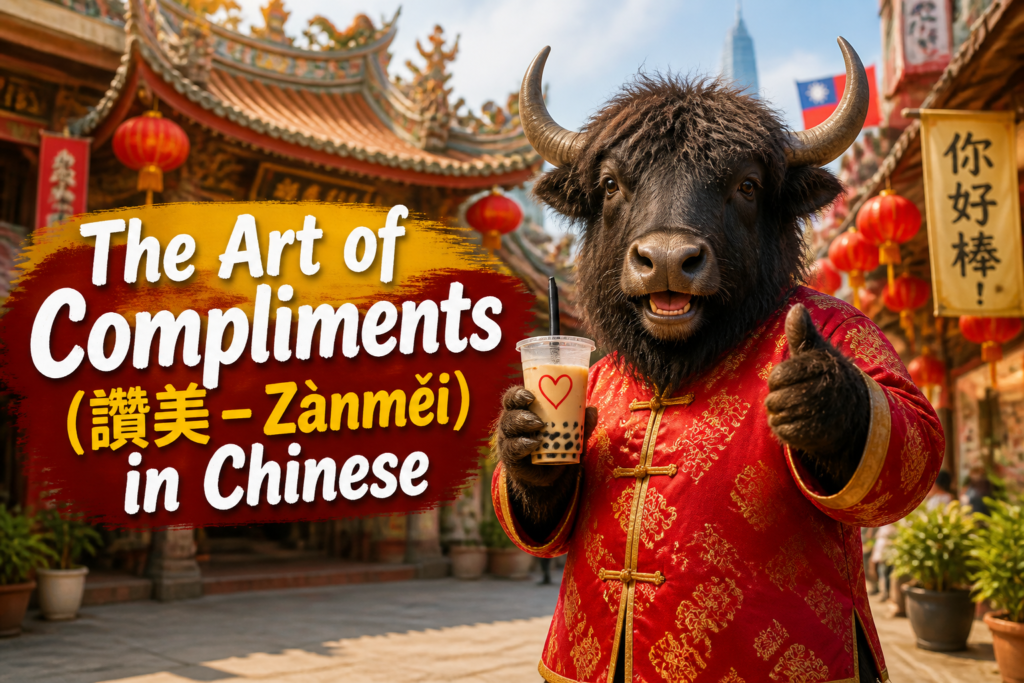
讚美 zàn měi means “to compliment” or “to praise.” In Chinese, a good compliment is not just about being nice. It is about sounding natural, warm, and not a little bit overdramatic in the wrong way. Say it well, and people smile. Say it awkwardly, and you may sound like a TV host who has never met a real human.
For the broader learning path, visit our parent guide.
This guide will help you give compliments in Traditional Chinese with the right tone, the right words, and the right amount of sincerity. You will learn useful phrases for friends, family, work, food, clothes, skills, and everyday life in Taiwan.
For extra language practice, you can also check Traditional Chinese Vocabulary Test, Traditional Chinese Placement Test (TOCFL), Essential Traditional Chinese Phrases, Conversational Traditional Chinese, and Say “I’m Sorry” in Traditional Chinese.
Why Compliments Matter In Chinese
Compliments in Chinese are often modest, friendly, and indirect. People may respond with 沒有啦 méi yǒu la (“oh, not really”) or 哪裡哪裡 nǎ lǐ nǎ lǐ (“you flatter me”). That does not mean the compliment was rejected. It usually means the social dance has begun. Everyone knows the steps. Nobody wants to be the person who starts breakdancing in the middle of it.
In Taiwan, compliments often sound relaxed and practical. People praise effort, taste, ability, and appearance, but they usually avoid sounding too intense unless the situation really calls for it.
Useful Compliments You Can Use Right Away
Here are common compliments with Traditional Chinese, pinyin, English meaning, and real examples. Learn these first, and you already sound much more natural.
| Traditional Chinese | Pinyin | Meaning | Example (ZH) | Example (Pinyin) | Translation (EN) |
|---|---|---|---|---|---|
| 你很厲害 | nǐ hěn lì hài | You are really impressive / capable | 你修這個電腦修得很厲害。 | Nǐ xiū zhè ge diàn nǎo xiū de hěn lì hài. | You fixed this computer really well. |
| 你真棒 | nǐ zhēn bàng | You are awesome | 你今天表現得很棒。 | Nǐ jīn tiān biǎo xiàn de hěn bàng. | You performed really well today. |
| 你做得很好 | nǐ zuò de hěn hǎo | You did a great job | 這份報告你做得很好。 | Zhè fèn bào gào nǐ zuò de hěn hǎo. | You did a great job on this report. |
| 你好有耐心 | nǐ hǎo yǒu nài xīn | You are so patient | 你教小朋友的時候好有耐心。 | Nǐ jiāo xiǎo péng yǒu de shí hòu hǎo yǒu nài xīn. | You are so patient when teaching children. |
| 你好會講話 | nǐ hǎo huì jiǎng huà | You speak really well / you are eloquent | 她真的好會講話,大家都喜歡聽她說話。 | Tā zhēn de hǎo huì jiǎng huà, dà jiā dōu xǐ huān tīng tā shuō huà. | She is really good with words; everyone likes listening to her. |
| 你很會穿搭 | nǐ hěn huì chuān dā | You have great style | 你今天這件外套很有型,你很會穿搭。 | Nǐ jīn tiān zhè jiàn wài tào hěn yǒu xíng, nǐ hěn huì chuān dā. | This jacket looks great on you; you have great style. |
| 你人很好 | nǐ rén hěn hǎo | You are very kind | 謝謝你幫我搬東西,你人真好。 | Xiè xie nǐ bāng wǒ bān dōng xi, nǐ rén zhēn hǎo. | Thanks for helping me carry things. You’re really kind. |
| 這個好好吃 | zhè ge hǎo hǎo chī | This is really delicious | 這家滷肉飯好好吃。 | Zhè jiā lǔ ròu fàn hǎo hǎo chī. | This braised pork rice is really delicious. |
| 這個好漂亮 | zhè ge hǎo piào liang | This is very beautiful | 你的包包好漂亮。 | Nǐ de bāo bāo hǎo piào liang. | Your bag is very beautiful. |
| 好可愛 | hǎo kě ài | So cute | 這隻貓真的好可愛。 | Zhè zhī māo zhēn de hǎo kě ài. | This cat is really cute. |
| 很有氣質 | hěn yǒu qì zhí | Very elegant / classy | 她看起來很有氣質。 | Tā kàn qǐ lái hěn yǒu qì zhí. | She looks very elegant. |
| 很有創意 | hěn yǒu chuàng yì | Very creative | 你的想法很有創意。 | Nǐ de xiǎng fǎ hěn yǒu chuàng yì. | Your idea is very creative. |
Compliments For Daily Life
Some compliments fit very specific situations. These are the ones people actually use in real life, not the stiff textbook ones that feel like they were assembled by committee.
| Traditional Chinese | Pinyin | Meaning | Example (ZH) | Example (Pinyin) | Translation (EN) |
|---|---|---|---|---|---|
| 你英文很好 | nǐ Yīng wén hěn hǎo | Your English is very good | 你的英文很好,口音也很自然。 | Nǐ de Yīng wén hěn hǎo, kǒu yīn yě hěn zì rán. | Your English is very good, and your accent sounds natural too. |
| 你進步很多 | nǐ jìn bù hěn duō | You have improved a lot | 你這次中文進步很多。 | Nǐ zhè cì Zhōng wén jìn bù hěn duō. | You improved a lot in Chinese this time. |
| 你很用心 | nǐ hěn yòng xīn | You are very thoughtful / diligent | 你準備得很用心。 | Nǐ zhǔn bèi de hěn yòng xīn. | You prepared very thoughtfully. |
| 你很細心 | nǐ hěn xì xīn | You are very careful and attentive | 你連小地方都注意到了,真細心。 | Nǐ lián xiǎo dì fāng dōu zhù yì dào le, zhēn xì xīn. | You noticed even the small details. Very attentive. |
| 你很有效率 | nǐ hěn yǒu xiào lǜ | You are very efficient | 你處理事情很有效率。 | Nǐ chǔ lǐ shì qíng hěn yǒu xiào lǜ. | You handle things very efficiently. |
| 你很會煮 | nǐ hěn huì zhǔ | You cook very well | 這道菜是你煮的嗎?你很會煮耶。 | Zhè dào cài shì nǐ zhǔ de ma? Nǐ hěn huì zhǔ yē. | Did you cook this dish? You cook really well. |
| 這家店很有名 | zhè jiā diàn hěn yǒu míng | This place is very famous | 這家店真的很有名,排隊的人很多。 | Zhè jiā diàn zhēn de hěn yǒu míng, pái duì de rén hěn duō. | This place is really famous, and there are lots of people in line. |
| 這件衣服很適合你 | zhè jiàn yī fú hěn shì hé nǐ | This clothing suits you well | 這件外套很適合你,顏色也很好看。 | Zhè jiàn wài tào hěn shì hé nǐ, yán sè yě hěn hǎo kàn. | This jacket suits you well, and the color looks great. |
| 你的發音很好 | nǐ de fā yīn hěn hǎo | Your pronunciation is good | 你的發音很自然。 | Nǐ de fā yīn hěn zì rán. | Your pronunciation is very natural. |
| 你很上道 | nǐ hěn shàng dào | You know how to do things properly / you are tactful | 他很上道,大家都喜歡跟他合作。 | Tā hěn shàng dào, dà jiā dōu xǐ huān gēn tā hé zuò. | He knows the ropes, and everyone likes working with him. |
Compliments For People
When you compliment a person in Chinese, start with something specific. “You are amazing” is fine, but “you explained that so clearly” often feels warmer and more believable.
| Traditional Chinese | Pinyin | Meaning | Example (ZH) | Example (Pinyin) | Translation (EN) |
|---|---|---|---|---|---|
| 你講得很清楚 | nǐ jiǎng de hěn qīng chǔ | You explained it clearly | 你講得很清楚,我一下就懂了。 | Nǐ jiǎng de hěn qīng chǔ, wǒ yí xià jiù dǒng le. | You explained it clearly, and I understood right away. |
| 你很聰明 | nǐ hěn cōng míng | You are smart | 你一下就想出答案,真的很聰明。 | Nǐ yí xià jiù xiǎng chū dá àn, zhēn de hěn cōng míng. | You came up with the answer right away. You’re really smart. |
| 你很有想法 | nǐ hěn yǒu xiǎng fǎ | You have ideas / strong opinions | 你的設計很有想法。 | Nǐ de shè jì hěn yǒu xiǎng fǎ. | Your design has a lot of thought behind it. |
| 你很可靠 | nǐ hěn kě kào | You are reliable | 有你幫忙,我很放心,因為你很可靠。 | Yǒu nǐ bāng máng, wǒ hěn fàng xīn, yīn wèi nǐ hěn kě kào. | I feel at ease with your help because you are reliable. |
| 你很專業 | nǐ hěn zhuān yè | You are professional | 你的回答很專業。 | Nǐ de huí dá hěn zhuān yè. | Your answer is very professional. |
| 你很會帶人 | nǐ hěn huì dài rén | You are good at leading people | 他很會帶人,所以團隊合作很好。 | Tā hěn huì dài rén, suǒ yǐ tuán duì hé zuò hěn hǎo. | He is good at leading people, so the team works well. |
| 你很有禮貌 | nǐ hěn yǒu lǐ mào | You are very polite | 小朋友很有禮貌,會主動打招呼。 | Xiǎo péng yǒu hěn yǒu lǐ mào, huì zhǔ dòng dǎ zhāo hū. | The child is very polite and greets people proactively. |
| 你很成熟 | nǐ hěn chéng shú | You are mature | 你雖然年輕,但想法很成熟。 | Nǐ suī rán nián qīng, dàn xiǎng fǎ hěn chéng shú. | Even though you are young, your thinking is mature. |
Compliments For Things
Chinese compliments often point to the thing itself first, then the person behind it. That makes the praise feel concrete, not floaty and weird like a compliment balloon drifting in from nowhere.
| Traditional Chinese | Pinyin | Meaning | Example (ZH) | Example (Pinyin) | Translation (EN) |
|---|---|---|---|---|---|
| 這個設計很漂亮 | zhè ge shè jì hěn piào liang | This design is beautiful | 這個網站設計很漂亮。 | Zhè ge wǎng zhàn shè jì hěn piào liang. | This website design is beautiful. |
| 這個想法很棒 | zhè ge xiǎng fǎ hěn bàng | This idea is great | 你的想法很棒,我們可以試試看。 | Nǐ de xiǎng fǎ hěn bàng, wǒ men kě yǐ shì shì kàn. | Your idea is great. We can try it. |
| 這張照片拍得很好 | zhè zhāng zhào piàn pāi de hěn hǎo | This photo was taken very well | 這張照片拍得很好,光線也很自然。 | Zhè zhāng zhào piàn pāi de hěn hǎo, guāng xiàn yě hěn zì rán. | This photo was taken really well, and the lighting looks natural. |
| 這首歌很好聽 | zhè shǒu gē hěn hǎo tīng | This song sounds very good | 這首歌真的很好聽。 | Zhè shǒu gē zhēn de hěn hǎo tīng. | This song is really nice to listen to. |
| 這本書很好看 | zhè běn shū hěn hǎo kàn | This book is very good | 這本書很好看,我一晚就看完了。 | Zhè běn shū hěn hǎo kàn, wǒ yí wǎn jiù kàn wán le. | This book is very good. I finished it in one night. |
| 這間店很舒服 | zhè jiān diàn hěn shū fú | This place is very comfortable | 這間咖啡店很舒服,適合讀書。 | Zhè jiān kā fēi diàn hěn shū fú, shì hé dú shū. | This café is very comfortable and good for studying. |
| 這道菜很有味道 | zhè dào cài hěn yǒu wèi dào | This dish has a lot of flavor | 這道菜很有味道,吃得出來很用心。 | Zhè dào cài hěn yǒu wèi dào, chī de chū lái hěn yòng xīn. | This dish has a lot of flavor. You can tell it was made with care. |
| 這個活動很有意義 | zhè ge huó dòng hěn yǒu yì yì | This event is meaningful | 這個活動很有意義,大家都很支持。 | Zhè ge huó dòng hěn yǒu yì yì, dà jiā dōu hěn zhī chí. | This event is meaningful, and everyone supports it. |
How To Make Compliments Sound Natural
Compliments in Chinese often sound better when they are specific. Compare these two styles:
| Pattern | Meaning | Example (ZH) | Pinyin | English |
|---|---|---|---|---|
| 你很厲害 | General praise | 你很厲害。 | Nǐ hěn lì hài. | You are impressive. |
| 你把這件事處理得很漂亮 | Specific praise | 你把這件事處理得很漂亮。 | Nǐ bǎ zhè jiàn shì chǔ lǐ de hěn piào liang. | You handled this matter beautifully. |
Rule: the more concrete your compliment, the more sincere it sounds.
Another useful pattern is 很 + adjective. In Chinese, this often sounds smoother than direct English-style praise.
| Pattern | Meaning | Example (ZH) | Pinyin | English |
|---|---|---|---|---|
| 你很漂亮 | You are pretty | 你今天很漂亮。 | Nǐ jīn tiān hěn piào liang. | You look very pretty today. |
| 你很帥 | You are handsome | 你今天很帥。 | Nǐ jīn tiān hěn shuài. | You look very handsome today. |
| 這裡很安靜 | This place is quiet | 這裡很安靜,適合工作。 | Zhè lǐ hěn ān jìng, shì hé gōng zuò. | This place is quiet and good for working. |
Responding To A Compliment
If someone compliments you, a polite modest response is common in Taiwan. You do not need to act like a runway model accepting a trophy.
| Traditional Chinese | Pinyin | Meaning | Example (ZH) | Example (Pinyin) | Translation (EN) |
|---|---|---|---|---|---|
| 沒有啦 | méi yǒu la | Oh, not really | 沒有啦,我還要多學。 | Méi yǒu la, wǒ hái yào duō xué. | Oh, not really. I still need to learn more. |
| 哪裡哪裡 | nǎ lǐ nǎ lǐ | You’re too kind / not at all | 哪裡哪裡,你過獎了。 | Nǎ lǐ nǎ lǐ, nǐ guò jiǎng le. | Not at all, you’re too kind. |
| 謝謝 | xiè xie | Thank you | 謝謝,你人真好。 | Xiè xie, nǐ rén zhēn hǎo. | Thank you, you’re really kind. |
| 過獎了 | guò jiǎng le | You flatter me | 過獎了,我還差得遠。 | Guò jiǎng le, wǒ hái chà de yuǎn. | You flatter me. I still have a long way to go. |
| 你太客氣了 | nǐ tài kè qì le | You’re too polite | 你太客氣了,真的不用這麼說。 | Nǐ tài kè qì le, zhēn de bú yòng zhè me shuō. | You’re too kind. You really don’t need to say that. |
Tone And Nuance Notes
Some compliment words are easy to misuse because English and Chinese do not map perfectly. A little nuance saves you from sounding accidentally weird.
- 厲害 lì hài can mean “amazing,” “impressive,” or “skilled.” It is very common in Taiwan.
- 棒 bàng is cheerful and positive. It works well in casual speech.
- 漂亮 piào liang is often used for people, clothes, objects, and even solutions that are “well done.”
- 可愛 kě ài is not only for babies or cats. People use it for outfits, gestures, and sometimes a person’s vibe.
- 有氣質 yǒu qì zhí suggests elegance, grace, or classy style. It is often used for women, but not only.
- 有想法 yǒu xiǎng fǎ means someone has ideas or a personal point of view, not just that they are “thinking a lot.”
Also note the pattern 好 + adjective in spoken Chinese. In many compliments, 好 hǎo works like “so” or “really”:
| Pattern | Meaning | Example (ZH) | Pinyin | English |
|---|---|---|---|---|
| 好漂亮 | So pretty | 這件裙子好漂亮。 | Zhè jiàn qún zi hǎo piào liang. | This dress is so pretty. |
| 好厲害 | So impressive | 你真的好厲害。 | Nǐ zhēn de hǎo lì hài. | You are really impressive. |
| 好可愛 | So cute | 這個小孩好可愛。 | Zhè ge xiǎo hái hǎo kě ài. | This child is so cute. |
Compliments In Taiwan: What Sounds Natural
In Taiwan, praise is often mixed with comfort, practicality, and gentle friendliness. A compliment might mention effort, taste, or usefulness rather than only appearance. For example, saying 你很用心 nǐ hěn yòng xīn often feels warm and mature.
People also use compliments to encourage others after work, study, or daily errands. A phrase like 辛苦了 xīn kǔ le is not exactly a compliment, but it often functions like appreciation. In Taiwan, it is a very normal and useful thing to say after someone has worked hard.
If you want more conversational patterns like this, it helps to study common social language alongside compliments. A good next stop is Conversational Traditional Chinese.
Mini Comparisons: Which Compliment Fits?
| Situation | Better Compliment | Why |
|---|---|---|
| A friend solved a problem fast | 你很厲害 nǐ hěn lì hài | Natural and flexible praise |
| Someone gave a thoughtful gift | 你好用心 nǐ hǎo yòng xīn | Praises effort and thoughtfulness |
| A coworker explained something clearly | 你講得很清楚 nǐ jiǎng de hěn qīng chǔ | Specific and sincere |
| A meal tastes excellent | 這個好好吃 zhè ge hǎo hǎo chī | Common, natural, casual |
| Someone looks elegant | 你很有氣質 nǐ hěn yǒu qì zhí | Classy, polite, and positive |
Practice: Swap The Word
Try replacing the bold part with the correct compliment phrase. The goal is to make the sentence feel natural, not to win a poetry prize.
| Practice Sentence | Hint | Suggested Answer |
|---|---|---|
| 你把這個問題處理得很___。 | “well done” | 漂亮 piào liang |
| 你真的很___,一下就懂了。 | “smart” | 聰明 cōng míng |
| 這個蛋糕好___。 | “delicious” | 好吃 hǎo chī |
| 你今天看起來很___。 | “pretty” | 漂亮 piào liang |
| 你教得很___,我都懂了。 | “clearly” | 清楚 qīng chǔ |
Practice: Choose The Best Compliment
- For a good presentation: 你講得很清楚 nǐ jiǎng de hěn qīng chǔ
- For a great-looking outfit: 你很會穿搭 nǐ hěn huì chuān dā
- For a tasty lunch: 這個好好吃 zhè ge hǎo hǎo chī
- For someone who helps others kindly: 你人很好 nǐ rén hěn hǎo
- For a person who improved a lot: 你進步很多 nǐ jìn bù hěn duō
Common Mistakes And Fixes
| Mistake | Better Version | Why |
|---|---|---|
| Using only one generic praise word every time | Use specific praise like 你講得很清楚 nǐ jiǎng de hěn qīng chǔ | Specific compliments sound warmer and more real |
| Sounding too intense for a normal situation | Try 你很厲害 nǐ hěn lì hài or 你做得很好 nǐ zuò de hěn hǎo | These are friendly and not too dramatic |
| Forgetting that Chinese often likes modest replies | Reply with 沒有啦 méi yǒu la or 謝謝 xiè xie | It sounds natural in Taiwan |
| Using appearance words in the wrong context | Use 有氣質 yǒu qì zhí or 很適合你 hěn shì hé nǐ | These are often safer and more nuanced |
| Making compliments too long and flowery | Keep it short: 好棒 hǎo bàng, 很厲害 hěn lì hài, 很用心 hěn yòng xīn | Short praise often sounds more natural |
Quick Reference Summary
- 最通用 zuì tōng yòng: 你很厲害 nǐ hěn lì hài
- 最自然的日常稱讚 zuì zì rán de rì cháng chēng zàn: 你做得很好 nǐ zuò de hěn hǎo
- 稱讚努力 chēng zàn nǔ lì: 你很用心 nǐ hěn yòng xīn
- 稱讚外表 chēng zàn wài biǎo: 你很漂亮 nǐ hěn piào liang
- 稱讚食物 chēng zàn shí wù: 這個好好吃 zhè ge hǎo hǎo chī
- 稱讚能力 chēng zàn néng lì: 你很專業 nǐ hěn zhuān yè
- 回應稱讚 huí yìng chēng zàn: 謝謝 xiè xie / 沒有啦 méi yǒu la
If you want to keep building your Chinese social skills, a good compliment is a tiny superpower. It makes conversations warmer, smoother, and a lot less like you are reading from a robot manual. The best praise is simple, specific, and sincere. That is the whole trick.
Yak Takeaway: In Chinese, the best compliment is usually short, specific, and kind. Say 你很厲害 nǐ hěn lì hài, 你很用心 nǐ hěn yòng xīn, or 這個好好吃 zhè ge hǎo hǎo chī, and you are already speaking like a real person. Fancy speeches are optional. Sincerity is not.