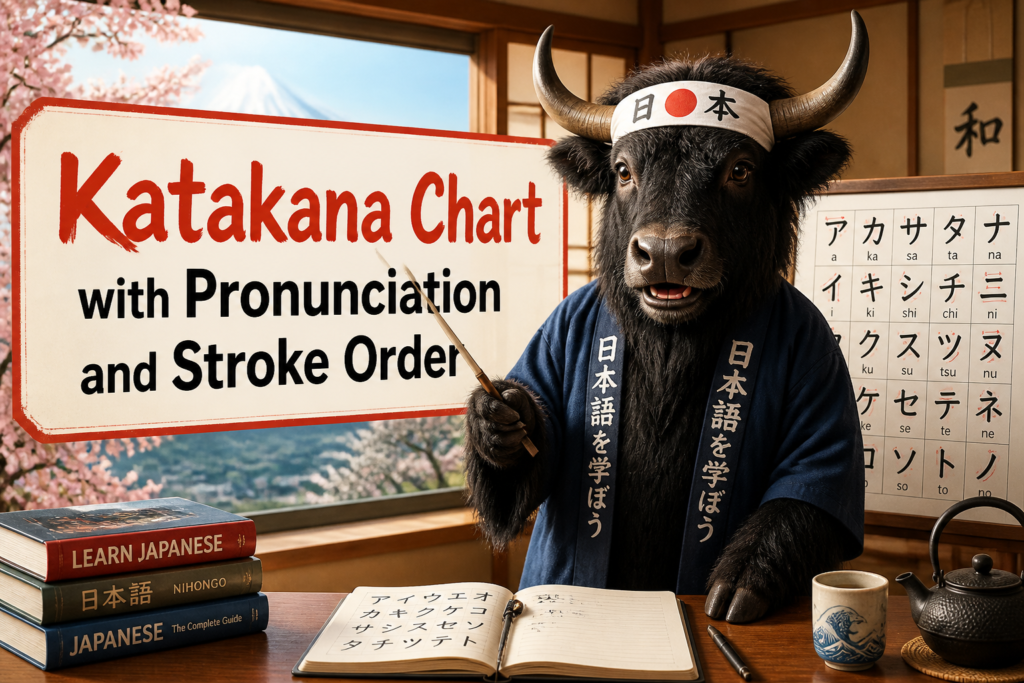
Katakana is the Japanese script that loves foreign words, sound effects, names, and anything that wants to look a little cooler than it probably should. If hiragana is the friendly starter set, katakana is the sharp-edged cousin that shows up in signs, menus, and pop culture. Learning it early pays off fast.
For the broader learning path, visit our parent guide.
This guide gives you a complete Katakana Chart with Pronunciation, Stroke Order, and Example Words, plus simple memory tips and real examples. If you already know hiragana, great. If not, the hiragana chart is the sensible place to begin before katakana starts tossing foreign names around.
One more thing: katakana looks clean and simple, but it is not just “blocky hiragana.” The shapes, stroke flow, and sound patterns matter. Japanese handwriting can be surprisingly picky about this. Rude, honestly. Helpful, but rude.
What Katakana Is Used For
カタカナ
Katakana
Katakana script
Katakana is used for:
- 外来語
gairaigo
borrowed foreign words - 名前
namae
names, especially foreign names - 動物・植物の音や強調
doubutsu shokubutsu no oto ya kyouchou
sound effects, emphasis, and special style - 外国の地名
gaikoku no chimei
foreign place names - 商品名
shouhinmei
product names and branding
Example:
コーヒー
kōhī
coffee
コーヒーを飲みます。
Kōhī o nomimasu.
I drink coffee.
Katakana Chart With Pronunciation
Here is the standard katakana chart. The vowels are short and clear: a, i, u, e, o. Keep them crisp. Japanese does not really want messy vowel drama.
Keep building your Japanese
Choose a practical next step when you are ready.
| Katakana | Rōmaji | Pronunciation Tip | Example Word | Meaning |
|---|---|---|---|---|
| ア | a | like “ah” | アイス / aisu | ice cream |
| イ | i | like “ee” | イギリス / Igirisu | England |
| ウ | u | between “oo” and “uh” | ウサギ / usagi | rabbit |
| エ | e | like “eh” | エビ / ebi | shrimp |
| オ | o | like “oh” | オレンジ / orenji | orange |
| Katakana | Rōmaji | Pronunciation Tip | Example Word | Meaning |
|---|---|---|---|---|
| カ | ka | clean “kah” | カメラ / kamera | camera |
| キ | ki | like “key” | キッチン / kicchin | kitchen |
| ク | ku | short “koo” | クラブ / kurabu | club |
| ケ | ke | like “keh” | ケーキ / kēki | cake |
| コ | ko | like “koh” | コーヒー / kōhī | coffee |
| Katakana | Rōmaji | Pronunciation Tip | Example Word | Meaning |
|---|---|---|---|---|
| サ | sa | soft “sah” | サラダ / sarada | salad |
| シ | shi | like “she” | システム / shisutemu | system |
| ス | su | short “soo” | スープ / sūpu | soup |
| セ | se | like “seh” | セーター / sētā | sweater |
| ソ | so | like “soh” | ソファ / sofa | sofa |
| Katakana | Rōmaji | Pronunciation Tip | Example Word | Meaning |
|---|---|---|---|---|
| タ | ta | clear “tah” | タクシー / takushī | taxi |
| チ | chi | like “chee” | チーズ / chīzu | cheese |
| ツ | tsu | tight “tsu” sound | ツアー / tsuā | tour |
| テ | te | like “teh” | テレビ / terebi | television |
| ト | to | like “toh” | トマト / tomato | tomato |
| Katakana | Rōmaji | Pronunciation Tip | Example Word | Meaning |
|---|---|---|---|---|
| ナ | na | simple “nah” | ナイフ / naifu | knife |
| ニ | ni | like “knee” | ニュース / nyūsu | news |
| ヌ | nu | like “noo” | ヌードル / nūdoru | noodle |
| ネ | ne | like “neh” | ネクタイ / nekutai | necktie |
| ノ | no | like “noh” | ノート / nōto | notebook |
| Katakana | Rōmaji | Pronunciation Tip | Example Word | Meaning |
|---|---|---|---|---|
| ハ | ha | gentle “hah” | ハンバーガー / hanbāgā | hamburger |
| ヒ | hi | like “hee” | ヒント / hinto | hint |
| フ | fu | not quite “fu,” more airy | フルーツ / furūtsu | fruit |
| ヘ | he | like “heh” | ヘリコプター / herikoputā | helicopter |
| ホ | ho | like “hoh” | ホテル / hoteru | hotel |
| Katakana | Rōmaji | Pronunciation Tip | Example Word | Meaning |
|---|---|---|---|---|
| マ | ma | clear “mah” | ママ / mama | mom |
| ミ | mi | like “me” | ミルク / miruku | milk |
| ム | mu | short “moo” | ムービー / mūbī | movie |
| メ | me | like “meh” | メニュー / menyū | menu |
| モ | mo | like “moh” | モール / mōru | mall |
| Katakana | Rōmaji | Pronunciation Tip | Example Word | Meaning |
|---|---|---|---|---|
| ヤ | ya | like “yah” | ヤマ / yama | mountain |
| ユ | yu | like “you” | ユニフォーム / yunifōmu | uniform |
| ヨ | yo | like “yoh” | ヨーグルト / yōguruto | yogurt |
| Katakana | Rōmaji | Pronunciation Tip | Example Word | Meaning |
|---|---|---|---|---|
| ラ | ra | light “rah” | ラジオ / rajio | radio |
| リ | ri | like “ree” | リモコン / rimokon | remote control |
| ル | ru | short “roo” | ルール / rūru | rule |
| レ | re | like “reh” | レストラン / resutoran | restaurant |
| ロ | ro | like “roh” | ロボット / robotto | robot |
| Katakana | Rōmaji | Pronunciation Tip | Example Word | Meaning |
|---|---|---|---|---|
| ワ | wa | like “wah” | ワイン / wain | wine |
| ヲ | wo | usually pronounced like “o” | ヲタク / otaku | otaku |
| ン | n | nasal “n” sound | パン / pan | bread |
Voiced And Small Katakana You Will Meet Often
Once the basics are in place, katakana starts adding extra sounds. These are very common in borrowed words, so they are worth learning early. Otherwise, the chart will suddenly feel like it grew a second personality.
| Katakana | Rōmaji | Meaning / Use | Example Word | English |
|---|---|---|---|---|
| ガ | ga | voiced ka | ガラス / garasu | glass |
| ギ | gi | voiced ki | ギター / gitā | guitar |
| グ | gu | voiced ku | グラス / gurasu | glass |
| ゲ | ge | voiced ke | ゲーム / gēmu | game |
| ゴ | go | voiced ko | ゴルフ / gorufu | golf |
| パ | pa | handakuten sound | パスポート / pasupōto | passport |
| ピ | pi | handakuten sound | ピザ / piza | pizza |
| プ | pu | handakuten sound | プリン / purin | pudding |
| ペ | pe | handakuten sound | ペン / pen | pen |
| ポ | po | handakuten sound | ポケット / poketto |
| Small Katakana | Rōmaji | Use | Example Word | Meaning |
|---|---|---|---|---|
| ャ | ya | small ya sound | キャベツ / kyabetsu | cabbage |
| ュ | yu | small yu sound | ニューヨーク / Nyū Yōku | New York |
| ョ | yo | small yo sound | チョコレート / chokorēto | chocolate |
| ー | long vowel mark | lengthens the vowel | コーヒー / kōhī | coffee |
Stroke Order Basics
Katakana stroke order follows a simple idea: top to bottom, left to right, horizontal before vertical when it makes sense. Most characters are written in 2 to 4 strokes. Do not guess wildly. Japanese writing usually has a preferred rhythm, and katakana is no exception.
書き順
kakijun
stroke order
書きます。
Kakimasu.
I write.
| Katakana | Typical Stroke Order Note | Beginner Tip |
|---|---|---|
| ア | first slanted stroke, then the short horizontal, then the longer vertical stroke | keep the middle section neat and not too wide |
| イ | left stroke first, then right stroke | the second stroke is longer and more decisive |
| ウ | top stroke, then left curve, then right curve | do not make it too round |
| エ | top horizontal, then vertical, then bottom horizontal, then small diagonal | the bottom line should stay stable |
| オ | two main crossing strokes, then the final sweeping stroke | the last stroke gives the character its shape |
| カ | first left stroke, then the long vertical-right stroke, then the short diagonal | think “clean and sharp” |
| キ | top horizontal, second horizontal, then vertical with crossing line | the middle should not drift too far |
| ツ | short top strokes, then the lower curve-like strokes | do not confuse with シ |
| ン | short left stroke, then longer right stroke | the direction helps distinguish it from ソ |
| ソ | top-left to bottom-right flow, then final stroke | compare carefully with ン |
Easy Differences That Confuse Beginners
Some katakana pairs look annoyingly similar. That is part of the fun, apparently.
| Looks Similar | How To Tell Them Apart | Quick Memory Hint |
|---|---|---|
| シ and ツ | シ has strokes that point more upward; ツ tends to drop more downward | ツ looks like a little “smile with rain” |
| ソ and ン | ソ has a different stroke direction and flow than ン | ン is often more upright in feel |
| ラ and ヲ | watch the stroke angle and how the final part is written | slow down. rushing makes them identical nonsense |
| イ and り style shapes | katakana イ is more angular | katakana likes straight lines and sharp edges |
Useful Katakana Words And Phrases
| Kanji / Katakana | Rōmaji | English Meaning | Example Sentence | Rōmaji | Translation |
|---|---|---|---|---|---|
| コーヒー | kōhī | coffee | コーヒーを飲みます。 | Kōhī o nomimasu. | I drink coffee. |
| テレビ | terebi | television | テレビを見ます。 | Terebi o mimasu. | I watch TV. |
| ホテル | hoteru | hotel | ホテルに泊まります。 | Hoteru ni tomarimasu. | I stay at a hotel. |
| パン | pan | bread | パンを食べます。 | Pan o tabemasu. | I eat bread. |
| バス | basu | bus | バスに乗ります。 | Basu ni norimasu. | I ride the bus. |
| タクシー | takushī | taxi | タクシーを呼びます。 | Takushī o yobimasu. | I call a taxi. |
| レストラン | resutoran | restaurant | レストランで食べます。 | Resutoran de tabemasu. | I eat at a restaurant. |
| ニュース | nyūsu | news | ニュースを聞きます。 | Nyūsu o kikimasu. | I listen to the news. |
| カメラ | kamera | camera | カメラで写真を撮ります。 | Kamera de shashin o torimasu. | I take photos with a camera. |
| サラダ | sarada | salad | サラダを注文します。 | Sarada o chūmon shimasu. | I order salad. |
| チーズ | chīzu | cheese | チーズが好きです。 | Chīzu ga suki desu. | I like cheese. |
| フルーツ | furūtsu | fruit | フルーツを買います。 | Furūtsu o kaimasu. | I buy fruit. |
If you want another fruit-related word set after this, a handy companion guide is fruits in Japanese. Katakana shows up there a lot, because Japanese loves borrowing and polishing food words like a language with excellent taste.
Katakana Reading Practice
Try reading these out loud. Slow is good. Fast and wrong is just a speedrun to confusion.
| Katakana | Rōmaji | English |
|---|---|---|
| アイス | aisu | ice cream |
| コーヒー | kōhī | coffee |
| ゲーム | gēmu | game |
| システム | shisutemu | system |
| パスポート | pasupōto | passport |
| ニュース | nyūsu | news |
| レストラン | resutoran | restaurant |
| チョコレート | chokorēto | chocolate |
Common Mistakes And Fixes
- Mixing up シ and ツ
Fix: check the stroke direction and practice them side by side. - Mixing up ソ and ン
Fix: write them slowly and notice the stroke flow. - Using the wrong vowel length
Fix: remember that ー stretches the sound, like in コーヒー. - Pronouncing フ as a hard “fu”
Fix: the Japanese sound is lighter and more airy. - Skipping stroke order
Fix: learn it early so handwriting looks natural, not like it lost a fight with a pencil.
Quick Reference Summary
- Katakana is used for borrowed words, names, and emphasis.
- Rōmaji helps you read the sounds, but do not rely on it forever.
- Long vowels often use ー.
- Small letters like ャ, ュ, ョ change the sound into combinations like キャ, ニュ, and チョ.
- Stroke order matters for neat, readable writing.
- Practicing with real words makes the chart useful much faster than memorizing it in a vacuum like a tiny language astronaut.
For a broader path into Japanese, the main Learn Japanese page is a good next stop after this chart. Katakana is one of those skills that feels small at first, then quietly starts showing up everywhere. Menus, signs, names, products, songs, game titles — it is basically unavoidable. Which, honestly, is excellent news. The more you see it, the faster it sticks.
Reference List
Browse the full Yak Yacker reference list below. If a PDF is available for this page, the download button will appear under the table.
The original guide stays below, and now you can review the topic more actively with a quiz, the full reference table, and a free PDF download under the list.
Want more than one list? Browse our Japanese section for more Yak Yacker study pages, printable lists, and quiz-friendly review material.
Quick Quiz
Think you can match タ to ‘ta’ without peeking? Give the quick quiz a spin and see which characters still need a second look.
Quiz data not found. No rows have values for both headword and meaning.
Browse the Full List
The Yak Yacker reference table below gives you meanings, examples where available for this list, and a free PDF download button below the table.
| Character | Romaji | Type | Example | Example Reading |
|---|---|---|---|---|
| ノ | no | Katakana | ノート | nooto |
| ハ | ha | Katakana | ハンカチ | hankachi |
| ヒ | hi | Katakana | ヒント | hinto |
| フ | fu | Katakana | フライパン | furaipan |
| ヘ | he | Katakana | ヘリコプター | herikoputaa |
| ホ | ho | Katakana | ホテル | hoteru |
| マ | ma | Katakana | マンガ | manga |
| ミ | mi | Katakana | ミルク | miruku |
| ム | mu | Katakana | ムード | muudo |
| メ | me | Katakana | メニュー | menyuu |
| モ | mo | Katakana | モダン | modan |
| ヤ | ya | basic | ヤカン | yakan |
| ユ | yu | basic | ユキ | yuki |
| ヨ | yo | basic | ヨット | yotto |
| ラ | ra | basic | ラーメン | raamen |
| リ | ri | basic | リンゴ | ringo |
| ル | ru | basic | ルーム | ruumu |
| レ | re | basic | レモン | remon |
| ロ | ro | basic | ロボット | robotto |
| ワ | wa | basic | ワイン | wain |
| ン | n | Katakana | パン | pan |