


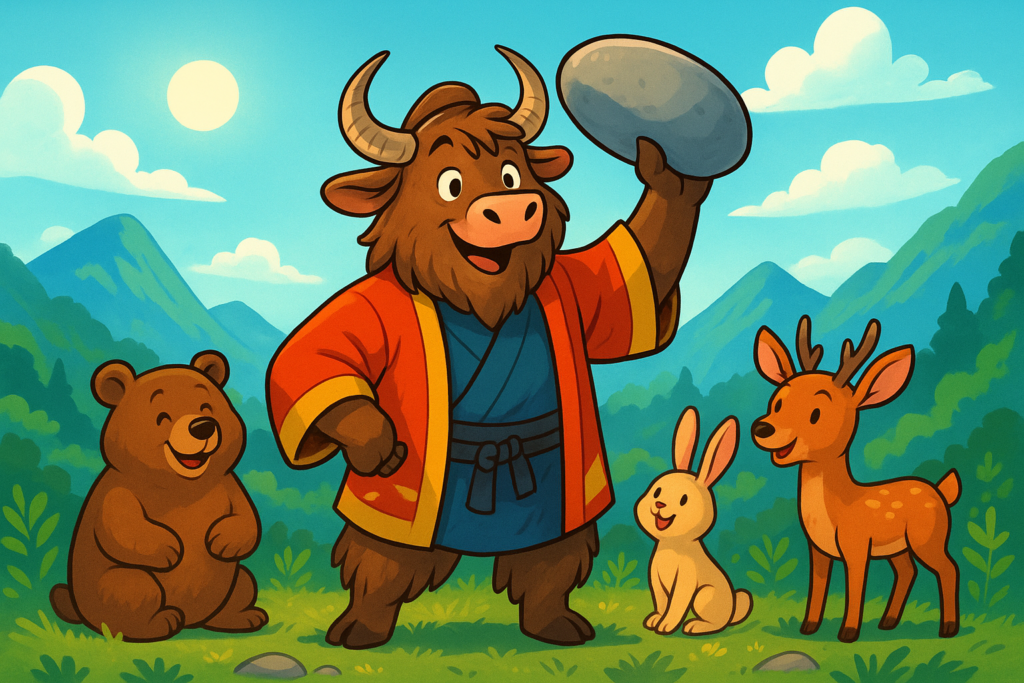
Meet Kintarō, the legendary golden boy of Japanese folklore: a rosy-cheeked child raised in the mountains who wrestles bears, befriends woodland animals, and grows up to become a great warrior. In this beginner-friendly retelling, you'll follow the golden boy from his forest childhood to the moment his strength and kindness are put to the test.
This is an A1 beginner graded reader (CEFR) – real Japanese kept short, simple, and repeated just enough to stick. Every sentence uses basic vocabulary and easy grammar, so even if you're brand new to Japanese, you can read a whole story from start to finish.
Tap any word for instant help, listen along with the story audio, and check the lesson notes at the end for a few key phrases like mountain, bear, and strong. Everything is free – no sign-up, no paywall, just a golden little story waiting for you.
むかしむかし、 なかに、男の 子が いました。
名前は きんたろう です。きんたろうは の 服を いました。
きんたろうは とても つよい でした。山の どうぶつは みんな、きんたろうが すきでした。
きんたろうは 、もりで あそびました。くまと を しました。
「いち、に、の、さん!」
くまは おおきくて、つよい でした。でも、きんたろうは !
うさぎと さると さるも、きんたろうの でした。みんなで もりを 。
ある日、うさぎが いいました。「きんたろう、みて! おおきい さかな!」
きんたろうは かわの さかなを 。さかなは おおきかった です。でも、きんたろうは つよかった です。
きんたろうは こどもでした。ちいさい どうぶつを 。
「?」と きんたろうは いいました。
「、きんたろう!」と どうぶつたちは いいました。
きんたろうは 、山で ねました。ほしが でした。
そして、きんたろうは おおきく なりました。つよくて、やさしい おとこのひとに なりました。
もりと どうぶつたちは、 きんたろうが すきでした。
Long ago, in the mountains, there lived a boy.
His name was Kintaro. Kintaro wore golden clothes.
Kintaro was very strong. All the mountain animals loved him.
Kintaro played in the forest every day. He wrestled with a bear.
"One, two, three!"
The bear was big and strong. But Kintaro won!
A rabbit and monkeys were also Kintaro's friends. They walked through the forest together.
One day, the rabbit said, "Kintaro, look! A big fish!"
Kintaro grabbed the fish from the river. The fish was huge. But Kintaro was strong.
Kintaro was a kind child. He helped small animals.
"Are you okay?" Kintaro asked.
"Thank you, Kintaro!" said the animals.
Every night, Kintaro slept in the mountains. The stars were beautiful.
And Kintaro grew up. He became a strong and kind man.
The forest and the animals loved Kintaro forever.
Kintarō's story happens in the mountains and the forest, so it's full of nature words you'll meet again and again. These are great first words to learn because they describe things you can picture instantly.
- 山 (yama) - mountain
- もり (mori) - forest
- かわ (kawa) - river
- どうぶつ (dōbutsu) - animals
Kintarō's friends are the bear (くま, kuma), the rabbit (うさぎ, usagi), and the monkey (さる, saru). Try saying them out loud - they're short, bouncy words that stick easily.
When you read 「うさぎと さると さるも」, remember that と means "and" when joining things: くまと うさぎ = "a bear and a rabbit."
- くま (kuma) - bear
- うさぎ (usagi) - rabbit
- さる (saru) - monkey
- ~と ~ - A and B
The story repeats a few key adjectives: おおきい (ōkii, big), ちいさい (chiisai, small), つよい (tsuyoi, strong), and きれい (kirei, pretty). Notice the pattern: ~は つよい でした means "~ was strong."
For people and animals, use が すきでした: どうぶつは きんたろうが すきでした - "the animals liked Kintarō."
- くまは つよい でした。- The bear was strong.
- さかなは おおきかった です。- The fish was big.
- きんたろうは やさしかった です。- Kintarō was kind.
Well done! You've just walked through a classic Japanese tale full of simple past-tense sentences. Re-reading the story aloud once or twice will help the patterns settle in.
Next time, try spotting all the ~ました endings - they mark completed actions like あそびました (played) and あるきました (walked). You already know more than you think!
- Re-read the story and say the animal names out loud.
- Try making one new sentence: ~は おおきい でした。
Kintarō: The Golden Boy comes from the Japanese / folk tale tradition and is best known as a folk hero tale. This Yak Yacker article is an original learner retelling based on Traditional Japanese folk hero tale; public domain, so the wording here is simplified for modern learners rather than copied from one old edition.
Older printings, translations, and retellings of this story can vary quite a bit. The original audience was usually kids, but this version is adapted for A1 Beginner learners studying Japanese. Good mountains/animals/strength vocabulary.
If you want to look into the source tradition, start with Wikipedia.
If you want to keep going, browse more in our Japanese section and review the Geography Vocabulary in Japanese. After that, try Essential Japanese Phrases for another useful next step.