This A2 Elementary retelling of Die goldene Gans keeps the plot clear for learners while still giving the story some atmosphere and momentum. Es war einmal ein junger Mann. Er hieß Hans und war der jüngste von drei Brüdern.
This version teaches German through English and includes clickable word help inside the story, full story audio, and lesson notes after the reading. It is free to use on Yak Yacker and is designed to feel natural, readable, and manageable for learners.
Es war einmal ein junger Mann. Er hieß Hans und war der jüngste von drei Brüdern. Seine Brüder nannten ihn immer "Dummling". Eines Tages ging Hans in den Wald. Er traf einen alten, grauen Mann. Der alte Mann bat: "Bitte, gib mir etwas zu essen." Hans teilte sein Brot und seinen Käse mit ihm.
Der alte Mann lächelte. "Du hast ein gutes Herz. den alten Baum dort drüben. Im Inneren findest du etwas Besonderes." Hans fällte den Baum. Im saß eine Gans mit . Hans nahm die goldene Gans und ging weiter.
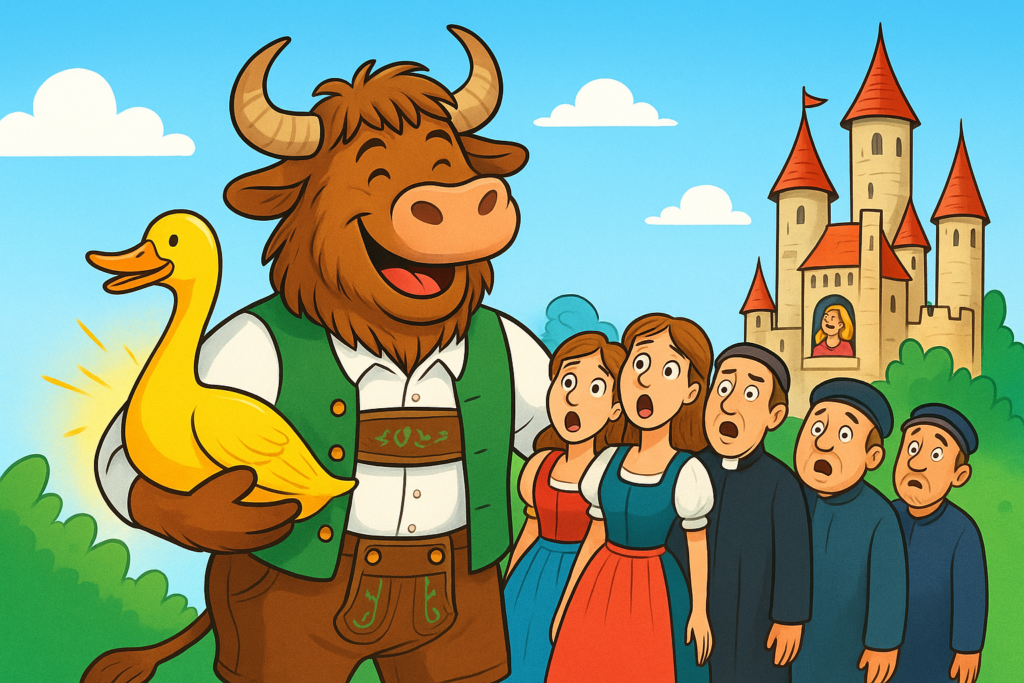
Am Abend kam Hans zu einem . Der Wirt hatte drei Töchter. Die Töchter sahen die goldene Gans und dachten: "Ich will eine goldene Feder!" Die älteste Tochter die Gans an. Sofort ihre Hand fest. Die zweite Tochter versuchte zu helfen und ihre Schwester – auch sie klebte fest. Die dritte Tochter rief: "Was ist los?" und zog an der zweiten – plötzlich klebten alle drei an der Gans.
Hans merkte nichts. Er ging weiter. Die drei Mädchen mussten hinter ihm herlaufen. Auf der Straße sah ein Pfarrer das . "Was macht ihr da?" rief er. Er packte die Hand der letzten Tochter und – zack! – klebte auch er fest. Dann kam der Küster und rief: "Halt!" und berührte den Pfarrer. Auch er blieb kleben.
So sammelte Hans immer mehr Leute hinter sich. Alle klebten an der Gans. Es war eine . "Wir kleben wie die !" rief einer. Ein anderer lachte: "Aber wir haben keine Federn!"
In der Hauptstadt lebte ein König. Er hatte eine schöne Tochter, die Prinzessin Isabella. Sie lachte nie. Der König verkündete: "Wer meine Tochter zum Lachen bringt, bekommt sie zur Frau und das halbe Königreich dazu."
Hans zog mit seiner goldenen Gans und den vielen Leuten durch das . Die Prinzessin schaute aus dem Fenster. Sie sah die von Menschen, die alle an einer Gans klebten. Sie sah den Pfarrer, den Küster, die drei Mädchen – und Hans, der fröhlich . Da musste sie lachen. Sie lachte und lachte.
Der König war . Hans und Isabella noch am selben Tag. Alle Leute im Königreich mit. Und die goldene Gans? Die bekam einen Ehrenplatz im Schlosshof. Und sie lebten glücklich bis ans Ende.
Once there was a young man named Hans, the youngest of three brothers, whom his brothers called 'Dummy'. One day in the forest, he met an old gray man who asked for food, and Hans shared his bread and cheese.
The old man smiled, praised Hans's good heart, and told him to cut down an old tree for a special find. Inside the stump, Hans found a golden goose and carried it away.
That evening at an inn, the innkeeper's three daughters tried to take golden feathers from the goose. The eldest got her hand stuck, the second stuck trying to help, and the third pulled on them and got stuck too.
Unaware, Hans walked on as the girls trailed behind. A pastor grabbed one and stuck, then a sexton tried to intervene and also got glued to the goose.
Hans unwittingly gathered a growing, comical parade of people stuck to the goose, joking they were like flies but without feathers.
In the capital, a king had a princess who never laughed, so he offered her hand and half his kingdom to anyone who could make her laugh.
Hans entered the castle with his entourage. Seeing the ridiculous procession, the princess burst out laughing.
The delighted king married Hans to Isabella, they celebrated, the goose got honored, and they lived happily ever after.
This classic story brings a handful of charming words and phrases that are worth keeping. Many of them are concrete nouns and simple actions, perfect for A2 learners.
Let’s look at a few that appear more than once or play a special role in the tale.
- die Gans, die Gänse – goose, geese (notice the umlaut in the plural)
- die Feder, die Federn – feather, feathers
- golden – golden (a nice adjective: eine goldene Feder)
- kleben – to stick. The story builds a whole comical chain around this verb!
- der Pfarrer, der Küster – the pastor, the sexton (church roles you might meet in old tales)
The story is told in the simple past tense (Präteritum), which is common in written narratives. Some verbs are regular and easy to spot, while others are irregular and need a bit of attention.
Here are a few you saw – try to find them in the text and notice the pattern.
- Regelmäßige Verben: teilen → teilte, lächeln → lächelte, fällen → fällte
- Unregelmäßige Verben: sein → war, gehen → ging, bitten → bat, sehen → sah, rufen → rief, kleben → klebte (regular here, but many irregular verbs appear!)
- Tip: The simple past of 'kleben' is regular, but the story plays with it so much that it feels like an irregular hero!
When you want to tell a story yourself, little words like 'dann', 'plötzlich', and 'sofort' help you move the action forward smoothly. This story uses them to keep the chain of sticky events clear.
Collect these connectors and try them out when you retell a simple story.
- Eines Tages – one day (classic fairy-tale opening after 'Es war einmal')
- Dann – then (simple and frequent)
- Plötzlich – suddenly (for a surprise)
- Sofort – immediately (quick reaction)
- Am Ende – in the end (to wrap up)
Now that you have a few tools, why not try telling a short version yourself? You can start from 'Es war einmal ein junger Mann…' and pick just three or four events.
Use the simple past forms you spotted and drop in a couple of sequence words. Don’t worry about mistakes – Hans wouldn’t mind, and neither does the golden goose.
- Say it out loud or write it down – both help the new words stick.
- If you get stuck, just imagine the goose waddling along and the line of people behind it. Laughter is the best language glue!
Die goldene Gans comes from an older public-domain story tradition and is best known as a public_domain_fairy_tale_retelling. This Yak Yacker article is an original learner retelling based on public-domain source material, so the wording here is simplified for modern learners rather than copied from one old edition.
Older printings, translations, and retellings of this story can vary quite a bit. This version is adapted for A2 Elementary learners studying German.
If you want to keep going, browse more in our German section and review the Goethe A1 German Vocabulary. After that, try German Comparative and Superlative Forms for another useful next step.