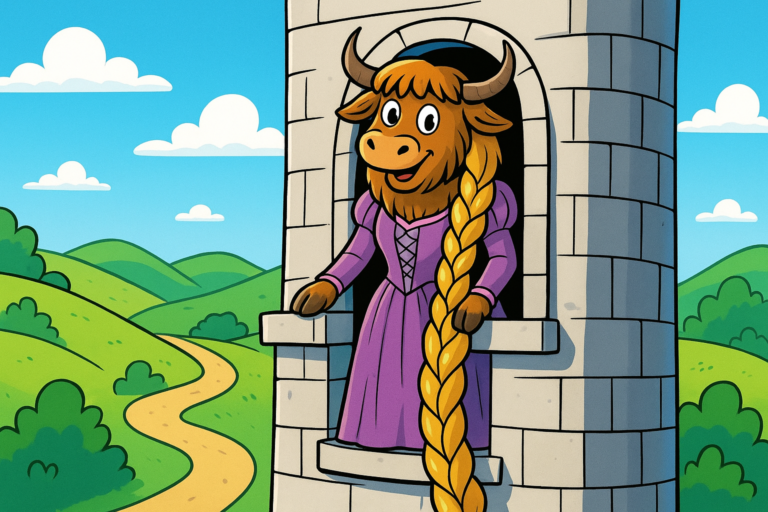
Step into the quirky world of Heinrich Hoffmann's classic German cautionary tale, Struwwelpeter, where we meet Shock-Headed Peter-a boy so unwilling to groom himself that his hair becomes a tangled nest and his nails grow long and grimy. Despite pleas from those around him, Peter refuses to change his ways, leading to a comical yet telling lesson about the importance of self-care.
In this free interactive reader for A1 German beginners, you'll enjoy a simplified retelling of the story, complete with story audio to help you master pronunciation. As you read, you can tap on tricky words for instant help, and when you finish, check out the lesson notes for a quick grammar and vocabulary boost.
Das ist Peter. Peter hat sehr lange Haare und lange Fingernägel.
Seine Haare sind und . Er sie nie. Er seine Hände nicht.
Seine Mutter sagt: "Peter, bitte deine Haare!"
Peter sagt: "Nein, ich habe !"
Die Kinder : "Schau, der !" Peter ist .
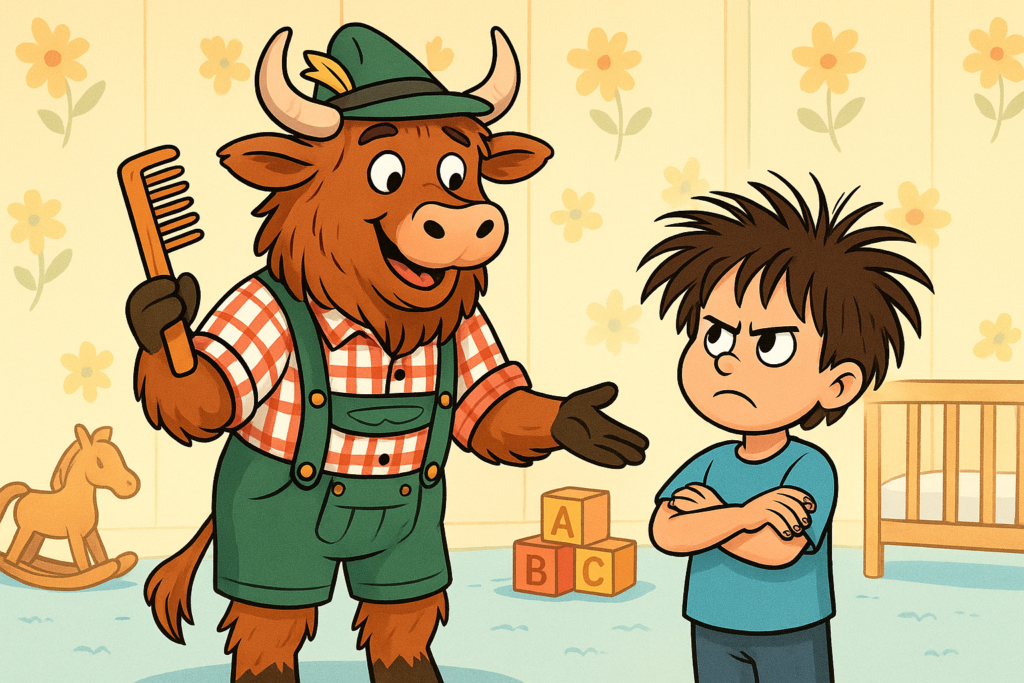
Peter . Er nimmt einen und seine Haare.
Jetzt ist Peter . Die Kinder . Peter .
That is Peter. Peter has very long hair and long fingernails.
His hair is dirty and messy. He never combs it. He doesn't wash his hands.
His mother says, "Peter, please comb your hair!"
Peter says, "No, I don't feel like it!"
The children laugh: "Look, Struwwelpeter!" Peter is sad.
Peter thinks about it. He takes a comb and combs his hair.
Now Peter is clean. The children smile. Peter is happy.
Let's pick out some key vocabulary from the story. These words will help you talk about grooming and appearance in German.
- die Haare – hair
- der Kamm – comb
- kämmen – to comb
- schmutzig – dirty / sauber – clean
- sich freuen – to be happy
The story shows two handy grammar points: telling someone to do something (the imperative) and refusing with 'kein'.
To form an informal command, take the 'du' form of the verb and drop the '-st'. So 'du kämmst' becomes 'kämm!' – comb! Peter's mom says 'kämm deine Haare!' For negation, use 'kein' before nouns to mean 'no' or 'not a'. Peter says 'ich habe keine Lust!' – I have no desire!
- Imperative: (du form) - st = command (kämm!, wasch!)
- Negation with kein: keine Lust, kein Problem, keine Haare
Now you can describe your own grooming habits! Try saying: 'Ich kämme meine Haare jeden Tag.' (I comb my hair every day.) Or ask a friend: 'Kämmst du deine Haare?' (Do you comb your hair?)
Struwwelpeter is a classic German children's book that has been loved for generations. Knowing these words connects you to a fun piece of German culture.
- Use 'jeden Tag' (every day) to talk about routines.
- Practice opposites: schmutzig vs. sauber, lang vs. kurz.
You’ve learned useful vocabulary and grammar from a charming story. Practice by making your own sentences about staying clean and tidy. Can you describe Peter's look in German?
- Re-read the story and point to objects as you say their names.
- Tell a friend about Shock-Headed Peter in simple German.
- Look for other short stories in German to build your skills.
Struwwelpeter: Shock-Headed Peter comes from an older public-domain story tradition and is best known as a public_domain_story_retelling. This Yak Yacker article is an original learner retelling based on public-domain source material, so the wording here is simplified for modern learners rather than copied from one old edition.
Older printings, translations, and retellings of this story can vary quite a bit. This version is adapted for A1 Beginner learners studying German.
If you want to keep going, browse more in our German section and review the A1 German Vocabulary List. After that, try Essential German Grammar Words for another useful next step.