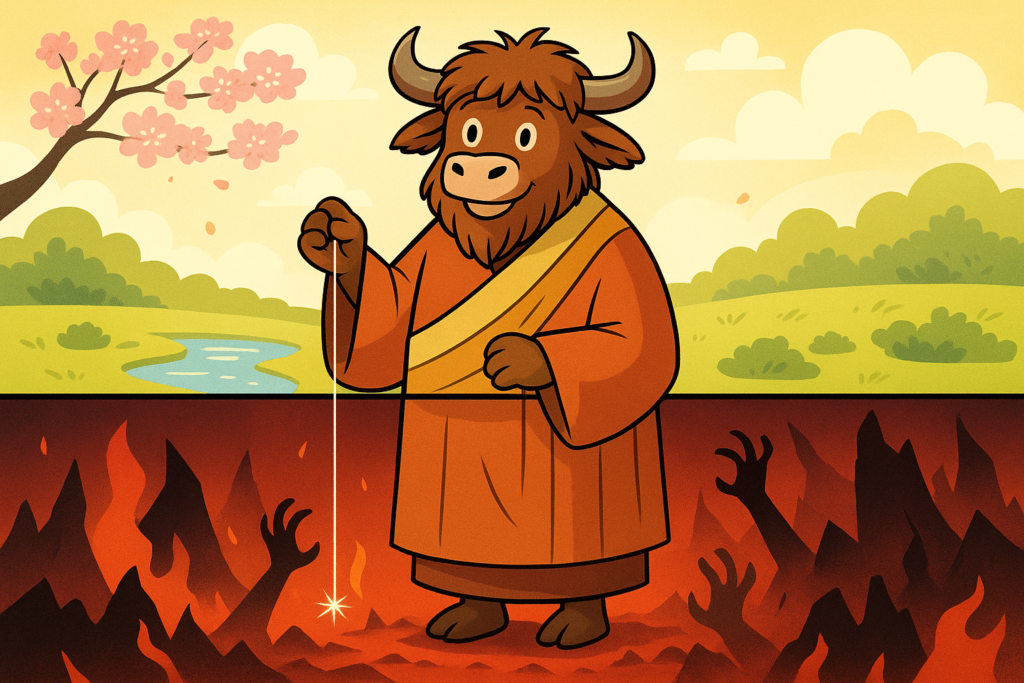
This A2 Elementary retelling of 蜘蛛の糸 keeps the plot clear for learners while still giving the story some atmosphere and momentum.
This version teaches Japanese through English and includes clickable word help inside the story, full story audio, and lesson notes after the reading. It is free to use on Yak Yacker and is designed to feel natural, readable, and manageable for learners.
ある日、地獄にカンダタという男がいました。カンダタは悪いことをたくさんしました。だから地獄に落ちました。地獄はとても暗くて、怖い場所でした。
天国で、お釈迦様が庭を歩いていました。小さな蜘蛛を見ました。「この蜘蛛の命をカンダタは」とお釈迦様が。カンダタは一度だけ良いことをしたのです。
お釈迦様は言いました。「カンダタにをあげましょう。」お釈迦様は蜘蛛の糸を。そして、その糸を地獄へ。
カンダタは暗い地獄で、上から糸を見ました。「あれは何だ?」とカンダタが言いました。カンダタはその糸を。「強い糸だ!かもしれない!」とカンダタが叫びました。
カンダタは糸を。のぼって、のぼって、のぼっていきました。しばらくすると、下からが聞こえました。も糸をのぼっていました。
カンダタは急に。「この糸は。大勢の人がのぼったら、!」とカンダタが大声で言いました。「おい、みんな!この糸は俺のものだ!!!」と叫びました。
その瞬間、蜘蛛の糸が。カンダタはに地獄へ落ちていきました。天国で、お釈迦様は見ていました。
One day, in hell, there was a man named Kandata. Kandata had done many bad things. So he fell into hell. Hell was a very dark and scary place.
In heaven, the Buddha was walking in the garden. He saw a small spider. He remembered, "Kandata saved this spider's life." Kandata had done a good deed just once.
The Buddha said, "Let's give Kandata a chance." He took a spider thread and lowered it down to hell.
In the dark hell, Kandata saw a shining thread from above. "What is that?" he said. He grabbed the thread and shouted, "It's strong! I might be able to climb it!"
Kandata started climbing the thread. He kept climbing and climbing. After a while, he heard voices from below. Other sinners were also climbing the thread.
Kandata suddenly got scared. He shouted, "This thread is thin. If many people climb, it will break! Hey, everyone! This thread is mine! Don't climb! Get off!"
At that moment, the spider thread snapped. Kandata fell headlong back into hell. In heaven, the Buddha watched sadly.
These words appear in the story and are useful for everyday Japanese. Pay attention to the kanji and readings.
- 地獄 (じごく) - hell
- 天国 (てんごく) - heaven
- 蜘蛛 (くも) - spider
- 糸 (いと) - thread
かもしれない is a useful expression to say "might" or "maybe." It attaches to the plain form of verbs, adjectives, and nouns. In the story, Kandata says "のぼれるかもしれない," meaning "I might be able to climb." (のぼれる is the potential form of のぼる.)
- Verb: 行く → 行くかもしれない (might go)
- i-adjective: 高い → 高いかもしれない (might be expensive)
- na-adjective: 静か → 静かかもしれない (might be quiet)
- Noun: 先生 → 先生かもしれない (might be a teacher)
Japanese often uses ~と言いました to quote what someone said or thought. The pattern is: 「quoted words」 + と + verb of saying/thinking (e.g., 言いました, 叫びました, 思いました). The story has many examples, such as 「強い糸だ!」と叫びました.
- 「おはよう」と言いました。 (He said "Good morning.")
- 「行きたい」と思いました。 (I thought "I want to go.")
- 「危ない!」と叫びました。 (He shouted "Dangerous!")
- The quoted part often uses casual style.
Now that you've read the story and learned some key patterns, try retelling it in your own words. Use the vocabulary and grammar you've practiced. You can also listen to the audio or read the original classic, "Kumo no Ito" by Ryunosuke Akutagawa, to see a more detailed version.
蜘蛛の糸 comes from the Japanese / Akutagawa tradition and is best known as a literary short story. This Yak Yacker article is an original learner retelling based on Ryūnosuke Akutagawa, 1918; public domain in Japan/U.S. source basis, so the wording here is simplified for modern learners rather than copied from one old edition.
Older printings, translations, and retellings of this story can vary quite a bit. The original audience was usually general/older kids, but this version is adapted for A2 Elementary learners studying Japanese. Buddhist hell imagery; older kids/adults.
If you want to look into the source tradition, start with Wikisource.
If you want to keep going, browse more in our Japanese section and review the Geography Vocabulary in Japanese. After that, try JLPT N4 Japanese Grammar for another useful next step.