


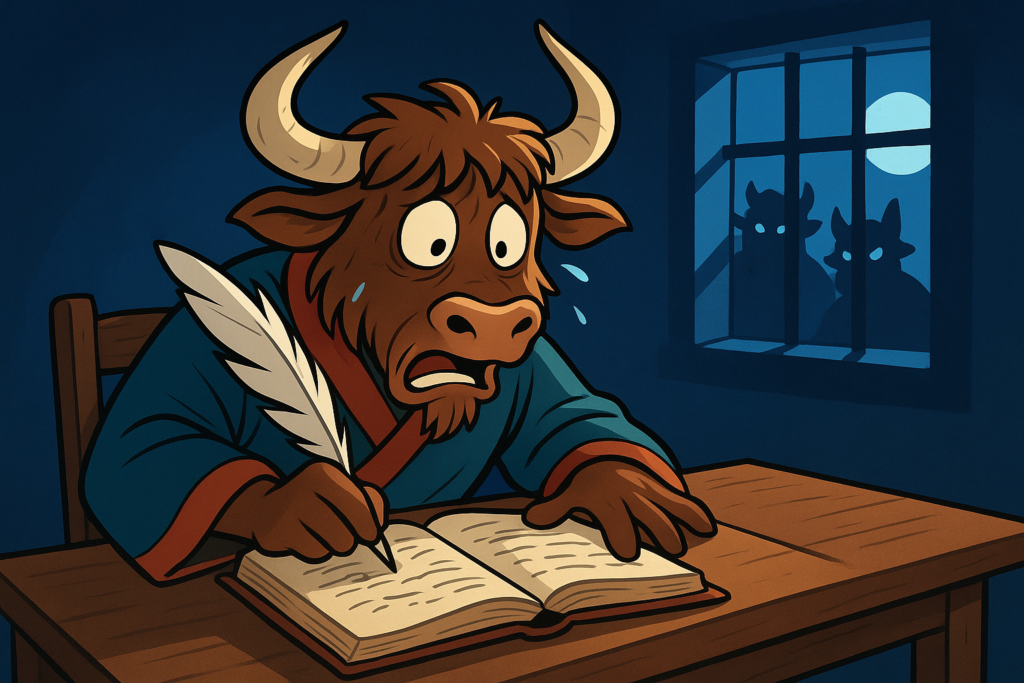
Welcome to this interactive reading of Lu Xun's famous short story, "A Madman's Diary." In this retelling, you'll step into the mind of a villager who becomes convinced that everyone around him is a cannibal. As his paranoia grows, his diary entries reveal a chilling satire of old Chinese society. This graded reader is crafted for intermediate learners (B1), so you can enjoy the story in accessible Simplified Chinese while expanding your vocabulary naturally.
Click any word you don't know for instant definitions and pronunciation help. Listen to the full story audio to practice your listening skills and perfect your accent. Plus, our lesson notes guide you through key grammar points and cultural insights, making this a complete learning package. The story is free to read, and no account is needed-just dive in and start reading!
今天晚上,。
。为什么人们都看着我?他们的眼神好像在说…… "。"
。邻居家的狗一直叫,。
昨天,我的哥哥带了一位医生来看我。医生我的脉,:"你需要休息。" 可是,我觉得他的眼睛很冷。
"哥哥," 我小声说,"你我吗?我觉得有人在。"
哥哥笑了,。"你太累了,。"
今天早晨,我看到我的日记。我发现每一页都写着""两个字!
我。我也吃过人吗?我想起小时候,可能吃过妹妹的肉……
不,我不相信!我要。我历史书,可是书里写的都是"仁义道德"。但,我看到两个字–"吃人"!
我决定去找赵先生。他是镇上最有名的人。我问他:"赵先生,你?"
赵先生的,没有说话。旁边的孩子们笑了起来。
我明白了:这个世界!,但他们自己不知道。
也许,我才是唯一。但没有人相信我。
"……" 我最后写道。我不想让孩子们也成为。
The moonlight is beautiful tonight.
I feel very strange. Why are people staring at me? Their eyes seem to say... 'I want to eat you.'
I dare not go outside. The neighbor's dog keeps barking, as if it wants to bite me.
Yesterday, my brother brought a doctor to see me. The doctor felt my pulse and said, 'You need rest.' But I felt his eyes were very cold.
'Brother,' I whispered, 'do you believe me? I feel someone is trying to harm me.'
My brother laughed, but it was an ugly laugh. 'You're too tired, don't let your mind wander.'
This morning, I saw my diary. I found that every page had the two words 'eat people' written on it!
I was extremely frightened. Could it be that I have also eaten people? I remembered when I was little, I might have eaten my sister's flesh...
No, I don't believe it! I need to find evidence. I opened a history book, but it was all filled with 'benevolence, righteousness, morality.' But between the lines, I saw two words-'eat people'!
I decided to go see Mr. Zhao. He is the most famous person in town. I asked him, 'Mr. Zhao, have you ever eaten people?'
Mr. Zhao's face turned pale, and he said nothing. The children nearby started laughing.
I understood: this world is crazy! Everyone is eating people, but they don't know it themselves.
Perhaps, I am the only lucid person. But no one believes me.
'Save the children...' I wrote at last. I don't want the children to become people who eat others.
The diary entries are drenched in fear, doubt, and dark curiosity. Understanding the precise shades of these emotions helps you see inside the narrator's mind-and enriches your own expressive range.
Here are the standout feeling-words and accusation-words from the story, complete with examples from the text and everyday usage.
- 害怕 (hàipà) - afraid, scared: "我害怕极了" (I was terrified).
- 奇怪 (qíguài) - strange: "我觉得很奇怪" (I find it very strange).
- 眼神 (yǎnshén) - gaze, look in the eyes: "他们的眼神好像在说..." (their eyes seemed to say...).
- 相信 (xiāngxìn) - to believe: "你相信我吗?" (Do you believe me?).
Paranoia lives in uncertainty, and Chinese has a wonderful palette of words to express doubt without stating a fact. Notice how the madman uses them to build his frightening theories.
These modifiers soften declarations, ask rhetorical questions, and create atmosphere. Mastering them lets you speculate, wonder, and plant suspicion like a native.
- 好像 (hǎoxiàng) - seems like, as if: "他们的眼神好像在说..." (their eyes seemed to say...).
- 也许 (yěxǔ) - perhaps, maybe: "也许,我才是唯一清醒的人。" (Perhaps I am the only one awake.).
- 可能 (kěnéng) - possible, maybe: "可能吃过妹妹的肉" (possibly ate my little sister's flesh).
- 难道 (nándào) - could it be that: "难道我也吃过人吗?" (Could it be that I, too, have eaten people?).
The climax unfolds when the madman examines a history book. On the surface, it's full of '仁义道德' (rén yì dào dé)-Confucian benevolence, righteousness, and virtue. But between the lines, he reads '吃人' (chī rén)-cannibalism.
Lu Xun plays with double meanings. 吃人 literally means 'eat people', but metaphorically it refers to a society that consumes individuals. The phrase '字缝里' (zì fèng lǐ) means 'in the cracks between the characters' - a poetic way to say 'reading between the lines' or 'seeing the hidden truth'.
- 仁义道德 (rén yì dào dé) - traditional Confucian virtues; often invoked to mask selfishness.
- 吃人 (chī rén) - cannibalism; metaphor for oppressive social systems.
- 字缝 (zì fèng) - the literal 'cracks between characters'; a metaphor for hidden meanings.
You've just read a condensed version of Lu Xun's most famous short story. Try writing a few diary sentences of your own using today's words: describe a moment when you felt suspicious or uncertain. Use at least one '好像' and one '也许'.
To dive deeper, explore the full story '狂人日记' (Kuángrén Rìjì)-it's short but powerful. You'll find it in bilingual editions or online, and it will stretch your reading in a rewarding way. Lu Xun's other stories like '阿Q正传' are also unforgettable.
A Madman's Diary comes from the Chinese / Lu Xun tradition and is best known as a modern short story. This Yak Yacker article is an original learner retelling based on Lu Xun, 1918; likely public domain in U.S./China, but check edition, so the wording here is simplified for modern learners rather than copied from one old edition.
Older printings, translations, and retellings of this story can vary quite a bit. The original audience was usually adult, but this version is adapted for B1 Intermediate learners studying Simplified Chinese. Adult satire/mental distress; avoid modern translations.
If you want to look into the source tradition, start with Wikisource.
If you want to keep going, browse more in our Simplified Chinese section and review the HSK Level 1 Chinese Vocabulary. After that, try How to Ask Questions in Chinese for another useful next step.