English Phrases: The Beginner-Friendly Guide To Sound Natural
Learn the phrases people actually use—plus meanings, real examples, and quick practice.
If you can say the right phrases, you can communicate even with simple grammar. This page is your “phrase toolbox” for beginner to intermediate American English—clear meanings, real sentences, and the stuff you’ll use today (not in a dusty textbook from 1997).
New here? You can always climb back to the main guide at /learn-english. And yes, this is YakYacker, where a yak tries to make English less dramatic.
Your Learn English Map
These pages link together, so you always know what to study next:
How To Learn Phrases Without Memorizing Like A Robot
- Pick a situation (coffee shop, class, work, travel).
- Learn 5–8 phrases for that situation (not 50 at once).
- Swap one word to make new sentences: “Could you repeat that?” → “Could you explain that?”
- Steal the rhythm: say the phrase out loud 3 times with the same stress.
- Use it today. If you don’t use it, your brain throws it out like old leftovers.
If you want a guided path, the big plan lives at /learn-english—this page is your phrase toolkit.
Quick “Sound Natural” Cards
How’s It Going?
Meaning: A friendly “How are you?” (casual).
Example: “Hey! How’s it going?”
Could You…?
Meaning: A polite request.
Example: “Could you speak a little slower?”
Do You Mind If…?
Meaning: Asking permission (polite).
Example: “Do you mind if I sit here?”
I’m Just Looking.
Meaning: “I don’t need help right now.” (stores)
Example: “Thanks—I’m just looking.”
That Works For Me.
Meaning: “I agree with that plan.”
Example: “Tuesday at 3? That works for me.”
Let Me Think.
Meaning: “Give me a moment to decide.”
Example: “Let me think… okay, yes.”
Most Useful English Phrases By Situation
Want deeper phrase lists for specific topics? These hub posts are great companions: Useful English Greetings, Basic English Words And Phrases, and the Conversational English Guide.
Greetings And Goodbyes
| Phrase | Meaning | Example |
|---|---|---|
| Hello! | A standard greeting. | “Hello! Nice to meet you.” |
| Hi! | A casual greeting. | “Hi! How are you?” |
| Good morning. | Greeting before noon. | “Good morning, Ms. Lee.” |
| Good afternoon. | Greeting after noon. | “Good afternoon—do you have a minute?” |
| Good evening. | Greeting in the evening (often after 5–6pm). | “Good evening! Welcome in.” |
| How are you? | Asking how someone is. | “How are you? I’m doing well.” |
| How’s it going? | Casual “How are you?” | “How’s it going? Everything okay?” |
| Nice to meet you. | Polite first-meeting phrase. | “Nice to meet you. I’m Alex.” |
| See you later. | Goodbye (casual). | “See you later! Take care.” |
| Take care. | Friendly goodbye. | “Take care—text me when you get home.” |
| Have a good one. | Casual “have a good day.” | “Thanks! Have a good one.” |
| Good night. | Goodbye at bedtime/evening. | “Good night! Sleep well.” |
More greeting deep-dives: How To Say Hello In English, How Are You In English, Good Afternoon In English, Good Night In English, and Goodbye In English.
Introductions And Basic Info
| Phrase | Meaning | Example |
|---|---|---|
| My name is… | Introducing your name (neutral). | “My name is Priya.” |
| I’m… | Short intro (casual). | “I’m Diego. Nice to meet you.” |
| I’m from… | Saying your hometown/country. | “I’m from Taiwan.” |
| Where are you from? | Asking someone’s origin. | “Where are you from?” |
| What do you do? | Asking someone’s job. | “What do you do? I’m a designer.” |
| I work as a… | Stating your job. | “I work as a teacher.” |
| This is my friend… | Introducing another person. | “This is my friend, Sam.” |
| Nice to see you again. | Greeting someone you’ve met. | “Nice to see you again! How have you been?” |
| It’s been a while. | You haven’t met recently. | “It’s been a while—how’s everything?” |
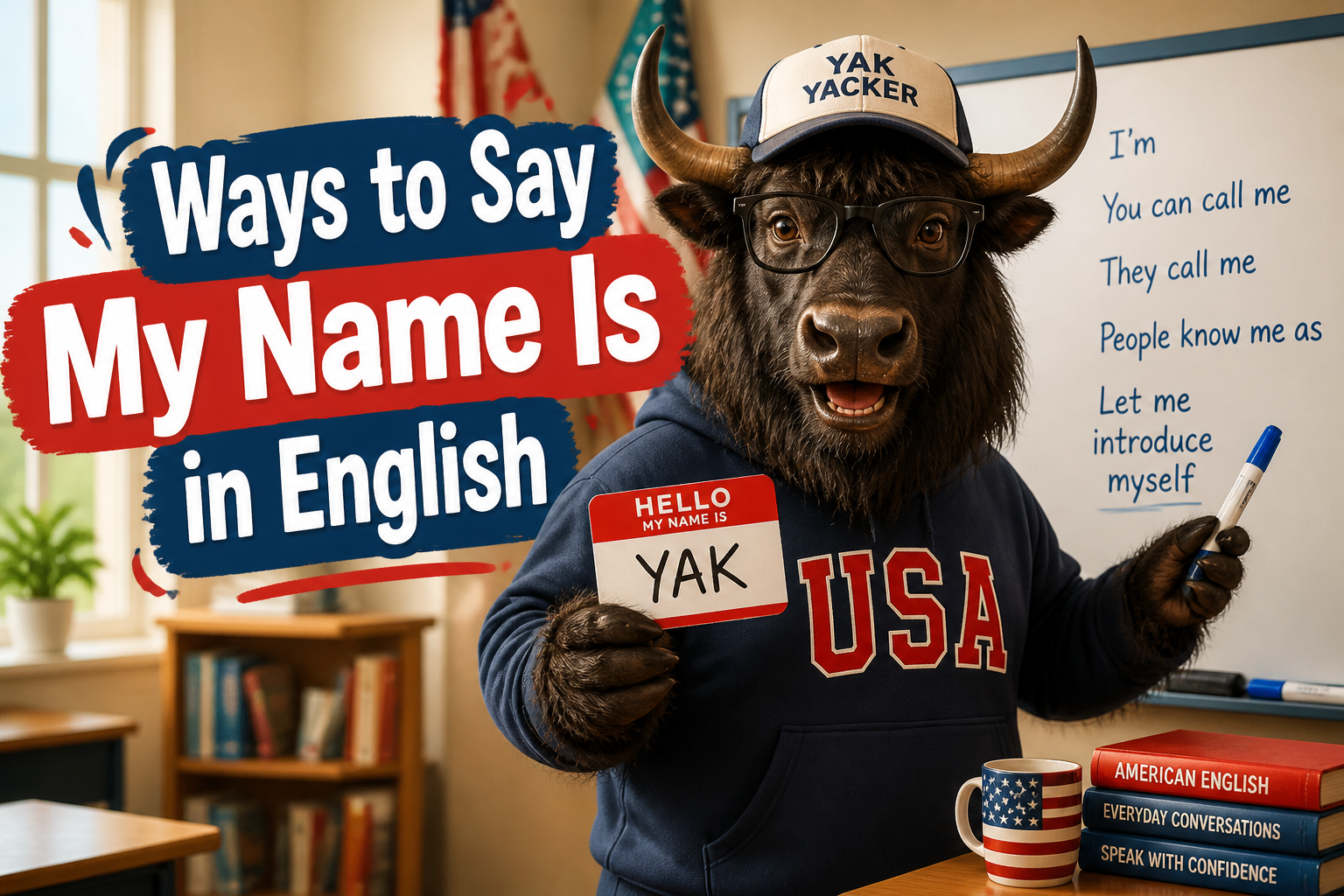
| Let me introduce myself. | More formal self-intro. | “Let me introduce myself. I’m the new intern.” |
Practice intros here: How To Introduce Yourself In English, My Name Is In English, and Where Are You From In English.
Small Talk And Keeping The Conversation Going
| Phrase | Meaning | Example |
|---|---|---|
| How’s your day going? | Friendly small talk question. | “How’s your day going so far?” |
| What have you been up to? | Asking what someone has been doing. | “What have you been up to lately?” |
| That’s interesting. | Showing you’re listening. | “That’s interesting—tell me more.” |
| No way! | Surprised reaction (casual). | “No way! That happened to you?” |
| Really? | Checking/confirming. | “Really? How did it go?” |
| I know what you mean. | Showing you understand. | “I know what you mean—Mondays are tough.” |
| Same here. | Agreeing you feel the same. | “I’m tired.” “Same here.” |
| By the way, … | Changing topic gently. | “By the way, did you get my message?” |
| Speaking of…, … | Connecting to a new topic. | “Speaking of movies, have you seen the new one?” |
| What do you think? | Asking for an opinion. | “What do you think we should do next?” |
| I’m not sure. | You don’t know / unsure. | “I’m not sure—let me check.” |
| Let’s catch up. | Suggest meeting to talk. | “Let’s catch up this weekend.” |
Want a simple plan for this skill? Try How To Make Small Talk In English.
Questions, Clarifying, And Buying Time
| Phrase | Meaning | Example |
|---|---|---|
| What does ___ mean? | Asking for a definition. | “What does ‘refund’ mean?” |
| How do you spell that? | Asking for spelling. | “How do you spell your last name?” |
| Can you repeat that? | Asking someone to say it again. | “Sorry—can you repeat that?” |
| Could you say that again? | Politer repeat request. | “Could you say that again, please?” |
| Could you speak more slowly? | Asking for slower speech. | “Could you speak more slowly? Thanks.” |
| What do you mean? | Asking for clarification. | “What do you mean by ‘next quarter’?” |
| So you’re saying… | Checking understanding. | “So you’re saying the meeting is canceled?” |
| Let me make sure I understand. | Polite clarity check. | “Let me make sure I understand: we start at 9?” |
| Give me a second. | Short pause request. | “Give me a second—I’m looking for it.” |
| Let me think. | Buying time to decide. | “Let me think… okay, yes.” |
| I don’t know. | You don’t have the answer. | “I don’t know, but I can find out.” |
| It depends. | The answer changes by situation. | “It depends on the price.” |
If you want more question patterns, see Basic Questions In English and I Don’t Know In English.
Polite Phrases That Make Life Easier
Requests And Permission
| Phrase | Meaning | Example |
|---|---|---|
| Could you help me? | Polite request for help. | “Could you help me with this form?” |
| Can you help me? | Request (slightly more casual). | “Can you help me find this?” |
| Would you mind helping me? | Very polite request. | “Would you mind helping me for a minute?” |
| Could you please…? | Polite request with “please.” | “Could you please email me the file?” |
| Do you mind if I…? | Asking permission. | “Do you mind if I open the window?” |
| Is it okay if I…? | Asking permission (friendly). | “Is it okay if I sit here?” |
| May I…? | Formal permission request. | “May I ask a question?” |
| Could I get…? | Polite ordering/requesting (common in the US). | “Could I get a small coffee?” |
| I’d like… | Polite want/request. | “I’d like a table for two.” |
| That would be great. | Polite positive response. | “If you can send it today, that would be great.” |
| Thanks in advance. | Polite thanks before action. | “Thanks in advance for your help.” |
| I appreciate it. | Stronger “thank you.” | “I appreciate it—seriously.” |
More polite power moves: How To Ask For Help Politely In English and Thank You In English.
Apologies And Fixing Mistakes
| Phrase | Meaning | Example |
|---|---|---|
| I’m sorry. | Basic apology. | “I’m sorry I’m late.” |
| Sorry about that. | Quick apology (small mistakes). | “Oops—sorry about that.” |
| My bad. | Casual “my mistake.” | “My bad—I sent the wrong link.” |
| That’s my mistake. | Clear, responsible apology. | “That’s my mistake. I’ll fix it.” |
| No worries. | “It’s okay.” (casual) | “No worries—thanks for telling me.” |
| It’s all good. | “It’s fine.” (casual) | “It’s all good. Don’t stress.” |
| Excuse me. | Polite attention / small apology. | “Excuse me—could I get by?” |
| Pardon me. | More formal “excuse me.” | “Pardon me—did you say 15 or 50?” |
Need more “sorry” options? Go here: How To Say Sorry In English.
Agreeing, Disagreeing, And Setting Boundaries
| Phrase | Meaning | Example |
|---|---|---|
| I agree. | Direct agreement. | “I agree. That’s the best option.” |
| Exactly. | Strong agreement. | “Exactly! That’s what I meant.” |
| That makes sense. | You understand/agree. | “That makes sense—let’s do it.” |
| That works for me. | You accept the plan. | “Friday at 10? That works for me.” |
| I’m not sure about that. | Soft disagreement. | “I’m not sure about that—can we check?” |
| I see it differently. | Polite disagreement. | “I see it differently, but I get your point.” |
| I get what you’re saying, but… | Respectful disagreement. | “I get what you’re saying, but I think we need more time.” |
| Let’s compromise. | Find a middle option. | “Let’s compromise: we’ll start at 9:30.” |
| I’d rather not. | Polite refusal. | “I’d rather not share that.” |
| I’m not available. | Clear boundary (neutral). | “I’m not available this weekend.” |
| Maybe another time. | Soft “no” / postpone. | “Maybe another time—this week is busy.” |
| Let me get back to you. | Delay decision politely. | “Let me get back to you tomorrow.” |
Want polite disagreement scripts? Try How To Disagree Politely In English.
Travel And Daily Life Phrases
Restaurant And Coffee Shop
| Phrase | Meaning | Example |
|---|---|---|
| A table for two, please. | Requesting a table. | “Hi—table for two, please.” |
| Could I get…? | Ordering politely (common US). | “Could I get the chicken sandwich?” |
| I’ll have… | Ordering (neutral). | “I’ll have a latte, please.” |
| Can I have…? | Ordering (common everywhere). | “Can I have the check, please?” |
| What do you recommend? | Asking for a suggestion. | “What do you recommend here?” |
| No onions, please. | Making a simple request. | “No onions, please—thank you.” |
| Could I get this to go? | Takeout request. | “Could I get this to go?” |
| Could we split the bill? | Separate checks/payment. | “Could we split the bill?” |
| Can I get the check, please? | Asking to pay. | “Can I get the check, please?” |
| Keep the change. | You don’t want change back. | “Keep the change—thanks.” |
More real ordering language: How To Order At A Restaurant In English and How To Order Coffee Drinks In English.
Directions And Emergencies
| Phrase | Meaning | Example |
|---|---|---|
| Where is the bathroom? | Asking for the restroom. | “Excuse me—where is the bathroom?” |
| Where’s the nearest ___? | Finding a place close by. | “Where’s the nearest pharmacy?” |
| How do I get to ___? | Asking directions. | “How do I get to the train station?” |
| Is it far? | Asking distance. | “Is it far from here?” |
| Turn left / turn right. | Giving directions. | “Turn left at the next light.” |
| Go straight. | Continue forward. | “Go straight for two blocks.” |
| I’m lost. | You can’t find your way. | “I’m lost—can you help me?” |
| I need help. | Emergency/urgent request. | “I need help. Please call someone.” |
| Can you call 911? | Emergency call in the US. | “Can you call 911? It’s an emergency.” |
| I don’t feel well. | Health issue. | “I don’t feel well—I need to sit down.” |
Bathroom survival language: Where Is The Toilet In English.
Work, School, And Professional Phrases
| Phrase | Meaning | Example |
|---|---|---|
| Could you clarify that? | Ask for clearer explanation. | “Could you clarify that last point?” |
| Just to confirm… | Double-check details. | “Just to confirm, the deadline is Friday?” |
| Here’s a quick update. | Short progress message. | “Here’s a quick update: we finished step one.” |
| I’ll follow up. | Contact again later with info. | “I’ll follow up tomorrow with the details.” |
| Could you send that in an email? | Request written info. | “Could you send that in an email so I don’t miss anything?” |
| Let’s schedule a call. | Plan a phone meeting. | “Let’s schedule a call for Monday.” |
| Does that work for you? | Check if time/plan is okay. | “2 PM—does that work for you?” |
| Thanks for your time. | Polite closing. | “Thanks for your time—talk soon.” |
| I’m looking forward to it. | Positive anticipation (formal-ish). | “I’m looking forward to working with you.” |
| Let’s touch base. | Meet/talk briefly later. | “Let’s touch base next week.” |
If your life includes emails and phone calls, these are gold: How To Write An Email In English and How To Speak Professionally On The Phone. For business vocabulary, see Business English Terms And Phrases.
Common Idioms, Slang, And “Native Stuff” (Use Carefully)
Idioms and slang are fun… and also a fast way to sound confusing if you use them too early. Learn them, recognize them, then use them slowly.
| Phrase | Meaning | Example |
|---|---|---|
| What’s up? | Casual greeting (“How’s it going?”). | “What’s up? Long time no see.” |
| I’m down. | I’m willing / I agree (casual). | “Pizza tonight?” “I’m down.” |
| No big deal. | It’s not a problem. | “No big deal—I can redo it.” |
| It’s on me. | I will pay. | “Dinner’s on me tonight.” |
| That’s awesome. | That’s great. | “You got the job? That’s awesome!” |
| I’m beat. | I’m very tired (casual). | “I’m beat—I’m going to bed.” |
| Cut it out. | Stop doing that (casual). | “Cut it out—you’re distracting me.” |
| My bad. | My mistake (casual). | “My bad—I forgot.” |
| Hang on. | Wait a moment (casual). | “Hang on—I’m coming.” |
| You’re kidding! | I’m surprised / I don’t believe it. | “You’re kidding! That’s wild.” |
Go deeper when you’re ready: Everyday English Idioms, English Slang, Work Idioms In English, and Party Idioms. For super common verb phrases, see Most Common Phrasal Verbs and Common Collocations.
American Vs British English Notes (Quick And Useful)
- Ordering: In American English, “Could I get a coffee?” is very common. In British English, you might hear “Can I have a coffee?” more often.
- “Cheers”: In the UK (and other places), “Cheers” can mean “thanks.” In the US, it’s less common (people might use it jokingly or in certain friend groups).
- Bathroom words: In the US, “bathroom” or “restroom” is standard. “Toilet” is understood, but can sound a bit blunt in polite situations.
Practice: Use These Phrases Today
Mini Drills (Fast And Effective)
- Drill 1 (Polite Request): Replace the verb: “Could you help me?” → “Could you repeat that?” → “Could you explain that?”
- Drill 2 (Agree Softly): Replace the phrase: “I agree.” → “That makes sense.” → “That works for me.”
- Drill 3 (Buy Time): Choose one: “Give me a second.” / “Let me think.” / “Let me get back to you.”
Two Real-Life Role Plays
Role Play A (Coffee): Use 3 phrases from “Restaurant And Coffee Shop.”
Say it: “Hi. Could I get a small iced coffee? No sugar, please. Can I get the check… actually, to go, please.”
Role Play B (Work): Use 3 phrases from “Professional Phrases.”
Say it: “Just to confirm, the deadline is Friday, right? Could you clarify the last step? I’ll follow up with an email.”
Common Mistakes And Quick Fixes
- Mixing up “Do you mind…?” — If you ask “Do you mind if I sit here?” a “No” usually means “No, I don’t mind” (so it’s okay).
Fix: If you’re unsure, ask: “Is it okay if I sit here?” - Overusing slang — “I’m down” is casual. Not great in formal situations.
Fix: Use “That works for me” or “Sure.” - Too direct at work — “Send it now” can sound bossy.
Fix: Use “Could you send it today?” or “When you have a moment, could you…?” - Forgetting the softener — “Repeat” alone can sound harsh.
Fix: Add “Sorry” + “please”: “Sorry, could you repeat that, please?”
Quick Reference: Polite Vs Casual
| Situation | Casual | Polite / Neutral | More Formal |
|---|---|---|---|
| Ask for help | “Can you help me?” | “Could you help me?” | “Would you mind helping me?” |
| Ask to repeat | “Huh?” / “What?” | “Sorry, can you repeat that?” | “Could you please repeat that?” |
| Disagree | “Nah.” | “I’m not sure about that.” | “I see it differently.” |
| Say no | “Nope.” | “I’d rather not.” | “I’m not available.” |
| Close conversation | “Gotta go.” | “I should get going.” | “Thanks for your time.” |
Phrases Deep Dives (Hub Links)
If you want focused phrase lists by topic, these are great next clicks (pick one, don’t binge-click like it’s snacks):
- Thank You In English and How To Say Sorry In English
- How To Order At A Restaurant In English and How To Order Coffee Drinks In English
- Where Is The Toilet In English (because travel is real life)
- How To Make Small Talk In English
- How To Write An Email In English and How To Speak Professionally On The Phone
- Everyday English Idioms and English Slang
FAQ: Quick Answers
How many phrases should I learn per week?
For beginners, aim for 20–30 phrases per week—but only if you use them. If you don’t use them, cut it to 10 and practice more.
Should I learn phrases or grammar first?
Both—but phrases give you fast speaking power. Grammar helps you build more sentences later. If you’re overwhelmed, start with phrases here, then visit Grammar when you’re ready.
Do I need idioms to sound fluent?
Nope. You need clarity and confidence first. Idioms are “extra flavor,” not the meal.
Final Yak: Learn phrases for one situation, use them today, and repeat tomorrow. Fluency loves boring consistency.
If you want a simple next step, go to Vocabulary (more words to plug into these phrases) or Grammar (to build longer sentences). And whenever you need the big map again, it’s at /learn-english.