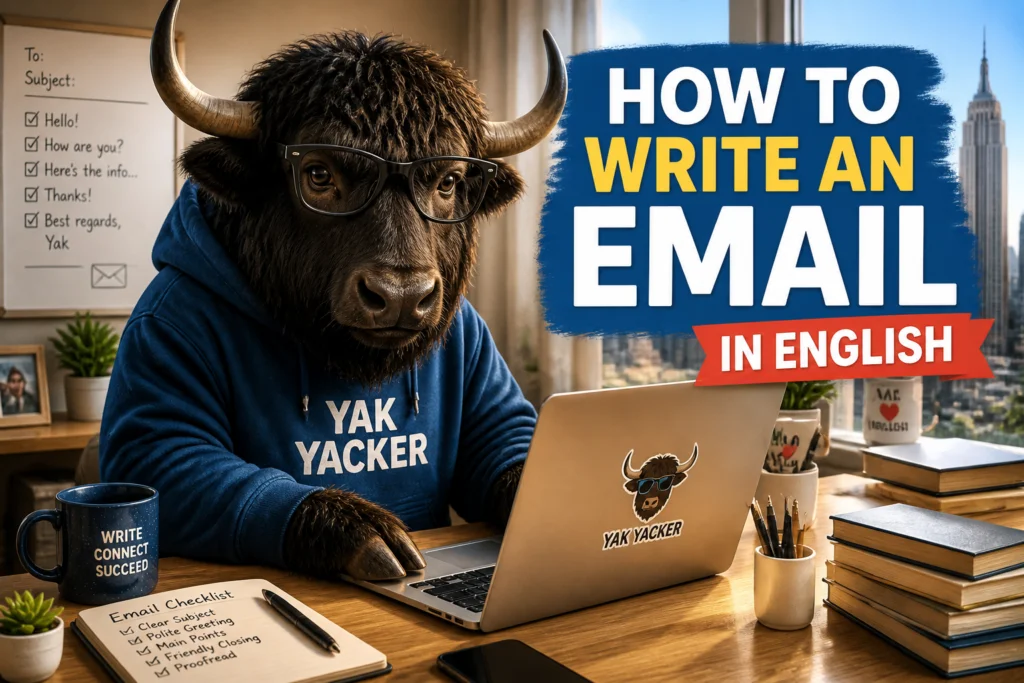
How To Write An Email In English: A Complete Guide for clear, polite, and natural messages that do not sound like they were assembled by a tired robot at 2:00 a.m.
Writing email in English is one of those skills that looks simple until you actually have to do it. Then suddenly you are staring at the screen wondering whether Hi John sounds friendly or suspicious, and whether Dear Sir makes you sound formal or like a museum plaque.
The good news: most emails in English follow the same basic pattern. Once you know the structure, the tone, and a few useful phrases, you can write emails for work, school, travel, customer service, and everyday life with much less stress.
By the end of this guide, you will know how to write a clear subject line, choose the right greeting, explain your purpose, make requests politely, and close your email naturally.
If you want to keep building your English skills after this, you can also explore the Yak Yacker English learning hub.
The Basic Email Structure
Most English emails use this simple order:
- Subject line
- Greeting
- Opening line
- Main message
- Request or next step
- Closing line
- Sign-off
You do not need fancy language. You need clear language. That is the whole trick. Emails are not poetry, and thankfully nobody expects them to be.
| Part | What It Does | Example |
|---|---|---|
| Subject line | Shows the main topic | Meeting rescheduled for Friday |
| Greeting | Opens the email politely | Hi Maria, |
| Opening line | Gives friendly context | I hope you’re doing well. |
| Main message | Explains why you are writing | I’m writing about the report deadline. |
| Request | Asks for help, action, or information | Could you please send the file by Thursday? |
| Closing line | Ends politely | Thanks for your help. |
| Sign-off | Finishes the email | Best, |
Useful Email Phrases You Can Use Right Away
Below are common phrases for real-life emails. These are the workhorses. Not glamorous, but very useful.
| English | Pronunciation | Meaning | Example Sentence | Learner Note |
|---|---|---|---|---|
| I hope you’re doing well. | eye hohp yoor DOO-ing wel | A polite, friendly opening | I hope you’re doing well. I’m writing to ask about the schedule. | Very common in business and neutral emails. |
| I’m writing to… | aim RY-ting too | I am emailing for this reason | I’m writing to confirm our meeting tomorrow. | Clear and professional. |
| Thank you for your email. | thangk yoo for yor EE-mail | Polite opening after receiving a message | Thank you for your email. I’ll reply with the details below. | Good for replies and business emails. |
| Just a quick note to… | juhst uh kwik noht too | A short, simple message | Just a quick note to say the meeting is now at 3 p.m. | Friendly and efficient. |
| Could you please…? | kood yoo pleez | Polite request | Could you please send me the invoice? | Safer than “Send me the invoice.” Oof. |
| Would it be possible to…? | wud it bee POS-uh-bul too | Very polite request | Would it be possible to move the appointment to Monday? | Use with strangers, customers, or formal situations. |
| Please let me know. | pleez let mee no | Ask for a response | Please let me know if you need anything else. | Common in polite business English. |
| Looking forward to your reply. | LOOK-ing FOR-werd too yor ri-PLY | You expect a response happily | Looking forward to your reply. | Friendly and professional. |
| Thank you for your help. | thangk yoo for yor help | Express gratitude | Thank you for your help with this matter. | Useful in requests and customer service emails. |
| Best regards, | best ri-GAHRDZ | Polite sign-off | Best regards, Anna | Formal and safe. |
| Best, | best | Short, friendly sign-off | Best, Chris | Neutral and very common in modern email. |
| Kind regards, | kynd ri-GAHRDZ | Polite sign-off | Kind regards, Dr. Lee | Slightly more formal than Best. |
| Regards, | ri-GAHRDZ | Formal sign-off | Regards, Michael | Common in work emails, a bit direct. |
| Thanks, | thangks | Friendly sign-off | Thanks, Sara | Good for casual or work emails. |
How To Choose The Right Greeting
The greeting is the first line of your email. It sets the tone immediately. In English, tone matters a lot. A tiny choice can make you sound warm, cold, formal, or slightly like a form letter from the void.
| Greeting | When To Use It | Example | Learner Note |
|---|---|---|---|
| Hi James, | Friendly, neutral, common | Hi James, thanks for your message. | Great for most modern emails. |
| Hello Priya, | Neutral and polite | Hello Priya, I’m writing to follow up. | Slightly more formal than Hi. |
| Dear Mr. Smith, | Formal, respectful | Dear Mr. Smith, I am contacting you about the interview. | Use with names and titles in formal email. |
| Dear Ms. Garcia, | Formal, respectful | Dear Ms. Garcia, please find the document attached. | Ms. is safe when you do not know marital status. |
| Dear Hiring Manager, | Formal when you do not know the person’s name | Dear Hiring Manager, I am applying for the position. | Very useful for job applications. |
| To Whom It May Concern, | Very formal, old-fashioned, or when no name is available | To Whom It May Concern, I am requesting a copy of my records. | Still used, but often less personal. |
American vs. British note: both varieties use Hi and Hello very often. In British English, some business emails can sound a little more formal, but modern email style is pretty similar in both varieties.
How To Write The Opening Line
The opening line usually does one of three things: it thanks the reader, gives context, or creates a friendly tone. Keep it short.
- Thank you for your email. Use this when replying.
- I hope you’re doing well. Use this for a polite, warm opening.
- I’m writing to follow up on… Use this when continuing a previous conversation.
- I wanted to ask about… Use this when making a simple inquiry.
- It was nice meeting you yesterday. Use this after meeting someone in person.
Example:
I hope you’re doing well. I’m writing to ask about the status of my application.
That opening is simple, polite, and easy to understand. No drama. No fancy perfume. Just useful English.
How To Explain Your Reason Clearly
After the greeting, say why you are writing. In English, direct communication is usually appreciated, especially in work and customer service emails.
| Pattern | Meaning | Example | Learner Note |
|---|---|---|---|
| I’m writing to + verb | State your purpose | I’m writing to ask for an update. | Very common and clean. |
| I’m writing regarding + noun | About a topic | I’m writing regarding the payment issue. | Slightly formal. |
| I’m contacting you about + noun | About a topic | I’m contacting you about my reservation. | Useful in customer service or business. |
| Just to let you know… | Share information | Just to let you know, the class starts at 9:30. | Friendly and casual. |
| I wanted to let you know that… | Polite information | I wanted to let you know that the file is attached. | Very natural in everyday email. |
Rule: one email, one main purpose. If you need to ask five unrelated things, your reader may start blinking slowly and wondering what happened to the subject line.
How To Make A Polite Request
Requests in English often use modal verbs like could and would. These make your message sound polite, not bossy.
| Pattern | Meaning | Example | Learner Note |
|---|---|---|---|
| Could you please…? | Polite request | Could you please send me the report by Friday? | Very common and safe. |
| Would you mind + -ing…? | Polite request | Would you mind checking this document? | More formal and soft. |
| Would it be possible to…? | Very polite request | Would it be possible to reschedule our meeting? | Useful for formal emails. |
| Can you…? | Direct request | Can you send the photo today? | Okay for casual emails, but less polite. |
| I would appreciate it if you could… | Polite, formal request | I would appreciate it if you could reply by noon. | Very useful in work English. |
Important learner note: Would you mind sending me… means “please send me…” It does not mean the other person should mind. English loves making polite requests sound slightly roundabout. Charming, really.
How To Give Information Without Sounding Abrupt
Sometimes you are not asking for anything. You are giving an update, explaining a delay, or sharing details. In those cases, use gentle language.
- Just a quick update: useful for short progress notes
- For your information: a neutral way to share facts
- I’d like to let you know that… polite and clear
- Please note that… useful for important details
- As discussed, … refers to a previous conversation
- Attached you will find… formal way to mention an attachment
- We have decided to… used for decisions or plans
- There has been a delay in… useful for problems or changes
Example:
Please note that the office will be closed on Monday for a holiday.
How To Close An Email Naturally
Good closings help your email feel complete. They also remind the reader what happens next.
| Closing Line | Meaning | Example | Learner Note |
|---|---|---|---|
| Thanks for your help. | Express gratitude | Thanks for your help with this. | Friendly and common. |
| I appreciate your time. | Polite thanks | I appreciate your time and attention. | Good in formal emails. |
| Let me know if you have any questions. | Invite a reply | Let me know if you have any questions about the form. | Very useful in work messages. |
| I look forward to hearing from you. | Expect a reply | I look forward to hearing from you soon. | Formal and safe. |
| Have a great day. | Friendly ending | Have a great day, and thanks again. | Casual or semi-formal. |
Tip: your closing line and sign-off should match your tone. A friendly email usually ends with Thanks or Best. A formal email usually ends with Best regards or Kind regards.
Sign-Offs: Which One Should You Use?
| Sign-Off | Style | Use It When… | Example |
|---|---|---|---|
| Best, | Neutral, modern | You want a simple ending | Best, Maria |
| Thanks, | Friendly | You thanked the person or expect help | Thanks, David |
| Best regards, | Polite, formal | You need a professional tone | Best regards, Elena |
| Kind regards, | Polite, formal | You want to sound warm but respectful | Kind regards, Ahmed |
| Sincerely, | Very formal | You are writing a formal letter or important email | Sincerely, John Carter |
In American English, Best is extremely common. In British English, Kind regards and Best regards are also very common. Both varieties understand all of these options well.
Email Examples You Can Copy
Here are short model emails for different situations. They are simple on purpose. Simple is good. Simple gets read.
2. Friendly Email To A Teacher Or Classmate
Subject: Question About Homework
Hi Sofia,
I hope you’re doing well. I’m writing to ask about the homework assignment. Could you please tell me which pages we need to complete?
Thanks for your help.
Best,
Ryan
3. Customer Service Email
Subject: Problem With My Order
Hello,
I’m writing to report a problem with my order. The item arrived damaged, and I would like to request a replacement.
Could you please let me know what I should do next?
Thank you for your help.
Kind regards,
Nina Patel
Useful Grammar For Email Writing
Emails often use a few grammar patterns more than others. If you know these, your writing becomes much smoother.
| Pattern | Meaning | Example | Learner Note |
|---|---|---|---|
| Could / Would + base verb | Polite request | Could you reply today? | Very common in email. |
| I’m writing to + verb | Purpose | I’m writing to confirm the address. | Clear and professional. |
| Please + verb | Direct request | Please send the file. | Okay, but can sound too direct without context. |
| Present simple | Facts or schedules | The office closes at 5 p.m. | Great for routines and fixed facts. |
| Present perfect | Connection to now | I have attached the document. | Common in formal email. |
| Future with will | Promise or plan | I will send the invoice tomorrow. | Useful for confirming action. |
Short, clear, and polite is usually better than long, clever, and confusing. English emails like manners more than drama.
Common Mistakes And Fixes
| Common Mistake | Better Version | Why |
|---|---|---|
| Write subject missing | Include a clear subject line | Readers know what the email is about right away. |
| Hello Sir, | Dear Sir, or Dear Mr. Smith, | Hello Sir sounds unnatural in modern English. |
| I want that you send me the file. | Could you please send me the file? | Want that is not natural English here. |
| I wait your answer. | I look forward to your reply. | Use a natural email phrase. |
| Thanks for your kindly help. | Thanks for your help. | Kindly help is awkward in this context. |
| Write very long paragraph | Use short paragraphs | Emails are easier to read when they are broken up. |
| Too casual in formal email | Use polite, professional phrases | Tone matters in work and school messages. |
| Too many exclamation marks!!! | Use one or none | Too many can sound emotional or unprofessional. |
Polite Vs Casual Email Language
English emails change depending on who you are writing to. A message to your boss is not the same as a message to your friend. Shocking, but true.
| Casual | Polite / Formal | Use When… |
|---|---|---|
| Hi Tom, | Dear Mr. Tompson, | Casual vs business or official writing |
| Can you send it? | Could you please send it? | You need a polite request |
| Thanks! | Thank you for your help. | You want a more professional tone |
| Let me know. | Please let me know at your earliest convenience. | You need a softer formal request |
| Sorry for the delay. | I apologize for the delay. | You need more formal apology language |
How To Write Better Subject Lines
A subject line should be short and specific. It should tell the reader what the email is about before they open it.
- Good: Meeting schedule for Tuesday
- Good: Question about your job posting
- Good: Invoice for March 2026
- Good: Request for vacation approval
- Good: Follow-up on interview
- Too vague: Hello
- Too vague: Important
- Too vague: Question
- Too vague: Can you help?
- Too vague: Please read
Rule: if the subject line helps the reader find the email later, it is doing its job.
Pronunciation Tips For Common Email Words
| Word | Simple Pronunciation | Meaning | Example |
|---|---|---|---|
| reply | ri-PLY | answer | Please reply by Friday. |
| regards | ri-GAHRDZ | polite ending | Kind regards, Amina |
| attach | uh-TACH | add a file | I’ve attached the document. |
| invoice | IN-voys | billed document | Please send the invoice. |
| deadline | DED-line | last time to do something | The deadline is Monday. |
| schedule | SKED-jool in American English; SHED-yool in British English | plan or timetable | Our schedule changed. |
| follow up | FAH-loh up | check again or continue | I wanted to follow up on my email. |
| confirm | kun-FIRM | make sure | Please confirm your attendance. |
For a dictionary-style check of meaning and usage, Cambridge Dictionary is a reliable place to look up words and see examples in context.
Practice: Build An Email Sentence
Try changing these sentences into more polite, natural email English.
- Send me the file. → Could you please send me the file?
- I need an answer now. → Please let me know as soon as possible.
- I ask about the meeting. → I’m writing to ask about the meeting.
- I want to know if you are free. → I wanted to ask if you are free.
- Thanks for help. → Thanks for your help.
Now try the same idea with your own situation. Write one short email in English. Keep it simple. Fancy writing is optional; clear writing is not.
Quick Email Template
Here is a simple template you can reuse:
| Part | Template |
|---|---|
| Subject | [Clear topic] |
| Greeting | Hi/Hello/Dear + name, |
| Opening | I hope you’re doing well. |
| Purpose | I’m writing to… |
| Details | Give the important information here. |
| Request | Could you please…? |
| Closing | Thanks for your help. |
| Sign-off | Best, / Kind regards, / Thanks, |
You can reuse this pattern for work, school, travel, appointments, and customer service. Once you know the skeleton, you just swap the bones. Lovely mental image, yes?
Useful Resources And Next Steps
If you want to check your English level before writing more practice emails, try the English Placement Test CEFR. If you want to review common words before writing, the English Vocabulary Test can help too.
A little progress every day beats one giant panic session before the deadline. Email English is not about sounding fancy. It is about sounding clear, polite, and human.
Yak Takeaway: A good English email has one clear purpose, a polite tone, and simple sentences. If it sounds natural, kind, and easy to follow, it is probably doing just fine.