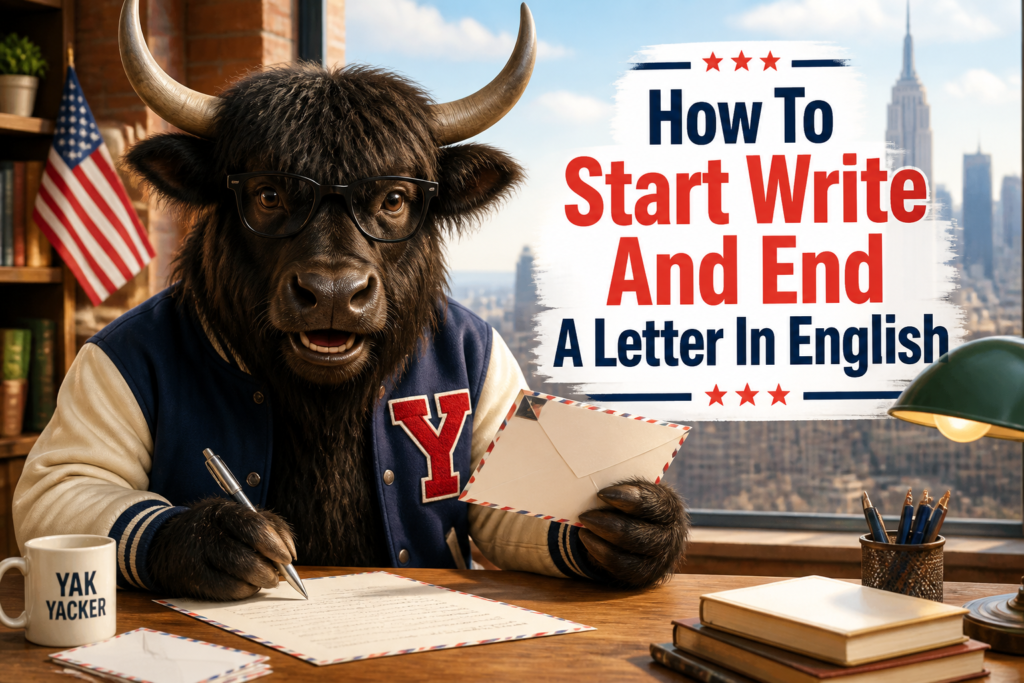
Writing a letter in English is not as mysterious as people sometimes make it sound. Good news: you do not need royal grammar, fancy vocabulary, or a dramatic fountain pen held at a weird angle. You just need the right opening, a clear body, and a polite ending.
In this guide, you will learn How To Start, Write, And End A Letter In English with simple, real-life phrases for formal letters, semi-formal letters, and friendly letters. By the end, you will know what to say when you write to a company, a teacher, a friend, or anyone else who still appreciates a well-written message.
If you want more practice after this, you can also explore the Learn English section, or test your level with the English Placement Test CEFR and the English Vocabulary Test.
Letter Writing Basics
In English, a letter usually has 4 main parts:
- Greeting — how you start the letter
- Opening — the first sentence or two
- Body — the main message
- Closing — how you end the letter
That is the whole game. Fancy formatting may change a little, but the basic logic stays the same. English letters like structure. Shocking, I know.
A good letter is clear, polite, and easy to follow. You do not need to sound “advanced.” You need to sound understood.
Useful Ways To Start A Letter
The right greeting depends on who you are writing to. A letter to your boss is not the same as a letter to your cousin. English likes social distance when needed.
| English | Pronunciation | Meaning | Example Sentence | Learner Note |
|---|---|---|---|---|
| Dear Sir or Madam | deer sur or MAD-um | Formal greeting when you do not know the person’s name | Dear Sir or Madam, I am writing to ask about your course schedule. | Very formal. Use when you do not know the name. |
| Dear Mr. Smith | deer MISTER smith | Formal greeting for a man, using his last name | Dear Mr. Smith, thank you for your email. | Use Mr. for men. Do not use a first name in formal letters unless invited. |
| Dear Ms. Johnson | deer MIZ JON-sən | Formal greeting for a woman, using her last name | Dear Ms. Johnson, I am writing to apply for the position. | Ms. is safe and neutral. It does not show marital status. |
| Dear Dr. Lee | deer DOK-ter lee | Formal greeting for someone with a doctorate or medical title | Dear Dr. Lee, I hope you are well. | Use the person’s title if you know it. |
| Dear [Name], | deer … | Standard greeting in many business and neutral letters | Dear Anna, thank you for your help. | Neutral and widely used. More direct than “Dear Mr./Ms.” when first names are appropriate. |
| Hello [Name], | HEL-oh … | Friendly but still polite greeting | Hello Maria, I hope you are doing well. | Good for email-style letters, work messages, and semi-formal writing. |
| Hi [Name], | hay … | Casual greeting | Hi Tom, how have you been? | Friendly and relaxed. Not for very formal letters. |
| To Whom It May Concern | too HOOM it may kun-SURN | Formal phrase when the reader is unknown | To Whom It May Concern, I am writing to confirm my address. | Useful, but old-fashioned and a little stiff. Use only when necessary. |
| Dear Customer Service Team | deer KUS-tuh-mer SUR-viss teem | Formal group greeting | Dear Customer Service Team, I have a question about my order. | Good for companies when you do not know one person’s name. |
| Good morning, | good MOR-ning | Polite opening for a letter or email sent early in the day | Good morning, I would like to reschedule our meeting. | More common in email than paper letters. |
| Good afternoon, | good af-ter-NOON | Polite opening for daytime messages | Good afternoon, I am writing about the appointment. | Polite and simple. |
In American English, Dear is very common in formal and semi-formal letters. In British English, it is also common. So yes, one phrase gets to travel internationally without drama.
How To Open The Letter
After the greeting, the opening sentence should quickly show why you are writing. English readers like purpose. Do not make them guess for three paragraphs like it is a treasure hunt.
| Pattern | Meaning | Example | Learner Note |
|---|---|---|---|
| I am writing to… | Very common formal opening | I am writing to ask about the job application process. | Safe, clear, and professional. |
| I am writing regarding… | Formal way to introduce the topic | I am writing regarding your recent email. | Good for business or official letters. |
| I hope you are well. | Polite, warm opening | I hope you are well. I wanted to follow up on our meeting. | Very common in modern letters and emails. |
| I hope this letter finds you well. | Formal and traditional greeting line | I hope this letter finds you well. I am contacting you about the vacancy. | Natural in formal writing, though a bit traditional. |
| Thank you for your email. | Polite reply opening | Thank you for your email. I would like to confirm the details. | Useful when responding to someone who contacted you first. |
| It was great to hear from you. | Friendly response opening | It was great to hear from you. I am glad we can stay in touch. | Warm and natural in semi-formal letters. |
| I am sorry for the delay in replying. | Apology opening | I am sorry for the delay in replying. I have been traveling. | Useful when you are late responding. |
| I hope you had a nice weekend. | Friendly small talk opening | I hope you had a nice weekend. Here is the report you asked for. | Common in friendly work letters and emails. |
Rule: open with purpose, then move on. A letter is not a mystery novel. Get to the point politely.
Useful Phrases For The Main Body
The body is where you explain your reason, give details, ask questions, or make a request. Keep your sentences clear. Shorter is often better than “professional-sounding” and confusing.
| English | Pronunciation | Meaning | Example Sentence | Learner Note |
|---|---|---|---|---|
| I am writing to ask about… | eye am RY-ting too ask uh-BOUT | Polite way to ask for information | I am writing to ask about the next available interview date. | Very useful in formal letters. |
| I would like to know… | eye wood like too no | Polite request for information | I would like to know if the class is still open. | Polite and common. |
| I am interested in… | eye am IN-truh-stid in | Shows interest in a product, course, job, or topic | I am interested in your summer program. | Good for applications and inquiries. |
| I am contacting you because… | eye am KON-tak-ting yoo bi-KAWZ | Explains the reason for the letter | I am contacting you because I have not received my package. | Useful in customer service or complaints. |
| I would appreciate your help. | eye wood uh-PREE-shee-ayt yor help | Polite way to ask for help | I would appreciate your help with this matter. | Polite and professional. |
| Could you please… | kud yoo pleez | Polite request | Could you please send me the updated schedule? | Very common in letters and emails. |
| Would it be possible to… | wood it bee POS-uh-bul too | Very polite request | Would it be possible to move the meeting to Friday? | Good for formal and respectful writing. |
| Please let me know… | pleez let mee no | Asks someone to reply with information | Please let me know if you need any further details. | Useful in many situations. |
| I look forward to hearing from you. | eye look FOR-werd too HEER-ing frum yoo | Polite sentence showing you expect a reply | I look forward to hearing from you. | Very common in formal letters. Do not write “I am looking forward to hear from you.” |
| Thank you for your time. | thank yoo fer yor time | Polite appreciation | Thank you for your time. I appreciate your help. | Good near the end or after a request. |
| Let me know if you have any questions. | let mee no if yoo hav en-ee KWES-chuns | Invites a reply or follow-up | Let me know if you have any questions. | Friendly and useful in work letters. |
| I am attaching… | eye am uh-TACH-ing | Says you included a file | I am attaching my résumé for your review. | Very useful in digital letters and email. |
How To End A Letter Politely
The ending should match the tone of the letter. Formal letters need formal closings. Friendly letters can be warmer. No one wants a serious job application to end like a text message from a cousin at 1 a.m.
| English | Pronunciation | Meaning | Example Sentence | Learner Note |
|---|---|---|---|---|
| Sincerely, | sin-SEER-lee | Very common formal closing | Sincerely, Emma Johnson | Safe for formal letters in American English. |
| Yours sincerely, | yorz sin-SEER-lee | Formal closing, more common in British English | Yours sincerely, Emma Johnson | Usually used when you know the recipient’s name. |
| Best regards, | best ri-GARDS | Polite, neutral closing | Best regards, Emma Johnson | Very common in work emails and letters. |
| Kind regards, | kynd ri-GARDS | Warm and polite closing | Kind regards, Emma Johnson | Slightly warmer than “Best regards.” |
| Regards, | ri-GARDS | Simple neutral closing | Regards, Emma Johnson | Short and common, especially in business writing. |
| Thank you, | thank yoo | Polite closing when you want to show gratitude | Thank you, Emma Johnson | Works well after asking for help or information. |
| Best, | best | Casual but still polite closing | Best, Emma | Common in modern emails and semi-formal letters. |
| Warm regards, | worm ri-GARDS | Friendly and polite closing | Warm regards, Emma Johnson | Useful when you want a friendly tone without being too casual. |
| With appreciation, | with uh-pree-shee-AY-shun | Formal closing showing thanks | With appreciation, Emma Johnson | Good for thank-you letters or requests. |
| Take care, | tayk kair | Friendly, warm closing | Take care, Maria | Better for friends, family, or familiar colleagues. |
| Love, | luv | Very close and affectionate closing | Love, Mom | Use only with people you know well. |
American vs British note: Sincerely, is common in American English. Yours sincerely, and Yours faithfully, are more common in British English, especially in more traditional formal letters. If you are unsure, Best regards, is a safe middle ground.
Common Letter Endings And Sign-Off Rules
After the closing phrase, use a comma. Then leave a line and write your name. If the letter is formal and typed, you can also leave space for a signature before your printed name.
| Pattern | Meaning | Example | Learner Note |
|---|---|---|---|
| Closing + comma + name | Standard letter ending | Best regards, Alex Chen | Most common in email and typed letters. |
| Closing + signature + name | Formal paper letter format | Sincerely, [signature] Alex Chen | Useful for official letters. |
| First name only | Casual/friendly ending | Take care, Ben | Good for friends and people you know well. |
Simple Letter Structure You Can Copy
Here is a basic structure for a formal letter. You can follow this pattern without inventing a whole new personality.
Dear Ms. Johnson,

I am writing to ask about the English course schedule.

I would like to know when the next class begins and how much it costs.
Please let me know if there are any placement requirements.

Thank you for your time.

Sincerely,
Maria Lopez
Notice the order:
- Greeting
- Opening sentence
- Main message
- Polite closing line
- Closing phrase
- Name
Friendly Letter Example
Not every letter has to sound like a government form. Friendly letters can be natural and warm.
Hi Anna,

I hope you are doing well. It was great to hear from you.

I am writing to tell you about my new job. The schedule is busy, but I am learning a lot.
Let’s plan to meet next week if you are free.

Take care,
Lena
This style is relaxed, but it still has structure. Friendly does not mean messy.
Common Phrases For Different Types Of Letters
| Situation | Useful Phrase | Example | Learner Note |
|---|---|---|---|
| Asking for information | I am writing to ask about… | I am writing to ask about your refund policy. | Direct and polite. |
| Applying for a job | I am writing to apply for… | I am writing to apply for the office assistant position. | Very common in job letters. |
| Making a complaint | I would like to report… | I would like to report a problem with my order. | Calm and professional. |
| Asking for help | Could you please help me with… | Could you please help me with my application? | Polite and useful. |
| Thanking someone | Thank you for your support. | Thank you for your support. | Good in appreciation letters. |
| Following up | I am writing to follow up on… | I am writing to follow up on our previous conversation. | Common in work and school letters. |
| Requesting a meeting | Would it be possible to meet on…? | Would it be possible to meet on Thursday afternoon? | Very polite. |
| Ending a request | I look forward to your reply. | I look forward to your reply. | Standard formal ending. |
Common Mistakes And Easy Fixes
Letter writing mistakes are usually not dramatic. They are more like tiny habits that make English sound less natural. Easy enough to fix.
- Wrong: Dear Mr. John
Better: Dear Mr. Smith
Why: Use the last name with Mr./Ms. - Wrong: I am writing for ask about the schedule.
Better: I am writing to ask about the schedule.
Why: Use to before the verb here. - Wrong: I look forward to hear from you.
Better: I look forward to hearing from you.
Why: Use the -ing form after to in this phrase. - Wrong: Thanks you for your time.
Better: Thank you for your time.
Why: The correct phrase is Thank you. - Wrong: Yours faithfully, in a letter to someone whose name you know
Better: Sincerely, or Yours sincerely,
Why: Closing choices depend on whether you know the person’s name. - Wrong: Hi Sir,
Better: Dear Sir, or Hello Mr. Smith,
Why: Hi is too casual for many formal letters.
Quick Pronunciation Help
Some letter-writing phrases are easy to say but hard to stress naturally. A little pronunciation help can save you from sounding like a robot who just discovered stationery.
| Phrase | Pronunciation Help | Tip |
|---|---|---|
| I would appreciate your help. | eye wood uh-PREE-shee-ayt yor help | Stress appreciate clearly. |
| I am writing to ask about… | eye am RY-ting too ask uh-BOUT | Link the words smoothly. Do not pause too much after writing. |
| I look forward to hearing from you. | eye look FOR-werd too HEER-ing frum yoo | Forward is stressed on the first syllable. |
| Best regards, | best ri-GARDS | Keep it short and calm. No need to over-enunciate like a speech contest. |
| Sincerely, | sin-SEER-lee | The middle syllable is strongest. |
Mini Practice
Try these quick exercises. Small practice, big payoff. Annoyingly effective, really.
- Choose the best greeting for a formal letter to a company: Hi John, Dear Sir or Madam, or Hey.
- Complete the sentence: I am writing to ____ about the job opening.
- Choose the best closing for a business letter: Love, Best regards, or See you later,
- Fix the mistake: I look forward to hear from you.
- Rewrite this more politely: Send me the information.
Answer Key
1. Dear Sir or Madam
2. ask
3. Best regards,
4. I look forward to hearing from you.
5. Could you please send me the information?
Quick Reference Summary
| Part | Useful Choices | Best For |
|---|---|---|
| Start | Dear Sir or Madam, Dear Mr. Smith, Dear Anna, Hi Anna, | Choose based on formality and relationship |
| Opening | I am writing to…, I hope you are well., Thank you for your email. | Explaining your purpose politely |
| Body | Could you please…, I would like to know…, Please let me know… | Requests, questions, details, updates |
| End | Sincerely, Best regards, Kind regards, Take care, | Match the tone of the letter |
Yak Takeaway: Start with the right greeting, say why you are writing quickly, keep the body clear, and end with a closing that matches the tone. That is how to write a letter in English without turning it into a stress test for your adjectives.