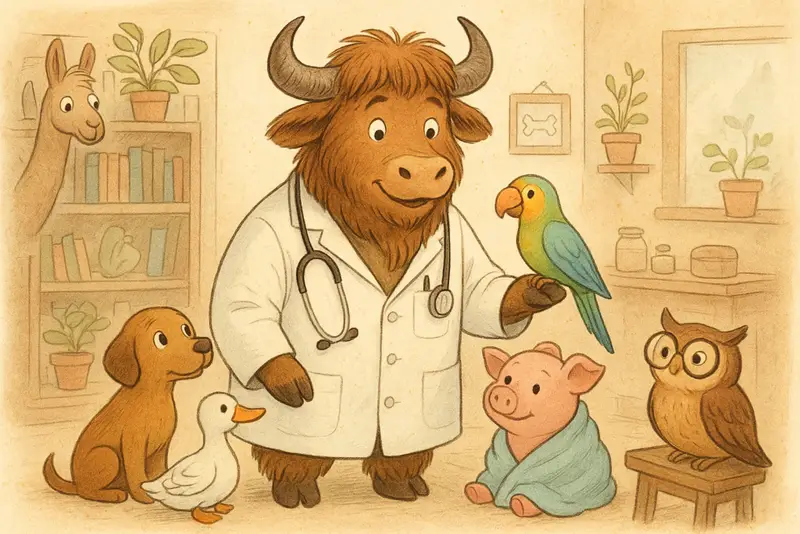
Read this story on Yak Yacker with clickable word help, full story audio, and lesson notes below the text.
This version is written for English-speaking learners who want a friendly reading experience in English.
Doctor Dolittle lived in a little town called Puddleby-on-the-Marsh. He loved animals very much. His house was full of animals-a dog, a pig, an owl, a duck, and many others. But the people in the town did not like the animals. They stopped coming to the Doctor when they were sick. So the Doctor did not have much money. But he was happy with his animal friends.
One day, his parrot said, 'You know, Doctor, I can to speak animal language.' The Doctor was very . 'You can talk?' he asked. 'Of course,' said Polynesia. 'Animals talk all the time. You just need to .' So the parrot taught him. Soon the Doctor could understand what every animal said.
After that, animals came from to see Doctor Dolittle. They said, 'Doctor, my tummy hurts!' and 'Doctor, my wing is broken!' He helped them all with kind words and . The news . One day, a swallow arrived. 'Doctor Dolittle!' she cried. 'The monkeys in Africa are very sick! Please come and help them!'
'I must go to Africa!' the Doctor said. He took his best animal friends-Jip the dog, Dab-Dab the duck, Gub-Gub the pig, and the owl Too-Too. They got on a big boat. The animals were . 'I will see real lions!' said Jip. 'And I will eat African bananas,' said Gub-Gub .
When they arrived in Africa, the monkeys were waiting. They looked sad and sick. The Doctor worked for many days. He gave the monkeys medicine and told them funny stories to make them smile. Soon the monkeys were . The king of the monkeys said, 'Thank you, Doctor! We want to give you a special present.' And they brought out a animal. It had two heads-one on each end! 'It's a pushmi-pullyu!' cried Dab-Dab.
The pushmi-pullyu was very shy. 'Hello,' said one head. 'Hello,' said the other head. The Doctor smiled. 'What a wonderful animal! But we must go home now.' On the way back, pirates stopped their boat. 'Give us your treasure!' the pirates shouted. The pushmi-pullyu looked at them with both heads. The pirates were so they fell into the water!
The animals laughed and the boat sailed away safely. After a long journey, Doctor Dolittle came home to Puddleby. Now people heard about his and came to visit. Everyone wanted to see the pushmi-pullyu. The Doctor was not poor anymore. But he never changed. He still loved animals best of all.
'Talking to animals is easy,' the Doctor often said. 'You just need to be a good .' And all the animals in his house nodded and said, 'He's right!'
Doctor Dolittle lived in a small town. He loved animals. His house had many animals: a dog, a pig, an owl, a duck, and more. But the townspeople didn't like the animals. They stopped visiting him when sick. So the Doctor became poor. But he was happy with his animal friends.
One day, his parrot Polynesia offered to teach him animal language. The Doctor was surprised and asked if she could talk. Polynesia said animals always talk; he just needed to listen carefully. She taught him, and soon he understood all animals.
Then animals from far away came to him with problems like tummy aches or broken wings. He treated them kindly. News spread fast. One day, a swallow came and said the monkeys in Africa were very sick. She asked him to help.
The Doctor decided to go to Africa. He took his animal friends: Jip the dog, Dab-Dab the duck, Gub-Gub the pig, and Too-Too the owl. They boarded a big boat. The animals were excited. Jip wanted to see lions, Gub-Gub wanted to eat African bananas.
In Africa, the monkeys were sad and sick. The Doctor treated them with medicine and funny stories. They got well. The monkey king thanked him and gave a special present: a strange animal with two heads, one at each end. Dab-Dab identified it as a pushmi-pullyu.
The pushmi-pullyu was shy, both heads saying hello. The Doctor admired it but they had to return home. On the way back, pirates demanded their treasure. The pushmi-pullyu stared with both heads, surprising the pirates so much that they fell overboard.
The animals laughed as the boat escaped safely. After a long trip, the Doctor returned home. People heard of his adventures and visited to see the pushmi-pullyu. He became rich but stayed the same, loving animals most.
The Doctor often said that talking to animals is easy if you are a good listener. All his animals agreed.
Let's look at some important words from the story. When you know these, you can talk about animals and feelings.
- Tummy (noun) - a friendly word for stomach. Example: "My tummy hurts!"
- Medicine (noun) - something you take to feel better when you are sick.
- Treasure (noun) - valuable things like gold or jewels.
- Nodded (verb) - moved the head up and down to say "yes". Example: "He nodded and smiled."
The story uses some great phrases that you can use in everyday English. Let's practice them.
- "What a + noun!" - This shows surprise or strong feeling. Example: "What a wonderful day!"
- "not ... anymore" - This means something is not true now, but it was true before. Example: "He was not poor anymore."
- "You just need to..." - This means the only thing you need to do is... Example: "You just need to listen."
- "best of all" - This means "more than any other thing". Example: "I love chocolate best of all."
Doctor Dolittle can understand animals. What do animals "say" in English? Here are some fun animal sounds.
- A dog says "woof" (or "bark").
- A duck says "quack".
- A pig says "oink".
- An owl says "hoot".
In the story, the Doctor says, "Talking to animals is easy. You just need to be a good listener." This is good advice for learning English too. Listen carefully to English sounds, songs, and stories.
- Try to listen to an English podcast or song this week.
- Remember: every time you listen, you learn something new.
Doctor Dolittle and the Talking Animals comes from an older public-domain story tradition and is best known as a public_domain_children_story_retelling. This Yak Yacker article is an original learner retelling based on public-domain source material, so the wording here is simplified for modern learners rather than copied from one old edition.
Older printings, translations, and retellings of this story can vary quite a bit. This version is adapted for A2 Elementary learners studying English.
If you want to keep going, browse more in our English section and review the A2 English Vocabulary List. After that, try 1,200 English Phrases and Expressions for another useful next step.