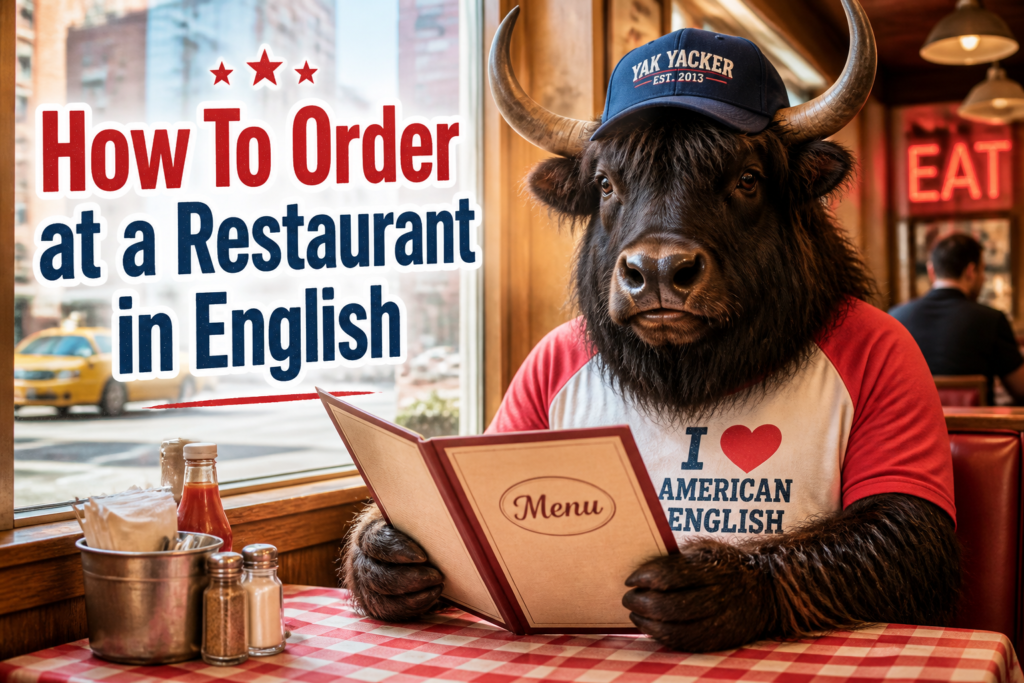
Ordering food in English should be easy. Then the waiter shows up, your brain briefly leaves the building, and suddenly “I would like…” sounds like a legal document. Relax. Real restaurant English is much simpler than people think.
For the broader learning path, visit our parent guide.
In this guide, you’ll learn the most useful phrases for ordering at a restaurant in English, from sitting down to asking for the bill. You’ll also get pronunciation help, example sentences, and a few small culture notes so you sound natural, not like you memorized a robot script.
By the end, you should be able to order politely, ask questions, and handle common restaurant moments with confidence.
Quick Restaurant English Basics
In American English, people often say “check” for the bill. In British English, “bill” is the common word. Both are normal in English, but they are not always used the same way. Small detail, big survival value.
If you want a quick vocabulary check before you start, you can also try the English vocabulary test or the English placement test CEFR.
Polite English in restaurants is usually simple English. You do not need fancy words. You just need the right words.
Useful Phrases For Ordering
Here are the most common phrases you will hear and use in a restaurant.
| English | Pronunciation | Meaning | Example Sentence | Learner Note |
|---|---|---|---|---|
| Can I see the menu? | kan eye see thuh MEN-yoo | Ask to look at the menu. | Can I see the menu, please? | Very common and polite. |
| Are you ready to order? | ahr yoo RED-ee toh OR-der | Asking if someone is ready to choose food. | Yes, we’re ready to order. | The server may say this to you. |
| I’d like… | eye-d lyke | A polite way to say what you want. | I’d like the chicken sandwich. | Very useful and natural. |
| Can I get…? | kan eye get | Casual way to ask for food or drink. | Can I get a coffee? | Common in American English. |
| May I have…? | may eye hav | Polite way to ask for something. | May I have the soup, please? | Slightly more formal. |
| I’ll have… | eye-l hav | Say what you choose. | I’ll have the pasta. | Very common at restaurants. |
| What do you recommend? | wut doo yoo rek-uh-MEND | Ask for the server’s suggestion. | What do you recommend here? | Helpful when the menu is huge. |
| What’s good here? | wuts good heer | Ask what is tasty or popular. | What’s good here today? | Casual and natural. |
| Is this spicy? | iz this SPY-see | Ask about heat or strong seasoning. | Is this dish spicy? | Very important for many learners. |
| Can I have the check/bill? | kan eye hav thuh chek / bill | Ask for the payment slip. | Can I have the check, please? | “Check” is common in U.S. English; “bill” in British English. |
| Could we get some water? | kood wee get sum WAW-ter | Ask for water politely. | Could we get some water, please? | “Could we” sounds softer than “Give us.” |
| Could I have this to go? | kood eye hav this tə go | Ask for takeaway food. | Could I have the leftovers to go? | “To go” is American English. British English often says “take away.” |
Step By Step: How To Order Politely
Most restaurant conversations follow a simple pattern. You do not need to know every word. You just need the sequence.
- 1. Greet the server. “Hi” or “Hello” is enough.
- 2. Ask for the menu if you do not have one.
- 3. Look at the menu and decide what you want.
- 4. Order food and drinks with polite phrases.
- 5. Ask questions about ingredients, spice, size, or price.
- 6. Ask for the check/bill when you are finished.
That’s it. Restaurant English is basically a short script with a few optional extras. Fancy, but not difficult.
Real-Life Ordering Sentences
| English | Pronunciation | Meaning | Example Sentence | Learner Note |
|---|---|---|---|---|
| I’m ready to order. | ahym RED-ee toh OR-der | You are ready to choose food. | Excuse me, I’m ready to order. | Very common after reading the menu. |
| We’re still deciding. | weer stil dih-SY-ding | You need more time. | Sorry, we’re still deciding. | Polite way to ask for a moment. |
| I’d like the burger, please. | eye-d lyke thuh BUR-ger | Order one item politely. | I’d like the burger, please. | “Please” makes it softer and friendlier. |
| I’ll take the salad. | eye-l tayk thuh SAL-ud | Say your choice. | I’ll take the salad and soup. | Natural and common in spoken English. |
| Can I also get fries? | kan eye AWL-soh get fryz | Ask for an extra item. | Can I also get fries with that? | Use “also” for adding something. |
| Could I substitute the rice for potatoes? | kood eye SUB-sti-toot… | Ask to replace one side dish with another. | Could I substitute fries for a side salad? | Useful, but not every restaurant allows it. |
| Do you have anything vegetarian? | doo yoo hav EN-ee-thing vej-ih-TAIR-ee-an | Ask for vegetarian food. | Do you have anything vegetarian? | Good question if the menu is unclear. |
| Is that gluten-free? | iz that GLOO-tən free | Ask about gluten. | Is the soup gluten-free? | Very important for health reasons. |
| Can I get the sauce on the side? | kan eye get thuh saws on thuh syde | Ask for sauce separately. | Can I get the dressing on the side? | Very practical in real restaurants. |
| Can we split the check? | kan wee split thuh chek | Ask to divide the bill. | Can we split the check, please? | Common in the U.S. when people share a meal. |
| Could we have another fork? | kood wee hav uh-NUTH-er fork | Ask for extra utensils. | Could we have another spoon? | Useful when something is missing. |
| Everything looks great. | EV-ree-thing looks grayt | Friendly comment while ordering. | Everything looks great here. | Nice small talk. Optional, but natural. |
Common Questions You May Hear
Servers often ask short questions. Here are some common ones so they do not sound like mysterious background noise.
- “Can I start you off with something to drink?” = What would you like to drink first?
- “What can I get for you?” = What do you want?
- “Would you like any appetizers?” = Do you want a starter before the main food?
- “How would you like that cooked?” = Do you want meat rare, medium, or well-done?
- “For here or to go?” = Do you want to eat here or take the food away?
- “Anything else?” = Do you want more food or drink?
- “How was everything?” = Was the meal good?
Tip: If you do not understand a question, just say “Sorry, could you repeat that?” or “Could you say that again, please?” That sentence saves lives. Well, maybe not lives. Definitely awkward moments.
Pronunciation Tips For Restaurant English
| Word / Phrase | Simple Pronunciation Help | Common Learner Note |
|---|---|---|
| menu | MEN-yoo | The stress is on the first syllable. |
| recommend | rek-uh-MEND | Stress the last syllable. |
| vegetarian | vej-ih-TAIR-ee-an | Four syllables. Do not rush it. |
| gluten-free | GLOO-tən free | Say it clearly; it matters for health. |
| appetizer | AP-ih-ty-zer | American English. British English often says “starter.” |
| dessert | dih-ZURT | Stress the second syllable. |
| receipt | ri-SEET | Do not pronounce the “p.” |
| check | chek | In American English, this often means the bill. |
If you want to confirm a word or pronunciation, a boring but helpful source is Cambridge Dictionary. Boring, yes. Useful, also yes.
American Vs British Restaurant Words
| American English | British English | Meaning | Example |
|---|---|---|---|
| check | bill | The payment slip | Can we have the check/bill, please? |
| appetizer | starter | Food before the main dish | I’d like an appetizer/starter first. |
| entrée | main course | The main dish | What’s the entrée/main course today? |
| to go | take away | Food you take home | Can I get this to go/take away? |
| French fries | chips | Fried potato sticks | I’ll have fries/chips with that. |
Learner note: in British English, chips means what Americans call fries. If you order “chips” in the U.S., you may get a bag of potato crisps instead. English likes to be just annoying enough to keep life interesting.
Mini Conversations You Can Use
These short dialogues are simple, natural, and very reusable.
| Situation | Conversation | Useful Pattern |
|---|---|---|
| Getting the menu | Server: Here are the menus. Guest: Thank you. | “Here are…” / “Thank you.” |
| Ordering food | Server: Are you ready to order? Guest: Yes. I’d like the chicken soup. | “I’d like…” |
| Asking for a recommendation | Guest: What do you recommend? Server: The grilled salmon is very popular. | “What do you recommend?” |
| Changing an order | Guest: Could I get the salad without onions? Server: Of course. | “Could I get… without…” |
| Asking for the check | Guest: Can I have the check, please? Server: Sure. | “Can I have the check, please?” |
Common Mistakes And Easy Fixes
- Mistake: “Give me water.”
Better: “Could I have some water, please?”
Why: The second one is polite. The first one can sound rude. - Mistake: “I want burger.”
Better: “I’d like a burger.”
Why: English usually needs an article like a here. - Mistake: “Check, please” in a British restaurant.
Better: “Bill, please.”
Why: British English uses bill more often. - Mistake: “Can I to get…”
Better: “Can I get…”
Why: Do not use to after can. - Mistake: “I am wanting…”
Better: “I’d like…” or “I want…”
Why: I’m wanting sounds unnatural in most restaurant situations. - Mistake: Speaking too fast and swallowing the order.
Better: Slow down a little and stress the main food word.
Why: Clear pronunciation matters more than perfect grammar.
Practice: Make The Sentence Sound Natural
Try changing these direct or awkward sentences into polite restaurant English.
- “Give me a coffee.” → Could I have a coffee, please?
- “I want the soup.” → I’d like the soup, please.
- “Bring water.” → Could we get some water, please?
- “I need bill.” → Can I have the bill/check, please?
- “What food good?” → What do you recommend?
Now say these out loud:
- I’d like the pasta, please.
- Can I get a tea and a glass of water?
- What do you recommend here?
- Can we split the check?
- Could I have this to go?
Pronunciation practice tip: in real speech, I’d like often sounds fast and smooth, like one chunk: “eyd-like”. That is normal. English loves to glue words together just to keep learners humble.
Quick Reference Summary
- To order politely: “I’d like…” / “I’ll have…” / “Can I get…?”
- To ask for help: “What do you recommend?” / “Is this spicy?”
- To ask for more: “Could we get some water?” / “Can I have another fork?”
- To say you need time: “We’re still deciding.”
- To pay: “Can I have the check?” in American English, or “Can I have the bill?” in British English
- To take food home: “Can I have this to go?” or “Can I have this take away?”
If you remember just three phrases, use these: “I’d like…”, “What do you recommend?”, and “Can I have the check/bill, please?” That covers a lot of restaurant life without turning dinner into an exam.
Yak takeaway: keep it polite, keep it simple, and speak clearly. Restaurant English is not about being fancy. It is about getting the food you want without accidentally ordering chaos.