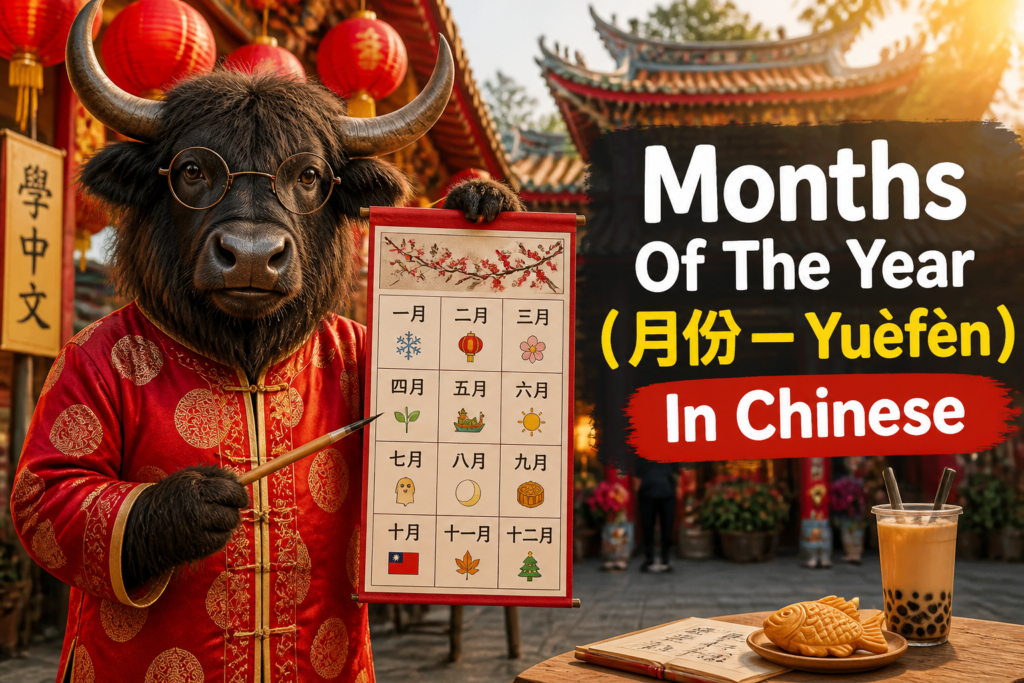
月份(yuèfèn)means “month.” Good news: Chinese months are refreshingly logical. No mysterious names, no random historical chaos, just 一月 to 十二月. Honestly, it is one of those rare moments when Mandarin behaves itself.
For the broader learning path, visit our parent guide.
If you can count to twelve, you can already say the months. That is the whole trick. In real life, you will hear these in birthdays, school schedules, travel plans, and the extremely important business of talking about deadlines that appeared out of nowhere.
By the end of this guide, you will know how to say every month in Traditional Chinese, how to use them in real sentences, and how to write dates without getting tangled up like a scooter in a night market lane.
For extra practice later, you can also compare this lesson with Days Of The Week In Traditional Chinese and Write The Date In Traditional Chinese.
The Basic Pattern
Chinese month names are built in a very neat way:
- 一月(yī yuè)= January
- 二月(èr yuè)= February
- 三月(sān yuè)= March
- …
- 十二月(shí’èr yuè)= December
Just put a number in front of 月(yuè), which means “month.” Simple. Efficient. Very little drama.
| Traditional Chinese | Pinyin | Meaning | Example (ZH) | Example (Pinyin) | Translation (EN) |
|---|---|---|---|---|---|
| 一月 | yī yuè | January | 我一月要去台北。 | Wǒ yī yuè yào qù Táiběi. | I’m going to Taipei in January. |
| 二月 | èr yuè | February | 二月的天氣常常很冷。 | Èr yuè de tiānqì chángcháng hěn lěng. | The weather in February is often very cold. |
| 三月 | sān yuè | March | 三月我們有考試。 | Sān yuè wǒmen yǒu kǎoshì. | We have exams in March. |
| 四月 | sì yuè | April | 四月很適合去旅行。 | Sì yuè hěn shìhé qù lǚxíng. | April is a good time to travel. |
| 五月 | wǔ yuè | May | 五月我想開始學中文。 | Wǔ yuè wǒ xiǎng kāishǐ xué Zhōngwén. | In May, I want to start learning Chinese. |
| 六月 | liù yuè | June | 六月畢業季很忙。 | Liù yuè bìyè jì hěn máng. | June graduation season is busy. |
| 七月 | qī yuè | July | 七月很多人去海邊。 | Qī yuè hěn duō rén qù hǎibiān. | Many people go to the beach in July. |
| 八月 | bā yuè | August | 八月有時候會下大雨。 | Bā yuè yǒu shíhou huì xià dàyǔ. | Sometimes it rains heavily in August. |
| 九月 | jiǔ yuè | September | 九月是開學的時間。 | Jiǔ yuè shì kāixué de shíjiān. | September is school-starting time. |
| 十月 | shí yuè | October | 十月的晚上比較涼。 | Shí yuè de wǎnshàng bǐjiào liáng. | October evenings are cooler. |
| 十一月 | shíyī yuè | November | 十一月我常常很想睡。 | Shíyī yuè wǒ chángcháng hěn xiǎng shuì. | In November, I often feel very sleepy. |
| 十二月 | shí’èr yuè | December | 十二月快到了。 | Shí’èr yuè kuài dàole. | December is almost here. |
Useful Month Words You Will Hear A Lot
| Traditional Chinese | Pinyin | English Meaning | Example (ZH) | Example (Pinyin) | Translation (EN) |
|---|---|---|---|---|---|
| 月份 | yuèfèn | month; monthly period of time | 你要寫幾月份? | Nǐ yào xiě jǐ yuèfèn? | Which month do you need to write? |
| 這個月 | zhège yuè | this month | 這個月我很忙。 | Zhège yuè wǒ hěn máng. | I’m very busy this month. |
| 上個月 | shàng ge yuè | last month | 上個月我去高雄了。 | Shàng ge yuè wǒ qù Gāoxióng le. | Last month I went to Kaohsiung. |
| 下個月 | xià ge yuè | next month | 下個月再告訴我。 | Xià ge yuè zài gàosù wǒ. | Tell me again next month. |
| 幾月 | jǐ yuè | which month / what month | 你幾月生日? | Nǐ jǐ yuè shēngrì? | What month is your birthday? |
| 年月 | nián yuè | year and month | 請填寫年月。 | Qǐng tiánxiě nián yuè. | Please fill in the year and month. |
Notice 幾月(jǐ yuè)is used when asking “what month?” If you want the full date, you usually ask 幾月幾號(jǐ yuè jǐ hào)or 幾月幾日(jǐ yuè jǐ rì)depending on the setting.
Real-Life Phrases For Talking About Months
| Traditional Chinese | Pinyin | Meaning | Example (ZH) | Example (Pinyin) | Translation (EN) |
|---|---|---|---|---|---|
| 在三月 | zài sān yuè | in March | 我在三月回台灣。 | Wǒ zài sān yuè huí Táiwān. | I will return to Taiwan in March. |
| 三月一號 | sān yuè yī hào | March 1st | 會議是三月一號。 | Huìyì shì sān yuè yī hào. | The meeting is on March 1st. |
| 在十二月 | zài shí’èr yuè | in December | 我們在十二月放假。 | Wǒmen zài shí’èr yuè fàngjià. | We have a break in December. |
| 每個月 | měi ge yuè | every month | 我每個月都去看家人。 | Wǒ měi ge yuè dōu qù kàn jiārén. | I visit my family every month. |
| 幾月開始 | jǐ yuè kāishǐ | starting in which month | 課程幾月開始? | Kèchéng jǐ yuè kāishǐ? | What month does the class start? |
| 月底 | yuèdǐ | end of the month | 我月底才有空。 | Wǒ yuèdǐ cái yǒu kòng. | I’m only free at the end of the month. |
How To Say The Months Naturally
There are two small pronunciation things that help a lot.
First, 一月 is usually said yī yuè. In fast speech, native speakers may smooth it out a little, but beginners should just say it clearly. No need to overthink it. Mandarin already has enough tiny traps to keep things interesting.
Second, 十一月 and 十二月 can feel a little long at first. Break them into pieces:
- 十一月(shí yī yuè)= ten + one + month
- 十二月(shí èr yuè)= ten + two + month
The same pattern works for all months, so once you know the numbers, the whole system opens up. One of Mandarin’s rare acts of generosity.
A Few Important Grammar Patterns
| Pattern | Meaning | Example (ZH) | Pinyin | English |
|---|---|---|---|---|
| 幾月? | What month? | 你幾月生日? | Nǐ jǐ yuè shēngrì? | What month is your birthday? |
| 在+月份 | in a month | 我在六月去日本。 | Wǒ zài liù yuè qù Rìběn. | I’m going to Japan in June. |
| 這個月 | this month | 這個月我有很多作業。 | Zhège yuè wǒ yǒu hěn duō zuòyè. | I have a lot of homework this month. |
| 上個月 | last month | 上個月我搬家了。 | Shàng ge yuè wǒ bānjiā le. | I moved last month. |
| 下個月 | next month | 下個月我要開始工作。 | Xià ge yuè wǒ yào kāishǐ gōngzuò. | I will start working next month. |
| 每個月 | every month | 我每個月都會存錢。 | Wǒ měi ge yuè dōu huì cún qián. | I save money every month. |
月份(yuèfèn)is the clean, practical word for “month.”
Not poetic. Not flashy. Just useful. Which is frankly what you want most of the time.
How Months Connect To Dates
Months often appear with days and years. In Taiwan, you will often see dates written in this style:
- 2025年3月15日(èr líng èr wǔ nián sān yuè shíwǔ rì)
- 3月15日(sān yuè shíwǔ rì)
If you want to learn the full system, the lesson on Write The Date In Traditional Chinese will help a lot. Month names are only the first step; dates are where the paperwork begins to glare at you.
Also, note that Chinese often uses 號(hào)in spoken Taiwanese Mandarin for dates, especially in casual conversation:
| Traditional Chinese | Pinyin | English Meaning | Example (ZH) | Example (Pinyin) | Translation (EN) |
|---|---|---|---|---|---|
| 三月五號 | sān yuè wǔ hào | March 5th | 我們三月五號見。 | Wǒmen sān yuè wǔ hào jiàn. | We’ll meet on March 5th. |
| 七月二十號 | qī yuè èrshí hào | July 20th | 七月二十號是星期六。 | Qī yuè èrshí hào shì xīngqī liù. | July 20th is Saturday. |
Common Month Questions And Answers
| Question | Pinyin | Meaning | Sample Answer | Pinyin | English |
|---|---|---|---|---|---|
| 你幾月生日? | Nǐ jǐ yuè shēngrì? | What month is your birthday? | 我三月生日。 | Wǒ sān yuè shēngrì. | My birthday is in March. |
| 你幾月來台灣? | Nǐ jǐ yuè lái Táiwān? | What month are you coming to Taiwan? | 我十月來台灣。 | Wǒ shí yuè lái Táiwān. | I’m coming to Taiwan in October. |
| 課程幾月開始? | Kèchéng jǐ yuè kāishǐ? | What month does the course start? | 課程九月開始。 | Kèchéng jiǔ yuè kāishǐ. | The course starts in September. |
| 現在幾月? | Xiànzài jǐ yuè? | What month is it now? | 現在五月。 | Xiànzài wǔ yuè. | It’s May now. |
Taiwan Note: Seasonal Life And Month Words
In Taiwan, months come up constantly in everyday life: semester schedules, typhoon season, travel plans, festival dates, and family gatherings. You will hear phrases like 暑假(shǔjià,summer vacation)and 開學(kāixué,school starts)attached to certain months all the time.
And if you are learning about festivals and holidays, the months matter even more. For example, 農曆新年(nónglì xīnnián)does not always happen in the same Gregorian month, so month vocabulary helps you read calendars without guessing like it is a tiny weather-based prophecy.
You can also connect this to Lunar New Year Vocabulary In Traditional Chinese if you want to see how month and festival words work together in real life.
Pronunciation And Tone Tips
| Item | Note | Example | Pinyin | English |
|---|---|---|---|---|
| 一月 | 一 changes tone before another tone in many situations. | 一月 | yī yuè | January |
| 十一月 | Say it as two clear parts: shí yī yuè. | 十一月很忙。 | Shí yī yuè hěn máng. | November is busy. |
| 十二月 | Keep èr clear, not swallowed. | 十二月很冷。 | Shí èr yuè hěn lěng. | December is cold. |
One learner trap: do not confuse 月(yuè)with 約(yuē,to make an appointment or to roughly)。The tone and meaning matter. Mandarin enjoys making one syllable do five different jobs, because apparently it likes to keep everyone alert.
Mini Practice
Try saying these out loud before checking the answers. Slow is fine. Clear is better than heroic and messy.
- January = 一月(yī yuè)
- April = 四月(sì yuè)
- August = 八月(bā yuè)
- October = 十月(shí yuè)
- December = 十二月(shí’èr yuè)
Now translate these into Chinese:
- the month of May
- next month
- this month
- What month is your birthday?
- We meet in September.
Answer key:
- 五月(wǔ yuè)
- 下個月(xià ge yuè)
- 這個月(zhège yuè)
- 你幾月生日?(Nǐ jǐ yuè shēngrì?)
- 我們九月見。(Wǒmen jiǔ yuè jiàn.)
Common Mistakes And Easy Fixes
| Mistake | Why It Happens | Fix | Example |
|---|---|---|---|
| Using a special name for each month | English month names are irregular. | Just use number + 月. | 六月 = June |
| Forgetting 月 | English can say “in May” without an extra noun. | Say the full month form. | 我六月去。 |
| Mixing up 號 and 月 | Both appear in dates. | 月 = month, 號 = day in spoken Taiwanese Mandarin. | 三月五號 |
| Saying 幾個月 when asking what month | English “how many months” tempts learners. | Use 幾月 for “what month.” | 你幾月來? |
| Using 二月 for “two months” | 二 looks like “two.” | Use 兩個月 for “two months” when counting duration. | 兩個月後 = in two months |
That last one matters a lot. 二月 is February. 兩個月 is two months. Same idea, very different result. Tiny detail, big confusion, classic Mandarin behavior.
Extra Resource For Test Prep
If you are preparing for formal study or placement, month words are basic but useful everywhere. You can check structured practice through the Traditional Chinese Placement Test (TOCFL) and build vocabulary with the Traditional Chinese Vocabulary Test. Boring tools, yes. Effective tools, also yes.
For the official meaning and general usage of month-related writing, a plain reference like the Wikipedia entry on months can also help keep the concept straight, even if it is not trying to be glamorous. It is, mercifully, not trying very hard.
Quick Reference Summary
- 月份(yuèfèn)= month
- Chinese months are usually number + 月
- 一月 = January, 二月 = February, …, 十二月 = December
- 幾月 means “what month?”
- 這個月, 上個月, and 下個月 are very common in daily speech
- In Taiwan, spoken dates often use 號 for the day
- 二月 is February, but 兩個月 means two months
Yak Takeaway: If you know the numbers from one to twelve, you already know the months in Chinese. Add 月, keep the tone marks steady, and suddenly the calendar stops looking like an enemy.