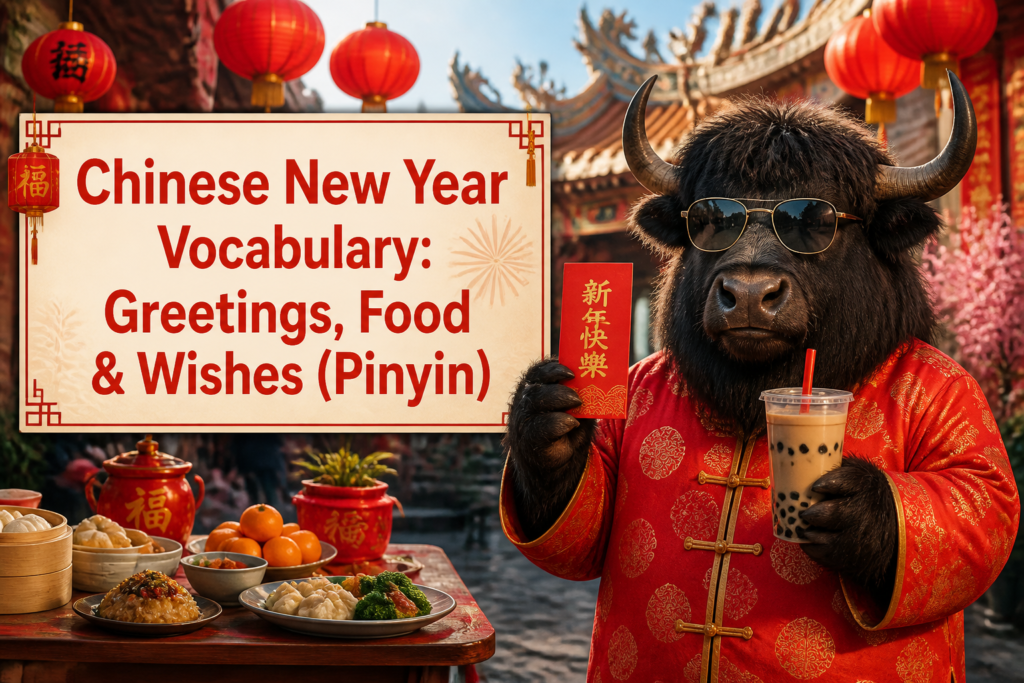
農曆新年 nónglì xīnnián is basically Mandarin’s annual excuse to say nice things, eat too much, and pretend the sofa can’t hear you. If you have ever wanted to join the cheerful chaos with the right words, this guide is for you.
For the broader learning path, visit our parent guide.
In Taiwan, people often say 過年 guònián for the holiday period. The language is warm, practical, and full of good wishes. Some phrases are polite, some are casual, and some are so classic they show up every year like clockwork. Very efficient. Very festive.
By the end, you will know common Chinese New Year greetings, food words, and lucky wishes in Traditional Chinese, pinyin, and simple English, with real example sentences you can actually use. For extra background on the festival itself, a boring-but-useful reference is Wikipedia’s Chinese New Year page.
Quick Start Phrases
If you only learn a few phrases, make them these. They are the heavy hitters of Lunar New Year speech.
| Traditional Chinese | Pinyin | Meaning | Example (ZH) | Example (Pinyin) | Translation (EN) |
|---|---|---|---|---|---|
| 新年快樂 | xīnnián kuàilè | Happy New Year | 新年快樂! | Xīnnián kuàilè! | Happy New Year! |
| 恭喜發財 | gōngxǐ fācái | Wishing you wealth and success | 恭喜發財,紅包拿來。 | Gōngxǐ fācái, hóngbāo nálái. | Wishing you wealth and success, now hand over the red envelope. |
| 萬事如意 | wànshì rúyì | May everything go as you wish | 祝你萬事如意。 | Zhù nǐ wànshì rúyì. | Wishing you that everything goes as you wish. |
| 心想事成 | xīn xiǎng shì chéng | May your wishes come true | 新的一年,祝你心想事成。 | Xīn de yī nián, zhù nǐ xīn xiǎng shì chéng. | In the new year, I wish your wishes come true. |
| 年年有餘 | nián nián yǒu yú | May you have surplus every year | 祝你年年有餘。 | Zhù nǐ nián nián yǒu yú. | Wishing you surplus every year. |
Small note: 新年快樂 xīnnián kuàilè is the safest, most universal greeting. If you forget everything else, you still look like you tried. Which, honestly, is already better than many people at family gatherings.
Core New Year Greetings
These are the phrases you will hear all the time during the holiday. Some are used when greeting relatives, some are for friends, and some are for those slightly awkward visits where you smile a bit too hard.
| Traditional Chinese | Pinyin | Meaning | Example (ZH) | Example (Pinyin) | Translation (EN) |
|---|---|---|---|---|---|
| 新年快樂 | xīnnián kuàilè | Happy New Year | 祝大家新年快樂! | Zhù dàjiā xīnnián kuàilè! | Wishing everyone a Happy New Year! |
| 春節快樂 | chūnjié kuàilè | Happy Spring Festival | 春節快樂,玩得開心! | Chūnjié kuàilè, wán de kāixīn! | Happy Spring Festival, have fun! |
| 過年好 | guònián hǎo | Happy New Year; good New Year to you | 阿姨,過年好! | Āyí, guònián hǎo! | Auntie, Happy New Year! |
| 恭喜發財 | gōngxǐ fācái | Wishing you wealth and success | 恭喜發財,生意興隆。 | Gōngxǐ fācái, shēngyì xīnglóng. | Wishing you wealth and success, and booming business. |
| 大吉大利 | dàjí dàlì | Great luck and great profit | 祝你新年大吉大利。 | Zhù nǐ xīnnián dàjí dàlì. | Wishing you great luck and great profit in the new year. |
| 吉祥如意 | jíxiáng rúyì | Auspicious and as wished | 祝你吉祥如意。 | Zhù nǐ jíxiáng rúyì. | Wishing you good fortune and that things go as you wish. |
| 福到 | fú dào | Good fortune has arrived | 福到了,大家都開心。 | Fú dàole, dàjiā dōu kāixīn. | Good fortune has arrived, and everyone is happy. |
| 招財進寶 | zhāocái jìnbǎo | Attract wealth and treasures | 門上貼著招財進寶。 | Mén shàng tiē zhe zhāocái jìnbǎo. | The door has “attract wealth and treasures” pasted on it. |
| 萬事如意 | wànshì rúyì | May everything go as you wish | 祝你萬事如意,平安健康。 | Zhù nǐ wànshì rúyì, píng’ān jiànkāng. | Wishing you that everything goes as you wish, with peace and health. |
| 心想事成 | xīn xiǎng shì chéng | May your wishes come true | 希望你心想事成。 | Xīwàng nǐ xīn xiǎng shì chéng. | Hope your wishes come true. |
| 平安健康 | píng’ān jiànkāng | Peace and good health | 新的一年平安健康最重要。 | Xīn de yī nián píng’ān jiànkāng zuì zhòngyào. | In the new year, peace and health matter most. |
Useful nuance: 恭喜發財 gōngxǐ fācái is famous, but it is not the only greeting. It often sounds slightly more festive or old-school, while 新年快樂 xīnnián kuàilè is the all-purpose choice. Taiwan loves a warm, practical phrase. Fancy is optional.
Lucky Wishes You Can Say To Family And Friends
These wishes are especially useful when you want to sound sincere instead of just repeating one phrase like a polite robot. New Year language often stacks good fortune words together. Mandarin really does enjoy being extra about luck.
| Traditional Chinese | Pinyin | Meaning | Example (ZH) | Example (Pinyin) | Translation (EN) |
|---|---|---|---|---|---|
| 祝你身體健康 | zhù nǐ shēntǐ jiànkāng | Wish you good health | 過年最常聽到的是祝你身體健康。 | Guònián zuì cháng tīng dào de shì zhù nǐ shēntǐ jiànkāng. | The most common thing you hear during New Year is wishing you good health. |
| 平安順心 | píng’ān shùnxīn | Peaceful and smooth | 希望你新年平安順心。 | Xīwàng nǐ xīnnián píng’ān shùnxīn. | Hope your new year is peaceful and smooth. |
| 鴻圖大展 | hóngtú dàzhǎn | Great success and expansion | 祝你工作鴻圖大展。 | Zhù nǐ gōngzuò hóngtú dàzhǎn. | Wishing your work expands with great success. |
| 步步高升 | bùbù gāoshēng | Rise step by step | 祝你步步高升。 | Zhù nǐ bùbù gāoshēng. | Wishing you promotion after promotion. |
| 學業進步 | xuéyè jìnbù | Progress in studies | 祝你學業進步。 | Zhù nǐ xuéyè jìnbù. | Wishing you progress in your studies. |
| 金榜題名 | jīnbǎng tímíng | Success in exams | 考生最喜歡聽到金榜題名。 | Kǎoshēng zuì xǐhuān tīng dào jīnbǎng tímíng. | Exam takers love hearing “success in the exams.” |
| 早日脫單 | zǎorì tuōdān | Find a partner soon | 朋友很愛祝我早日脫單。 | Péngyǒu hěn ài zhù wǒ zǎorì tuōdān. | My friends love wishing me to find a partner soon. |
| 財源滾滾 | cáiyuán gǔngǔn | May wealth keep rolling in | 希望你財源滾滾。 | Xīwàng nǐ cáiyuán gǔngǔn. | Hope wealth keeps rolling in for you. |
身體健康 shēntǐ jiànkāng is especially common for older relatives. If you are talking to grandparents, parents, or family friends, health is often the safest and warmest wish. Money comes up too, of course. This is New Year, not a poetry retreat.
Food Vocabulary For The New Year Table
Food is a giant part of the holiday. Many dishes are chosen because their names sound lucky, or because they symbolize wealth, fullness, or reunion. Mandarin speakers do love a good pun. Actually, they love it a lot.
| Traditional Chinese | Pinyin | Meaning | Example (ZH) | Example (Pinyin) | Translation (EN) |
|---|---|---|---|---|---|
| 年糕 | nián gāo | New Year cake; sticky rice cake | 過年一定會吃年糕。 | Guònián yídìng huì chī niángāo. | You will definitely eat New Year cake during the holiday. |
| 水餃 | shuǐjiǎo | Dumplings | 除夕晚上我們一起包水餃。 | Chúxī wǎnshàng wǒmen yìqǐ bāo shuǐjiǎo. | On New Year’s Eve we make dumplings together. |
| 湯圓 | tāngyuán | Sweet glutinous rice balls | 元宵節也會吃湯圓。 | Yuánxiāo Jié yě huì chī tāngyuán. | You also eat tangyuan at the Lantern Festival. |
| 魚 | yú | Fish | 年夜飯一定有魚。 | Niányèfàn yídìng yǒu yú. | There is always fish at the New Year’s Eve dinner. |
| 發糕 | fā gāo | Prosperity cake | 發糕象徵發財。 | Fāgāo xiàngzhēng fācái. | Prosperity cake symbolizes wealth. |
| 蘿蔔糕 | luóbo gāo | Radish cake | 過年早餐常吃蘿蔔糕。 | Guònián zǎocān cháng chī luóbogāo. | Radish cake is often eaten for breakfast during New Year. |
| 春捲 | chūnjuǎn | Spring roll | 我們買了春捲回家吃。 | Wǒmen mǎi le chūnjuǎn huíjiā chī. | We bought spring rolls to eat at home. |
| 糖果 | tángguǒ | Candy | 桌上放滿了糖果。 | Zhuō shàng fàng mǎn le tángguǒ. | The table is full of candy. |
| 橘子 | júzi | Mandarin orange | 過年會送橘子。 | Guònián huì sòng júzi. | People give oranges during New Year. |
| 年夜飯 | niányèfàn | New Year’s Eve dinner | 全家一起吃年夜飯。 | Quánjiā yìqǐ chī niányèfàn. | The whole family eats New Year’s Eve dinner together. |
One classic symbol word is 魚 yú because it sounds like 餘 yú, meaning surplus. That is why people say 年年有餘 nián nián yǒu yú. Same sound, lucky meaning. Mandarin speakers really do enjoy when language and symbolism show up to the same party.
Extra Food And Gift Words
These words help you talk about shopping, gifts, and the little details around the holiday. They are useful in markets, supermarkets, family visits, and anywhere someone is carrying a bag of oranges with the seriousness of a sacred mission.
| Traditional Chinese | Pinyin | Meaning | Example (ZH) | Example (Pinyin) | Translation (EN) |
|---|---|---|---|---|---|
| 紅包 | hóngbāo | Red envelope with money | 小孩最期待紅包。 | Xiǎohái zuì qīdài hóngbāo. | Kids look forward to red envelopes the most. |
| 禮盒 | lǐhé | Gift box | 我買了一盒水果禮盒。 | Wǒ mǎi le yì hé shuǐguǒ lǐhé. | I bought a fruit gift box. |
| 伴手禮 | bànshǒu lǐ | Gift to bring when visiting someone | 去親戚家要帶伴手禮。 | Qù qīnqī jiā yào dài bànshǒu lǐ. | You should bring a gift when visiting relatives. |
| 水果 | shuǐguǒ | Fruit | 過年常買水果送人。 | Guònián cháng mǎi shuǐguǒ sòng rén. | People often buy fruit as gifts during New Year. |
| 糖果 | tángguǒ | Candy | 孩子們一直吃糖果。 | Háizimen yìzhí chī tángguǒ. | The children keep eating candy. |
| 瓜子 | guāzǐ | Sunflower seeds | 聊天的時候會嗑瓜子。 | Liáotiān de shíhòu huì kē guāzǐ. | People snack on sunflower seeds while chatting. |
| 零食 | língshí | Snacks | 桌上放了很多零食。 | Zhuō shàng fàng le hěn duō língshí. | There are lots of snacks on the table. |
| 大魚大肉 | dàyú dàròu | Big meals; lots of meat and fish | 過年總是大魚大肉。 | Guònián zǒngshì dàyú dàròu. | New Year is always full of big feasts. |
Common New Year Actions And Traditions
These are not just vocabulary items; they are part of what people do. And yes, knowing the action words makes you sound much more natural. Magic, but with grammar.
| Traditional Chinese | Pinyin | Meaning | Example (ZH) | Example (Pinyin) | Translation (EN) |
|---|---|---|---|---|---|
| 拜年 | bàinián | New Year visit and greeting | 初一要去拜年。 | Chūyī yào qù bàinián. | On the first day of the new year, people go visit and greet others. |
| 團圓 | tuányuán | Reunion | 過年最重要的是團圓。 | Guònián zuì zhòngyào de shì tuányuán. | The most important thing during New Year is reunion. |
| 守歲 | shǒusuì | Staying up late on New Year’s Eve | 很多人會守歲到半夜。 | Hěn duō rén huì shǒusuì dào bànyè. | Many people stay up late until midnight. |
| 貼春聯 | tiē chūnlián | Put up Spring Festival couplets | 我們一起貼春聯。 | Wǒmen yìqǐ tiē chūnlián. | We put up Spring Festival couplets together. |
| 掃除 | sǎochú | Cleaning | 過年前大家都會掃除。 | Guònián qián dàjiā dōu huì sǎochú. | Everyone cleans before New Year. |
| 走春 | zǒuchūn | Go out for a New Year outing | 初二我們去走春。 | Chūèr wǒmen qù zǒuchūn. | On the second day we go out for a New Year outing. |
| 發紅包 | fā hóngbāo | Give red envelopes | 長輩會發紅包給小孩。 | Zhǎngbèi huì fā hóngbāo gěi xiǎohái. | Elders give red envelopes to children. |
| 吃團圓飯 | chī tuányuán fàn | Eat a reunion dinner | 除夕晚上全家吃團圓飯。 | Chúxī wǎnshàng quánjiā chī tuányuán fàn. | On New Year’s Eve the whole family eats a reunion dinner. |
In Taiwan, 走春 zǒuchūn is a nice phrase for going out during the holiday, often to temples, parks, or scenic places. It sounds cheerful and relaxed, which is convenient because the food situation is usually not relaxed at all.
Common Greetings By Situation
Different situations call for different wording. Here is the practical version, because no one wants to sound like they accidentally used a business slogan at grandma’s house.
| Situation | Traditional Chinese | Pinyin | English Meaning | Example Sentence |
|---|---|---|---|---|
| General greeting | 新年快樂 | xīnnián kuàilè | Happy New Year | 新年快樂! Xīnnián kuàilè! Happy New Year! |
| To older relatives | 恭喜發財 | gōngxǐ fācái | Wishing wealth and success | 阿公,恭喜發財! Āgōng, gōngxǐ fācái! Grandpa, wishing you wealth and success! |
| To family | 身體健康 | shēntǐ jiànkāng | Good health | 祝你身體健康。 Zhù nǐ shēntǐ jiànkāng. Wishing you good health. |
| To students or coworkers | 學業進步 | xuéyè jìnbù | Study progress | 祝你學業進步,工作順利。 Zhù nǐ xuéyè jìnbù, gōngzuò shùnlì. Wishing you progress in study and smooth work. |
| To business people | 生意興隆 | shēngyì xīnglóng | Prosperous business | 祝您生意興隆。 Zhù nín shēngyì xīnglóng. Wishing your business prospers. |
| To anyone you like | 萬事如意 | wànshì rúyì | May everything go as you wish | 新的一年,萬事如意! Xīn de yī nián, wànshì rúyì! In the new year, may everything go as you wish! |
Food And Wish Phrases In Real Life
Here are natural sentence patterns you will hear around the table, at the market, or while someone is already opening the snack box before dinner. Priorities.
- 我們吃年夜飯。 Wǒmen chī niányèfàn. We eat the New Year’s Eve dinner.
- 今年的魚很大。 Jīnnián de yú hěn dà. This year’s fish is very big.
- 這些水餃是我包的。 Zhèxiē shuǐjiǎo shì wǒ bāo de. These dumplings were made by me.
- 我祝你新年快樂。 Wǒ zhù nǐ xīnnián kuàilè. I wish you a Happy New Year.
- 希望你心想事成。 Xīwàng nǐ xīn xiǎng shì chéng. Hope your wishes come true.
- 我們一起去拜年。 Wǒmen yìqǐ qù bàinián. Let’s go visit and greet people together.
- 紅包拿來! Hóngbāo nálái! Hand over the red envelope!
- 過年要吃很多好料。 Guònián yào chī hěn duō hǎoliào. During New Year, you have to eat lots of good food.
- 祝你身體健康,平安順心。 Zhù nǐ shēntǐ jiànkāng, píng’ān shùnxīn. Wishing you good health and a peaceful, smooth year.
- 我們買了水果禮盒送人。 Wǒmen mǎi le shuǐguǒ lǐhé sòng rén. We bought a fruit gift box to give to someone.
Notice how the examples often pair a greeting with a second wish. That is very natural in Mandarin. One phrase is nice. Two phrases feel warmer. Three phrases and you are basically the family spokesperson.
Tone And Usage Notes
Here are a few practical points that help avoid awkward wording.
- 一 yī changes tone in natural speech. For example, 一年 is usually said yì nián, not yī nián.
- 不 bù also changes tone before another fourth tone. For example, 不錯 is búcuò.
- 恭喜發財 gōngxǐ fācái is common, but it is not the only greeting. Do not overuse it if a softer phrase fits better.
- 紅包 hóngbāo is not just “a red bag.” It means the envelope with money inside. Subtle difference. Huge social difference.
- 年夜飯 niányèfàn means the reunion dinner on New Year’s Eve, not just any dinner during the holiday.
- 年糕 niángāo and 蘿蔔糕 luóbogāo are both common holiday foods in Taiwan, often seen at breakfast or family meals.
If you want a formal reference for Mandarin vocabulary and spelling, the Traditional Chinese vocabulary test is a useful place to review word recognition in a structured way. For a broader language challenge, there is also the Traditional Chinese placement test TOCFL.
Practice Section
Try these quick drills. No drama, no pop quiz panic, just a little language cardio.
- Translate: “Happy New Year” → 新年快樂 xīnnián kuàilè
- Translate: “May everything go as you wish” → 萬事如意 wànshì rúyì
- Fill in the blank: 祝你______健康。 Zhù nǐ ______ jiànkāng. → 身體 shēntǐ
- Fill in the blank: 我們一起吃______飯。 Wǒmen yìqǐ chī ______ fàn. → 團圓 tuányuán
- Swap the word: 恭喜發財 gōngxǐ fācái → make it softer with 新年快樂 xīnnián kuàilè
- Say it in Chinese: “We bought a fruit gift box.” → 我們買了水果禮盒。 Wǒmen mǎi le shuǐguǒ lǐhé.
- Say it in Chinese: “The whole family eats reunion dinner.” → 全家吃團圓飯。 Quánjiā chī tuányuán fàn.
- Say it in Chinese: “I wish you good health.” → 祝你身體健康。 Zhù nǐ shēntǐ jiànkāng.
If you want more holiday phrase practice, the related guide Traditional Chinese greetings is a good companion piece. And if your brain is now thinking of dumplings, there is also Traditional Chinese food vocab for more edible words.
Common Mistakes And Easy Fixes
- Mistake: Using only 恭喜發財 for everyone.
Fix: Mix in 新年快樂, 身體健康, and 萬事如意. - Mistake: Saying 紅包 as if it just means “red bag.”
Fix: Remember it means the lucky money envelope. - Mistake: Forgetting that 年夜飯 is specifically the New Year’s Eve reunion dinner.
Fix: Use it for that special meal, not every dinner in January. - Mistake: Translating New Year wishes too literally and sounding stiff.
Fix: Keep the phrases short, warm, and natural. - Mistake: Thinking food words are just food words.
Fix: In New Year vocabulary, many foods also carry lucky meanings.
For the holiday in general, Taiwan speakers often use 過年 guònián in daily life. That is handy because you will hear it in conversation, signs, and probably at least one relative asking when you are getting married. Bless the family support system.
Quick Reference Summary
| Type | Traditional Chinese | Pinyin | English |
|---|---|---|---|
| Greeting | 新年快樂 | xīnnián kuàilè | Happy New Year |
| Greeting | 過年好 | guònián hǎo | Happy New Year |
| Lucky wish | 恭喜發財 | gōngxǐ fācái | Wishing wealth and success |
| Lucky wish | 萬事如意 | wànshì rúyì | May everything go as you wish |
| Lucky wish | 心想事成 | xīn xiǎng shì chéng | May your wishes come true |
| Food | 年糕 | nián gāo | New Year cake |
| Food | 水餃 | shuǐjiǎo | Dumplings |
| Food | 湯圓 | tāngyuán | Sweet rice balls |
| Tradition | 拜年 | bàinián | Visit and greet for New Year |
| Tradition | 紅包 | hóngbāo | Red envelope with money |
Chinese New Year vocabulary is not hard, but it is very festive, and festive words like to show off a little. Learn the key greetings, food items, and wishes, and you can survive most holiday conversations with confidence. That is the real goal: sound warm, sound natural, and avoid becoming the person who only says one phrase five times in a row.
Yak Takeaway: Say 新年快樂 xīnnián kuàilè for general use, 恭喜發財 gōngxǐ fācái for a classic festive vibe, and 身體健康 shēntǐ jiànkāng when you want to sound truly thoughtful. Add dumplings, red envelopes, and a little luck, and you are basically ready for the holiday.