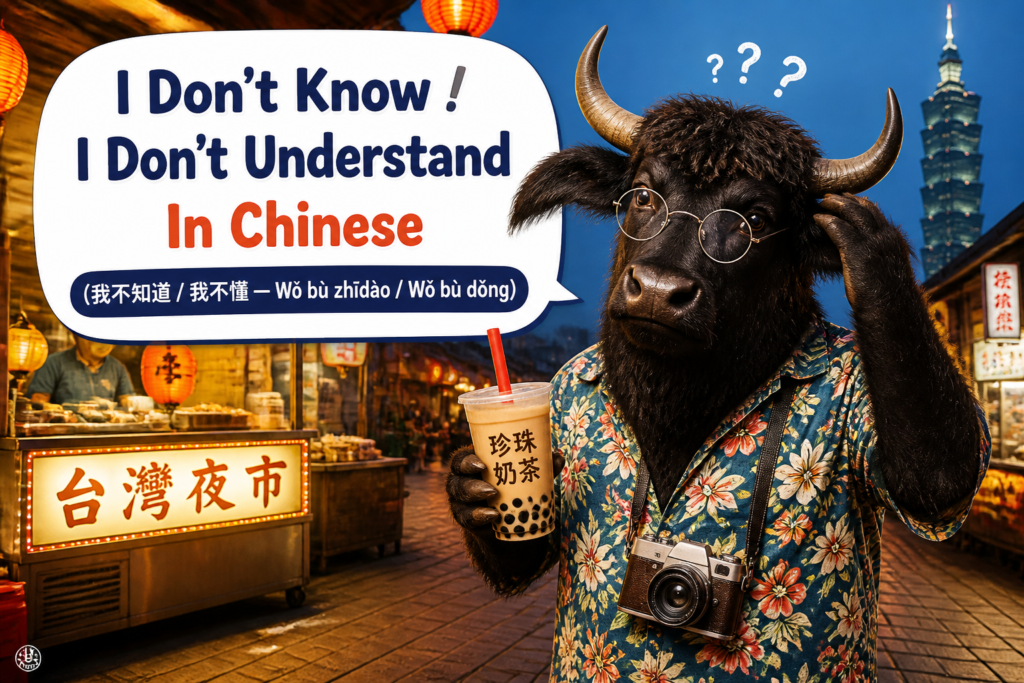
In Mandarin Chinese, 我不知道 — wǒ bù zhīdào — means I don’t know. On the other hand, 我不懂 — wǒ bù dǒng — means I don’t understand.
These two little phrases do a lot of work in real life. They help you survive class, conversations, airport confusion, and that moment when somebody says something in Mandarin at full speed and your brain politely leaves the building.
The good news?
Mandarin has neat, useful ways to say “I don’t know” and “I don’t understand” without sounding rude or dramatic. The better news? Once you learn the difference, you can sound a lot more natural.
For the broader learning path, visit our parent guide.
For a bigger picture of basic wording, you can also compare this with essential Traditional Chinese phrases and pronouns in Traditional Chinese.
The Two Main Phrases
| Traditional Chinese | Pinyin | Meaning | Example (ZH) | Example (Pinyin) | Translation (EN) |
|---|---|---|---|---|---|
| 我不知道 | wǒ bù zhīdào | I don’t know | 我不知道他在哪裡。 | Wǒ bù zhīdào tā zài nǎlǐ. | I don’t know where he is. |
| 我不懂 | wǒ bù dǒng | I don’t understand | 這句話我不懂。 | Zhè jù huà wǒ bù dǒng. | I don’t understand this sentence. |
Simple, right? Mandarin likes to keep the logic tidy, at least when it is not being mysterious on purpose.
When To Use 我不知道
我不知道 wǒ bù zhīdào is for facts, information, and unknown answers. If you do not know where something is, who did something, what time it is, or why your message never got replied to, this is your phrase.
Rule → Example
- 我不知道 wǒ bù zhīdào = I don’t know
- 我不知道他是誰。 Wǒ bù zhīdào tā shì shéi. = I don’t know who he is.
You can use it alone, or add more detail after it. Very handy. Very normal. Very “I am not a walking encyclopedia.”
| Traditional Chinese | Pinyin | Meaning | Example (ZH) | Example (Pinyin) | Translation (EN) |
|---|---|---|---|---|---|
| 我不知道。 | wǒ bù zhīdào. | I don’t know. | 我不知道。 | Wǒ bù zhīdào. | I don’t know. |
| 我不知道怎麼去。 | wǒ bù zhīdào zěnme qù. | I don’t know how to get there. | 我不知道怎麼去。 | Wǒ bù zhīdào zěnme qù. | I don’t know how to get there. |
| 我不知道要不要去。 | wǒ bù zhīdào yào bú yào qù. | I don’t know whether I should go. | 我不知道要不要去。 | Wǒ bù zhīdào yào bú yào qù. | I don’t know whether I should go. |
| 我不知道答案。 | wǒ bù zhīdào dǎ’àn. | I don’t know the answer. | 我不知道答案。 | Wǒ bù zhīdào dǎ’àn. | I don’t know the answer. |
| 我不知道發生什麼事。 | wǒ bù zhīdào fāshēng shénme shì. | I don’t know what happened. | 我不知道發生什麼事。 | Wǒ bù zhīdào fāshēng shénme shì. | I don’t know what happened. |
When To Use 我不懂
我不懂 wǒ bù dǒng is for understanding. If somebody explains something and your brain is still standing outside the door, this is the phrase you want.
Rule → Example
- 我不懂 wǒ bù dǒng = I don’t understand
- 我不懂你的意思。 Wǒ bù dǒng nǐ de yìsi. = I don’t understand what you mean.
In Taiwan Mandarin, 懂 dǒng is very common in casual speech, especially when you want to say you understand a language, a rule, a joke, or someone’s explanation.
| Traditional Chinese | Pinyin | Meaning | Example (ZH) | Example (Pinyin) | Translation (EN) |
|---|---|---|---|---|---|
| 我不懂。 | wǒ bù dǒng. | I don’t understand. | 你說太快了,我不懂。 | Nǐ shuō tài kuài le, wǒ bù dǒng. | You spoke too fast, I don’t understand. |
| 我不懂這個意思。 | wǒ bù dǒng zhège yìsi. | I don’t understand this meaning. | 我不懂這個意思。 | Wǒ bù dǒng zhège yìsi. | I don’t understand this meaning. |
| 我不懂中文。 | wǒ bù dǒng zhōngwén. | I don’t understand Chinese. | 我不懂中文。 | Wǒ bù dǒng zhōngwén. | I don’t understand Chinese. |
| 我不懂你在說什麼。 | wǒ bù dǒng nǐ zài shuō shénme. | I don’t understand what you’re saying. | 我不懂你在說什麼。 | Wǒ bù dǒng nǐ zài shuō shénme. | I don’t understand what you’re saying. |
| 我不懂規則。 | wǒ bù dǒng guīzé. | I don’t understand the rules. | 我不懂規則。 | Wǒ bù dǒng guīzé. | I don’t understand the rules. |
How They Differ
| Phrase | Use For | Natural Example |
|---|---|---|
| 我不知道 wǒ bù zhīdào | Not knowing a fact or answer | 我不知道他住哪裡。 |
| 我不懂 wǒ bù dǒng | Not understanding an explanation, meaning, or idea | 我不懂你的問題。 |
Think of it like this:
- 不知道 = “I do not have the information.”
- 不懂 = “I have the information in front of me, but it still makes no sense.”
不知道 is about facts. 不懂 is about understanding. Easy to mix up, but easy to fix.
Useful Follow-Up Phrases
Once you know the basics, these are the phrases you will actually use in real conversation. Not fancy. Not museum language. Just useful.
| Traditional Chinese | Pinyin | Meaning | Example (ZH) | Example (Pinyin) | Translation (EN) |
|---|---|---|---|---|---|
| 我聽不懂。 | wǒ tīng bù dǒng. | I can’t understand what I hear. | 你可以再說一次嗎?我聽不懂。 | Nǐ kěyǐ zài shuō yí cì ma? Wǒ tīng bù dǒng. | Can you say it again? I can’t understand it. |
| 我看不懂。 | wǒ kàn bù dǒng. | I can’t understand what I read. | 這張單子我看不懂。 | Zhè zhāng dānzi wǒ kàn bù dǒng. | I can’t understand this form. |
| 我完全不懂。 | wǒ wánquán bù dǒng. | I don’t understand at all. | 這個我完全不懂。 | Zhège wǒ wánquán bù dǒng. | I don’t understand this at all. |
| 我真的不知道。 | wǒ zhēn de bù zhīdào. | I really don’t know. | 我真的不知道。 | Wǒ zhēn de bù zhīdào. | I really don’t know. |
| 我不知道怎麼回答。 | wǒ bù zhīdào zěnme huídá. | I don’t know how to answer. | 這題我不知道怎麼回答。 | Zhè tí wǒ bù zhīdào zěnme huídá. | I don’t know how to answer this question. |
| 我不太懂。 | wǒ bú tài dǒng. | I don’t quite understand. | 這部分我不太懂。 | Zhè bùfèn wǒ bú tài dǒng. | I don’t quite understand this part. |
| 可以再說一次嗎? | kěyǐ zài shuō yí cì ma? | Can you say it again? | 可以再說一次嗎? | Kěyǐ zài shuō yí cì ma? | Can you say it again? |
| 你可以講慢一點嗎? | nǐ kěyǐ jiǎng màn yì diǎn ma? | Can you speak a little slower? | 你可以講慢一點嗎? | Nǐ kěyǐ jiǎng màn yì diǎn ma? | Can you speak a little slower? |
| 我需要時間想一下。 | wǒ xūyào shíjiān xiǎng yí xià. | I need time to think. | 我需要時間想一下。 | Wǒ xūyào shíjiān xiǎng yí xià. | I need time to think. |
| 我不確定。 | wǒ bú quèdìng. | I’m not sure. | 我不確定。 | Wǒ bú quèdìng. | I’m not sure. |
Polite Taiwan-Style Ways To Say It
In Taiwan, people often soften the message a little so it sounds friendly, not blunt. Not because the direct version is wrong, but because human beings like to sound decent when possible. Shocking, I know.
| Traditional Chinese | Pinyin | Meaning | Example (ZH) | Example (Pinyin) | Translation (EN) |
|---|---|---|---|---|---|
| 不好意思,我不太懂。 | bù hǎoyìsi, wǒ bú tài dǒng. | Sorry, I don’t quite understand. | 不好意思,我不太懂。 | Bù hǎoyìsi, wǒ bú tài dǒng. | Sorry, I don’t quite understand. |
| 不好意思,我不知道。 | bù hǎoyìsi, wǒ bù zhīdào. | Sorry, I don’t know. | 不好意思,我不知道。 | Bù hǎoyìsi, wǒ bù zhīdào. | Sorry, I don’t know. |
| 麻煩你再說一次。 | máfan nǐ zài shuō yí cì. | Please say it again. | 麻煩你再說一次。 | Máfan nǐ zài shuō yí cì. | Please say it again. |
| 可以請你講慢一點嗎? | kěyǐ qǐng nǐ jiǎng màn yì diǎn ma? | Could you speak a little slower? | 可以請你講慢一點嗎? | Kěyǐ qǐng nǐ jiǎng màn yì diǎn ma? | Could you speak a little slower? |
The phrase 不好意思 bù hǎoyìsi is incredibly useful in Taiwan. It can mean “excuse me,” “sorry,” or a polite softener before a request. Tiny phrase, big job.
Tone And Pronunciation Notes
不 bù changes tone before another fourth tone. So in 不知道 bù zhīdào, the 不 is usually pronounced bú in natural speech: bú zhīdào.
Likewise, in 不懂 bù dǒng, the pronunciation often becomes bú dǒng.
You do not need to overthink this every time. Just learn the phrase as a chunk. Your mouth will thank you later.
| Written Form | Common Spoken Sound | Note |
|---|---|---|
| 我不知道 | wǒ bú zhīdào | 不 changes before 知道 because 知 is fourth tone. |
| 我不懂 | wǒ bú dǒng | 不 changes before 懂 because 懂 is third tone? Actually tone change is based on following tone in careful rules; in natural speech this phrase is often heard smoothly as bú dǒng. |
If you want a reliable pronunciation reference, the Taiwan Ministry of Education has language resources worth poking around in when you feel academically responsible.
Mini Patterns You’ll Hear Everywhere
These patterns show up constantly in classrooms, chats, and daily life. Mandarin loves reusable chunks. Very efficient. Slightly smug.
| Pattern | Meaning | Example (ZH) | Pinyin | English |
|---|---|---|---|---|
| 我不知道 + question | I don’t know + question content | 我不知道他幾點來。 | Wǒ bù zhīdào tā jǐ diǎn lái. | I don’t know what time he is coming. |
| 我不懂 + noun/idea | I don’t understand + thing or idea | 我不懂這個笑話。 | Wǒ bù dǒng zhège xiàohuà. | I don’t understand this joke. |
| 我聽不懂 + speech | I can’t understand what I hear | 他口音太重,我聽不懂。 | Tā kǒuyīn tài zhòng, wǒ tīng bù dǒng. | His accent is too strong, so I can’t understand. |
| 我看不懂 + text | I can’t understand what I read | 這份公告我看不懂。 | Zhè fèn gōnggào wǒ kàn bù dǒng. | I can’t understand this notice. |
| 我不確定 + statement | I’m not sure + statement | 我不確定這樣對不對。 | Wǒ bú quèdìng zhèyàng duì bu duì. | I’m not sure whether this is correct. |
Common Mistakes And Easy Fixes
- Mistake: Using 我不懂 when you simply lack information.
Fix: Use 我不知道 for facts and answers. - Mistake: Saying 我不知道 when you mean “I don’t understand the explanation.”
Fix: Use 我不懂. - Mistake: Forgetting the object or topic.
Fix: Add what you do not know or understand: 我不知道答案, 我不懂這句話. - Mistake: Sounding too direct in a polite situation.
Fix: Add 不好意思 or 請. - Mistake: Trying to translate English word for word.
Fix: Use the whole phrase naturally. Mandarin likes structure, not drama.
Practice Time
Pick the better phrase: 我不知道 or 我不懂.
- 1. “I don’t know where the station is.” → 我不知道
- 2. “I don’t understand this sentence.” → 我不懂
- 3. “I don’t know his name.” → 我不知道
- 4. “I don’t understand what you mean.” → 我不懂
- 5. “I don’t know the answer.” → 我不知道
- 6. “I don’t understand this math problem.” → 我不懂
Now try translating these into Traditional Chinese:
- “Can you say it again?” → 可以再說一次嗎? kěyǐ zài shuō yí cì ma?
- “I don’t understand.” → 我不懂。 wǒ bù dǒng.
- “I don’t know.” → 我不知道。 wǒ bù zhīdào.
- “I’m not sure.” → 我不確定。 wǒ bú quèdìng.
Quick Reference Summary
| Phrase | Pinyin | Use It When… |
|---|---|---|
| 我不知道 | wǒ bù zhīdào | You do not know a fact, answer, or information. |
| 我不懂 | wǒ bù dǒng | You do not understand an idea, sentence, rule, or explanation. |
| 我聽不懂 | wǒ tīng bù dǒng | You cannot understand spoken Mandarin. |
| 我看不懂 | wǒ kàn bù dǒng | You cannot understand written text. |
| 不好意思,我不太懂 | bù hǎoyìsi, wǒ bú tài dǒng | You want to sound polite and soft. |
For more basic word building, it can help to review basic Traditional Chinese words and phrases and then test yourself with the Traditional Chinese vocabulary test or the Traditional Chinese placement test (TOCFL).
Yak takeaway: use 我不知道 for facts and 我不懂 for understanding. If you remember nothing else, remember that distinction. It will save you from a lot of awkward silence and at least one confused eyebrow.