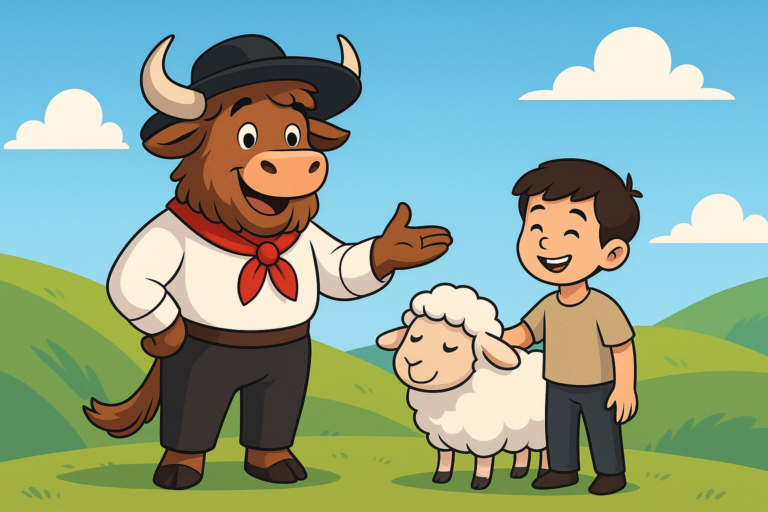
This A1 Beginner retelling of El burro flautista keeps the plot clear for learners while still giving the story some atmosphere and momentum. Un burro camina por el campo. Ve una flauta en el suelo.
This version teaches Spanish through English and includes clickable word help inside the story, full story audio, and lesson notes after the reading. It is free to use on Yak Yacker and is designed to feel natural, readable, and manageable for learners.
Un burro por el .
Ve una en el .
El burro la flauta.
"¡Qué música voy a !", dice.
El burro en la flauta.
Sale un muy : ¡Fuuu!
Un escucha y se .
"¡Qué tan !", dice.
El burro no se .
Sopla otra : ¡Friii!
Una oveja .
"¡, por favor!", .
"Tu música me da ".
El burro está muy .
"Todos a escuchar mi ", piensa.
Una vaca se .
" burro", dice la vaca.
"No es la flauta la que la música".
"Es el músico quien debe ".
El burro mira la flauta y .
"Entonces, mejor ", dice.
Y se va a comer .
A donkey walks through the field.
He sees a flute on the ground.
The donkey picks up the flute.
"What beautiful music I'll make!" he says.
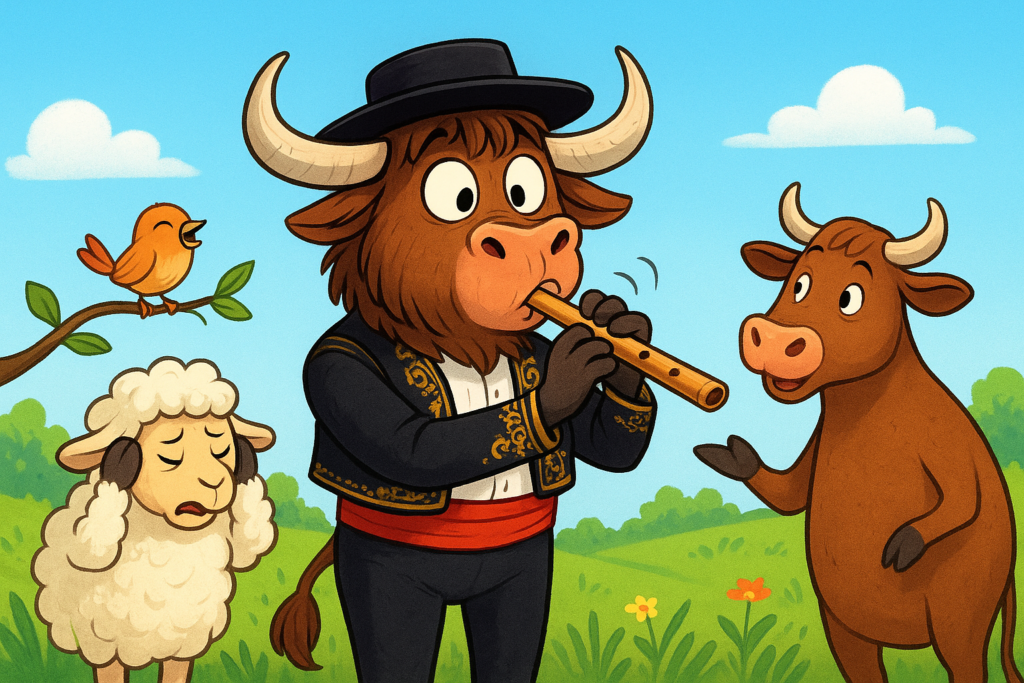
The donkey blows into the flute.
A very ugly sound comes out: Hoooonk!
A bird hears and laughs.
"What a horrible noise!" he says.
The donkey isn't worried.
He blows again: Freeeek!
A sheep comes running.
"Stop, please!" she yells.
"Your music gives me a headache."
The donkey is very proud.
"Everyone is coming to listen to my concert," he thinks.
A wise cow approaches.
"Friend donkey," says the cow.
"It's not the flute that makes the music."
"It's the musician who must have art."
The donkey looks at the flute and sighs.
"Then I better keep braying," he says.
And he goes off happily to eat grass.
Let’s meet the characters and things in our story. Notice that every Spanish noun has a gender: 'el' for masculine and 'la' for feminine.
- el burro – donkey
- la flauta – flute
- el pájaro – bird
- la oveja – sheep
- la vaca – cow
The story uses simple action words, all in the he/she form. For -ar verbs like 'caminar', the ending is -a. You’ll see this pattern a lot!
- camina – walks
- sopla – blows
- escucha – listens
- mira – looks
Exclamations like '¡Qué bonita música!' are a fun way to express strong feelings. Just start with ¡Qué and add an adjective or a noun.
- ¡Qué bonita! – How pretty!
- ¡Qué ruido tan horrible! – What a horrible noise!
- ¡Qué divertido! – How fun!
- Use 'tan' before an adjective to add extra emphasis.
You just read a whole story in Spanish—¡qué bien! Try reading it out loud, especially the sound words. Acting it out helps you remember.
When you’re ready, look for more simple stories. Every one you enjoy brings you closer to understanding Spanish naturally.
El burro flautista comes from an older public-domain story tradition and is best known as a public_domain_fable_retelling. This Yak Yacker article is an original learner retelling based on public-domain source material, so the wording here is simplified for modern learners rather than copied from one old edition.
Older printings, translations, and retellings of this story can vary quite a bit. This version is adapted for A1 Beginner learners studying Spanish.
If you want to keep going, browse more in our Spanish section and review the A1 Spanish Vocabulary List. After that, try Basic Questions in Spanish for another useful next step.