Meet Lazarillo, a poor boy from 16th-century Spain who must use his wits to survive after being apprenticed to a blind beggar. As he moves from one master to the next-a miserly priest, a starving squire, and others-Lazarillo's adventures paint a vivid, often satirical picture of Spanish society. This beloved picaresque novel is full of cunning tricks, sharp humor, and a surprisingly modern voice.
This B1 intermediate Spanish retelling brings the story to life with audio narration to boost your listening skills. Click any word for an instant translation, and enjoy free lesson notes that highlight key grammar and cultural insights. Dive into a classic tale while building real Spanish fluency-no stress, just story.
Me llamo Lázaro de Tormes. Nací a orillas del río Tormes, en Salamanca. Mi infancia fue pobre pero libre. Mi padre murió cuando yo tenía muy pocos años. Mi madre trabajaba y en un mesón.
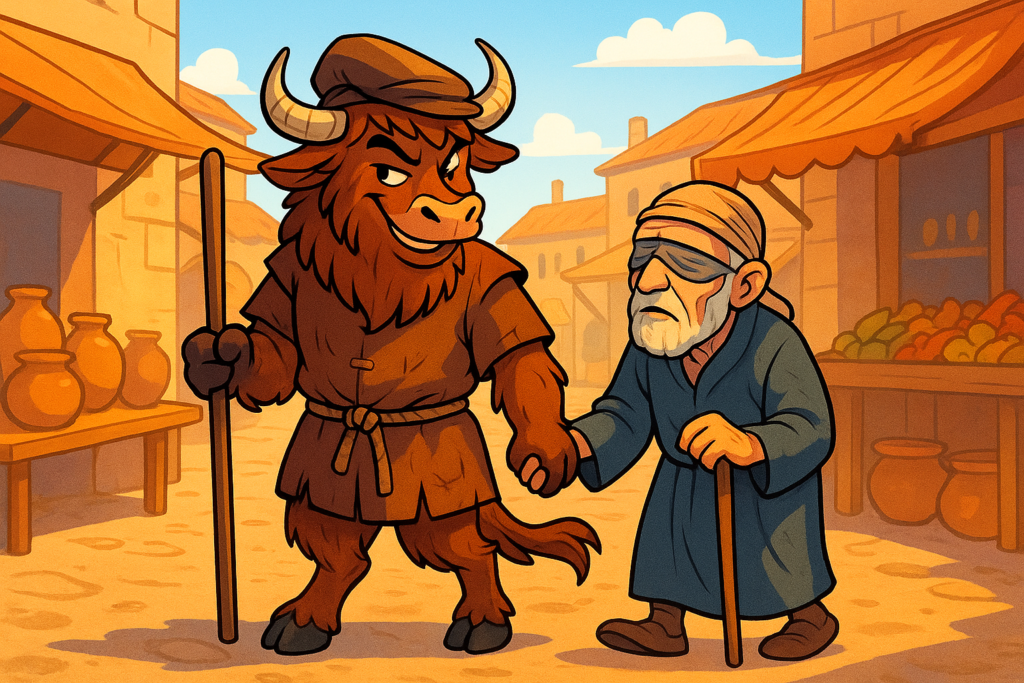
Un día, un ciego viejo llegó al mesón. Me ofreció una moneda a mi madre para que yo fuera su guía. Mi madre, con lágrimas, me dijo: «Vete con él, hijo. ».
Y así empecé mi vida con el ciego. Era un hombre muy , pero también muy . Me enseñó muchas para pedir limosna, pero me daba muy poca comida.
El ciego guardaba la comida y el vino en una jarra. Yo y tenía que para sobrevivir.
Un día, hice un pequeño agujero en la jarra y bebía el vino con una paja. Pero el ciego lo descubrió. «¡Ah, !» gritó, y me con la jarra en la cabeza. Me dolió muchísimo. Aprendí una lección: con un amo ciego, hay que tener los ojos bien abiertos.
Después de eso, escapé y llegué a Maqueda. Allí encontré a un clérigo. «¿Sabes ayudar en misa?» me preguntó. «Sí, señor», mentí. Él me tomó como .
Pero el clérigo era aún más que el ciego. Guardaba los panes bajo llave en un arcón. Yo pasaba hambre otra vez. «Dios proveerá», decía él mientras comía. Pero yo veía que a mí no me llegaba nada.
Una noche, mientras él dormía, encontré una llave que abría el arcón. Empecé a tomar un poco de pan cada día. Pero el clérigo notó que faltaba pan. «¡Hay ratones!» gritaba. Y yo, con cara de inocente, le decía: «Tal vez sea un , señor».
Un día, mientras dormía, la llave se me cayó al suelo y sonó. El clérigo se despertó y me descubrió. Me dio una y me . «¡Vete de aquí, ladrón!» me dijo.
Caminé hasta Toledo. Llevaba ropa muy vieja y estaba muy flaco. Vi a un hombre bien vestido, pero con cara triste. «Joven, ¿buscas amo?» me preguntó. «Sí, señor», respondí. «Soy un , sígueme».
El escudero parecía noble: su capa estaba limpia, su espada brillaba, pero su casa… ¡oh, su casa! No había muebles ni comida. Solo cuatro paredes .
Mi nuevo amo no trabajaba porque decía que «eso no es propio de un hidalgo». Pasaba el día por la ciudad, riqueza, mientras los dos teníamos el estómago vacío.
Muchas veces, yo iba a pedir limosna para los dos. Era una situación extraña: el criado alimentaba al amo. Un día, el escudero me dijo: «Lázaro, la es más importante que el pan». Pero yo pensaba en mi barriga.
Al final, unos llegaron a cobrarle. El escudero huyó y yo me quedé solo otra vez. Entendí algo sobre el mundo: las y la verdadera riqueza está en la tripa llena.
Con el tiempo, aprendí a . Tuve otros amos, unos mejores, otros peores. Pero nunca olvidé lo que me enseñó la vida en el camino: hay que ser , pero también tener corazón.
Y así, querido lector, termina esta parte de mi historia. Si algún día pasas por Salamanca, mira el río Tormes. Tal vez veas a un niño corriendo por sus , que se parece a mí.
I am Lázaro de Tormes. I was born on the banks of the Tormes River in Salamanca. My childhood was poor but free. My father died when I was very young. My mother worked washing clothes and cooking at an inn.
One day, an old blind man came to the inn. He offered my mother a coin for me to be his guide. My mother, in tears, said: "Go with him, son. You'll learn to earn a living."
And so I began my life with the blind man. He was very cunning, but also very cruel. He taught me many tricks for begging, but gave me very little food.
The blind man kept the food and wine in a jug. I was starving and had to steal from him to survive.
One day, I made a small hole in the jug and drank the wine with a straw. But the blind man discovered it. "Ah, thief!" he shouted, and hit me on the head with the jug. It hurt a lot. I learned a lesson: with a blind master, you must keep your eyes wide open.
After that, I escaped and arrived in Maqueda. There I found a priest. "Do you know how to help at Mass?" he asked. "Yes, sir," I lied. He took me on as an altar boy.
But the priest was even more miserly than the blind man. He kept the breads under lock and key in a chest. I went hungry again. "God will provide," he said while eating. But I saw that nothing came to me.
One night, while he slept, I found a key that opened the chest. I began to take a little bread each day. But the priest noticed bread was missing. "There are mice!" he shouted. And I, with an innocent face, said: "Maybe it's a goblin, sir."
One day, while he slept, the key fell from my hand and made a noise. The priest woke up and discovered me. He beat me and threw me out. "Get out of here, thief!" he said.
I walked to Toledo. I wore very old clothes and was very skinny. I saw a well-dressed man with a sad face. "Young man, are you looking for a master?" he asked. "Yes, sir," I replied. "I am a squire, follow me."
The squire seemed noble: his cape was clean, his sword shone, but his house... oh, his house! There was no furniture or food. Just four bare walls.
My new master did not work because he said "that is not fit for a nobleman." He spent the day walking around the city, pretending to be rich, while both of us had empty stomachs.
Often, I went begging for alms for both of us. It was a strange situation: the servant fed the master. One day, the squire said: "Lázaro, honor is more important than bread." But I was thinking about my belly.
In the end, some creditors came to collect from him. The squire fled and I was left alone again. I understood something about the world: appearances deceive and true wealth is a full belly.
Over time, I learned to survive. I had other masters, some better, some worse. But I never forgot what life on the road taught me: you must be clever, but also have a heart.
And so, dear reader, this part of my story ends. If you ever pass through Salamanca, look at the Tormes River. Perhaps you'll see a child running along its banks, who looks like me.
Lazarillo’s world is full of hunger, tricks, and false appearances. To follow his journey, you’ll want a handful of words that keep popping up – not just for recognition, but because they carry the ironic tone of the story.
Below are a few terms that pack extra meaning in this context. The English glosses give you the surface meaning, but pay attention to how they’re used: sometimes the real message is the opposite of what’s said.
- trampas – 'tricks' or 'cheats.' The blind man teaches him 'muchas trampas para pedir limosna' – not noble skills, but survival tactics.
- astuto – 'cunning, shrewd.' Often used with a wink: is being astuto clever or just desperate?
- apariencias – 'appearances.' The escudero lives by them, and Lazarillo learns not to trust them.
- sobrevivir – 'to survive.' It’s not just living – it’s getting by on wits when there’s nothing in your stomach.
One of the secret tools behind Lazarillo’s voice is the way he moves between the preterite and imperfect tenses. The imperfect sets the stage – it describes how things usually were, the ongoing desperation (moría de hambre, guardaba la comida). The preterite punches in for the specific, jagged moments that change everything (me golpeó, escapé).
This back-and-forth doesn’t just build a timeline – it creates irony. When a habitual misery (imperfect) is shattered by a sudden slap (preterite), the contrast makes us feel the unfairness, often with a sour little laugh.
- Imperfect for background: 'El ciego guardaba la comida…' – this was his constant behavior, the setup for the theft.
- Preterite for the break: 'Me golpeó con la jarra…' – a single brutal event that changes the narrator’s path.
- Mixed in one sentence: 'Pasaba el día paseando… mientras los dos teníamos el estómago vacío.' The escudero’s daily pretense (imperfect) against the ongoing emptiness (imperfect) – no action, just a sharp picture.
The whole story is a masterclass in saying one thing while meaning another. Lazarillo himself tells us early on: 'con un amo ciego, hay que tener los ojos bien abiertos.' On the surface, it’s a literal lesson – watch out because the blind man can’t see. But the deeper meaning is: even the blind can spot your tricks, and the truly blind are the ones who trust too much.
The critique gets sharper with every master. The priest says 'Dios proveerá' while he eats well and locks the bread away; the escudero preaches that 'la honra es más importante que el pan' while his servant begs for both. These aren’t just funny contradictions – they’re attacks on a society that values appearance over flesh and blood.
- 'Dios proveerá, decía él mientras comía.' The holy phrase is undercut by the action – God provides, but only for the hypocrite.
- 'La honra es más importante que el pan' – a noble ideal that leaves two people starving. The word 'honra' becomes almost a curse.
- 'Con un amo ciego, hay que tener los ojos bien abiertos.' A pun that turns the blind man’s condition into a warning about everyone else.
You’ve seen how a few well-chosen words and a clever tense shift can turn a simple adventure into a biting social portrait. The next time you read a Spanish story – or even tell one of your own – listen for that second voice: the irony humming beneath the lines.
Try writing a short paragraph about a day in your life, but add a little Lazarillo twist: describe your routine with imperfect verbs, then drop in a preterite surprise. See if you can make your reader smile and think at the same time.
- Continue with the original 'Lazarillo de Tormes' – the full text is short and packed with these tricks.
- Pay attention to object pronouns when you read: they often hide a sarcastic kick ('me' dolió muchísimo carries more than just pain).
- Tell a friend about the worst job you ever had – in Spanish, using imperfect for the misery and preterite for the moment you left.
Lazarillo de Tormes comes from an older public-domain story tradition and is best known as a public_domain_story_retelling. This Yak Yacker article is an original learner retelling based on public-domain source material, so the wording here is simplified for modern learners rather than copied from one old edition.
Older printings, translations, and retellings of this story can vary quite a bit. This version is adapted for B1 Intermediate learners studying Spanish.
If you want to keep going, browse more in our Spanish section and review the B1 Spanish Vocabulary List. After that, try Spanish Gender Rules for Nouns and Adjectives for another useful next step.