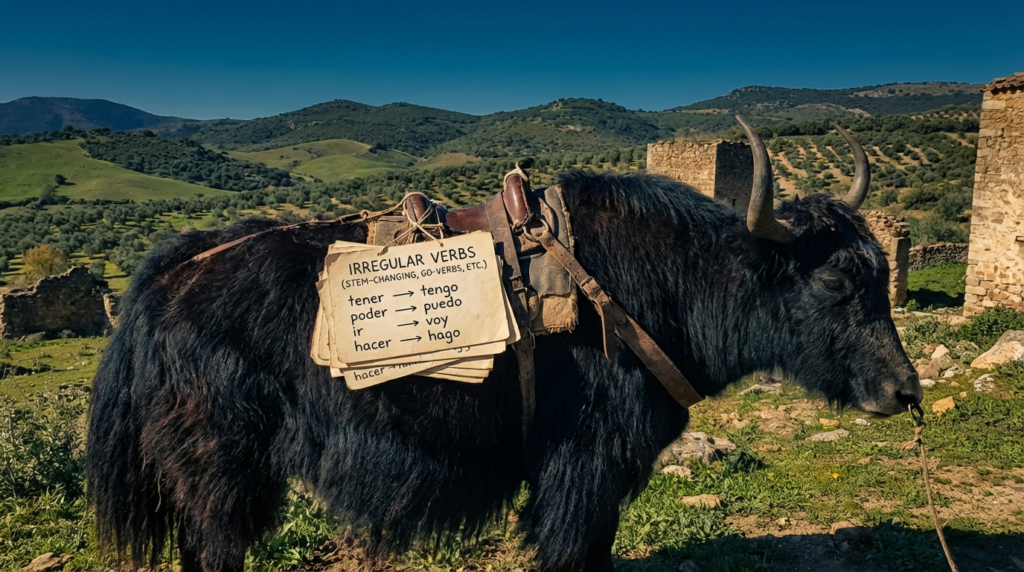
Yak Box: The Three Reasons Verbs “Go Irregular”
- Stem change: the middle of the verb shifts in the present tense (querer → quiero).
- Weird yo form: the yo form has its own special spelling (tener → tengo).
- Irregular past: the preterite (simple past) uses a different “stem” (tener → tuve).
Key Spanish terms you’ll see:
- verbo irregular = irregular verb. Ese es un verbo irregular. (That’s an irregular verb.)
- raíz = stem/root. La raíz cambia en el presente. (The stem changes in the present.)
- conjugación = conjugation. La conjugación de “ir” es irregular. (The conjugation of “to go” is irregular.)
Mexican Spanish note: You’ll mostly hear ustedes (not vosotros), so the tables here use ustedes.
Stem-Changing Verbs (The “Boot” Verbs)
Stem-changers change in the present tense for yo, tú, él/ella, and ustedes… but not for nosotros. (In charts, it looks like a boot shape—hence the nickname.)
| Change | Meaning | Starter Verb | Real Sentence |
|---|---|---|---|
| e → ie | “e” turns into “ie” | querer (to want) | Quiero un café, por favor. (I want a coffee, please.) |
| o → ue | “o” turns into “ue” | poder (to be able to) | ¿Puedes ayudarme? (Can you help me?) |
| e → i | “e” turns into “i” | pedir (to ask for / order) | Pido tacos de pastor. (I’m ordering pastor tacos.) |
| u → ue | “u” turns into “ue” | jugar (to play) | Jugamos fútbol los sábados. (We play soccer on Saturdays.) |
Model Verb: Querer (e → ie)
- yo: quiero = I want. Quiero dormir. (I want to sleep.)
- tú: quieres = you want. ¿Quieres agua? (Do you want water?)
- él/ella: quiere = he/she wants. Ella quiere aprender español. (She wants to learn Spanish.)
- nosotros: queremos = we want. Queremos irnos. (We want to leave.)
- ustedes: quieren = you all want. ¿Quieren la cuenta? (Do you all want the check?)
Model Verb: Poder (o → ue)
- yo: puedo = I can. Hoy no puedo. (I can’t today.)
- tú: puedes = you can. ¿Puedes venir? (Can you come?)
- él/ella: puede = he/she can. Él puede manejar. (He can drive.)
- nosotros: podemos = we can. Podemos hablar aquí. (We can talk here.)
- ustedes: pueden = you all can. Ustedes pueden pasar. (You all can come in.)
Fast reality check: Stem changes happen in the present. In the past tense, some verbs change differently (you’ll see a quick preterite cheat sheet below).
Ready-To-Use Lines (Say These Today)
- ¿Quieres…? = Do you want…? ¿Quieres ir conmigo? (Do you want to go with me?)
- No puedo. = I can’t. No puedo ahorita. (I can’t right now.)
- ¿Puedes repetir? = Can you repeat? ¿Puedes repetir, por favor? (Can you repeat, please?)
- Prefiero… = I prefer… Prefiero té. (I prefer tea.)
- Te pido un favor. = I’m asking you a favor. Te pido un favor: mándame el mensaje. (I’m asking you a favor: send me the message.)
- ¿A qué hora vuelves? = What time are you coming back? ¿A qué hora vuelves a casa? (What time are you coming back home?)
- Encuentro mis llaves. = I find my keys. Siempre encuentro mis llaves… al final. (I always find my keys… eventually.)
- Me siento bien. = I feel good. Hoy me siento mejor. (Today I feel better.)
- ¿Sigues aquí? = Are you still here? ¿Sigues aquí o ya te vas? (Are you still here or are you leaving?)
- Te digo la verdad. = I’ll tell you the truth. Te digo la verdad: no me acuerdo. (I’ll tell you the truth: I don’t remember.)
- Hago ejercicio. = I work out. Hago ejercicio en la mañana. (I work out in the morning.)
- Salgo en cinco minutos. = I’m leaving in five minutes. Salgo en cinco minutos, espérame. (I’m leaving in five minutes, wait for me.)
Go-Verbs (Present Tense “Yo” Ends In -go)
Go-verbs are the ones where the yo form ends in -go. The rest of the conjugation often looks more normal (sometimes with extra irregularity—because Spanish likes a plot twist).
| Infinitive | English Meaning | Yo Form | Real Sentence |
|---|---|---|---|
| tener | to have | tengo | Tengo hambre. (I’m hungry.) |
| venir | to come | vengo | Vengo de la tienda. (I’m coming from the store.) |
| salir | to leave / go out | salgo | Salgo tarde hoy. (I’m leaving late today.) |
| poner | to put / place | pongo | Pongo la música. (I put on the music.) |
| traer | to bring | traigo | Traigo efectivo. (I’m bringing cash.) |
| decir | to say / tell | digo | No digo nada. (I’m not saying anything.) |
| hacer | to do / make | hago | Hago la cena. (I’m making dinner.) |
| valer | to be worth | valgo | No valgo para eso. (I’m not good for that.) |
Double Trouble: Decir (Go-Verb + Stem Change)
decir = to say / tell.
- yo: digo. Digo “hola”. (I say “hi.”)
- tú: dices. ¿Qué dices? (What are you saying?)
- él/ella: dice. Ella dice que sí. (She says yes.)
- nosotros: decimos. Decimos la verdad. (We tell the truth.)
- ustedes: dicen. Ustedes dicen lo mismo. (You all say the same thing.)
Other Common Weird “Yo” Verbs (Not -go)
The “-zco” Crew
In the yo form, some verbs add -zco.
- conocer → conozco = to know (a person/place). Conozco a tu hermana. (I know your sister.)
- parecer → parezco = to seem. Parezco cansado. (I seem tired.)
- ofrecer → ofrezco = to offer. Te ofrezco agua. (I offer you water.)
- agradecer → agradezco = to appreciate/thank. Te agradezco mucho. (I really appreciate it.)
The Tiny Gang: Doy, Voy, Estoy, Soy
- dar → doy = to give. Te doy mi número. (I’ll give you my number.)
- ir → voy = to go. Voy al trabajo. (I’m going to work.)
- estar → estoy = to be (temporary). Estoy en casa. (I’m at home.)
- ser → soy = to be (identity). Soy de México. (I’m from Mexico.)
Bonus: saber → sé = to know (a fact). Sé la respuesta. (I know the answer.)
Preterite Irregulars (Quick And Dirty Cheat Sheet)
The preterite is the simple past (“I did,” “she went”). Many high-frequency verbs use an irregular preterite stem. Once you know the stem, you add these endings:
| Person | Regular Pattern | Meaning | Mini Example |
|---|---|---|---|
| yo | stem + e | I (did) | tuve (I had) |
| tú | stem + iste | you (did) | tuviste (you had) |
| él/ella | stem + o | he/she (did) | tuvo (he had) |
| nosotros | stem + imos | we (did) | tuvimos (we had) |
| ustedes | stem + ieron | you all (did) | tuvieron (you all had) |
Most-Useful Irregular Preterite Stems
- tener → tuv- (to have): Tuve tiempo. (I had time.)
- estar → estuv- (to be): Estuve en Guadalajara. (I was in Guadalajara.)
- venir → vin- (to come): Vine temprano. (I came early.)
- poder → pud- (to be able to): No pude ir. (I couldn’t go.)
- poner → pus- (to put): Puse la mesa. (I set the table.)
- saber → sup- (to know): No supe nada. (I didn’t know anything.)
- querer → quis- (to want/try): Quise ayudarte. (I wanted to help you.)
- hacer → hic-/hiz- (to do/make): Hice la tarea. (I did the homework.)
- decir → dij- (to say/tell): Dije la verdad. (I told the truth.)
- traer → traj- (to bring): Traje mi credencial. (I brought my ID.)
Heads-up: Verbs with -j- stems (dije, traje) use -eron (not -ieron): dijeron, trajeron.
Tables Of Words (Grouped Cheat Sheets)
Stem-Changers You’ll Hear All The Time
| Spanish | English Meaning | Example 1 | Example 2 | Example 3 |
|---|---|---|---|---|
| pensar | to think / plan | Pienso en ti. | ¿Qué piensas? | Pensamos igual. |
| querer | to want / love | Quiero dormir. | ¿Quieres café? | Queremos paz. |
| entender | to understand | No entiendo. | ¿Entiendes? | Entendemos todo. |
| empezar | to start | Empiezo hoy. | ¿A qué hora empiezas? | Empezamos mañana. |
| preferir | to prefer | Prefiero agua. | ¿Prefieres aquí? | Preferimos caminar. |
| cerrar | to close | Cierro la puerta. | Cierran a las ocho. | Cerramos temprano. |
| volver | to return / come back | Vuelvo luego. | ¿Vuelves hoy? | Volvemos en una hora. |
| encontrar | to find | Encuentro mi celular. | ¿Encuentras la entrada? | Encontramos un lugar. |
| recordar | to remember | Recuerdo tu nombre. | ¿Recuerdas eso? | Recordamos todo. |
| dormir | to sleep | Duermo tarde. | ¿Duermes bien? | Dormimos aquí. |
| pedir | to ask for / order | Pido la cuenta. | ¿Pides tacos? | Pedimos agua. |
| servir | to serve | Sirvo el café. | ¿Sirves tú? | Servimos primero. |
| seguir | to continue / follow | Sigo aquí. | ¿Sigues cansado? | Seguimos mañana. |
| repetir | to repeat | Repito la palabra. | ¿Repites? | Repetimos juntos. |
| jugar | to play | Juego ajedrez. | ¿Juegas hoy? | Jugamos los domingos. |
Go-Verbs And Friends (Present “Yo” Specials)
| Spanish | English Meaning | Example 1 | Example 2 | Example 3 |
|---|---|---|---|---|
| tener | to have | Tengo sueño. | ¿Tienes tiempo? | Tenemos prisa. |
| venir | to come | Vengo contigo. | ¿Vienes hoy? | Venimos temprano. |
| salir | to leave / go out | Salgo del trabajo. | ¿Sales a las seis? | Salimos juntos. |
| poner | to put | Pongo la mesa. | ¿Pones música? | Ponemos la tele. |
| traer | to bring | Traigo mi cartera. | ¿Traes agua? | Traemos regalos. |
| hacer | to do / make | Hago ejercicio. | ¿Haces la comida? | Hacemos planes. |
| decir | to say / tell | Digo la verdad. | ¿Qué dices? | Decimos “sí”. |
| valer | to be worth | Valgo mucho. | ¿Cuánto vale? | Valemos lo mismo. |
| conocer | to know (someone/place) | Conozco a tu papá. | ¿Conoces Puebla? | Conocemos el lugar. |
| parecer | to seem | Parezco nervioso. | Pareces feliz. | Parecemos listos. |
| ofrecer | to offer | Te ofrezco ayuda. | ¿Ofreces algo? | Ofrecemos café. |
| dar | to give | Te doy un abrazo. | ¿Me das tu correo? | Damos permiso. |
| ir | to go | Voy al súper. | ¿Vas conmigo? | Vamos en taxi. |
| estar | to be (temporary) | Estoy bien. | ¿Estás aquí? | Estamos listos. |
| ser | to be (identity) | Soy estudiante. | ¿Eres de aquí? | Somos amigos. |
| saber | to know (a fact) | Sé eso. | ¿Sabes la hora? | Sabemos la respuesta. |
| ver | to see | Veo la tele. | ¿Ves el mensaje? | Vemos una película. |
Irregular Preterite Verbs (Simple Past MVPs)
| Spanish | English Meaning | Example 1 | Example 2 | Example 3 |
|---|---|---|---|---|
| tener (tuve) | to have | Tuve una junta. | ¿Tuviste tiempo? | Tuvieron suerte. |
| estar (estuve) | to be | Estuve enfermo. | ¿Estuviste ahí? | Estuvieron en casa. |
| venir (vine) | to come | Vine solo. | ¿Viniste temprano? | Vinieron tarde. |
| poder (pude) | to be able to | No pude entrar. | ¿Pudiste llamar? | Pudieron pagar. |
| poner (puse) | to put | Puse gasolina. | ¿Pusiste la alarma? | Pusieron música. |
| saber (supe) | to find out / know | Supe la noticia. | ¿Supiste eso? | Supieron tarde. |
| querer (quise) | to want / try | Quise llamar. | ¿Quisiste venir? | Quisieron salir. |
| hacer (hice) | to do / make | Hice la comida. | ¿Hiciste tarea? | Hicieron ruido. |
| decir (dije) | to say / tell | Dije “no”. | ¿Dijiste eso? | Dijeron la verdad. |
| traer (traje) | to bring | Traje dinero. | ¿Trajiste tu ID? | Trajeron comida. |
| ser/ir (fui) | to be / to go | Fui al cine. | ¿Fuiste tú? | Fueron juntos. |
Practice Drills (Small, Fast, Actually Useful)
Say the answer out loud first. Then write it. Your brain loves drama.
Drill 1: Pick The Correct Present Form
- Yo ______ (querer) un café. → _____
- ¿Tú ______ (poder) venir hoy? → _____
- Nosotros ______ (dormir) aquí. → _____
- Ustedes ______ (decir) la verdad. → _____
- Yo ______ (tener) prisa. → _____
Drill 2: Switch To “Nosotros” (No Stem Change!)
- Yo quiero pizza. → Nosotros ______ pizza.
- Yo puedo pagar. → Nosotros ______ pagar.
- Yo pido la cuenta. → Nosotros ______ la cuenta.
- Yo vuelvo mañana. → Nosotros ______ mañana.
Drill 3: Irregular Preterite (Yesterday Mode)
- Ayer yo ______ (tener) tiempo. → _____
- Ayer nosotros ______ (poder) entrar. → _____
- El viernes ella ______ (venir) temprano. → _____
- Ellos ______ (decir) la verdad. → _____
Answer Key
Drill 1: quiero, puedes, dormimos, dicen, tengo
Drill 2: queremos, podemos, pedimos, volvemos
Drill 3: tuve, pudimos, vino, dijeron
Common Mistakes (And The Fix)
- Mistake: Stem-changing in nosotros (“queremos” → “quieremos”).
Fix: Nosotros is usually normal: queremos, podemos, pedimos, dormimos. - Mistake: Adding -go to every form (“tengo, tengas, tenga…”).
Fix: The -go is mainly a yo problem: tengo but tienes, tiene, tenemos, tienen. - Mistake: Mixing ser and estar randomly.
Fix: ser = identity/what it is (Soy Ana.) and estar = location/temporary state (Estoy cansado.). - Mistake: Seeing fui and panicking.
Fix: ser and ir share the same preterite: fui, fuiste, fue, fuimos, fueron. Context tells you which one: Fui al cine (went), Fui feliz (was).
Quick Reference Summary (Screenshot This)
- Stem-changers (present): e→ie (quiero), o→ue (puedo), e→i (pido), u→ue (juego).
- No stem change in nosotros: queremos, podemos, pedimos, dormimos.
- Go-verbs (yo): tengo, vengo, salgo, pongo, traigo, digo, hago.
- Mini irregular yo forms: doy, voy, estoy, soy, sé, veo.
- Irregular preterite stems: tuv-, estuv-, vin-, pud-, pus-, sup-, quis-, hic-, dij-, traj-.
Final Yak: Don’t memorize “irregular verbs.” Memorize patterns. Spanish is predictable… in its own chaotic way.
Reference List
Browse the full Yak Yacker reference list below. If a PDF is available for this page, the download button will appear under the table.
The original guide stays below, and now you can review the topic more actively with a quiz, the full reference table, and a free PDF download under the list.
If this topic helped, explore more in our Spanish learning section. it’s the easiest way to keep building related vocabulary without jumping around the web.
Quick Quiz
Think you’ve got a handle on these irregular forms? Try the quick quiz below to see which verbs have already stuck and which ones could use a second look.
Browse the Full List
The Yak Yacker reference table below gives you meanings, examples, audio playback where available for this list, and a free PDF download button below the table.
| Infinitive | Meaning | Stem Change | Example | Translation | Audio |
|---|---|---|---|---|---|
| dormir | to sleep | o > ue | Duermo ocho horas. | I sleep eight hours. | |
| dormir | to sleep | o -> duermo | Duermo ocho horas. | I sleep eight hours. | |
| e → i | “e” turns into “i” | irregular | Pido tacos de pastor. (I’m ordering pastor tacos.) | Pido tacos de pastor. (I’m ordering pastor tacos.) | |
| e → ie | “e” turns into “ie” | irregular | Quiero un café, por favor. (I want a coffee, please.) | Quiero un café, por favor. (I want a coffee, please.) | |
| él/ella | stem + o | irregular | tuvo (he had) | tuvo (he had) | |
| empezar | to start | Stem change e > ie; spelling change zc in yo form | Empiezo la clase a las ocho. | I start class at eight. | |
| empezar | to begin | e > ie stem change | La clase empieza a las ocho. | The class begins at eight. | |
| empujar | to push | regular verb; spelling changes in some forms | No empujes la puerta. | Don't push the door. | |
| encontrar | to find | Stem change o > ue in present tense | Encuentro mi mochila aquí. | I find my backpack here. | |
| encontrar | to find | o > ue stem change | Encuentro mis llaves en la mesa. | I find my keys on the table. | |
| entender | to understand | Stem change e > ie in present tense | Entiendo la pregunta. | I understand the question. | |
| entender | to understand | e > ie stem change | Entiendo la pregunta. | I understand the question. | |
| estar | to be | e -> estoy; stem changes in present | Estoy en casa. | I am at home. | |
| estar | to be (temporary) | e -> estoy | Estoy en casa. | I am at home. | |
| estar (estuve) | to be | irregular | ¿Estuviste ahí? | Estuvieron en casa. | |
| freír | to fry | irregular in some forms: frío, fríe | Voy a freír un huevo. | I'm going to fry an egg. | |
| haber | to have, there is/are | Highly irregular; present: he, has, ha | Hay mucha gente aquí. | There are many people here. | |
| hacer | to do, to make | irregular yo form | Hago la tarea por la noche. | I do homework at night. | |
| hacer | to do; to make | irregular yo form | Hago la tarea por la noche. | I do homework at night. | |
| hacer (hice) | to do / make | irregular | ¿Hiciste tarea? | Hicieron ruido. | |
| ir | to go | highly irregular | Vamos al parque. | We are going to the park. | |
| ir | to go | highly irregular | Vamos al parque. | We are going to the park. | |
| jugar | to play | u > ue | Juego al fútbol. | I play soccer. | |
| jugar | to play | u -> juego | Juego con mis amigos. | I play with my friends. | |
| medir | to measure | e > i stem change | Mido la mesa con una cinta. | I measure the table with a tape. |