


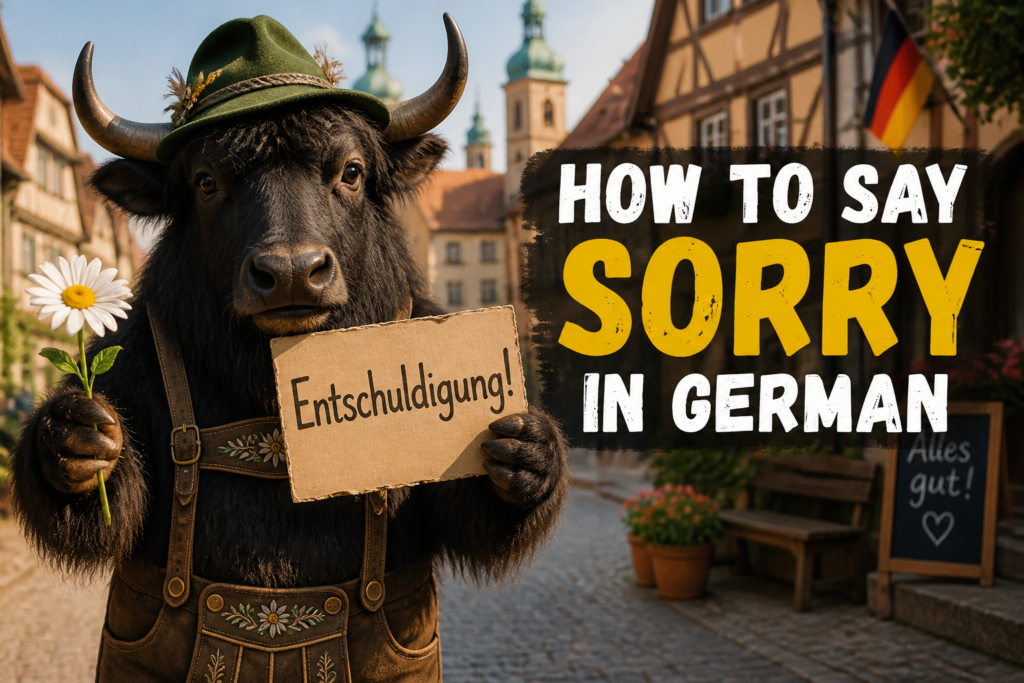
Sich entschuldigen in German is not just one phrase. English gets to toss out “sorry” for everything from bumping elbows to missing a deadline. German is a little more specific, because apparently feelings also need grammar.
The good news: once you know the main phrases, you can sound polite, natural, and appropriately human in everyday situations. By the end of this guide, you’ll know how to apologize in German for small mistakes, bigger problems, and those awkward moments when you need to say “my bad” without sounding like a robot.
And yes, Germans do say sorry a lot, just not always with the exact same word you’d use in English.
The Main Ways To Say Sorry
Here are the most useful apology phrases first. The safest all-purpose one is Entschuldigung. It can mean “sorry,” “excuse me,” or “pardon me,” depending on the situation. Very useful. Slightly overworked. Like a trusty umbrella in German weather.
| German | Pronunciation | Meaning | Example Sentence | Translation | Learner Note |
|---|---|---|---|---|---|
| Entschuldigung | ent-SHOOL-di-gung | Sorry / Excuse me / Pardon me | Entschuldigung, können Sie mir helfen? | Excuse me, can you help me? | Very common and polite. Great for getting attention or apologizing briefly. |
| Entschuldige mich | ent-SHOOL-di-guh mish | Excuse me / I’m sorry | Entschuldige mich, ich bin zu spät. | I’m sorry, I’m late. | Use with du. The mich form often means you are apologizing for yourself. |
| Entschuldigen Sie mich | ent-SHOOL-di-gen zee mish | Excuse me / I’m sorry | Entschuldigen Sie mich, ich habe einen Fehler gemacht. | Excuse me, I made a mistake. | Use with Sie in formal situations. |
| Es tut mir leid. | es toot meer lite | I’m sorry / It’s my fault / I regret it | Es tut mir leid, dass ich das vergessen habe. | I’m sorry that I forgot that. | One of the most important apology phrases in German. Sounds sincere and natural. |
| Es tut mir wirklich leid. | es toot meer vookh-lich lite | I’m really sorry. | Es tut mir wirklich leid, dass du warten musstest. | I’m really sorry that you had to wait. | Add wirklich for more warmth or seriousness. |
| Verzeihung | fer-TSY-hung | Forgive me / Excuse me | Verzeihung, ist dieser Platz frei? | Excuse me, is this seat free? | Slightly more formal or old-fashioned than Entschuldigung. |
| Sorry | SOR-ree | Sorry | Sorry, ich habe dich nicht gesehen. | Sorry, I didn’t see you. | Used in modern spoken German too, especially casually. Borrowed from English. |
| Mein Fehler. | mine FAIL-er | My mistake. | Mein Fehler, ich habe die falsche Uhrzeit gesagt. | My mistake, I said the wrong time. | Short, natural, and very useful after small mistakes. |
Duden is the kind of source that looks completely boring and therefore extremely trustworthy, which is exactly what you want for German spelling and usage.
When To Use Each One
Different apology phrases work better in different situations. German often separates “excuse me” from “I am sorry,” while English happily mixes them together and hopes for the best.
| Situation | Best Phrase | Why It Works | Example |
|---|---|---|---|
| Getting someone’s attention | Entschuldigung | Polite and short | Entschuldigung, wo ist der Bahnhof? |
| Small accident or mistake | Entschuldigung / Sorry | Natural and simple | Entschuldigung, das war mein Fehler. |
| Real apology | Es tut mir leid. | Sounds sincere | Es tut mir leid, ich bin zu spät gekommen. |
| Formal apology | Entschuldigen Sie bitte … | Polite and respectful | Entschuldigen Sie bitte die Umstände. |
| Asking a person to repeat something | Wie bitte? / Entschuldigung? | Common and natural | Entschuldigung? Können Sie das wiederholen? |
Useful Apology Phrases You’ll Actually Hear
These are the phrases that show up in real life, not just in textbook fairy land.
| German | Pronunciation | Meaning | Example Sentence | Translation | Learner Note |
|---|---|---|---|---|---|
| Entschuldigung für die Verspätung. | ent-SHOOL-di-gung foor dee fair-SPEH-tung | Sorry for the delay. | Entschuldigung für die Verspätung, der Zug hatte Verspätung. | Sorry for the delay, the train was late. | Very useful for emails, messages, and real-life chaos. |
| Entschuldige die Störung. | ent-SHOOL-di-guh dee shtoe-rung | Sorry for the interruption. | Entschuldige die Störung, kannst du kurz helfen? | Sorry to interrupt, can you help briefly? | Common in speech and messaging. |
| Es war nicht meine Absicht. | es var nisht MY-nuh UP-zicht | It wasn’t my intention. | Es war nicht meine Absicht, dich zu verletzen. | It wasn’t my intention to hurt you. | Good when you want to soften a mistake. |
| Das war nicht absichtlich. | das var nisht up-ZIHKH-tlich | That wasn’t intentional. | Das war nicht absichtlich, wirklich. | That wasn’t intentional, really. | Natural in conversation. absichtlich means intentional. |
| Ich habe einen Fehler gemacht. | ikh HA-buh I-nen FAY-ler guh-MAKHT | I made a mistake. | Ich habe einen Fehler gemacht, sorry. | I made a mistake, sorry. | Very common and clear. Simple is good here. |
| Das war mein Fehler. | das var mine FAY-ler | That was my mistake. | Das war mein Fehler, ich korrigiere es sofort. | That was my mistake, I’ll fix it right away. | Useful in work, school, and everyday conversation. |
| Bitte entschuldige mich. | BIT-teh ent-SHOOL-di-guh mish | Please excuse me. | Bitte entschuldige mich, ich muss kurz telefonieren. | Please excuse me, I have to make a quick call. | Polite and flexible. Good for stepping away. |
| Bitte entschuldigen Sie mich. | BIT-teh ent-SHOOL-di-gen zee mish | Please excuse me. | Bitte entschuldigen Sie mich, ich komme gleich zurück. | Please excuse me, I’ll be right back. | Formal version with Sie. |
| Ich bitte um Entschuldigung. | ikh BIT-teh oom ent-SHOOL-di-gung | I apologize. | Ich bitte um Entschuldigung für die Unannehmlichkeiten. | I apologize for the inconvenience. | Formal and a bit more written than spoken. |
| Verzeih mir bitte. | fer-TSY heer BIT-teh | Please forgive me. | Verzeih mir bitte, ich wollte dich nicht verletzen. | Please forgive me, I didn’t want to hurt you. | More personal and emotional. |
| Kannst du mir verzeihen? | kahnst doo meer fer-TSY-en | Can you forgive me? | Kannst du mir verzeihen? Ich habe einen Fehler gemacht. | Can you forgive me? I made a mistake. | Good after a serious misunderstanding. |
| Bitte, nicht böse sein. | BIT-teh nikt BOY-zuh zine | Please don’t be angry. | Bitte, nicht böse sein, ich habe es nicht böse gemeint. | Please don’t be angry, I didn’t mean it badly. | Very common in personal conversations. |
Polite Apologies With Bitte
Bitte is one of those tiny German words that does a lot of heavy lifting. It can mean “please,” “you’re welcome,” or help soften an apology. Small word, big attitude.
| Pattern | Meaning | German Example | English Translation | Learner Note |
|---|---|---|---|---|
| Entschuldigen Sie bitte … | Polite apology / excuse me | Entschuldigen Sie bitte die Verspätung. | Please excuse the delay. | Very useful in formal situations. |
| Entschuldige bitte … | Polite apology / excuse me | Entschuldige bitte mein spätes Antworten. | Please excuse my late reply. | Casual but still polite. |
| Bitte entschuldigen Sie … | Please excuse … | Bitte entschuldigen Sie die Umstände. | Please excuse the inconvenience. | Common in letters, emails, and service language. |
| Bitte entschuldige … | Please excuse … | Bitte entschuldige die späte Antwort. | Please excuse the late reply. | Natural for messages and everyday speech. |
Pronunciation tip: ch in Entschuldigung is the softer German sound, not the hard “k” sound English speakers often want to shove in there. In bitte, the i sounds short, like “bit-uh,” not “beet.” Germany is very committed to this tiny vowel difference for reasons known only to the language gods.
Sorry In Casual German
In everyday conversation, people also use sorry directly. Yes, the English word. German borrows it all the time. Language is messy like that, and honestly, that’s part of the fun.
| German | Pronunciation | Meaning | Example Sentence | Translation | Learner Note |
|---|---|---|---|---|---|
| Sorry, ich bin spät. | SOR-ree ikh bin shpayt | Sorry, I’m late. | Sorry, ich bin spät, der Bus kam nicht. | Sorry, I’m late, the bus didn’t come. | Casual and modern. Fine with friends and colleagues in informal settings. |
| Sorry! | SOR-ree | Oops / sorry | Sorry! Ich habe dich nicht gesehen. | Sorry! I didn’t see you. | Great for small accidents. |
| Sorry, mein Fehler. | SOR-ree mine FAY-ler | Sorry, my mistake. | Sorry, mein Fehler, ich korrigiere das. | Sorry, my mistake, I’ll correct that. | Common and relaxed. |
| Oh, sorry! | oh SOR-ree | Oh, sorry! | Oh, sorry! Ich wollte nicht stören. | Oh, sorry! I didn’t mean to disturb you. | Useful when you interrupt someone by accident. |
Formal Versus Casual Apologies
German politeness changes depending on whether you use du or Sie. If you are talking to a friend, child, or someone who has agreed to informal address, du is normal. If you are speaking politely to a stranger, older person, customer, teacher, or in a business setting, use Sie.
| Casual | Formal | Meaning | Example | Learner Note |
|---|---|---|---|---|
| Entschuldige bitte. | Entschuldigen Sie bitte. | Please excuse me. | Entschuldige bitte, ich habe dich unterbrochen. | Use the casual form with du; the formal form with Sie. |
| Es tut mir leid. | Es tut mir leid. | I’m sorry. | Es tut mir leid, dass ich zu spät bin. | This one does not change. Nice and convenient. |
| Verzeih mir. | Ich bitte um Entschuldigung. | Forgive me / I apologize | Verzeih mir, bitte. | Verzeih mir is personal; Ich bitte um Entschuldigung is more formal. |
Rule of thumb: if you’re unsure, Entschuldigung and Es tut mir leid are safe. They’re polite, common, and unlikely to sound weird, which is always a small victory.
Real-Life Examples You Can Copy
Here are practical apology sentences for common everyday situations: being late, interrupting, making mistakes, and responding when you need a little forgiveness.
| German | Pronunciation | Meaning | Example Sentence | Translation | Learner Note |
|---|---|---|---|---|---|
| Entschuldigung, ich bin zu spät. | ent-SHOOL-di-gung ikh bin tsoo shpayt | Sorry, I’m late. | Entschuldigung, ich bin zu spät, der Zug hatte Verspätung. | Sorry, I’m late, the train was delayed. | Classic everyday apology. |
| Entschuldigung, ich habe Sie nicht gesehen. | ent-SHOOL-di-gung ikh HA-buh zee nisht guh-ZAY-en | Sorry, I didn’t see you. | Entschuldigung, ich habe Sie nicht gesehen. | Sorry, I didn’t see you. | Use Sie in formal situations or with strangers. |
| Entschuldige, ich war abgelenkt. | ent-SHOOL-di-guh ikh var UP-guh-lenkt | Sorry, I was distracted. | Entschuldige, ich war abgelenkt und habe nicht zugehört. | Sorry, I was distracted and didn’t listen. | Natural in conversation. |
| Es tut mir leid, ich habe den Termin vergessen. | es toot meer lite ikh HA-buh dane ter-MEEN fer-GES-sen | I’m sorry, I forgot the appointment. | Es tut mir leid, ich habe den Termin vergessen. | I’m sorry, I forgot the appointment. | Useful for work, school, and appointments. |
| Es tut mir leid, dass ich das gesagt habe. | es toot meer lite dass ikh das guh-ZAKHT HA-buh | I’m sorry that I said that. | Es tut mir leid, dass ich das gesagt habe. | I’m sorry that I said that. | Good when you want to apologize for words, not actions. |
| Bitte entschuldigen Sie die Unannehmlichkeiten. | BIT-teh ent-SHOOL-di-gen zee dee oon-un-HMEEKH-kite-en | Please excuse the inconvenience. | Bitte entschuldigen Sie die Unannehmlichkeiten. | Please excuse the inconvenience. | Formal and common in business or service language. |
| Es war keine Absicht. | es var KY-nuh UP-zicht | It wasn’t intentional. | Es war keine Absicht, wirklich. | It wasn’t intentional, really. | Use keine because Absicht is feminine. |
| Kannst du mir verzeihen? | kahnst doo meer fer-TSY-en | Can you forgive me? | Kannst du mir verzeihen? Ich möchte es wieder gutmachen. | Can you forgive me? I want to make it up to you. | Use carefully; this is more emotional. |
Common Mistakes And Easy Fixes
Here are the mistakes English-speaking learners make most often. No shame. German has a lot of tiny traps, because apparently one apology word would be too easy.
| Common Mistake | Better Version | Why |
|---|---|---|
| Ich bin leid. | Es tut mir leid. | In German, you don’t usually say “I am sorry” with sein. The fixed phrase is Es tut mir leid. |
| Entschuldige ich. | Entschuldige mich. | Use the reflexive idea correctly: “Excuse me” / “I excuse myself.” |
| Es tut leid mir. | Es tut mir leid. | The order matters. mir comes before leid. |
| Verzeihen Sie mich. | Verzeihen Sie mir. | With verzeihen, the person forgives me, so use mir in the dative. |
| Entschuldigung für spät. | Entschuldigung für die Verspätung. | German usually needs the noun article and the correct noun form. |
| Sorry, I am late because traffic. | Entschuldigung, ich bin zu spät, weil es Stau gab. | German needs a full clause after weil. |
Grammar nugget: In Es tut mir leid, mir is the person affected by the feeling, and leid is part of the fixed expression. You don’t swap them around just because English would. English does love chaos, but German has rules and plans.
Quick Pronunciation Tips
- Entschuldigung sounds like ent-SHOOL-di-gung. The ch is soft.
- Es tut mir leid sounds like es toot meer lite. The t in tut is clear and crisp.
- Verzeihung starts with a v that sounds like f.
- Bitte has a short vowel: bit-uh, not “beet.”
- Leid rhymes roughly with “light” without the gh sound.
- Absicht ends with a soft ch, not a hard k.
Mini Practice
Try these quick swaps. German apologies are easier once your mouth stops panicking.
- Translate: “Sorry, I’m late.” → Entschuldigung, ich bin zu spät.
- Translate: “I’m really sorry.” → Es tut mir wirklich leid.
- Translate: “Excuse me, where is the station?” → Entschuldigung, wo ist der Bahnhof?
- Translate: “That was my mistake.” → Das war mein Fehler.
- Translate: “Please excuse me.” → Bitte entschuldigen Sie mich. / Bitte entschuldige mich.
- Translate: “It wasn’t intentional.” → Das war nicht absichtlich.
- Translate: “Can you forgive me?” → Kannst du mir verzeihen?
Extra Note: Excuse Me Versus I’m Sorry
In German, Entschuldigung often works for both “excuse me” and “sorry,” but Es tut mir leid is the stronger choice for an actual apology. If you bump into someone, Entschuldigung is fine. If you missed the meeting, Es tut mir leid is better.
That little difference matters. It’s one of those German habits that makes you sound more natural fast, instead of like someone translating English with a wobbling paper dictionary.
Yak wisdom: In German, the safest apology is usually Entschuldigung for small things and Es tut mir leid for real apologies. Keep those two close, and your German gets instantly more polite.
If you want to keep building basic conversation skills, it also helps to learn how to say hello in German, how to say how are you in German, and how to answer where are you from in German. Apologies are useful, but so is not needing them every five minutes.
For more German basics, you can also explore the main Learn German page. Yak takeaway: keep Entschuldigung for polite everyday use, keep Es tut mir leid for sincere apologies, and you’ll already sound way more natural than the average language app casualty.