
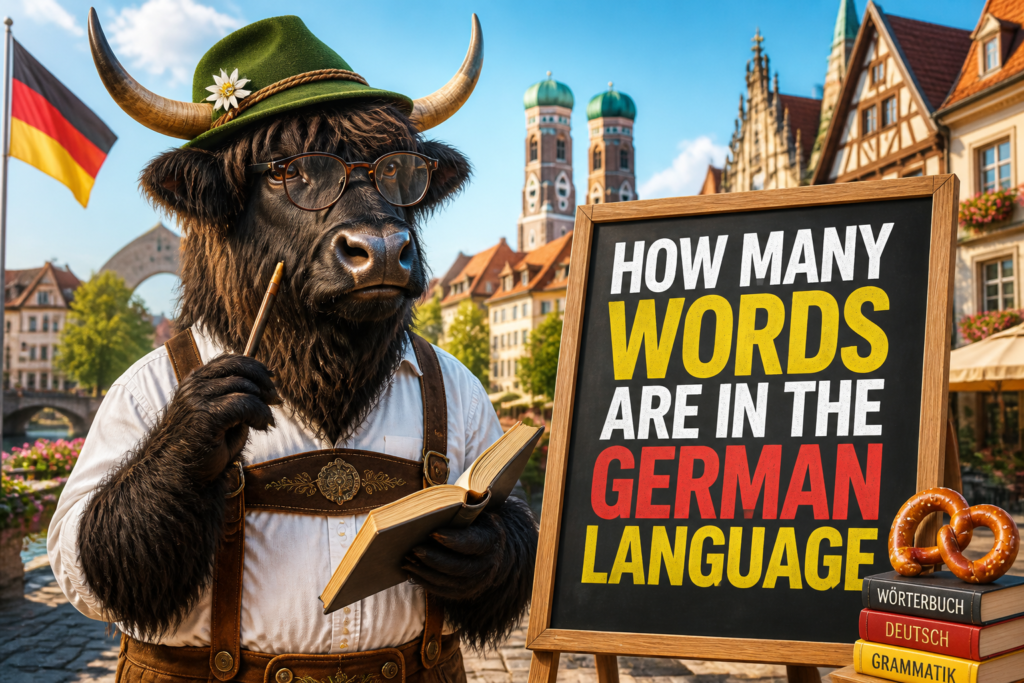
If German looks like a language that could casually build a 40-letter monster noun before breakfast, you are not imagining things. The short answer to How Many Words Are In The German Language? is: nobody knows exactly, because German keeps growing, borrowing, combining, and reinventing itself like it has no chill.
For the broader learning path, visit our parent guide.
Some counts focus on dictionary entries. Others count only everyday standard words. Others try to include technical terms, regional words, old words, slang, and compounds like Schadenfreude and Handschuh. That means the number changes depending on who is counting and what they count as a “word.”
So yes, the question sounds simple. German, naturally, refuses to make it easy.
The Short Answer
There is no single official number for how many words German has. Estimates vary a lot, but German is often described as having hundreds of thousands of words, and some estimates go higher when compounds and specialist vocabulary are included.
The biggest reason is that German can build new words very freely. Instead of always using a phrase, German often sticks smaller words together and creates a new one. It is very efficient. Also mildly rude to anyone trying to count everything by hand.
Why The Count Is So Hard
When people ask how many words German has, they usually mean one of these things:
- How many words are in a dictionary?
- How many words are used in everyday speech?
- How many technical words exist in science, law, medicine, and industry?
- How many compound words can be made?
- Do we count slang, regional words, and old-fashioned words too?
That last one is where the chaos starts. A language with productive compounding does not behave nicely for statistics. German is one of those languages.
German Can Build Words Like Lego
German often creates new nouns by combining existing words. That means the language can expand without needing a brand-new root word every time.
| German | Pronunciation | Meaning | Example Sentence | Translation | Learner Note |
|---|---|---|---|---|---|
| Hand | hahnt | hand | Ich hebe die Hand. | I raise my hand. | Basic noun, feminine in meaning but die Hand. |
| Schuh | shoo | shoe | Der Schuh ist neu. | The shoe is new. | der Schuh is masculine. |
| Handschuh | HAHNT-shoo | glove, literally “hand shoe” | Ich brauche warme Handschuhe. | I need warm gloves. | Plural: die Handschuhe. Great example of compounding. |
| Wort | vort | word | Dieses Wort ist wichtig. | This word is important. | das Wort, plural Wörter or Worte depending on meaning. |
| Wörterbuch | VUR-ter-bookh | dictionary, literally “word book” | Ich schaue im Wörterbuch nach. | I look it up in the dictionary. | Another compound. German loves these. |
That is the core reason counts get messy. If a language can keep combining building blocks, the list never really ends.
What Counts As A “Word” Anyway?
This is the boring-but-important part. Dictionaries usually count headwords, which are the main entries. But real language use includes much more:
- Standard words like Haus, gehen, schön
- Compound nouns like Krankenhaus or Arbeitszimmer
- Inflected forms like geht, ging, gegangen
- Technical terms in law, science, engineering, and medicine
- Regional words used in Germany, Austria, and Switzerland
- Slang and casual speech
- Old or rare words that are still listed in dictionaries
For learners, this matters because a dictionary number is not the same thing as the number of words you need to speak German well. In everyday life, a much smaller set does most of the work.
How Many Words Do You Need To Know?
Here is the more useful question. Not “How many words exist?” but “How many words do I need?”
For daily conversation, you can do a surprising amount with a few thousand common words and phrases. That is why learning the essential German words and phrases is a much better strategy than trying to memorize the entire language like a heroic spreadsheet goblin.
| Goal | Rough Vocabulary Range | What It Lets You Do | Learner Note |
|---|---|---|---|
| Survival German | 500–1,000 words | Basic greetings, food, travel, simple questions | Enough for “Please help me find the train station” energy. |
| Everyday conversation | 2,000–5,000 words | Family, work, shopping, routines, opinions | A very practical target for learners. |
| Comfortable reading | 5,000–10,000+ words | News, simple books, general articles | Context helps a lot here. |
| Advanced / professional use | 10,000+ words | Specialized topics, precise expression, nuance | Technical fields add a ton of words fast. |
Numbers like these are only rough guides. Still, they show something important: you do not need to “know all the German words” to communicate well. Happily, nobody does.
German Word Types That Make The Language Look Bigger
Some German words are especially good at making the language look enormous. Let’s meet the usual suspects.
| German | Pronunciation | Meaning | Example Sentence | Translation | Learner Note |
|---|---|---|---|---|---|
| zusammen | tsu-ZAH-men | together, combined | Wir lernen zusammen. | We are learning together. | Very common. Also appears in compounds. |
| zusammensetzen | tsu-ZAH-men-ZET-tsen | to put together | Die Teile lassen sich leicht zusammensetzen. | The parts can be put together easily. | Separable verb in many uses. |
| Arbeitsplatz | AR-bites-platz | workplace | Mein Arbeitsplatz ist heute im Büro. | My workplace is in the office today. | Compound noun: Arbeit + Platz. |
| Fernseher | FAIRN-zay-er | television set | Der Fernseher ist aus. | The TV is off. | Not the same as “television” as a concept; it is the device. |
| Bevölkerung | beh-fœL-keh-roong | population | Die Bevölkerung wächst. | The population is growing. | Useful in news and statistics. |
| Wissenschaft | VEE-sen-shaft | science | Wissenschaft ist wichtig. | Science is important. | Formal, broad term. |
| Hochschule | HOHKH-shoo-leh | university-level institution | Ich studiere an einer Hochschule. | I study at a university-level institution. | Can mean university or college of applied sciences depending on context. |
| Krankenhaus | KRAHN-ken-house | hospital | Er liegt im Krankenhaus. | He is in the hospital. | Literally “sick house.” Very German. |
These examples show a basic truth: German word-building can make vocabulary feel endless even when the core pieces are familiar.
Dictionary Words Versus Real-Life Words
Dictionary counts are useful, but they can be misleading. A dictionary may include old-fashioned words, specialist words, or rare regional forms that you may never hear in ordinary conversation.
On the other hand, real-life German includes everyday short forms, contractions, and spoken habits that dictionaries do not always highlight enough. So the language lives in two worlds: the neat world of reference books, and the messier world of actual humans talking fast over coffee.
For a solid learner-friendly source on meaning and usage, a boring reliable option like Duden is worth knowing. It is not glamorous, but it does the job without drama.
Why German Looks So Long
German often packs information into one word instead of using a whole phrase. That can make words look intimidating, but it also makes them very logical once you spot the parts.
| German | Pronunciation | Meaning | Example Sentence | Translation | Learner Note |
|---|---|---|---|---|---|
| Hauptbahnhof | HOWPT-bahn-hohf | main train station | Wir treffen uns am Hauptbahnhof. | We are meeting at the main train station. | Common travel word. Haupt = main, Bahn = rail, Hof = yard. |
| Schreibtisch | SHRYPE-tish | desk | Mein Schreibtisch ist voll. | My desk is full. | Literally “writing desk.” |
| Regenbogen | RAY-gen-boh-gen | rainbow | Nach dem Regen sieht man einen Regenbogen. | After the rain, you can see a rainbow. | Beautiful, simple compound. |
| Lebensmittel | LAY-bens-mit-tel | food, groceries | Ich kaufe Lebensmittel ein. | I am shopping for groceries. | Plural-looking word, but often used as a collective noun. |
| Haustür | HOWS-toor | front door, house door | Die Haustür ist offen. | The front door is open. | Easy compound: Haus + Tür. |
The fun part is that once you know the parts, long German words stop being scary and start being suspiciously practical.
How German Compares With English
English has a huge vocabulary too, partly because it borrowed from many languages over time. German also borrows words, especially in modern life, but it additionally loves compounding its own material. That makes the word stock feel very large.
English often uses phrases where German uses one compound noun. For example:
| English Idea | German Word | Pronunciation | Learner Note |
|---|---|---|---|
| train station | Bahnhof | BAHN-hohf | Simple and common. |
| shopping list | Einkaufsliste | EYE-n-kows-lis-teh | Very normal everyday compound. |
| birthday cake | Geburtstagstorte | geh-BOORTS-tags-tor-teh | Long, but logical. |
| armchair | Sessel | SEH-sel | Not a compound, but useful to know. |
This is one reason German can seem “full of words.” Some of those words are compact, specialized, and built from pieces learners already know.
Common German Word Count Myths
There are a few myths that pop up again and again.
- Myth: German has one exact official word count.
Reality: It does not. - Myth: Every compound noun is listed separately in a dictionary count.
Reality: It depends on the counting method. - Myth: If you know the most common 1,000 words, you know most of German.
Reality: You know a useful base, but context and grammar still matter a lot. - Myth: German is impossible because the words are too long.
Reality: Long words usually have visible parts, which is actually helpful once you get used to them.
German does not hide meaning in fancy decoration. It usually puts the pieces right in front of you. The trick is learning to read the pieces before the word laughs at you.
Pronunciation Helps With Big German Words
Long words feel less scary if you chunk them into pieces. That is not just a reading trick; it is also a pronunciation trick.
| German | Pronunciation Help | Meaning | Example Sentence | Translation | Learner Note |
|---|---|---|---|---|---|
| Schade | SHAH-deh | too bad, what a pity | Schade, ich kann nicht kommen. | Too bad, I can’t come. | Very common in speech. |
| Freude | FROY-deh | joy | Die Freude ist groß. | The joy is great. | eu sounds like “oy.” |
| Schadenfreude | SHAH-den-froy-deh | joy at someone else’s misfortune | Das Wort Schadenfreude gibt es auch im Englischen. | The word Schadenfreude also exists in English. | Famous loanword. Not exactly a goal in life, obviously. |
| Wahrscheinlichkeit | VAH-shayn-likh-kite | probability | Die Wahrscheinlichkeit ist hoch. | The probability is high. | Break it into chunks when reading. |
| Unabhängigkeit | OON-up-HENG-ee-kite | independence | Unabhängigkeit ist wichtig. | Independence is important. | ä often sounds like a short “e” in this kind of word. |
If you want more practice with tricky sounds and famous tongue-twisters, the hardest German words to pronounce is a useful next stop. It is basically a playground for your mouth, with a little danger.
A Quick Look At Helpful Word-Family Patterns
German words often come in families. Learn one base word, and you can often understand several related words.
| Base Word | Related Word | Meaning | Example Sentence | Translation | Learner Note |
|---|---|---|---|---|---|
| arbeiten | Arbeit | to work / work | Ich arbeite heute. | I am working today. | Verb and noun from same root. |
| lernen | der Lerner | to learn / learner | Ich lerne Deutsch. | I am learning German. | Common root for study-related words. |
| fahren | die Fahrt | to drive, ride / trip, journey | Die Fahrt dauert lang. | The trip takes a long time. | Meaning changes by form. |
| sprechen | die Sprache | to speak / language | Ich spreche Deutsch. | I speak German. | Useful root for language words. |
| sehen | ansichtlich | to see / visible, apparent | Das ist offensichtlich. | That is obvious. | Related forms can be very handy. |
Mini Practice: Spot The Word-Building
Try breaking these words into parts. You do not need perfect grammar knowledge yet. Just see the pieces.
- Krankenhaus = sick + house → hospital
- Bahnhof = rail + yard → train station
- Schreibtisch = writing + desk → desk
- Einkaufsliste = shopping + list → shopping list
- Regenbogen = rain + bow → rainbow
Now try these on your own:
- What parts do you see in Arbeitsplatz?
- What parts do you see in Handschuh?
- What parts do you see in Geburtstag?
- What parts do you see in Fußball?
Answer key: Arbeit + Platz, Hand + Schuh, Geburt + Tag, Fuß + Ball.
Useful Related Phrases About Words And Language
These phrases are handy if you want to talk about language learning, vocabulary, or just German being German.
| German | Pronunciation | Meaning | Example Sentence | Translation | Learner Note |
|---|---|---|---|---|---|
| das Wort | das vort | the word | Was bedeutet das Wort? | What does the word mean? | Useful for dictionary work. |
| die Bedeutung | dee beh-DEW-toong | meaning | Die Bedeutung ist klar. | The meaning is clear. | Common in explanations. |
| der Wortschatz | dair VORT-shahts | vocabulary | Mein Wortschatz wächst langsam. | My vocabulary is growing slowly. | Literally “word treasure.” Nice, right? |
| die Aussprache | dee OWSS-shprah-kheh | pronunciation | Die Aussprache ist schwierig. | The pronunciation is difficult. | Very useful when learning new words. |
| die Sprache | dee SHPRAH-kheh | language | Deutsch ist eine schöne Sprache. | German is a beautiful language. | die Sprache is feminine. |
| das Fremdwort | das FREHMT-vort | loanword, foreign word | Dieses Wort ist ein Fremdwort. | This word is a loanword. | Good for vocabulary discussions. |
| der Ausdruck | dair OWSS-drook | expression | Das ist ein nützlicher Ausdruck. | That is a useful expression. | Very common in learning materials. |
| die Vokabel | dee voh-KAH-bel | vocabulary item, word | Ich lerne neue Vokabeln. | I am learning new vocabulary items. | Plural often used in language learning. |
| der Begriff | dair beh-GRIF | term, concept | Der Begriff ist wichtig. | The term is important. | Useful in academic or formal contexts. |
| die Zusammensetzung | dee tsu-ZAH-men-zeh-tsung | composition, combination | Die Zusammensetzung ist logisch. | The composition is logical. | Handy when talking about compounds. |
Good To Know: Germany, Austria, And Switzerland
When people talk about “German,” they often mean standard German used in Germany. But German is spoken across several countries, and some words differ by region.
That does not massively change the total number of words, but it does affect how big the vocabulary feels in real life. Austria and Switzerland have their own common words, preferences, and everyday expressions.
| Region | What Changes | Example | Learner Note |
|---|---|---|---|
| Germany | Standard everyday vocabulary is the default reference point. | Brötchen for a bread roll | Most beginner materials use this variety. |
| Austria | Some food, everyday, and school words differ. | Semmel for a bread roll | Totally normal in Austria. |
| Switzerland | Some standard words differ, and Swiss German dialects are very distinct in speech. | Velo for bicycle | Written standard German still exists, but spoken Swiss German is its own beast. |
So if two learners say different words for the same thing, that does not mean one of them is wrong. It usually means German is doing its multilingual regional thing again.
Common Learner Questions About German Word Counts
Here are the questions that come up most often.
| Question | Short Answer | Learner Note |
|---|---|---|
| Is German one of the biggest vocabularies in the world? | It is often described that way, but exact comparisons are tricky. | Different languages are counted in different ways. |
| Do German compounds count as separate words? | Sometimes yes, sometimes no, depending on the method. | That is why estimates vary so much. |
| Is German harder because there are so many words? | Not really. Grammar and word formation matter more than raw number. | The system is the challenge, not just the size. |
| Should beginners worry about the total number? | No. Focus on high-frequency vocabulary first. | That is how fluency actually starts. |
For a bigger picture of what to learn first, the German learning hub is a good place to branch out once vocabulary starts feeling less like a storm and more like a map.
Quick Reference Summary
- No exact official number exists for the total number of German words.
- Compounding makes German vocabulary seem especially large.
- Dictionary counts and real-life counts are not the same thing.
- Everyday German uses a much smaller set of core words than the full language inventory.
- Learning the most common words and phrases is far more useful than chasing the total count.
- German looks huge, but a lot of that hugeness is built from familiar pieces.
If you want to keep going, try the beautiful cool German words guide for fun vocabulary, or the essential German words and phrases article for the stuff that actually shows up in real life.
Yak takeaway: German does not have one neat official word count, because the language keeps making new words like it has a personal grudge against tidy statistics. But that is also the good news: once you learn the common building blocks, the vocabulary starts looking less like a mountain and more like a very determined pile of Lego.