
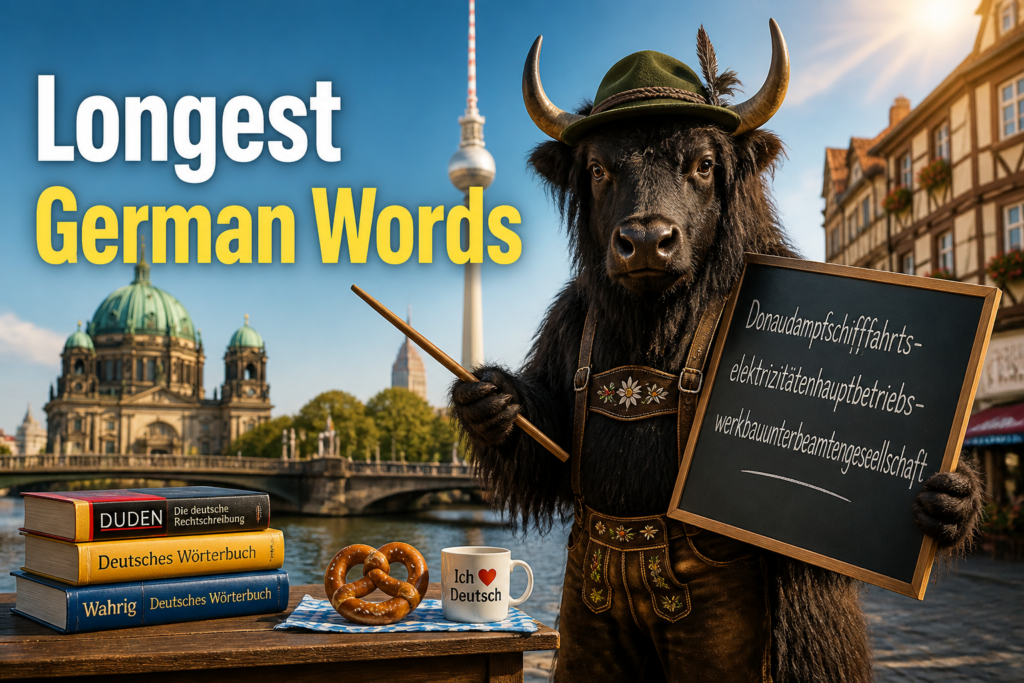
German has a reputation for long words, and honestly, it earns it. Sometimes the length is practical, sometimes it is gloriously ridiculous, and sometimes it looks like a keyboard fell into a dictionary and nobody stopped it.
For the broader learning path, visit our parent guide.
The good news: long German words are not random. They are usually built from smaller words glued together. Once you can spot the pieces, the monster starts looking a lot less scary and a lot more logical.
By the end of this article, you will understand how long German words work, how to read them, how to break them apart, and why native speakers can still say them without needing emergency medical support.
How many words are in German? is a fun question, but long words are a more useful one if you want to decode real German. And if pronunciation is your nemesis, pair this with hardest German words to pronounce and shortest German words for the full size spectrum.
Why German Words Get So Long
German loves compounds. That means two or more words can join together to make one very long word. English does this too, but German does it more openly and more often. Instead of writing “the law for the registration of vehicles,” German may pack the whole idea into one tidy monster.
The structure is usually simple: start with the main idea, then keep adding detail at the front. The last word is the key one. That last part tells you what the whole word actually is.
Yak wisdom: In German, the last word is the boss. Everything before it is just staff.
How To Read A Long German Word
The trick is to split the word into smaller pieces. Once you find the base noun, the whole thing usually makes sense. You do not need to memorize the entire monster at once. Good news: your brain is not a suitcase.
- Look for smaller nouns inside the big word.
- Find the final noun first.
- Translate the pieces from right to left.
- Watch for linking letters like -s-, -n-, or -es-.
- Do not panic if the word looks absurd. That is normal German behavior.
Example: Hauptbahnhof = Haupt (main) + Bahnhof (train station) = main train station.
Useful Long German Words You Will Actually Meet
These are not all record-breakers. They are just the kind of long words that show up in real life, on signs, in newspapers, and occasionally to humble learners in public.
| German | Pronunciation | Meaning | Example Sentence | Translation | Learner Note |
|---|---|---|---|---|---|
| Hauptbahnhof | HOWPT-bahn-hohf | main train station | Wir treffen uns am Hauptbahnhof. | We are meeting at the main train station. | Very common in cities. The last word, Bahnhof, tells you it is a station. |
| Krankenhaus | KRAHN-ken-house | hospital | Sie arbeitet im Krankenhaus. | She works in the hospital. | It looks long, but it is everyday vocabulary. |
| Handschuh | HAHNT-shoo | glove | Ich brauche warme Handschuhe. | I need warm gloves. | Literally “hand shoe.” German is not subtle. |
| Fußball | FOOS-bahl | football / soccer | Er spielt gern Fußball. | He likes playing soccer. | Very common. Note the ß sound like “ss.” |
| Regenbogen | RAY-gen-boh-gen | rainbow | Nach dem Regen kam ein Regenbogen. | After the rain, a rainbow appeared. | Two easy nouns glued together. |
| Lebensmittel | LAY-bens-mit-tel | food, groceries | Ich kaufe Lebensmittel im Supermarkt. | I buy groceries in the supermarket. | Often used in stores and on packaging. |
| Arbeitsplatz | AR-bites-plats | workplace, job position | Mein Arbeitsplatz ist klein, aber hell. | My workplace is small, but bright. | Can mean the physical place or the job itself, depending on context. |
| Schreibmaschine | SHRYP-ma-shee-neh | typewriter | Die alte Schreibmaschine steht im Museum. | The old typewriter is in the museum. | More historical than daily life, but a nice compound word. |
| Weltmeisterschaft | VELT-my-ster-shaft | world championship | Die Weltmeisterschaft beginnt im Juni. | The world championship begins in June. | Great example of how German stacks meaning neatly. |
| Versicherung | fehr-SEEH-roong | insurance | Ich habe eine gute Versicherung. | I have good insurance. | Watch the pronunciation: the stress is on the middle syllable. |
| Wohnungstür | VOH-noongs-toor | apartment door | Bitte schließen Sie die Wohnungstür. | Please close the apartment door. | The s is a linking sound. Compounds often do this. |
| Steuererklärung | SHTOY-er-er-kleh-roong | tax return | Ich muss meine Steuererklärung machen. | I have to do my tax return. | Not cheerful, but very useful adult vocabulary. |
| Umweltverschmutzung | OOM-velt-fer-SHMOOT-soong | environmental pollution | Umweltverschmutzung ist ein großes Problem. | Environmental pollution is a big problem. | Formal but common in articles and news. |
| Datenschutz | DAH-ten-shoots | data protection, privacy protection | Datenschutz ist in Deutschland wichtig. | Data protection is important in Germany. | Very relevant online and in official contexts. |
| Geburtstagsparty | geh-BOORTS-tahks-pahr-tee | birthday party | Sie geht heute zur Geburtstagsparty. | She is going to the birthday party today. | Casual and easy to split into smaller parts. |
Notice how the words stay readable once you know the building blocks. German compounds often feel intimidating only until you realize they are basically LEGO with grammar rules.
Famous Long German Words And What They Mean
Some long German words became famous because they are enormous, not because people use them every day. Still, they are perfect for spotting how compounding works.
| German | Pronunciation | Meaning | Example Sentence | Translation | Learner Note |
|---|---|---|---|---|---|
| Rindfleischetikettierungsüberwachungsaufgabenübertragungsgesetz | RINT-flysh-eh-tee-ket-TEER-oongs-oo-ber-VAH-hoongs-OWF-gah-ben-oo-ber-TRAH-goongs-ge-ZETS | law about delegation of supervision of cattle marking | Dieses Wort ist berühmt, aber im Alltag fast nie nötig. | This word is famous, but almost never needed in daily life. | Yes, it is a real example from German word history. No, you do not need to memorize it. |
| Donaudampfschifffahrtsgesellschaftskapitän | DOY-now-dahmpf-SHIF-fahrts-ge-ZEL-shafts-kah-pi-TAIN | Danube steamship company captain | Der Donaudampfschifffahrtsgesellschaftskapitän klingt wie ein Witz. | The Danube steamship company captain sounds like a joke. | Classic long-word showpiece. Realistic? Not much. Memorable? Absolutely. |
| Rechtsschutzversicherungsgesellschaften | REKHTS-shoots-fer-ZEEH-roongs-ge-ZEL-shaf-ten | legal protection insurance companies | Rechtsschutzversicherungsgesellschaften sind schwer auszusprechen. | Legal protection insurance companies are hard to pronounce. | Good example of stacked compounds in plural form. |
These words are mostly famous because they look like they are trying to win a competition. Real German is usually less dramatic, but the same logic applies.
Grammar And Spelling Tricks Behind Long Words
Long German words are easier when you know a few spelling habits. These are not exotic grammar dragons. They are just the usual German pieces doing their jobs in a longer line.
- Nouns are capitalized. That helps you spot the building blocks.
- Compound words are usually written as one word. No spaces in the middle.
- Linking letters like -s-, -n-, or -es- can connect parts smoothly.
- The final noun controls the gender. For example, die Versicherung stays feminine even in a compound.
- Plural endings usually attach to the whole compound, not the first part.
| Pattern | Meaning | German Example | English Translation | Learner Note |
|---|---|---|---|---|
| Last noun decides gender | The final word sets der / die / das | die Wohnungstür | the apartment door | Tür is feminine, so the full compound is feminine. |
| Linking letter -s- | Shows connection between parts | Arbeitsplatz | workplace | That s does not mean “of.” It just helps the compound flow. |
| Plural at the end | Plural belongs to the whole word | die Handschuhe | the gloves | Singular is der Handschuh; plural adds -e. |
A tiny warning: long German words are often easier to understand than to pronounce. The spelling gives you clues, but your mouth still has to do actual work. Rude, but fair.
For a boring but reliable reference on compound nouns, the Duden dictionary is always there, quietly doing grammar’s accounting work.
Pronunciation Tips For Long German Words
When a word gets long, do not try to swallow it in one giant bite. Break it into chunks and say each chunk clearly. German speakers do this naturally, and so can you.
- Stress usually falls on the first main part of the compound or the most important root.
- Keep vowels clean. German vowels are usually more stable than English vowels.
- Final consonants may sound “devoiced.” That means b can sound closer to p, d to t, and g to k at the end of a syllable.
- Watch the “ch” sound in words like Krankenhaus or Steuererklärung if the word includes it.
- Do not overpronounce every internal boundary. Smooth is better than robotic.
Example chunking: Steuer-er-klä-rung instead of one terrifying blur. Your mouth will thank you, if only reluctantly.
If pronunciation is the main headache, compare this topic with hardest German words to pronounce. Long does not always mean hard, and hard does not always mean long. German likes to keep life interesting.
Germany, Austria, And Switzerland: Any Difference?
For long compound words, standard German works the same across Germany, Austria, and Switzerland most of the time. The style may sound a little more formal in official language, and some everyday vocabulary choices vary by region, but the compounding habit itself is shared.
- Germany: very common to form compounds in news, admin language, and everyday speech.
- Austria: compounds are normal too, though some everyday words differ.
- Switzerland: compounds are also standard, but spelling and usage may differ in some cases, especially with ß not being used.
So yes, the long-word factory is a shared German-speaking hobby. Very wholesome. Very intense.
Practice: Break The Monster Apart
Try splitting these words into smaller parts. Then read the meaning aloud. Slow is fine. Confident is better. Panic is optional.
- Hauptbahnhof = __________________
- Regenbogen = __________________
- Lebensmittel = __________________
- Arbeitsplatz = __________________
- Wohnungstür = __________________
- Steuererklärung = __________________
Check yourself:
- Hauptbahnhof = main + train station
- Regenbogen = rain + bow
- Lebensmittel = life + means/foods, meaning groceries
- Arbeitsplatz = work + place
- Wohnungstür = apartment + door
- Steuererklärung = tax + explanation, meaning tax return
And yes, some of these are more logical in German than in English. That is the moment where German smugly pretends it is helping.
Mini Spot-The-Difference Challenge
| Word | Meaning | What Changes? |
|---|---|---|
| Haus | house | base word |
| Krankenhaus | hospital | adds kranken to show illness |
| Wohnung | apartment | base word |
| Wohnungstür | apartment door | adds Tür as the final noun |
| Tag | day | base word |
| Geburtstag | birthday | adds Geburt to make a special day |
Spotting the final noun is the fastest way to decode many long German words. Once you can do that, the whole language feels less like a wall and more like a trail of breadcrumbs.
Common Mistakes Learners Make
- Trying to translate from left to right only. In German compounds, the end matters most.
- Adding spaces where there should be none. German compounds usually stay closed up.
- Forgetting gender comes from the last noun.
- Ignoring linking letters. That missing -s- can make a word look confusing.
- Pronouncing everything like English. German vowels and stress patterns are different.
Fixes are simple: find the last noun, split the pieces, say them slowly, then speed up once the pattern feels natural. That is the whole game. No smoke machine required.
Quick Reference Summary
- German long words are usually compounds made from smaller words.
- The last noun is the most important part.
- Compounds are often written as one word.
- Linking letters like -s- help the word flow.
- Pronunciation gets easier when you split the word into chunks.
- The gender of the whole compound usually comes from the final noun.
- Long does not automatically mean hard. It just looks dramatic.
If you can read one long German compound, you can read many. That is the lovely part: the language looks like a beast, but it often behaves like a puzzle. A weird, slightly smug puzzle, but still a puzzle.
For more German language fun, continue with shortest German words, revisit how many words are in German, or compare your pronunciation courage with hardest German words to pronounce. Yak takeaway: long German words are just smaller words wearing a trench coat.