


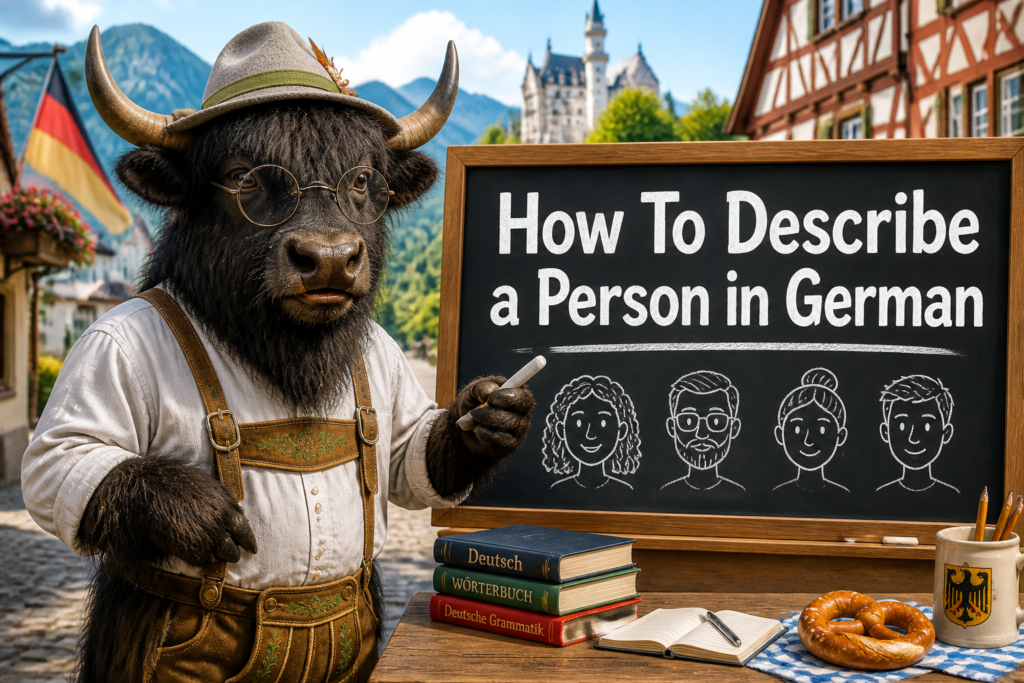
Describing a person in German is one of those skills that sounds simple until you try to do it and suddenly your brain is juggling gender, adjective endings, and whether groß means “tall” or “big.” Very helpful. Very German.
For the broader learning path, visit our parent guide.
The good news: once you know a few core patterns, you can describe almost anyone clearly — their appearance, personality, style, age, and overall vibe. By the end of this guide, you’ll be able to say what someone looks like, what they’re like as a person, and how to sound natural doing it.
If you also want a quick refresher on articles, the usual German noun business, and why der / die / das keeps showing up like an overenthusiastic guest, have a look at German Articles Explained. And if you’re just getting started with people and introductions, Introduce Yourself in German is a good companion lesson.
Core Pattern: Appearance, Then Character
In everyday German, people usually start with appearance and then move to personality. You can also reverse that if the situation calls for it. The basic pattern is simple:
Er / Sie ist + adjective
Examples:
- Er ist groß. — He is tall.
- Sie ist freundlich. — She is friendly.
- Er hat dunkle Haare. — He has dark hair.
- Sie hat blaue Augen. — She has blue eyes.
Small but important detail: German often uses haben for body features and sein for general qualities. English doesn’t always do this in the same way, so yes, your brain gets to do a tiny stretch first.
Useful Vocabulary For Appearance
| German | Pronunciation | Meaning | Example Sentence | Translation | Learner Note |
|---|---|---|---|---|---|
| groß | gros | tall / big | Mein Bruder ist groß. | My brother is tall. | For people, groß usually means “tall.” |
| klein | kline | short / small | Das Kind ist klein. | The child is small. | For people, often “short” in height. |
| jung | yoong | young | Sie ist noch jung. | She is still young. | Very common in description and age talk. |
| alt | ahlt | old | Er ist alt, aber fit. | He is old, but fit. | Can sound blunt. Use carefully with people. |
| schlank | shlangk | slim | Sie ist schlank. | She is slim. | Neutral and common. |
| dick | dik | fat / thick | Der Hund ist dick. | The dog is fat. | Can be rude for people. Be careful. |
| sportlich | SHPORT-lich | athletic / sporty | Er sieht sportlich aus. | He looks athletic. | Often used with aussehen. |
| attraktiv | at-trak-TEEF | attractive | Sie ist sehr attraktiv. | She is very attractive. | Direct but normal in German. |
| hübsch | huepsh | pretty / nice-looking | Das ist ein hübsches Kleid. | That is a pretty dress. | Often used for women, children, things. |
| elegant | eh-leh-GANT | elegant | Sie sieht elegant aus. | She looks elegant. | Good for style and appearance. |
| gut aussehend | goot OWSS-zay-end | good-looking | Er ist sehr gut aussehend. | He is very good-looking. | More formal than everyday chat. |
| eine Brille tragen | INEH BRIL-uh TRAH-gen | to wear glasses | Sie trägt eine Brille. | She wears glasses. | tragen is common for clothes and glasses. |
Useful Phrases For Hair, Eyes, And Face
| German | Pronunciation | Meaning | Example Sentence | Translation | Learner Note |
|---|---|---|---|---|---|
| braune Haare | BROWN-uh HAH-reh | brown hair | Sie hat braune Haare. | She has brown hair. | Haare is plural in German. |
| blonde Haare | BLON-duh HAH-reh | blond hair | Er hat blonde Haare. | He has blond hair. | German often uses the plural Haare. |
| schwarze Haare | SHVAR-tsuh HAH-reh | black hair | Sie hat schwarze Haare. | She has black hair. | Adjective ending changes because of plural noun. |
| lockige Haare | LOK-ih-guh HAH-reh | curly hair | Er hat lockige Haare. | He has curly hair. | lockig = curly. |
| glatte Haare | GLA-tuh HAH-reh | straight hair | Sie hat glatte Haare. | She has straight hair. | Very common description word. |
| blaue Augen | BLOW-eh OW-gen | blue eyes | Er hat blaue Augen. | He has blue eyes. | Augen is plural too. |
| grüne Augen | GRUE-nuh OW-gen | green eyes | Sie hat grüne Augen. | She has green eyes. | The ü sound is rounded. Not “gree-neh.” |
| helle Haut | HEL-uh howt | light skin | Er hat helle Haut. | He has light skin. | Use carefully and respectfully. |
| ein Bart | INE bart | a beard | Er hat einen Bart. | He has a beard. | Bart is masculine: der Bart. |
| ein Schnurrbart | SHNOOR-bart | a mustache | Er hat einen Schnurrbart. | He has a mustache. | Long-ish word, very German. Of course it is. |
A quick pronunciation note: au sounds like “ow” in Augen, ei sounds like “eye,” and sch sounds like “sh.” German spelling is often friendlier than it first looks — it just likes to act mysterious.
Useful Phrases For Character And Personality
| German | Pronunciation | Meaning | Example Sentence | Translation | Learner Note |
|---|---|---|---|---|---|
| freundlich | FROYN-dlich | friendly | Die Verkäuferin ist freundlich. | The sales assistant is friendly. | Neutral and very useful. |
| nett | net | nice | Er ist nett zu allen. | He is nice to everyone. | Common everyday word. |
| lustig | LOOS-tikh | funny | Sie ist sehr lustig. | She is very funny. | Can also mean “amusing” or “odd,” depending on context. |
| ruhig | ROO-ikh | quiet / calm | Das Kind ist ruhig. | The child is quiet. | Great for people and situations. |
| schüchtern | SHUEKH-tern | shy | Er ist am Anfang etwas schüchtern. | He is a little shy at first. | The ü matters here. |
| selbstbewusst | ZELBST-beh-VUSST | confident | Sie wirkt sehr selbstbewusst. | She seems very confident. | Common in character descriptions. |
| intelligent | in-tel-LEE-gent | intelligent / smart | Er ist sehr intelligent. | He is very intelligent. | Standard and useful. |
| ehrlich | AIR-likh | honest | Sie ist immer ehrlich. | She is always honest. | Good for describing trustworthiness. |
| hilfsbereit | HILFS-beh-rite | helpful | Mein Kollege ist hilfsbereit. | My colleague is helpful. | Very common in school and work contexts. |
| faul | fowl | lazy | Er ist heute faul. | He is lazy today. | Can sound harsh. Use carefully. |
| freundlich und offen | FROYN-dlich oont OFF-en | friendly and open | Sie wirkt freundlich und offen. | She seems friendly and open. | Useful for first impressions. |
| streng | shtreng | strict | Der Lehrer ist streng. | The teacher is strict. | Very common in family and school talk. |
How To Say “He Looks…” And “She Seems…”
German loves the verb aussehen. It literally means “to look” in the sense of appearance.
| Pattern | Meaning | German Example | English Translation | Learner Note |
|---|---|---|---|---|
| Er sieht … aus. | He looks … | Er sieht müde aus. | He looks tired. | aussehen is a separable verb. The aus goes to the end. |
| Sie sieht … aus. | She looks … | Sie sieht freundlich aus. | She looks friendly. | Very common in everyday German. |
| Er wirkt … | He seems … | Er wirkt nett. | He seems nice. | wirken = seem / give the impression. |
| Sie scheint … | She seems … | Sie scheint nervös. | She seems nervous. | A bit more analytical or careful in tone. |
Er sieht gut aus. does not mean “He sees himself well.” It means “He looks good.” German is helpful like that, after it decides to hide the verb in two pieces.
Real-Life Descriptions You Can Actually Use
Here are natural full sentences you can use when describing a friend, colleague, classmate, or someone in a photo. These are the kinds of sentences that come up in introductions, small talk, and “Who was that again?” moments.
| German | Pronunciation | Meaning | Example Sentence | Translation | Learner Note |
|---|---|---|---|---|---|
| Er ist ziemlich groß und schlank. | air ist TSEE-mikh gros oont shlangk | He is fairly tall and slim. | Er ist ziemlich groß und schlank. | He is fairly tall and slim. | ziemlich = quite / fairly. |
| Sie hat kurze blonde Haare. | zee hat KOORT-suh BLON-duh HAH-reh | She has short blond hair. | Sie hat kurze blonde Haare. | She has short blond hair. | Adjective endings matter here, yes, even in simple phrases. |
| Er trägt eine Brille und hat blaue Augen. | air trairgt IN-uh BRIL-uh oont hat BLOW-eh OW-gen | He wears glasses and has blue eyes. | Er trägt eine Brille und hat blaue Augen. | He wears glasses and has blue eyes. | Great basic description pattern. |
| Sie sieht sehr elegant aus. | zee zeet zair eh-leh-GANT ows | She looks very elegant. | Sie sieht sehr elegant aus. | She looks very elegant. | Common with clothes, style, and posture. |
| Er ist freundlich, aber etwas ruhig. | air ist FROYN-dlich AH-ber ET-was ROO-ikh | He is friendly, but a bit quiet. | Er ist freundlich, aber etwas ruhig. | He is friendly, but a bit quiet. | Use aber to connect two traits naturally. |
| Sie ist selbstbewusst und offen. | zee ist ZELBST-beh-vusst oont OFF-en | She is confident and open. | Sie ist selbstbewusst und offen. | She is confident and open. | Good for personality and first impressions. |
| Er wirkt sehr intelligent. | air virst zair in-tel-LEE-gent | He seems very intelligent. | Er wirkt sehr intelligent. | He seems very intelligent. | wirken often sounds a little more observant. |
| Sie ist nett und hilfsbereit. | zee ist net oont HILFS-beh-rite | She is nice and helpful. | Sie ist nett und hilfsbereit. | She is nice and helpful. | Two very safe character words. |
| Er hat einen Bart und dunkle Haare. | air hat IN-en bart oont DOON-kluh HAH-reh | He has a beard and dark hair. | Er hat einen Bart und dunkle Haare. | He has a beard and dark hair. | einen Bart shows accusative case after haben. |
| Sie ist nicht sehr groß, aber sehr freundlich. | zee ist nikhht zair gros, AH-ber zair FROYN-dlich | She is not very tall, but very friendly. | Sie ist nicht sehr groß, aber sehr freundlich. | She is not very tall, but very friendly. | nicht negates the adjective phrase. |
Helpful Grammar: Adjective Endings In Simple Descriptions
When an adjective comes before a noun, it often changes ending. That’s the part that makes learners mutter things under their breath. Fair enough.
| Pattern | Meaning | German Example | English Translation | Learner Note |
|---|---|---|---|---|
| ein guter Freund | a good friend | Er ist ein guter Freund. | He is a good friend. | With ein, the adjective often gets -er in masculine nominative. |
| eine freundliche Frau | a friendly woman | Sie ist eine freundliche Frau. | She is a friendly woman. | With eine, feminine adjectives often take -e. |
| der nette Mann | the nice man | Er ist der nette Mann. | He is the nice man. | Definite articles change the adjective ending too. |
| schöne Augen | beautiful eyes | Sie hat schöne Augen. | She has beautiful eyes. | Plural adjective endings are often simpler than they look. |
For person descriptions, you don’t need to master every adjective ending at once. Start by recognizing the most common patterns: ein guter Freund, eine nette Kollegin, schöne Augen, freundliche Leute. That already gets you a long way.
Noun Gender You’ll Actually Need
Some people words are easy to guess, others are German just being German. Here are a few useful nouns for describing someone:
| German | Pronunciation | Meaning | Example Sentence | Translation | Learner Note |
|---|---|---|---|---|---|
| der Mann | der mahN | the man | Der Mann ist freundlich. | The man is friendly. | Masculine noun. |
| die Frau | dee frow | the woman | Die Frau ist nett. | The woman is nice. | Feminine noun. |
| das Kind | das kint | the child | Das Kind ist schüchtern. | The child is shy. | Neuter noun. |
| der Junge | der YUHN-guh | the boy | Der Junge ist klein. | The boy is small. | Ends in -e, but still masculine. |
| das Mädchen | das MAIRKH-en | the girl | Das Mädchen ist ruhig. | The girl is calm. | Neuter in German. Yes, really. |
| der Freund / die Freundin | der froynt / dee FROYN-din | male friend / female friend | Mein Freund ist lustig. | My friend is funny. | Can also mean boyfriend/girlfriend depending on context. |
| der Kollege / die Kollegin | der koh-LEH-guh / dee koh-LEH-gin | male colleague / female colleague | Meine Kollegin ist hilfsbereit. | My colleague is helpful. | Great for work descriptions. |
| die Person | dee pair-ZON | the person | Die Person ist sehr höflich. | The person is very polite. | Feminine in German. |
Mini Practice: Describe These People
Try building your own descriptions using the words above. Don’t worry about sounding like a novel. Simple, clear German is a win.
- 1. Describe a tall, friendly man with brown hair.
- 2. Describe a shy woman with blue eyes.
- 3. Describe a confident friend who wears glasses.
- 4. Describe a child who is small and quiet.
- 5. Describe someone who looks elegant and smart.
Possible answers:
| Task | Possible German Answer | English Translation | Learner Note |
|---|---|---|---|
| 1 | Er ist groß, freundlich und hat braune Haare. | He is tall, friendly, and has brown hair. | Nice basic sentence with haben. |
| 2 | Sie ist schüchtern und hat blaue Augen. | She is shy and has blue eyes. | Very common description structure. |
| 3 | Mein Freund ist selbstbewusst und trägt eine Brille. | My friend is confident and wears glasses. | trägt is the 3rd person singular form of tragen. |
| 4 | Das Kind ist klein und ruhig. | The child is small and quiet. | Simple adjective chain with und. |
| 5 | Sie sieht elegant und intelligent aus. | She looks elegant and intelligent. | Great example of aussehen with two adjectives. |
Common Mistakes And Easy Fixes
| Mistake | Correct Form | Why |
|---|---|---|
| Sie ist groß Haare. | Sie hat große Haare. | Use haben for hair, and the adjective must match the noun. |
| Er ist aussehen gut. | Er sieht gut aus. | aussehen is separable: verb first, aus at the end. |
| Er hat braun Haare. | Er hat braune Haare. | Plural noun + adjective ending. |
| Das Frau ist nett. | Die Frau ist nett. | Frau is feminine, so it takes die. |
| Er ist dick. when you mean “he is chubby” | Er ist etwas kräftig. or Er ist etwas füllig. | dick can sound rude for people. |
| Sie hat die blaue Augen. | Sie hat blaue Augen. | Plural often uses no article in this type of description. |
| Er ist ein freundlich Mann. | Er ist ein freundlicher Mann. | Adjective ending changes after ein. |
If you want a reliable dictionary check for any word in this lesson, Duden is the boring-but-trustworthy option. A classic. Not exciting. Very German.
Germany, Austria, And Switzerland: Any Differences?
For describing people, standard German is understood everywhere. Most of the words in this guide work across Germany, Austria, and Switzerland.
| Word / Phrase | Germany | Austria | Switzerland | Note |
|---|---|---|---|---|
| hübsch | common | common | common | Safe choice everywhere. |
| nett | common | common | common | Very broadly useful. |
| ehrlich | common | common | common | Good for personality and trust. |
| schick | common | common | common | Means stylish / smart-looking. |
| korpulent | formal | formal | formal | Polite, older, or more official than dick. |
In Switzerland, people may use some local words in casual speech, but for describing a person, standard German vocabulary is still your safest bet. No drama required.
Quick Reference: Best Words To Remember
- groß = tall
- klein = short / small
- freundlich = friendly
- nett = nice
- schüchtern = shy
- selbstbewusst = confident
- intelligent = intelligent
- lustig = funny
- hat … Haare = has … hair
- sieht … aus = looks …
- trägt eine Brille = wears glasses
- hat blaue Augen = has blue eyes
One more handy thing: German loves compound descriptions like freundlich, hilfsbereit, and selbstbewusst. They pack a lot of meaning into one word, which is efficient if mildly suspicious.
If you want to keep building your German conversation skills, the next smart step is combining these descriptions with greetings, introductions, and basic sentence patterns. Start simple, say it clearly, and don’t let adjective endings boss you around too much.
Yak takeaway: In German, describe people with sein for traits, haben for features, and aussehen for how they look. Keep it simple, keep it natural, and let the grammar do the tiny bit of sweating for you.