
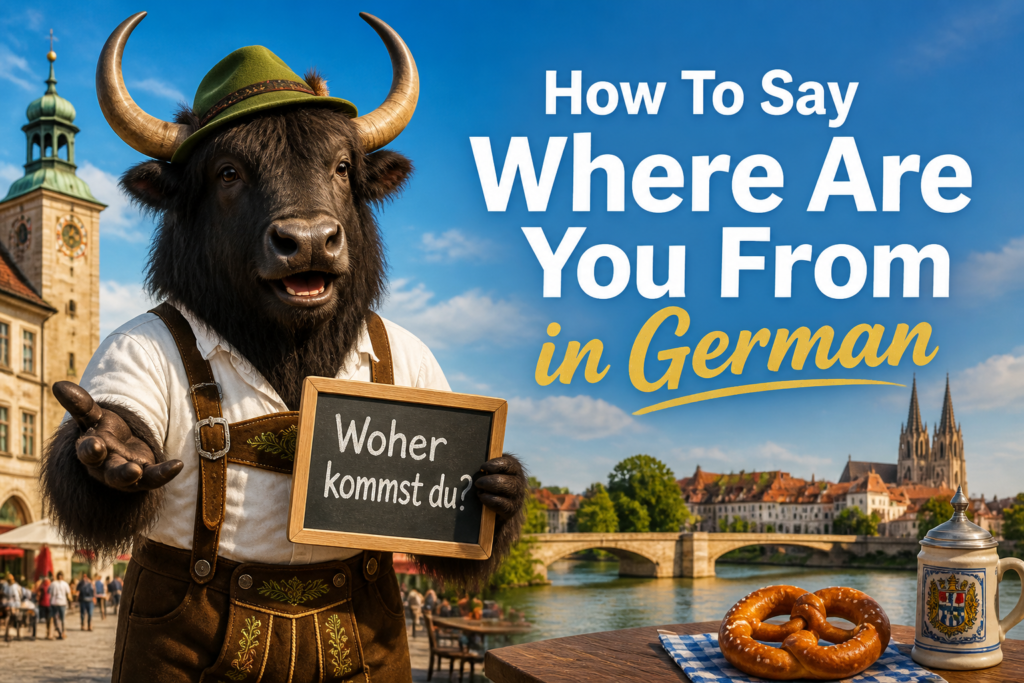
If you learn just one small conversation starter in German, make it this one. “Where are you from?” comes up fast—at language exchanges, in hostels, at work, on trains, and in every awkward “So… what do you do?” conversation humanity has ever invented.
The good news: German gives you a few clean, natural ways to ask it. The slightly annoying news: the “best” version depends on how formal, casual, or friendly the situation is. German, naturally, refuses to keep things boring.
By the end of this guide, you’ll know how to ask where are you from?, how to answer it, and how to keep the conversation going without sounding like a textbook with a headset mic.
The Main Ways To Say It
The most common everyday question is:
| German | Pronunciation | Meaning | Example Sentence | Translation | Learner Note |
|---|---|---|---|---|---|
| Woher kommst du? | VOH-hair koomst doo | Where are you from? | Woher kommst du? | Where are you from? | Casual, used with du. This is the go-to in friendly conversation. |
| Woher kommen Sie? | VOH-hair KOM-men zee | Where are you from? | Woher kommen Sie? | Where are you from? | Polite/formal with Sie. Use with strangers, older people, or in professional settings. |
| Woher bist du? | VOH-hair bist doo | Where are you from? | Woher bist du? | Where are you from? | Possible, but less common than Woher kommst du?. Sounds more like “Where are you originally from?” in some contexts. |
The verb kommen means “to come,” but in this question it works like “Where do you come from?” English says “Where are you from?”; German usually says “Where do you come from?” Because verbs love to be slightly dramatic.
Woher means “from where.” In German questions, woher is often more natural than the English-style “from where.”
Useful Questions You’ll Actually Hear
Here are the most useful ways to ask about someone’s origin, hometown, or current place. Some are direct, some are softer, and some are what people say when they want to sound friendly instead of sounding like a border checkpoint.
| German | Pronunciation | Meaning | Example Sentence | Translation | Learner Note |
|---|---|---|---|---|---|
| Woher kommst du? | VOH-hair koomst doo | Where are you from? | Woher kommst du? | Where are you from? | Most common casual version. |
| Woher kommen Sie? | VOH-hair KOM-men zee | Where are you from? | Woher kommen Sie? | Where are you from? | Polite and formal. |
| Wo bist du her? | voh bist doo hair | Where are you from? / Where do you come from? | Wo bist du her? | Where are you from? | Very common in speech. Literally “Where are you from here?” Sounds strange in English, normal in German. |
| Wo sind Sie her? | voh zint zee hair | Where are you from? | Wo sind Sie her? | Where are you from? | Polite version of the same idea. |
| Aus welcher Stadt kommst du? | ows VEHL-cher shtaht koomst doo | Which city are you from? | Aus welcher Stadt kommst du? | Which city are you from? | Useful when you want a more specific answer. |
| Wo liegt deine Heimatstadt? | voh leegt DEY-nuh HY-mat-shtaht | Where is your hometown? | Wo liegt deine Heimatstadt? | Where is your hometown? | Heimatstadt = hometown. Slightly more specific and natural in some conversations. |
| Woher stammt du? | VOH-hair shtampt doo | Where do you originate from? | Woher stammst du? | Where do you originate from? | Grammar note: the correct form is stammst. Less common in casual chat; more formal or about family roots. |
| Woher bist du ursprünglich? | voh-hair bist doo oohr-SHPIIRKH-lish | Where are you originally from? | Woher bist du ursprünglich? | Where are you originally from? | Great if someone lives somewhere else now. |
How To Answer
To answer “Where are you from?” in German, you usually say:
| German | Pronunciation | Meaning | Example Sentence | Translation | Learner Note |
|---|---|---|---|---|---|
| Ich komme aus den USA. | ikh KOM-eh ows dehn oo-ess-ah | I’m from the USA. | Ich komme aus den USA. | I’m from the USA. | aus is the key word for origin. |
| Ich komme aus Kanada. | ikh KOM-eh ows kah-nah-dah | I’m from Canada. | Ich komme aus Kanada. | I’m from Canada. | Country names often come after aus with no article. |
| Ich komme aus Berlin. | ikh KOM-eh ows ber-LEEN | I’m from Berlin. | Ich komme aus Berlin. | I’m from Berlin. | For cities, just use aus + city name. |
| Ich bin aus München. | ikh bin ows MOON-khen | I’m from Munich. | Ich bin aus München. | I’m from Munich. | Very common and natural. You can use sein too. |
| Ich komme ursprünglich aus Indien. | ikh KOM-eh oohr-SHPIIRKH-likh ows IN-dee-en | I’m originally from India. | Ich komme ursprünglich aus Indien. | I’m originally from India. | Use ursprünglich when you now live somewhere else. |
| Ich lebe jetzt in Hamburg. | ikh LAY-buh yetst in HAM-boorg | I live in Hamburg now. | Ich lebe jetzt in Hamburg. | I live in Hamburg now. | Good follow-up if your original home and current home are different. |
| Ich stamme aus einer kleinen Stadt in Polen. | ikh SHTAH-meh ows EYE-ner KLY-nen shtaht in POH-len | I come from a small town in Poland. | Ich stamme aus einer kleinen Stadt in Polen. | I come from a small town in Poland. | Sounds a bit more formal or literary. |
A very common pattern is Ich komme aus + place. If you want to say your country, city, or region, this is usually the safest choice.
Example: Ich komme aus Spanien. — I’m from Spain.
From Country, City, Or Region?
German speakers often answer with different levels of detail depending on the situation. If someone asks casually, you can keep it short. If they seem curious, give a bit more.
| German | Pronunciation | Meaning | Example Sentence | Translation | Learner Note |
|---|---|---|---|---|---|
| Ich komme aus Italien. | ikh KOM-eh ows ee-TAH-lee-en | I’m from Italy. | Ich komme aus Italien. | I’m from Italy. | Simple and direct. |
| Ich komme aus Hamburg. | ikh KOM-eh ows HAM-boorg | I’m from Hamburg. | Ich komme aus Hamburg. | I’m from Hamburg. | Use this if the city is the key detail. |
| Ich komme aus Bayern. | ikh KOM-eh ows BY-ern | I’m from Bavaria. | Ich komme aus Bayern. | I’m from Bavaria. | Regions can be used too. |
| Ich komme aus der Schweiz. | ikh KOM-eh ows dair shvites | I’m from Switzerland. | Ich komme aus der Schweiz. | I’m from Switzerland. | Countries like die Schweiz use the article after aus. |
| Ich komme aus den Niederlanden. | ikh KOM-eh ows deyn NEE-der-lan-den | I’m from the Netherlands. | Ich komme aus den Niederlanden. | I’m from the Netherlands. | Watch the plural-style country names. |
| Ich bin aus Österreich. | ikh bin ows UR-rice-raise-kh | I’m from Austria. | Ich bin aus Österreich. | I’m from Austria. | Very natural in conversation. |
If you want to mention both where you’re from and where you live now, this pattern is handy:
| German Pattern | Meaning | German Example | English Translation | Learner Note |
|---|---|---|---|---|
| Ich komme aus …, aber ich wohne jetzt in … | I’m from …, but I live now in … | Ich komme aus Köln, aber ich wohne jetzt in Leipzig. | I’m from Cologne, but I live now in Leipzig. | aber = but. Very useful for real conversation. |
| Ich komme ursprünglich aus …, lebe aber jetzt in … | I’m originally from …, but now I live in … | Ich komme ursprünglich aus Brasilien, lebe aber jetzt in Berlin. | I’m originally from Brazil, but now I live in Berlin. | Natural and slightly more polished. |
Mini Grammar: Why Woher And Not Just Wo?
German often separates “where” into a few different questions:
| Question Word | Meaning | Use | Example | Translation |
|---|---|---|---|---|
| wo | where | location | Wo bist du? | Where are you? |
| wohin | to where | destination | Wohin gehst du? | Where are you going? |
| woher | from where | origin / source | Woher kommst du? | Where are you from? |
So if you’re asking about origin, woher is the one you want. If you ask Wo kommst du?, that sounds incomplete. Not forbidden, just weird enough to make a native speaker blink once.
Quick rule:
| Pattern | Meaning | German Example | English Translation | Learner Note |
|---|---|---|---|---|
| wo + movement? | location | Wo bist du? | Where are you? | No movement here; just position. |
| wohin + movement to a place | destination | Wohin fährst du? | Where are you going? | Think “to where.” |
| woher + origin | source | Woher kommst du? | Where are you from? | Think “from where.” |
If you want a clean overview of common question words, the very dull but very helpful basic questions in German guide sits nicely beside this one.
How To Answer Naturally In Conversation
When someone asks where you’re from, you usually don’t just drop a country name and stare into the middle distance. You can answer in layers.
Here’s a simple conversation pattern:
| German | Pronunciation | Meaning | Example Sentence | Translation | Learner Note |
|---|---|---|---|---|---|
| Ich komme aus Mexiko. | ikh KOM-eh ows MEHK-see-koh | I’m from Mexico. | Ich komme aus Mexiko. | I’m from Mexico. | Short answer. |
| Ich komme aus Mexiko, genauer gesagt aus Guadalajara. | ikh KOM-eh ows MEHK-see-koh guh-NOW-er guh-ZAKT ows gwah-dah-lah-HAH-rah | I’m from Mexico, more precisely from Guadalajara. | Ich komme aus Mexiko, genauer gesagt aus Guadalajara. | I’m from Mexico, more precisely from Guadalajara. | genauer gesagt = more precisely / to be exact. |
| Ich bin aus Mexiko, aber ich wohne jetzt in Wien. | ikh bin ows MEHK-see-koh AH-ber ikh VOH-nuh yetst in veen | I’m from Mexico, but I live in Vienna now. | Ich bin aus Mexiko, aber ich wohne jetzt in Wien. | I’m from Mexico, but I live in Vienna now. | Great for people living abroad. |
If you want to keep the chat going, ask back:
| German | Pronunciation | Meaning | Example Sentence | Translation | Learner Note |
|---|---|---|---|---|---|
| Und du? | oont doo | And you? | Ich komme aus Kanada. Und du? | I’m from Canada. And you? | Super common and friendly. |
| Und Sie? | oont zee | And you? / And yourself? | Ich komme aus Kanada. Und Sie? | I’m from Canada. And you? | Polite version. |
| Und woher kommst du? | oont VOH-hair koomst doo | And where are you from? | Ich komme aus Kanada. Und woher kommst du? | I’m from Canada. And where are you from? | Nice in a back-and-forth conversation. |
Useful Follow-Up Questions
If someone tells you where they’re from, keep the conversation alive. German conversation does not have to die after one fact. Revolutionary idea, yes.
| German | Pronunciation | Meaning | Example Sentence | Translation | Learner Note |
|---|---|---|---|---|---|
| Wie gefällt es dir hier? | vee guh-FEHLT ess deer heer | How do you like it here? | Wie gefällt es dir hier? | How do you like it here? | Great follow-up if they moved recently. |
| Wie lange lebst du schon hier? | vee LANG-uh laypst doo shohn heer | How long have you lived here? | Wie lange lebst du schon hier? | How long have you lived here? | Common and natural. |
| Sprichst du noch andere Sprachen? | shprikhst doo nokh AN-der-eh SHPRAH-khen | Do you speak any other languages? | Sprichst du noch andere Sprachen? | Do you speak any other languages? | Good language-exchange question. |
| Bist du hier auf Urlaub? | bist doo heer owf OOHR-lahp | Are you here on vacation? | Bist du hier auf Urlaub? | Are you here on vacation? | More common in Austria; in Germany people usually say im Urlaub. Nice regional difference. |
Common Mistakes And Easy Fixes
These are the slips English speakers make all the time. No shame. German just likes to trip people in polite shoes.
| Wrong | Better | Why |
|---|---|---|
| Wo kommst du? | Woher kommst du? | woher shows origin; wo just asks “where.” |
| Ich bin von Kanada. | Ich komme aus Kanada. | aus is the normal preposition for origin. von is usually not used for this. |
| Ich komme aus die USA. | Ich komme aus den USA. | die USA takes den after aus because of case usage. |
| Woher bist Sie? | Woher kommen Sie? | With polite Sie, use kommen, not bist. |
| Ich komme aus USA. | Ich komme aus den USA. | Some country names need the article. |
| Ich komme aus Berlin, Deutschland. | Ich komme aus Berlin in Deutschland. | German usually links the place more clearly with in or simply says one or the other. |
A small but useful pronunciation note: in woher, the h is not pronounced separately. It just helps show that the word has two parts: wo + her. Say it smoothly: VOH-hair.
Another easy sound point: the ch in ich is the soft German sound, not the hard English “k” sound. It’s lighter, like air moving through the back of your mouth. Not glamorous, but useful.
Germany, Austria, And Switzerland Differences
Standard German works well across countries, but a few phrases shift depending on region.
| Situation | Germany | Austria | Switzerland | Note |
|---|---|---|---|---|
| Asking where someone is from | Woher kommst du? | Woher kommst du? | Woher kommst du? | Works everywhere. |
| Vacation phrasing | im Urlaub | auf Urlaub / im Urlaub | in den Ferien more often | Regional preference depends on context. |
| Answering with a country | Ich komme aus der Schweiz. | Ich komme aus Österreich. | Ich komme aus der Schweiz. | Country names with articles can differ in everyday use, but the core pattern stays the same. |
If you want a boring but reliable dictionary check for a word like woher or kommen, Duden is the kind of source that behaves exactly like a dictionary should: no drama, just facts.
Quick Practice
Say these out loud or write them down. Tiny drills now save you from blank-stare silence later.
| Task | Prompt | Answer | Learner Note |
|---|---|---|---|
| 1 | Translate: “Where are you from?” in casual German. | Woher kommst du? | Use this with friends or people your age. |
| 2 | Translate: “Where are you from?” in formal German. | Woher kommen Sie? | Use Sie in polite settings. |
| 3 | Translate: “I’m from Spain.” | Ich komme aus Spanien. | aus + country. |
| 4 | Translate: “I’m originally from Turkey, but I live in Vienna now.” | Ich komme ursprünglich aus der Türkei, aber ich wohne jetzt in Wien. | Nice real-life sentence. |
| 5 | Choose the correct question: Wo / Wohin / Woher are you from? | Woher | wo = where, wohin = to where, woher = from where. |
| 6 | Correct the sentence: Ich bin von Berlin. | Ich komme aus Berlin. | von is the wrong choice here. |
Now try these without looking:
- Ask a friend where they are from using du.
- Ask a stranger where they are from using Sie.
- Answer with your country.
- Answer with your city.
- Answer with your original home and current home.
Nice Extra Phrases For Real Conversation
If you want to sound a little more natural, these small extras help a lot.
| German | Pronunciation | Meaning | Example Sentence | Translation | Learner Note |
|---|---|---|---|---|---|
| Ich wohne in … | ikh VOH-nuh in | I live in … | Ich wohne in Frankfurt. | I live in Frankfurt. | Great after saying where you’re from. |
| Ich lebe in … | ikh LAY-buh in | I live in … / I’m living in … | Ich lebe seit zwei Jahren in Berlin. | I’ve been living in Berlin for two years. | Can sound a little broader or more lifestyle-focused. |
| Seit zwei Jahren | zite tsvy YAHR-en | for two years | Ich wohne seit zwei Jahren hier. | I’ve lived here for two years. | seit takes the dative case in German. |
| Ich bin neu hier. | ikh bin noy heer | I’m new here. | Ich bin neu hier. | I’m new here. | Useful when you’re fresh in town. |
| Ich bin hier aufgewachsen. | ikh bin heer OWF-geh-vak-sen | I grew up here. | Ich bin in Hamburg aufgewachsen. | I grew up in Hamburg. | Very useful for hometown talk. |
One more tiny but important note: aufgewachsen is a separable verb in its base form aufwachsen. In the sentence, the prefix auf ends up attached to the end-form meaning, which is exactly the kind of thing German does when it wants to keep learners humble.
What To Say In Different Situations
Here’s the easiest way to choose the right version.
| Situation | Best Phrase | Why |
|---|---|---|
| Talking to a friend | Woher kommst du? | Casual and natural. |
| Talking to a teacher, client, or stranger | Woher kommen Sie? | Polite and safe. |
| Asking about someone’s hometown | Aus welcher Stadt kommst du? | More specific. |
| Asking about current living place | Wo wohnst du? | Different question: current home, not origin. |
| Asking about original background | Woher bist du ursprünglich? | Useful when someone moved. |
That last one matters. Where are you from? can mean origin, hometown, or current residence depending on context. German often makes that clearer by using kommen aus for origin and wohnen in for where someone lives now.
Simple Conversation Examples
These mini dialogs show the question in real life, not just in dictionary-land.
| German | Translation |
|---|---|
| A: Woher kommst du? B: Ich komme aus Italien. Und du? A: Ich komme aus Deutschland. | A: Where are you from? B: I’m from Italy. And you? A: I’m from Germany. |
| A: Woher kommen Sie? B: Ich komme aus Kanada. A: Ah, schön! Leben Sie jetzt hier? B: Ja, ich wohne jetzt in München. | A: Where are you from? B: I’m from Canada. A: Ah, nice! Do you live here now? B: Yes, I live in Munich now. |
| A: Woher kommst du ursprünglich? B: Ich komme ursprünglich aus Polen, aber ich lebe seit drei Jahren in Berlin. | A: Where are you originally from? B: I’m originally from Poland, but I’ve lived in Berlin for three years. |
Quick Reference Summary
If you only remember a few things, make them these:
- Woher kommst du? = Where are you from? (casual)
- Woher kommen Sie? = Where are you from? (polite)
- Ich komme aus … = I’m from …
- Ich wohne in … = I live in …
- woher asks about origin
- aus is the normal preposition for where you’re from
- du is informal, Sie is formal
For a full warm-up, it helps to pair this with say hello in German and the broader introduce yourself in German guide. Friendly questions work better when you can answer them without panic.
If you want to zoom out and build your whole conversation toolbox, the main learn German hub is the safe place to wander next.
Yak Takeaway: If you remember only one line, make it Woher kommst du? for casual talk and Woher kommen Sie? for polite situations. Answer with Ich komme aus …, and suddenly you’re not just a learner—you’re in the conversation. Annoyingly effective.