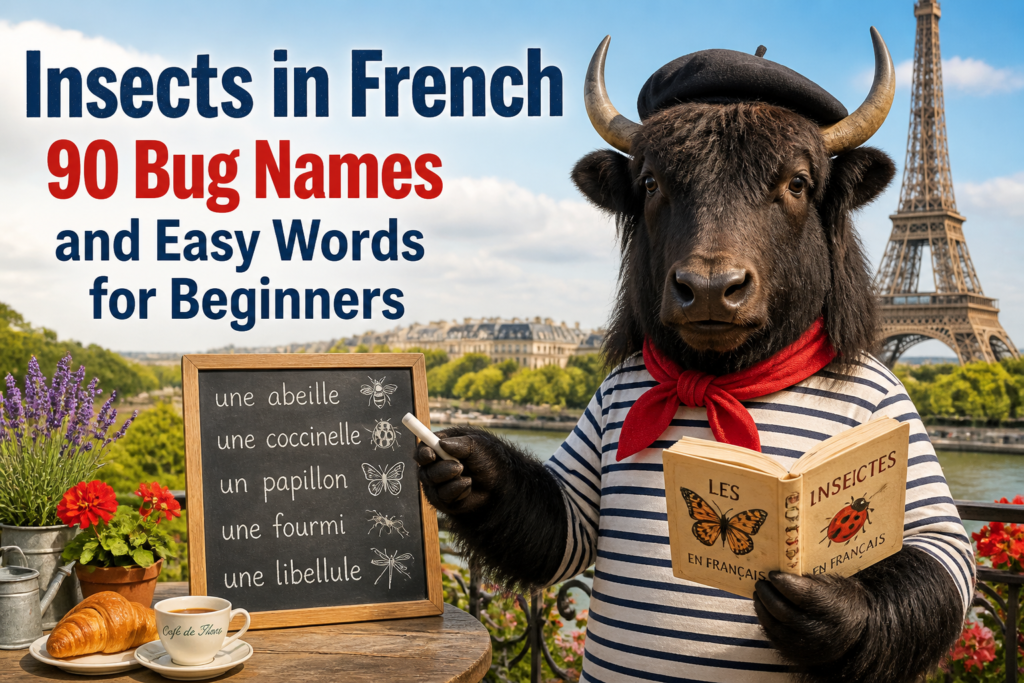
Bug vocabulary is weirdly useful. One day you are learning bonjour and croissant, and the next day you need to say, “There is a giant moth in the bathroom and I would like to leave immediately.” French can do that too.
In this guide, you will learn common insect names in French, plus a few other creepy-crawly words people often lump in with “bugs.” We will keep it beginner-friendly, practical, and much less terrifying than the average surprise spider moment.
By the end, you will know how to name insects, describe them, talk about bites and stings, and use simple real-life phrases. If you want more beginner French after this, visit the main Learn French page.
How To Say Insect In French
| French | Pronunciation | Meaning | Example Sentence | Translation | Learner Note |
|---|---|---|---|---|---|
| un insecte | uhn an-sekt | an insect | C’est un insecte très commun en été. | It’s a very common insect in summer. | Masculine noun: un insecte. |
| un bug | uhn beug | a bug | Il y a un bug sur la fenêtre. | There is a bug on the window. | In everyday speech, people may say bug, but it also means a computer bug. |
| une bestiole | ewn behs-tee-ol | a little critter / creepy-crawly | Quelle est cette bestiole dans la cuisine ? | What is that critter in the kitchen? | Casual, very common in speech. |
| une bête | ewn bet | a creature / beast / bug | Il y a une petite bête dans le jardin. | There’s a little creature in the garden. | Broad meaning; not only for insects. |
Insecte is the clean dictionary word. Bestiole is the real-life word people love when they do not know or care exactly what tiny thing is crawling around. Very efficient. Very human.
Common Insects In French
Let’s start with the bug celebrities: ants, bees, flies, mosquitoes, butterflies, and friends. These are the words you are most likely to hear first.
| French | Pronunciation | Meaning | Example Sentence | Translation | Learner Note |
|---|---|---|---|---|---|
| la fourmi | lah foor-mee | ant | La fourmi transporte une feuille. | The ant is carrying a leaf. | Feminine: la fourmi. |
| l’abeille | lah-bay | bee | L’abeille est sur la fleur. | The bee is on the flower. | Elision: la abeille becomes l’abeille. |
| la guêpe | lah guehp | wasp | Une guêpe vole autour de la table. | A wasp is flying around the table. | The accent helps show the short vowel sound. |
| la mouche | lah moosh | fly | La mouche est sur la vitre. | The fly is on the windowpane. | Very common word. |
| le moustique | luh moos-teek | mosquito | Le moustique m’a piqué cette nuit. | The mosquito bit me last night. | Masculine: le moustique. |
| le papillon | luh pah-pee-yon | butterfly | Le papillon est très coloré. | The butterfly is very colorful. | The ll sounds like y here. |
| la coccinelle | lah kok-see-nell | ladybug / ladybird | La coccinelle a des points noirs. | The ladybug has black spots. | A lovely beginner word, and a fun one. |
| le cafard | luh kah-far | cockroach | J’ai vu un cafard dans le garage. | I saw a cockroach in the garage. | Also means feeling down in some expressions, but here it means the insect. |
| la puce | lah peuss | flea | Le chien a des puces. | The dog has fleas. | Usually heard in the plural: des puces. |
| le pou | luh poo | louse | L’enfant a un pou. | The child has a louse. | Plural is irregular: des poux. |
| le taon | luh tahn | horsefly | Un taon m’a piqué près du lac. | A horsefly bit me near the lake. | Common in countryside contexts. |
| la mite | lah meet | moth / clothes moth | Les mites abîment les vêtements. | Moths damage clothes. | Often used for clothes moths. |
More Flying Insects And Similar Words
| French | Pronunciation | Meaning | Example Sentence | Translation | Learner Note |
|---|---|---|---|---|---|
| le bourdon | luh boor-don | bumblebee | Le bourdon est plus gros que l’abeille. | The bumblebee is bigger than the bee. | Masculine. |
| le frelon | luh fruh-lon | hornet | Le frelon est entré dans la maison. | The hornet came into the house. | Definitely a word worth knowing. |
| la libellule | lah lee-bell-ewl | dragonfly | La libellule vole au-dessus de l’eau. | The dragonfly is flying above the water. | Feminine noun. |
| la sauterelle | lah soh-tuh-rell | grasshopper | La sauterelle saute dans l’herbe. | The grasshopper jumps in the grass. | From the verb sauter, to jump. |
| le criquet | luh kree-kay | cricket | On entend le criquet la nuit. | You can hear the cricket at night. | Masculine noun. |
| la cigale | lah see-gal | cicada | La cigale chante en été. | The cicada sings in summer. | Very common in southern France. |
| le moucheron | luh moosh-ron | gnat / midge | Il y a des moucherons près des fruits. | There are gnats near the fruit. | Often plural in real life. |
| le phasme | luh fazm | stick insect | Le phasme ressemble à une branche. | The stick insect looks like a branch. | The final sound is simple despite the spelling. |
| la luciole | lah loo-see-ol | firefly | La luciole brille dans le noir. | The firefly glows in the dark. | More poetic and less common in daily speech. |
| le ver luisant | luh vair lwee-zahn | glow-worm | Le ver luisant produit une petite lumière. | The glow-worm produces a small light. | Literally “shining worm.” |
Crawling Bugs In French
Not every creepy thing is technically an insect, but beginners usually want all the “small crawling nightmare words” together in one place. Fair enough.
| French | Pronunciation | Meaning | Example Sentence | Translation | Learner Note |
|---|---|---|---|---|---|
| l’araignée | lah-ray-nyay | spider | L’araignée est au plafond. | The spider is on the ceiling. | Not an insect scientifically, but essential vocabulary. |
| le scarabée | luh skah-rah-bay | beetle | Le scarabée est noir et brillant. | The beetle is black and shiny. | Masculine noun. |
| le coléoptère | luh ko-lay-op-tair | beetle (scientific/class) | Le scarabée est un coléoptère. | The beetle is a coleopteran. | More formal/scientific. |
| la chenille | lah shuh-nee | caterpillar | La chenille mange une feuille. | The caterpillar is eating a leaf. | Feminine noun. |
| le ver | luh vair | worm | Le ver est dans la terre. | The worm is in the soil. | Not an insect, but very common. |
| le mille-pattes | luh meel-pat | centipede | J’ai trouvé un mille-pattes sous la pierre. | I found a centipede under the stone. | Literally “thousand legs.” Invariable in form here. |
| le cloporte | luh klo-port | woodlouse / pill bug | Le cloporte aime les endroits humides. | The woodlouse likes damp places. | Very useful house-and-garden word. |
| la tique | lah teak | tick | Il faut enlever la tique rapidement. | You need to remove the tick quickly. | Not an insect scientifically. |
| l’acarien | lah-kah-ree-an | mite | L’acarien est microscopique. | The mite is microscopic. | Usually more scientific or health-related. |
| la punaise | lah pew-nehz | stink bug / bedbug / thumbtack depending on context | J’ai trouvé une punaise sur le rideau. | I found a bug on the curtain. | Context matters a lot. It can also mean a drawing pin. |
Garden And Nature Bug Words
These come up when talking about gardens, parks, plants, and outdoor life. Handy if you also want to learn nature words in French habitats vocabulary.
| French | Pronunciation | Meaning | Example Sentence | Translation | Learner Note |
|---|---|---|---|---|---|
| le puceron | luh pews-ron | aphid | Les pucerons attaquent les roses. | Aphids attack roses. | Often used in gardening. |
| la mouche à fruits | lah moosh ah frwee | fruit fly | La mouche à fruits tourne autour des bananes. | The fruit fly circles around the bananas. | Very practical kitchen word. |
| la drosophile | lah dro-zo-feel | fruit fly (technical) | La drosophile est utilisée en laboratoire. | The fruit fly is used in laboratories. | More scientific than everyday. |
| la mante religieuse | lah mahnt ruh-lee-zyeuz | praying mantis | La mante religieuse bouge lentement. | The praying mantis moves slowly. | A long phrase, but common enough. |
| la tipule | lah tee-pyool | crane fly | La tipule ressemble à un grand moustique. | The crane fly looks like a big mosquito. | Useful because learners often confuse it with a mosquito. |
| le perce-oreille | luh pairs-or-ay | earwig | J’ai vu un perce-oreille dans le pot de fleurs. | I saw an earwig in the flowerpot. | Literally “ear-piercer,” which is not helping anyone relax. |
| le hanneton | luh an-tuh-non | cockchafer / May bug | Le hanneton vole près des arbres. | The May bug flies near the trees. | Less common, but still useful in nature vocab. |
| la blatte | lah blaht | cockroach | La blatte court très vite. | The cockroach runs very fast. | Another word for cockroach; often more technical than cafard. |
| la termite | lah tair-meet | termite | Les termites abîment le bois. | Termites damage wood. | Usually plural in context. |
| la teigne | lah ten-yuh | moth / pest moth | La teigne peut abîmer la laine. | The moth can damage wool. | Often appears in pest-control contexts. |
Body Parts And Bug Features In French
If you want to describe an insect, these words help a lot. Also useful in school French and nature documentaries, if that becomes your unexpectedly glamorous path.
| French | Pronunciation | Meaning | Example Sentence | Translation | Learner Note |
|---|---|---|---|---|---|
| la patte | lah paht | leg | L’insecte a six pattes. | The insect has six legs. | Common for animal legs too. |
| l’aile | lehl | wing | Le papillon a de grandes ailes. | The butterfly has large wings. | Feminine noun with elision. |
| l’antenne | lahn-ten | antenna / feeler | Le moustique a de longues antennes. | The mosquito has long antennae. | Often used in the plural: des antennes. |
| les ailes | lay zehl | wings | Les ailes de l’abeille sont transparentes. | The bee’s wings are transparent. | Liaison in careful speech: les-z-ailes. |
| les rayures | lay ray-yoor | stripes | L’abeille a des rayures jaunes et noires. | The bee has yellow and black stripes. | Great with color vocab. |
| les points | lay pwan | spots / dots | La coccinelle a des points noirs. | The ladybug has black spots. | Handy descriptive word. |
| la carapace | lah kah-rah-pahs | shell / outer covering | Le scarabée a une carapace dure. | The beetle has a hard shell. | Useful for beetles and similar creatures. |
| le dard | luh dar | stinger | La guêpe utilise son dard. | The wasp uses its stinger. | Important with bees and wasps. |
| les pinces | lay panss | pincers | Le perce-oreille a de petites pinces. | The earwig has small pincers. | Plural is common here. |
| le corps | luh kor | body | Le corps de l’insecte est minuscule. | The insect’s body is tiny. | The final ps is not strongly pronounced. |
Actions: What Bugs Do
| French | Pronunciation | Meaning | Example Sentence | Translation | Learner Note |
|---|---|---|---|---|---|
| voler | voh-lay | to fly | Les abeilles volent autour des fleurs. | Bees fly around the flowers. | Also means “to steal,” so context matters. |
| ramper | rahn-pay | to crawl | Le mille-pattes rampe sous la feuille. | The centipede crawls under the leaf. | Useful for many creatures. |
| sauter | soh-tay | to jump | La sauterelle saute très haut. | The grasshopper jumps very high. | Related to sauterelle. |
| piquer | pee-kay | to sting / bite / prick | Le moustique peut piquer la nuit. | The mosquito can bite at night. | Used for mosquitoes, bees, wasps, and even needles. |
| bourdonner | boor-do-nay | to buzz | J’entends une abeille bourdonner. | I hear a bee buzzing. | Great sound word. |
| grimper | gram-pay | to climb | L’araignée grimpe au mur. | The spider is climbing the wall. | Common everyday verb too. |
| se poser | suh poh-zay | to land / settle | La mouche se pose sur la table. | The fly lands on the table. | Reflexive verb. |
| sortir | sor-teer | to come out | Les insectes sortent la nuit. | Insects come out at night. | Very common verb. |
| entrer | ahn-tray | to enter | Une guêpe est entrée par la fenêtre. | A wasp came in through the window. | Useful panic vocabulary. |
| pondre | pon-druh | to lay eggs | La reine pond des œufs. | The queen lays eggs. | More advanced but useful in nature contexts. |
Useful Adjectives For Describing Insects
French adjectives often change form to match gender and number. For example, petit becomes petite with a feminine noun. Tiny ending, big grammar energy.
| French | Pronunciation | Meaning | Example Sentence | Translation | Learner Note |
|---|---|---|---|---|---|
| petit / petite | puh-tee / puh-teet | small | La fourmi est petite. | The ant is small. | Agreement matters. |
| gros / grosse | groh / grohs | big / fat | Ce bourdon est gros. | This bumblebee is big. | Masculine and feminine forms differ. |
| minuscule | mee-new-skewl | tiny | Le moucheron est minuscule. | The gnat is tiny. | Same form for masculine and feminine in everyday use. |
| rapide | rah-peed | fast | La blatte est très rapide. | The cockroach is very fast. | Same basic written form for both genders. |
| lent / lente | lahn / lahnt | slow | La chenille est lente. | The caterpillar is slow. | Notice feminine lente. |
| dangereux / dangereuse | dahn-juh-ruh / dahn-juh-reuz | dangerous | Cette guêpe semble dangereuse. | This wasp seems dangerous. | Very useful descriptive adjective. |
| inoffensif / inoffensive | ee-noh-fahn-seef / ee-noh-fahn-seev | harmless | La tipule est inoffensive. | The crane fly is harmless. | Nice word when people panic. |
| bruyant / bruyante | broo-ee-ahn / broo-ee-ahnt | noisy | La cigale est bruyante. | The cicada is noisy. | Common summer description. |
| coloré / colorée | koh-loh-ray | colorful | Le papillon est très coloré. | The butterfly is very colorful. | Useful with French colors. |
| noir / noire | nwar / nwar | black | La fourmi est noire. | The ant is black. | Good starter color adjective. |
Simple Phrases You Can Actually Use
Now for the real-life stuff: noticing a bug, describing it, complaining about it, and asking someone to please deal with it because you are suddenly busy being somewhere else.
| French Phrase | Pronunciation | Meaning | Example Sentence | Translation | Learner Note |
|---|---|---|---|---|---|
| Il y a un insecte. | eel yah uhn an-sekt | There is an insect. | Il y a un insecte dans la salle de bain. | There is an insect in the bathroom. | Il y a is one of the most useful French patterns. |
| C’est une abeille. | say tewn ah-bay | It’s a bee. | Ne t’inquiète pas, c’est une abeille. | Don’t worry, it’s a bee. | Easy identification pattern. |
| Je déteste les moustiques. | zhuh day-test lay moos-teek | I hate mosquitoes. | Je déteste les moustiques en été. | I hate mosquitoes in summer. | Very relatable sentence. |
| Le moustique m’a piqué. | luh moos-teek mah pee-kay | The mosquito bit me. | Le moustique m’a piqué sur le bras. | The mosquito bit me on the arm. | m’a = “me has” in structure, “bit me” in meaning. |
| La guêpe m’a piqué. | lah guehp mah pee-kay | The wasp stung me. | La guêpe m’a piqué près de la main. | The wasp stung me near my hand. | Same verb piquer. |
| Ça gratte. | sah graht | It itches. | Ma piqûre gratte beaucoup. | My bite/sting itches a lot. | Very useful for bites. |
| Il bourdonne autour de moi. | eel boor-don o-toohr duh mwah | It’s buzzing around me. | Le moustique bourdonne autour de moi. | The mosquito is buzzing around me. | Useful complaint phrase. |
| Ouvre la fenêtre. | oovruh lah fuh-netr | Open the window. | Ouvre la fenêtre pour faire sortir l’abeille. | Open the window to let the bee out. | Informal command. |
| Ferme la porte. | fairm lah port | Close the door. | Ferme la porte, les moustiques entrent. | Close the door, the mosquitoes are coming in. | Another practical command. |
| Laisse-le tranquille. | less luh trahn-keel | Leave it alone. | C’est juste un papillon, laisse-le tranquille. | It’s just a butterfly, leave it alone. | le replaces a masculine thing. |
| Il est inoffensif. | eel eh tee-noh-fahn-seef | It is harmless. | Ce phasme est inoffensif. | This stick insect is harmless. | Liaison often heard: est inoffensif. |
| Je ne sais pas ce que c’est. | zhuh nuh say pah suh kuh say | I don’t know what it is. | Je ne sais pas ce que c’est, mais c’est énorme. | I don’t know what it is, but it’s huge. | Excellent emergency sentence. |
Bug Places And Context Words
| French | Pronunciation | Meaning | Example Sentence | Translation | Learner Note |
|---|---|---|---|---|---|
| le nid | luh nee | nest | Le nid de guêpes est sous le toit. | The wasp nest is under the roof. | Useful with bees and wasps too. |
| la ruche | lah roosh | beehive | Les abeilles retournent à la ruche. | The bees return to the hive. | Feminine noun. |
| la toile d’araignée | lah twahl dah-rah-nyay | spider web | Il y a une toile d’araignée dans le coin. | There is a spider web in the corner. | Common house word. |
| le jardin | luh zhar-dan | garden | Il y a beaucoup d’insectes dans le jardin. | There are many insects in the garden. | Great context noun. |
| la fleur | lah flur | flower | L’abeille est sur la fleur jaune. | The bee is on the yellow flower. | Pairs well with color words. |
| la feuille | lah fuhy | leaf | La chenille mange la feuille. | The caterpillar is eating the leaf. | Common plant word. |
| la piqûre | lah pee-kewr | bite / sting | La piqûre de moustique me gêne. | The mosquito bite is bothering me. | Useful noun from piquer. |
| l’essaim | less-an | swarm | On voit un essaim d’abeilles. | We can see a swarm of bees. | Mostly for bees or flying insects in groups. |
| l’œuf | luhf | egg | L’insecte pond un œuf. | The insect lays an egg. | Singular œuf, plural œufs. |
| la larve | lah larv | larva | La larve devient un insecte adulte. | The larva becomes an adult insect. | Common in educational contexts. |
France French Notes And Small Confusions
- Le cafard and la blatte can both mean cockroach. In everyday France French, cafard is very common.
- La punaise is tricky. It can mean a stink bug, a bedbug, or even a thumbtack depending on context. French loves a little chaos.
- Piquer covers both “bite” and “sting” in many cases. So a mosquito pique, and a wasp pique too.
- L’araignée is not technically an insect, but learners absolutely need the word, because spiders do not care about your biology categories.
- With plural words like les insectes or les ailes, you may hear liaison: les-z-insectes, les-z-ailes.
- With vowel sounds, French often uses elision: l’abeille, l’araignée, l’insecte instead of la or le.
You do not need every scientific label to survive beginner French. You mostly need the words for the bugs in your room, your garden, and your worst summer memories.
Mini Theme Tables By Type
Stinging And Biting Bugs
| French | Meaning | Quick Note |
|---|---|---|
| le moustique | mosquito | Bites, especially at night. |
| la guêpe | wasp | Can sting. |
| l’abeille | bee | Usually not aggressive unless disturbed. |
| le frelon | hornet | Bigger and more alarming. |
| la puce | flea | Common with pets. |
| la tique | tick | Found in grass and woods. |
Pretty Or Harmless Bugs
| French | Meaning | Quick Note |
|---|---|---|
| le papillon | butterfly | Classic pretty insect word. |
| la coccinelle | ladybug | A favorite beginner word. |
| la libellule | dragonfly | Often near water. |
| le phasme | stick insect | Looks like a twig. |
| la luciole | firefly | Glows in the dark. |
| la sauterelle | grasshopper | More jumpy than scary. |
Indoor Annoyance Words
| French | Meaning | Quick Note |
|---|---|---|
| la mouche | fly | The classic kitchen visitor. |
| le moucheron | gnat | Tiny and annoying near fruit. |
| le cafard | cockroach | Nobody is thrilled. |
| la mite | moth | Can damage clothes. |
| l’araignée | spider | House vocabulary essential. |
| le perce-oreille | earwig | Great word, unpleasant surprise. |
Quick Practice
Try these fast little drills. No pressure. The bugs are already doing enough of that.
Match The Meaning
- la fourmi = ant
- l’abeille = bee
- le moustique = mosquito
- le papillon = butterfly
- la coccinelle = ladybug
- l’araignée = spider
Translate Into French
- The bee is on the flower. → L’abeille est sur la fleur.
- There is a spider in the bathroom. → Il y a une araignée dans la salle de bain.
- The mosquito bit me. → Le moustique m’a piqué.
- I hate flies. → Je déteste les mouches.
- The butterfly is colorful. → Le papillon est coloré.
Fill In The Blank
- La ______ est rouge avec des points noirs. → coccinelle
- Le ______ vole la nuit et me pique. → moustique
- L’______ grimpe au mur. → araignée
- La ______ fait du miel. → abeille
- La ______ mange les feuilles. → chenille
Related French Practice
If you want to keep building your vocabulary, try the French vocabulary test or check your level with the French placement test.
Seasonal learners can also explore French Halloween vocabulary, where bug words and spooky words get along a little too well.
Quick Reference Summary
- un insecte = an insect
- une bestiole = a little critter / bug
- le moustique = mosquito
- l’abeille = bee
- la guêpe = wasp
- la mouche = fly
- le papillon = butterfly
- la coccinelle = ladybug
- l’araignée = spider
- piquer = to bite / sting
- voler = to fly
- ramper = to crawl
- Il y a un insecte. = There is an insect.
- Je ne sais pas ce que c’est. = I don’t know what it is.
- Ça gratte. = It itches.
Yak Takeaway: you probably will not need all 90+ bug words today, but the useful ones show up fast: abeille, moustique, araignée, mouche, and guêpe. Learn those first, add a few phrases like Il y a un insecte and Le moustique m’a piqué, and suddenly your French is ready for summer, gardens, and tiny airborne drama.