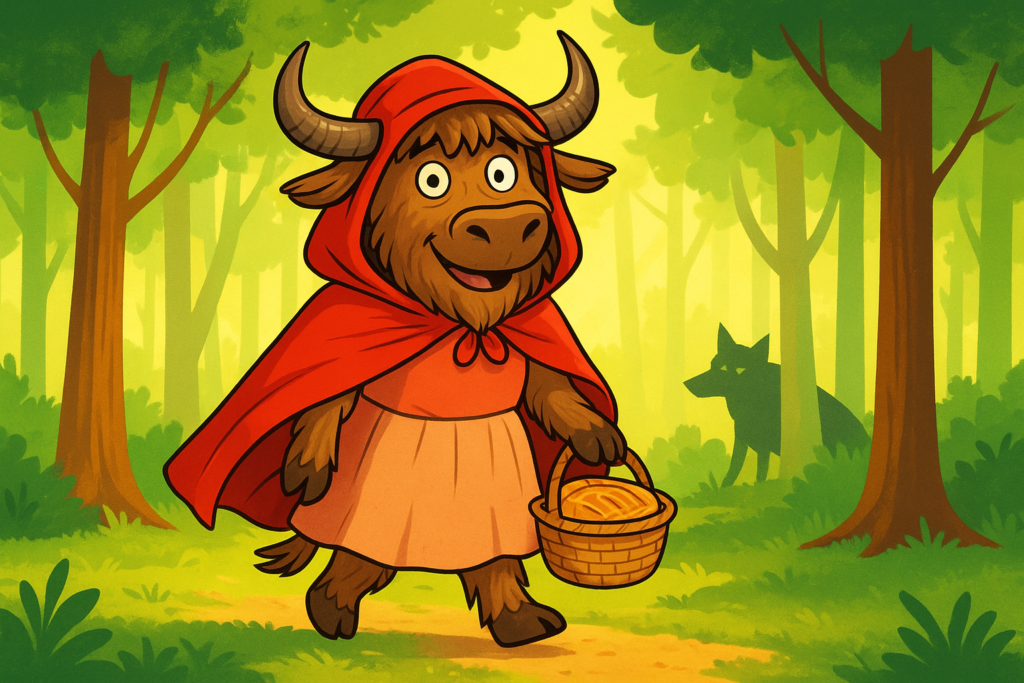
This A1 Beginner retelling of Le Petit Chaperon Rouge keeps the plot clear for learners while still giving the story some atmosphere and momentum. Il était une fois une petite fille. Elle s'appelait le Petit Chaperon Rouge.
This version teaches French through English and includes clickable word help inside the story, full story audio, and lesson notes after the reading. It is free to use on Yak Yacker and is designed to feel natural, readable, and manageable for learners.
Il était une fois .
Elle s'appelait .
Un jour,
« Ma petite fille,
« Ta grand-mère est . »
Le Petit Chaperon Rouge la galette.
Elle dans la forêt.
Dans la forêt, elle un .
Le loup : « Où vas-tu, petite fille ? »
« Je vais », dit-elle.
« Elle habite , dans une petite maison. »
Le loup . « Je veux lui dire bonjour aussi. »
Le loup à la maison de la grand-mère.
Le loup dans la maison.
Il la grand-mère. Oh non !
Le loup les vêtements de la grand-mère.
Il se dans le lit.
Le Petit Chaperon Rouge .
Elle dans la maison.
Elle sa grand-mère dans le lit.
« Bonjour, ! », dit-elle.
« Comme tu as de ! »
Le loup : « C'est pour mieux t'entendre, mon enfant. »
« Comme tu as de ! »
« C'est pour te voir. »
« Comme tu as de ! »
« C'est pour mieux te . »
« Comme tu as une ! »
« C'est pour mieux te ! »
Le loup du lit.
Il le Petit Chaperon Rouge.
Heureusement, un chasseur .
Il du bruit dans la maison.
Il et voit le loup qui dort.
Le chasseur le ventre du loup.
La grand-mère et le Petit Chaperon Rouge .
Elles sont .
Le chasseur des pierres dans le ventre du loup.
Le loup se . Il a mal au ventre.
Il ne de personnes.
Let's pick out some friendly little words that appear again and again in our story. Each one is like a stepping stone through the fairy tale.
Say them aloud a few times - they'll quickly feel familiar.
- la galette - the cake / round pastry
- le loup - the wolf
- la grand-mère - the grandmother
- le chasseur - the hunter
- la forêt - the forest
- la maison - the house
- le lit - the bed
- les vêtements - the clothes
This story has a wonderful question-and-answer pattern. Listen out for it when you re-read:
The wolf asks "Où vas-tu, petite fille ?" ('Where are you going, little girl?'), and later Little Red Riding Hood remarks on the 'grandmother's' big eyes, ears, and hands. The replies always begin with "C'est pour mieux…" - "It's to better…".
- "Où vas-tu ?" - Where are you going?
- "Je vais chez ma grand-mère." - I'm going to my grandmother's.
- "Comme tu as de grandes oreilles !" - What big ears you have!
- "C'est pour mieux t'entendre !" - It's to hear you better!
In the tale, you saw words like 'ma galette', 'ta grand-mère', and 'sa maman'. These small words show who something belongs to.
For feminine nouns like 'galette' and 'grand-mère', French uses 'ma' (my), 'ta' (your - informal), and 'sa' (his/her).
- ma → my (with a feminine noun): ma galette (my cake)
- ta → your (informal, feminine noun): ta grand-mère (your grandmother)
- sa → his / her (feminine noun): sa maman (her mum)
- Tip: 'grand-mère' is feminine even though it has no 'e' at the end!
You've just met lots of new French words and a classic fairy-tale pattern. Why not listen to the story once more, this time reading along?
Try saying the wolf's lines out loud in your best 'wolf voice' - it's a fun way to make the phrases stick.
Le Petit Chaperon Rouge comes from the French / Perrault tradition and is best known as a fairy tale. This Yak Yacker article is an original learner retelling based on Perrault/traditional versions public domain, so the wording here is simplified for modern learners rather than copied from one old edition.
Older printings, translations, and retellings of this story can vary quite a bit. The original audience was usually kids, but this version is adapted for A1 Beginner learners studying French. Keep mild for A1; Perrault ending is darker.
If you want to look into the source tradition, start with Project Gutenberg.
If you want to keep going, browse more in our French section and review the A1 French Vocabulary List. After that, try Basic Questions in French for another useful next step.