


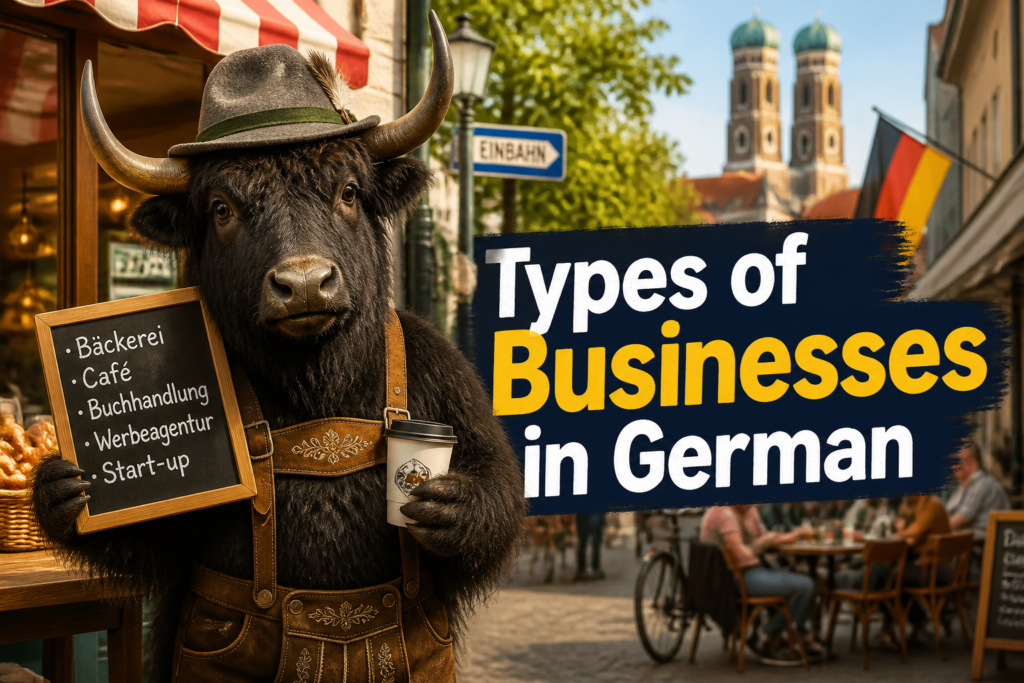
Learning how to talk about businesses in German is one of those “small topic, big payoff” things. Suddenly you can read signs, ask questions in shops, understand company names, and stop guessing whether that place is a bakery, a pharmacy, or some mysterious office that only exists to print forms and headaches.
This guide gives you practical German vocabulary for common business types, plus useful phrases for talking about shops, services, and company names. You’ll also see a few real-life usage notes, because German loves a tidy label almost as much as it loves capital letters.
By the way, if you want more everyday German after this, the related guides on essential German words and phrases and popular German phrases are a good next stop.
Core Words For Business Types
In German, many business types are just ordinary nouns. That means they are capitalized, and they often come with an article like der, die, or das. Tragic for your grammar anxiety, excellent for your vocabulary list.
| German | Pronunciation | Meaning | Example Sentence | Translation | Learner Note |
|---|---|---|---|---|---|
| das Geschäft | guh-SHREFT | shop, business, store | Ich gehe kurz ins Geschäft. | I’m going into the shop for a moment. | Very common. Can mean a shop or a business depending on context. |
| der Laden | LAH-den | shop, store | Der Laden schließt um acht Uhr. | The shop closes at eight o’clock. | Casual and very natural in everyday speech. |
| der Supermarkt | SOO-per-markt | supermarket | Im Supermarkt kaufe ich Obst und Brot. | I buy fruit and bread at the supermarket. | A standard everyday word. |
| die Bäckerei | behk-eh-RYE | bakery | Die Bäckerei ist morgens sehr voll. | The bakery is very busy in the morning. | Often you buy bread, rolls, cake, and coffee here. |
| die Apotheke | ah-poh-TAY-keh | pharmacy | Ich muss zur Apotheke gehen. | I have to go to the pharmacy. | Important: a pharmacy is Apotheke, not Drogerie. |
| die Drogerie | droh-guh-REE | drugstore, toiletries shop | In der Drogerie kaufe ich Shampoo. | I buy shampoo at the drugstore. | More like toiletries, cosmetics, cleaning items. Not a pharmacy. |
| das Café | kah-FAY | café | Wir treffen uns im Café. | We’re meeting at the café. | Usually pronounced with stress on the last syllable. |
| das Restaurant | ress-tow-RAHNT | restaurant | Das Restaurant ist heute geschlossen. | The restaurant is closed today. | Looks French, behaves like a German noun. Capitalize it. |
| der Imbiss | IM-biss | snack bar, takeaway food stand | Am Imbiss gibt es Currywurst. | There is currywurst at the snack bar. | Very useful for quick, casual food places. |
| das Hotel | hoh-TEL | hotel | Das Hotel liegt im Zentrum. | The hotel is in the center. | Common travel word. Simple and reliable. |
More Common Business Types
German business words often tell you exactly what kind of place you’re dealing with. That’s helpful, unless you’re trying to sound smart and accidentally call a bakery a restaurant. The bread will not forgive you.
| German | Pronunciation | Meaning | Example Sentence | Translation | Learner Note |
|---|---|---|---|---|---|
| die Firma | FEER-mah | company, firm | Ich arbeite für eine kleine Firma. | I work for a small company. | Very common and neutral. |
| das Unternehmen | oon-ter-NAY-men | company, enterprise | Das Unternehmen wächst schnell. | The company is growing quickly. | More formal than die Firma. |
| das Büro | boo-ROH | office | Ich bin heute im Büro. | I’m in the office today. | Pronounced with ü, which is not “oo.” |
| die Werkstatt | VEHRK-shtat | workshop, repair shop | Das Auto ist in der Werkstatt. | The car is in the repair shop. | Often used for car repair or crafts. |
| der Friseursalon | free-zur-zah-LOHN | hair salon | Ich habe morgen einen Termin im Friseursalon. | I have an appointment at the hair salon tomorrow. | You’ll also hear simply der Friseur for the salon or hairdresser. |
| die Tankstelle | TANK-shtel-leh | gas station | Wir halten an der Tankstelle an. | We’re stopping at the gas station. | Very common compound noun: fuel + station. |
| die Bank | bahnk | bank | Ich gehe zur Bank, um Geld abzuheben. | I’m going to the bank to withdraw money. | Be careful: die Bank can also mean a bench, depending on context. |
| die Post | post | post office, mail service | Ich muss noch zur Post. | I still have to go to the post office. | Short and very common. |
| der Buchladen | BOOK-lah-den | bookshop | Im Buchladen finde ich gute Reiseführer. | I find good travel guides in the bookshop. | Nice example of German compound nouns. |
| das Kaufhaus | KOWF-hows | department store | Das Kaufhaus hat viele Abteilungen. | The department store has many departments. | More old-school, but still useful. |
| die Boutique | boo-TEEK | boutique | Die Boutique verkauft Kleidung und Accessoires. | The boutique sells clothes and accessories. | Often used for fashion shops. |
| der Markt | markt | market | Samstags gehe ich gern auf den Markt. | I like going to the market on Saturdays. | In German, you often go auf den Markt. |
Service Places And Everyday Shops
These are the places people actually use all the time. If you can name them in German, you can ask for directions, understand signs, and look less like you’re wandering around with a phone map held upside down.
| German | Pronunciation | Meaning | Example Sentence | Translation | Learner Note |
|---|---|---|---|---|---|
| die Bäckerei | behk-eh-RYE | bakery | Die Bäckerei öffnet um sechs Uhr. | The bakery opens at six o’clock. | Very early opening hours are common in Germany. |
| der Metzger | METS-ger | butcher | Beim Metzger kaufen wir Wurst. | We buy sausage at the butcher’s. | In some regions people also say Fleischer. |
| der Metzgerei | mets-guh-RYE | butcher’s shop | Die Metzgerei ist neben der Apotheke. | The butcher’s shop is next to the pharmacy. | Regionally common; some areas prefer die Fleischerei. |
| die Konditorei | kon-dee-toh-RYE | pastry shop, patisserie | Wir kaufen Kuchen in der Konditorei. | We buy cake at the pastry shop. | Often sweeter and fancier than a bakery. |
| der Kiosk | kee-OSK | kiosk, small shop | Am Kiosk gibt es Zeitungen und Getränke. | There are newspapers and drinks at the kiosk. | Pronounce the final k clearly. |
| der Späti | SHPAY-tee | late-night convenience shop | In Berlin gehen viele Leute zum Späti. | In Berlin, many people go to the late-night shop. | Very Berlin-specific. Great little cultural nugget. |
| die Waschsalon | vash-sah-LON | laundromat | Ich wasche meine Jacke im Waschsalon. | I wash my jacket at the laundromat. | Usually der Waschsalon; article can vary by usage, but der is common. |
| das Reisebüro | RY-zeh-boo-roh | travel agency | Im Reisebüro buchen wir den Flug. | We book the flight at the travel agency. | Useful for travel and booking language. |
Useful Phrases For Talking About Businesses
These are the phrases that make the vocabulary actually useful. You can name the place, ask where it is, and talk about what it sells or does. In other words: less dictionary, more real life.
| German | Pronunciation | Meaning | Example Sentence | Translation | Learner Note |
|---|---|---|---|---|---|
| Was verkaufen Sie? | vahs fer-KOW-fen zee | What do you sell? | Was verkaufen Sie in diesem Laden? | What do you sell in this store? | Polite form with Sie. Good in shops. |
| Was gibt es hier? | vahs gipt es heer | What is there here? | Was gibt es hier zu essen? | What is there to eat here? | Very flexible question for stores, cafés, and markets. |
| Wie heißt der Laden? | vee highst der LAH-den | What is the shop called? | Wie heißt der neue Laden in der Straße? | What is the new shop on the street called? | Useful for asking about a business name. |
| Ich suche eine Apotheke. | ikh ZOO-kheh EYE-nuh ah-poh-TAY-keh | I’m looking for a pharmacy. | Entschuldigung, ich suche eine Apotheke. | Excuse me, I’m looking for a pharmacy. | One of the most useful travel phrases. |
| Ist das hier ein Café? | ist dahs heer ein kah-FAY | Is this a café? | Ist das hier ein Café oder ein Restaurant? | Is this a café or a restaurant? | Word order in yes/no questions: verb first. |
| Ich gehe zur Bank. | ikh GAY-uh tsur bahnk | I’m going to the bank. | Nach dem Frühstück gehe ich zur Bank. | After breakfast I’m going to the bank. | zu der becomes zur. Handy little contraction. |
| Ich gehe in die Bäckerei. | ikh GAY-uh in dee behk-eh-RYE | I’m going into the bakery. | Ich gehe in die Bäckerei und kaufe Brot. | I’m going into the bakery and buying bread. | in die shows movement into a place. |
| Die Öffnungszeiten | dee URF-nungs-tsyten | opening hours | Die Öffnungszeiten stehen an der Tür. | The opening hours are on the door. | Very common sign vocabulary. |
| Heute geschlossen | HOY-teh guh-SHLOSS-en | closed today | Das Geschäft ist heute geschlossen. | The shop is closed today. | Useful on doors, signs, and websites. |
| Nur Barzahlung | noor BAHR-tsahl-ung | cash only | Im kleinen Laden ist nur Barzahlung möglich. | Cash only is possible in the small shop. | Germany still loves cash. A lot. |
| Karte oder Bargeld? | KAR-teh OH-der BAHR-gelt | Card or cash? | Karte oder Bargeld? | Card or cash? | Very common in shops and cafés. |
| Wir haben einen Termin. | veer HAH-ben EYE-nen ter-MEEN | We have an appointment. | Wir haben um drei Uhr einen Termin. | We have an appointment at three o’clock. | Useful for salons, doctors, offices, and services. |
Duden is a reliable place to check German word meanings, spelling, and usage if a business term looks suspiciously simple and therefore probably has a hidden grammar trap.
Helpful Pattern: Shop Names In German
German often builds business names by stacking nouns together. This is wonderfully efficient and mildly terrifying. Once you get used to it, the name usually tells you exactly what the place is.
| Pattern | Meaning | German Example | English Translation | Learner Note |
|---|---|---|---|---|
| Noun + Noun | A compound business name | die Buchhandlung | bookshop | German loves compound nouns, and the main word comes at the end. |
| Noun + Markt | A type of market or store | der Supermarkt | supermarket | Markt is a very useful final part in business words. |
| Noun + Salon | A service place | der Friseursalon | hair salon | Often used for beauty and care businesses. |
| Noun + Laden | A shop | der Buchladen | bookshop | Laden is casual and common. |
| Noun + Büro | An office or office-type business | das Reisebüro | travel agency | Useful in travel and business contexts. |
For a broader look at business and company language, the Goethe-Institut and DW Learn German both have solid, no-nonsense learning material. Boring in the best possible way.
Germany, Austria, And Switzerland: Small Differences
Most of the words above work across German-speaking countries, but a few local differences show up in everyday business language. If you notice them, congrats: you’ve reached the part where German starts behaving like a family of related habits instead of one neat rulebook.
| Germany | Austria | Switzerland | Note |
|---|---|---|---|
| die Bäckerei | die Bäckerei | die Bäckerei | Same word, same idea. Nice for once. |
| der Supermarkt | der Supermarkt | der Supermarkt | Very widely shared. |
| der Späti | rare | rare | Very Berlin-specific, not standard everywhere. |
| die Trafik | not usual | not usual | In Austria, die Trafik means a tobacco kiosk/newsstand. |
| das Coiffeurgeschäft / der Coiffeur | Friseur | very common | Swiss German often uses Coiffeur instead of Friseur. |
If you’re learning standard German, keep Friseur, Bäckerei, Apotheke, Supermarkt, and Restaurant as your safe default set. They’ll work almost everywhere without drama.
Common Mistakes And Easy Fixes
- Wrong: Ich gehe in der Apotheke.
Correct: Ich gehe in die Apotheke.
Why: Going into a place uses the accusative: in die. - Wrong: das Geschäfte
Correct: die Geschäfte
Why: The plural is irregular. German plurals enjoy making life “interesting.” - Wrong: die Apotheker for a pharmacy
Correct: die Apotheke
Why: Apotheker is the pharmacist; Apotheke is the place. - Wrong: Ich suche eine Supermarkt.
Correct: Ich suche einen Supermarkt.
Why: Supermarkt is masculine: der/einen. - Wrong: Wir gehen zum Kaffee. when you mean café
Correct: Wir gehen ins Café.
Why: der Kaffee is coffee, not the café. - Wrong: die Laden
Correct: der Laden
Why: Laden is masculine. - Wrong: Ich gehe zur Banke.
Correct: Ich gehe zur Bank.
Why: Bank keeps the same spelling here; don’t invent extra letters like a sleep-deprived elf.
Quick Practice
Try these mini drills. Say them out loud if possible. German business words stick better when your mouth has to do the work too.
| Prompt | Answer | Learner Note |
|---|---|---|
| Translate: “I’m looking for a bakery.” | Ich suche eine Bäckerei. | Bäckerei is feminine, so use eine. |
| Translate: “The shop is closed today.” | Das Geschäft ist heute geschlossen. | Geschäft is neuter: das. |
| Translate: “We are going to the market.” | Wir gehen auf den Markt. | With markets, auf is often natural. |
| Translate: “Do you have an appointment?” | Haben Sie einen Termin? | Polite question. Verb first in a yes/no question. |
| Translate: “What do you sell here?” | Was verkaufen Sie hier? | verkaufen = to sell. |
| Translate: “I need to go to the pharmacy.” | Ich muss zur Apotheke gehen. | zu der becomes zur. |
Useful Mini Notes On Pronunciation
- ä often sounds like the e in “bed.” Example: Bäckerei.
- ö and ü are rounded vowels. They are not “oh” or “oo.” Example: Büro.
- sch sounds like “sh.” Example: Geschäft.
- sp at the start of a word often sounds like “shp.” Example: Späti.
- st at the start of a word often sounds like “sht.” Example: Strasse in some place names, though standard spelling is usually Straße.
- Final g can sound softer, almost like a k in some words. Example: Montag.
- German nouns are capitalized: die Bäckerei, das Restaurant, der Markt.
Yak rule: if the business name ends in -erei, there’s a good chance it’s a place that makes or sells something useful, delicious, or both.
More Useful Business Words
If you want to talk about a business a little more generally, these words help a lot. They’re especially handy in city life, travel, shopping, and work conversations.
| German | Pronunciation | Meaning | Example Sentence | Translation | Learner Note |
|---|---|---|---|---|---|
| der Inhaber | IN-hah-ber | owner | Der Inhaber spricht Englisch. | The owner speaks English. | Used for male owner; die Inhaberin for female owner. |
| die Inhaberin | IN-hah-beh-rin | female owner | Die Inhaberin ist heute nicht da. | The female owner is not here today. | Good to know for small shops and cafés. |
| das Personal | per-zoh-NAHL | staff | Das Personal ist sehr freundlich. | The staff is very friendly. | Collective noun; often treated as singular in German. |
| die Abteilung | ahp-TY-loong | department, section | Die Schuhe sind in der Damenabteilung. | The shoes are in the women’s department. | Useful in department stores. |
| die Kasse | KAS-seh | checkout, register, cash desk | Bitte bezahlen Sie an der Kasse. | Please pay at the checkout. | Very common in shops. |
| bezahlen | beh-TSAH-len | to pay | Kann ich mit Karte bezahlen? | Can I pay by card? | Extremely useful phrase in shops and cafés. |
| öffnen | URF-nen | to open | Der Laden öffnet um neun Uhr. | The shop opens at nine o’clock. | Verb for opening hours and schedules. |
| schließen | SHLEE-sen | to close | Die Apotheke schließt um sechs. | The pharmacy closes at six. | Spelled with ie, so it sounds like “shlee.” |
For single-word meanings and extra examples, WordReference is also useful when you want a quick check without a full grammar lecture pretending to be a dictionary.
When You Hear These Words In Real Life
- Imbiss = quick snack place, often for sausages, fries, kebabs, or takeaway food.
- Apotheke = pharmacy; if you need medicine, this is your word.
- Drogerie = toiletries and beauty products; think shampoo, soap, toothpaste, and makeup.
- Bank = bank, but context matters because it can also mean a bench.
- Geschäft and Laden are both “shop,” but Laden feels more casual and everyday.
- Unternehmen is the more formal “company” word, often used in business, news, or official writing.
If you want a nice “next step” page after this, the parent guide at Learn German is the main hub for more vocabulary and grammar practice.
Quick Takeaway
To talk about types of businesses in German, start with the big everyday words: die Bäckerei, die Apotheke, der Supermarkt, das Restaurant, die Firma, and das Büro. Then add simple phrases like Ich suche …, Was verkaufen Sie?, and Ich gehe zur …. Tiny vocabulary, huge usefulness. That’s the good kind of language learning sorcery.