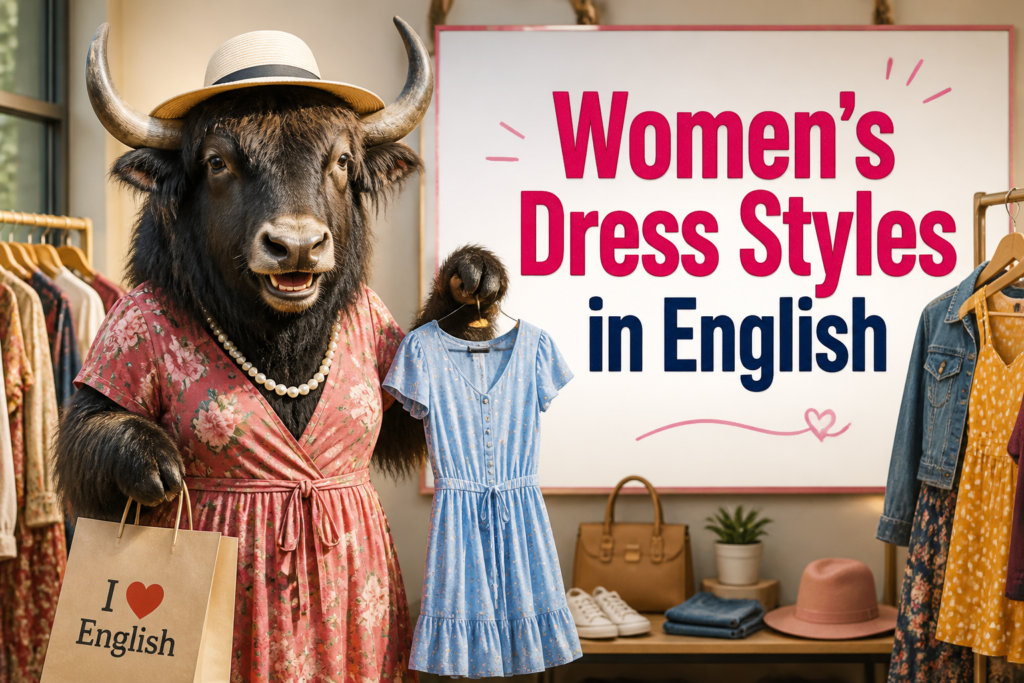
Learn the English names for common women’s dress styles, how to describe them, and how to use them naturally in real conversations.
Shopping for clothes in English can be weirdly confusing. One person says “I love that dress,” another says “That’s a slip dress,” and suddenly everyone is pretending they always knew the difference. Calm down. You do not need a fashion degree to talk about dresses in English.
In this guide, you’ll learn practical dress vocabulary, pronunciation help, useful phrases, and simple ways to describe style, fit, and occasion. By the end, you should feel comfortable talking about dresses at a store, online, or in a conversation with friends.
Before we start, here’s a tiny learner tip: in American English, people often say dress for a one-piece women’s garment, while in British English, “dress” is also common, but some style words and shopping terms may differ a little.
Common Women’s Dress Styles
Here are the most useful dress style words. The pronunciation help is simple, so you can actually say these out loud without sounding like a nervous robot.
| English | Pronunciation | Meaning | Example Sentence | Learner Note |
|---|---|---|---|---|
| a-line dress | AY-line dress | A dress that is fitted at the top and wider at the bottom, like the letter A. | I like a-line dresses because they are comfortable and flattering. | Very common for casual and semi-formal wear. |
| bodycon dress | BAH-dee-kon dress | A tight dress that fits close to the body. | She wore a black bodycon dress to the party. | Casual fashion word; often used in shopping. |
| maxi dress | MAK-see dress | A long dress that usually goes to the ankles. | My sister bought a floral maxi dress for summer. | Good for warm weather and vacations. |
| midi dress | MID-ee dress | A dress that ends around the middle of the calf. | That blue midi dress looks elegant and simple. | Popular in both casual and dressy styles. |
| mini dress | MIN-ee dress | A short dress that ends above the knee. | She wore a red mini dress with sandals. | Can sound casual or party-style. |
| English | Pronunciation | Meaning | Example Sentence | Learner Note |
|---|---|---|---|---|
| wrap dress | rap dress | A dress that crosses in the front and ties at the waist. | A wrap dress is easy to wear and often looks nice on many body types. | Very common and practical vocabulary. |
| shift dress | SHIFT dress | A loose dress that hangs straight from the shoulders. | She chose a simple shift dress for work. | Neutral and useful for professional style. |
| sheath dress | SHEETH dress | A fitted dress that follows the shape of the body. | The interviewer wore a navy sheath dress. | Often used for business or formal style. |
| shirt dress | SHURT dress | A dress styled like a long shirt, often with buttons. | She paired her shirt dress with white sneakers. | Casual and easy to describe. |
| sweater dress | SWET-er dress | A warm dress made from sweater-like material. | In winter, I like to wear a cozy sweater dress. | Common in colder weather. |
| English | Pronunciation | Meaning | Example Sentence | Learner Note |
|---|---|---|---|---|
| cocktail dress | KOK-tayl dress | A dress for semi-formal events or parties. | She wore a simple cocktail dress to the wedding reception. | More formal than casual dresses. |
| evening dress | EE-ving dress | A dress for formal night events. | That evening dress looks perfect for the gala. | Formal and elegant. |
| ball gown | BAWL gown | A very formal dress, often long and full. | The princess-style ball gown looked expensive. | Used for special events, proms, or weddings. |
| prom dress | prom dress | A dress worn to a prom or school dance. | She spent weeks choosing a prom dress. | Common in American English. |
| wedding dress | WED-ing dress | A dress worn by a bride at a wedding. | Her wedding dress was white and very simple. | Universal and very common. |
Useful Words To Describe A Dress
Sometimes you do not know the exact dress style, and that is fine. Real people often describe a dress by color, fit, length, or fabric instead. Useful, right? Language survives another day.
| English | Pronunciation | Meaning | Example Sentence | Learner Note |
|---|---|---|---|---|
| floral | FLOR-uhl | Covered with flowers or flower patterns. | She bought a floral dress for spring. | Very common in shopping descriptions. |
| plain | playn | Simple, with no pattern. | He liked the plain black dress better than the shiny one. | Use for simple style, not boring judgment. |
| slim-fitting | SLIM fit-ing | Close to the body, but not necessarily tight. | That slim-fitting dress looks modern. | Useful in fashion ads. |
| loose-fitting | LOOS fit-ing | Not tight; more relaxed. | She prefers loose-fitting dresses in hot weather. | Comfort-focused description. |
| strapless | STRAP-liss | Without straps on the shoulders. | Her strapless dress needed careful adjusting. | Often used for party or formal wear. |
| English | Pronunciation | Meaning | Example Sentence | Learner Note |
|---|---|---|---|---|
| sleeveless | SLEEV-liss | Without sleeves. | This sleeveless dress is great for summer. | Very common and easy to use. |
| long-sleeved | long-sleevd | Having long sleeves. | I need a long-sleeved dress for the winter dinner. | Spelling note: “sleeved,” not “sleeve.” |
| off-the-shoulder | of thuh SHOHL-der | Worn below the shoulders. | She wore an off-the-shoulder dress to the birthday party. | Popular in fashion and event descriptions. |
| high-low | HY-low | Shorter in front, longer in back. | That high-low dress looks playful and stylish. | Common in modern fashion language. |
| pleated | PLEE-tid | Made with folds in the fabric. | The pleated dress moved beautifully when she walked. | Useful for elegant or school-uniform style. |
Helpful Phrases You Can Use
These phrases are great for shopping, chatting, or describing clothes in a simple way. They also help you sound natural instead of sounding like you swallowed a dictionary and a mall directory at the same time.
| English Phrase | Pronunciation | Meaning | Example Sentence | Learner Note |
|---|---|---|---|---|
| It fits well. | it FITS wel | The dress is the right size and shape for the person. | This dress fits well, so I’m going to buy it. | Very useful in stores. |
| It’s too tight. | its too TITE | The dress is not comfortable because it is small or close-fitting. | This one is nice, but it’s too tight around the waist. | Common shopping phrase. |
| It’s too loose. | its too LOOS | The dress is too big or not fitted enough. | The dress is pretty, but it’s too loose on me. | Use for size problems. |
| It flatters you. | it FLAT-erz yoo | The dress makes someone look good. | That color flatters you. | “Flatter” is common in fashion talk. |
| It’s a bit revealing. | its uh bit ree-VEE-ling | The dress shows more skin than usual. | That dress is stylish, but it’s a bit revealing. | Can be polite, but context matters. |
| English Phrase | Pronunciation | Meaning | Example Sentence | Learner Note |
|---|---|---|---|---|
| It’s casual. | its KAZH-oo-uhl | Relaxed and everyday, not formal. | We can wear something casual for lunch. | Very common for dress codes. |
| It’s formal. | its FOR-muhl | Suitable for serious, dressy, or special occasions. | The invitation says the event is formal. | Useful for weddings, dinners, and offices. |
| It’s elegant. | its EL-uh-gent | Beautiful in a simple, graceful way. | She chose an elegant black dress. | Positive and polite. |
| It’s a good choice for summer. | its uh good choys fer SUM-er | The dress works well in hot weather. | A sleeveless cotton dress is a good choice for summer. | Helpful for shopping and travel. |
| What style do you prefer? | wut sty-l doo yoo pre-FER | A question asking about personal taste. | What style do you prefer: casual or formal? | Great for conversation practice. |
Style Differences You Should Know
Some dress words are about shape, and some are about occasion. That sounds obvious, but English learners often mix them up. A maxi dress is about length. A cocktail dress is about the kind of event. A wrap dress is about construction. Fashion language is a little bossy like that.
- Length: mini, midi, maxi
- Fit: bodycon, slim-fitting, loose-fitting, sheath
- Structure: wrap, shirt, shift, pleated
- Occasion: casual, cocktail, evening, wedding, prom
- Weather: sleeveless, long-sleeved, sweater dress
Here is a useful memory trick: if you can describe the dress by asking “How long is it?” “How tight is it?” “When do people wear it?” you will usually find the right English word.
American And British English Notes
Most basic dress words are the same in American and British English. Still, there are a few small differences in shopping language and style talk.
| American English | British English | Notes |
|---|---|---|
| dress | dress | Both are common for a one-piece women’s garment. |
| prom dress | Less common | Prom is especially American. In the UK, people may say party dress or use another event name. |
| sneakers with a dress | trainers with a dress | The shoes word changes, not the dress word. |
| pants under a dress | trousers under a dress | Not usually about dresses, but useful for clothing talk. |
If you want a broader English level check while learning clothing vocabulary, try the English Placement Test CEFR. If you want more practice with words like these, the English Vocabulary Test is also handy.
Mini Practice
Let’s make the vocabulary stick. English words love to hide in your brain until you actually use them. Rude little creatures.
- Choose the best word: A dress that is long and reaches the ankles is a maxi dress / mini dress / sheath dress.
- Choose the best word: A dress that is tight and hugs the body is a bodycon dress / shift dress / sweater dress.
- Choose the best word: A dress with no sleeves is sleeveless / pleated / formal.
- Fill in the blank: She wore an ______ dress to the wedding. Possible answers: elegant, evening, cocktail.
- Say it aloud: This midi dress fits well.
- Say it aloud: That floral wrap dress looks beautiful.
- Rewrite it: “The dress is not too big.” → The dress is not too loose.
- Rewrite it: “The dress is nice for summer.” → The dress is a good choice for summer.
Common Mistakes And Fixes
- Mistake: “She wore a beautiful cloth.” Fix: “She wore a beautiful dress.” Why: Cloth is material, not clothing.
- Mistake: “The dress is very fashion.” Fix: “The dress is very fashionable.” Why: Fashion is a noun; fashionable is the adjective.
- Mistake: “This dress is too smalling.” Fix: “This dress is too small” or “too tight.” Why: English does not use smalling.
- Mistake: “She has a long dress red.” Fix: “She has a long red dress.” Why: Adjectives usually go before the noun, and common order matters.
- Mistake: “That dress is expensiver.” Fix: “That dress is more expensive.” Why: Two-syllable and longer adjectives usually use more.
Yak wisdom: if you can describe the dress by shape, length, and occasion, you can usually talk about it like a native speaker. Fashion language is mostly just practical English wearing better shoes.
Quick Reference Summary
- Length: mini, midi, maxi
- Fit: bodycon, slim-fitting, loose-fitting, sheath
- Style: wrap, shift, shirt, pleated
- Weather: sleeveless, long-sleeved, sweater dress
- Event: casual, cocktail, evening, wedding, prom
- Useful verbs: wear, fit, flatter, match, choose
For more English learning, explore the main Learn English page and keep collecting words you can actually use in real life. The more you describe clothes in English, the less scary shopping becomes. Miracles happen.
Yak Takeaway: Women’s dress styles in English are easiest to learn when you group them by length, fit, and occasion. Start with the common ones first, use them in simple sentences, and English will stop acting so dramatic.