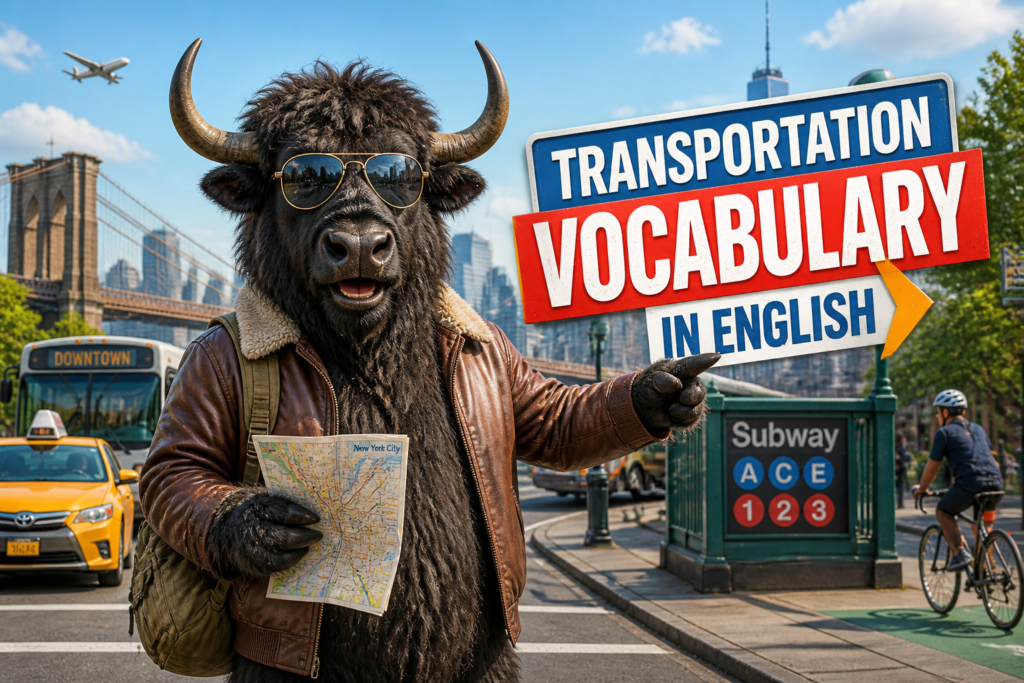
Transportation vocabulary shows up everywhere: at the airport, on the street, in emails, in travel plans, and in those charming moments when the bus is late and everyone suddenly becomes a philosopher. If you can talk clearly about how you move from place to place, life in English gets a lot easier.
In this guide, you’ll learn practical words and phrases for cars, buses, trains, planes, bikes, walking, and more. You’ll also see pronunciation help, simple meanings, example sentences, and a few useful notes about American and British English.
By the end, you should be able to talk about transportation naturally instead of waving your hands and saying, “You know… the thing that takes people places.”
Everyday Transportation Words
These are the most common words you need first. They cover public transport, private vehicles, and basic movement around town.
| English | Pronunciation | Meaning | Example Sentence | Learner Note |
|---|---|---|---|---|
| transportation | tran-sper-TAY-shun | the system of moving people or things from one place to another | Transportation in this city is cheap and convenient. | Common in American English. |
| transport | TRANS-port / trans-PORT | the movement of people or goods; also a vehicle or method in British English | Public transport is very busy during rush hour. | In British English, “public transport” is very common. |
| vehicle | VEE-ih-kul | a thing used to carry people or goods, such as a car, bus, or truck | That vehicle can carry eight passengers. | Formal and general. |
| commute | kuh-MYOOT | to travel regularly between home and work or school | I commute by train every day. | Very common in work and city life. |
| one-way | WUN-way | going in one direction only | I bought a one-way ticket to Chicago. | Used for tickets and streets. |
| round trip | ROWND trip | a trip there and back | A round-trip ticket is cheaper than two one-way tickets. | British English often says “return ticket.” |
| fare | fair | the money you pay to ride a bus, train, taxi, etc. | The bus fare is $2.50. | Not the same as “fair” for an event. |
| route | root | a path or road that a vehicle follows | This bus route goes downtown. | British and American pronunciation can vary a little. |
| stop | stop | a place where a bus, train, or tram stops | The next stop is near the museum. | Very useful in travel conversations. |
| station | STAY-shun | a place where trains, buses, or subways stop | We met at the train station. | Common in many transport phrases. |
Useful Transportation Phrases
These phrases help you ask for information, buy tickets, and describe your travel plans. They are the kind of English people actually say in real life, not the kind that just sits in textbooks looking important.
| English | Pronunciation | Meaning | Example Sentence | Learner Note |
|---|---|---|---|---|
| How do I get to…? | how do I GET too | How can I travel to a place? | How do I get to the airport from here? | Very common for asking directions. |
| Which bus goes to…? | which bus GOHZ too | Which bus travels to a place? | Which bus goes to the city center? | Useful at bus stops. |
| Does this train stop at…? | duz this train stop at | Asking if a train stops at a station | Does this train stop at Grand Central? | Good for checking before boarding. |
| I need a ticket to… | eye need uh TIK-it too | You want to buy a ticket | I need a ticket to Boston, please. | Polite and simple. |
| How much is the fare? | how much is the FAIR | Asking the price of the ride | How much is the fare to the airport? | “Fare” is the transport price. |
| Is it direct? | IZ it duh-REKT | Asking if there are no changes or stops that matter | Is it direct, or do I need to change trains? | Helpful for train and flight travel. |
| Do I need to transfer? | doo eye need to TRANS-fer | Asking if you must change vehicles | Do I need to transfer to another bus? | Common in American English. |
| What time does it leave? | what time duz it leev | Asking the departure time | What time does the train leave? | Great for schedules. |
| What time does it arrive? | what time duz it uh-RYV | Asking the arrival time | What time does the plane arrive? | Useful with tickets and timetables. |
| Can I get a day pass? | kan eye get uh DAY pass | A pass for unlimited rides in one day | Can I get a day pass for the subway? | Good for city travel. |
| Where is the platform? | where iz the PLAT-form | Asking where the train boarding area is | Where is platform 4? | Common in train stations. |
| Which terminal? | which TUR-muh-nul | Asking which airport terminal to go to | Which terminal is the flight leaving from? | Very common at airports. |
Cars And Driving Vocabulary
Cars are full of useful words, especially if you travel, rent vehicles, or talk about driving. Even if you do not drive, you will still hear these words constantly.
| English | Pronunciation | Meaning | Example Sentence | Learner Note |
|---|---|---|---|---|
| car | kar | a small vehicle for people | We drove to the beach in my car. | Very common and neutral. |
| driver | DRY-ver | a person who drives a vehicle | The driver was very polite. | Can mean a taxi driver, bus driver, or anyone driving. |
| license | LY-sens | official permission to drive | She got her driver’s license last year. | American spelling. British English often says “driving licence.” |
| gas | gas | fuel for a car | We need to stop for gas. | American English. British English usually says “petrol.” |
| trunk | trunk | the storage area at the back of a car | The suitcase is in the trunk. | British English usually says “boot.” |
| hood | hood | the front cover of a car engine | There’s steam coming from under the hood. | British English usually says “bonnet.” |
| steering wheel | STEER-ing wheel | the wheel used to control a car | He held the steering wheel carefully. | Very common vehicle part. |
| brake | brayk | something that slows or stops a vehicle | Press the brake slowly. | Don’t confuse with “break.” |
| accelerator | ak-SEH-luh-ray-ter | the pedal that makes the car go faster | She pressed the accelerator to pass the truck. | Formal, but useful. |
| parking lot | PAR-king lot | an area where cars are parked | The parking lot is full. | American English. British English often says “car park.” |
| turn signal | TURN SIG-nul | the light that shows a car will turn | Please use your turn signal. | British English often says “indicator.” |
| traffic jam | TRAF-ik jam | many cars on the road causing slow movement | We were late because of a traffic jam. | Very common collocation. |
Public Transportation Vocabulary
Public transportation is especially useful in cities. If you know these words, you can ask better questions and avoid looking lost in a station while pretending to know exactly where you are. Very classy.
| English | Pronunciation | Meaning | Example Sentence | Learner Note |
|---|---|---|---|---|
| bus | bus | a large vehicle that carries passengers | The bus comes every 15 minutes. | Common worldwide. |
| bus stop | BUS stop | a place where buses pick up and drop off people | The bus stop is across the street. | Very practical phrase. |
| subway | SUB-way | an underground train system | We took the subway to downtown. | American English. British English often says “the underground” or “the Tube.” |
| metro | MEH-troh | a city train system, often underground | The metro is faster than the bus. | Used in many countries. |
| train | trayn | a long vehicle that runs on tracks | The train to Seattle leaves at 8:10. | Common for city and long-distance travel. |
| platform | PLAT-form | the area where passengers board a train | Our train leaves from platform 2. | Important at stations. |
| ticket | TIK-it | proof that you paid for travel | Please show your ticket. | Can be paper or digital. |
| passenger | PASS-en-jer | a person traveling in a vehicle, not driving it | Passengers must wear seat belts. | Formal, but common. |
| rush hour | RUSH ow-er | the busiest time for traffic and public transport | The train is crowded during rush hour. | Very useful for city life. |
| transfer | TRANS-fer | to change from one vehicle to another | You need to transfer at Central Station. | Can be a noun or a verb. |
| delay | duh-LAY | a late departure or arrival | Our flight has a two-hour delay. | Common in travel announcements. |
| schedule | SKED-jool / SHED-yool | a planned list of times | The train schedule changes on weekends. | Pronunciation differs by region. |
Air Travel Vocabulary
Air travel vocabulary is useful even if you do not fly often. Airports love their own special language, because apparently “please wait here” needed a more dramatic version.
| English | Pronunciation | Meaning | Example Sentence | Learner Note |
|---|---|---|---|---|
| airport | AIR-port | a place where airplanes take off and land | We arrived at the airport early. | Very common travel word. |
| airplane | AIR-playn | a vehicle that flies in the sky | The airplane landed safely. | American English. British English often says “aeroplane.” |
| flight | flyt | a trip by airplane | Our flight is delayed. | Used for the trip and the service. |
| boarding pass | BOR-ding pass | paper or digital document allowing you to board | Keep your boarding pass ready. | Needed before entering the plane. |
| gate | gayt | the airport door area where passengers wait for a flight | Your flight leaves from Gate 12. | Very important at airports. |
| terminal | TUR-muh-nul | a building or section of an airport | They met us at Terminal B. | Common in airport directions. |
| carry-on | KAR-ee-on | luggage you take into the airplane with you | This bag is my carry-on. | American English. British English often says “hand luggage.” |
| check-in | CHEK-in | the process of registering for a flight | Check-in opens two hours before departure. | Can be a noun or verb. |
| take off | TAYK off | when a plane leaves the ground | The plane took off at 9:00 p.m. | Common phrasal verb. |
| land | land | when a plane comes down to the ground | The plane landed in New York. | Simple but essential. |
| seat belt | SEET belt | a strap used for safety in a plane or car | Please fasten your seat belt. | Also used in cars. |
| customs | KUS-tums | the border control area at an airport or border | We waited in line at customs. | Used for immigration and border checks. |
Bicycle, Walking, And Small-Trip Words
Not every trip needs a giant machine with luggage tags and airline snacks. Sometimes you just walk, ride a bike, or hop on a scooter. Simple words, big usefulness.
| English | Pronunciation | Meaning | Example Sentence | Learner Note |
|---|---|---|---|---|
| walk | wawk | to move on foot | It’s faster to walk than to drive. | Very common everyday verb. |
| pedestrian | puh-DES-tree-un | a person walking, especially on streets | Pedestrians should use the crosswalk. | Formal, but useful in city signs. |
| crosswalk | CROSS-wawk | a place where people cross the street safely | Use the crosswalk at the corner. | American English. British English often says “pedestrian crossing.” |
| bicycle | BY-si-kul | a two-wheeled vehicle you pedal | He rides his bicycle to school. | Can also be called a “bike.” |
| bike | bik | short word for bicycle or motorcycle, depending on context | I bought a new bike last month. | Context matters. |
| helmet | HEL-met | head protection for bike or motorcycle riders | Always wear a helmet when riding a bike. | Safety word, very important. |
| sidewalk | SYD-wawk | the path people walk on next to the road | Please walk on the sidewalk. | American English. British English often says “pavement.” |
| lane | layn | a marked line or path for traffic | Stay in the bike lane. | Used for roads and transport systems. |
| scooter | SKOO-ter | a small two-wheeled vehicle | She took a scooter to the store. | Can mean different things in different places. |
| ride | ryd | a journey in a vehicle; also to travel on a bike or scooter | We had a long bus ride home. | Very flexible word. |
Common Verbs For Transportation
Transportation verbs are extremely useful because they let you describe movement, plans, and changes. If nouns are the stuff, verbs are the action.
| English | Pronunciation | Meaning | Example Sentence | Learner Note |
|---|---|---|---|---|
| drive | dryv | to control a car or other vehicle | My brother drives to work. | Use with cars, trucks, and similar vehicles. |
| ride | ryd | to travel on a bike, horse, bus, or motorcycle | I ride the subway every morning. | Common with bikes and public transport in American English. |
| take | tayk | to use a vehicle or transport service | We took a taxi home. | Very common pattern: take + transport. |
| catch | kach | to get a bus, train, or plane in time | I need to catch the 7:30 train. | Very common and natural. |
| board | bawrd | to get on a plane, train, bus, or ship | Passengers are now boarding the plane. | More formal than “get on.” |
| get on | get on | to enter a bus, train, or plane | We got on the bus near the museum. | Everyday and common. |
| get off | get off | to leave a bus, train, plane, or other vehicle | Get off at the next stop. | Very common phrasal verb. |
| park | park | to leave a vehicle in a place | Can I park here? | Very common in daily English. |
| merge | murj | to join into one lane or road | Cars must merge carefully. | Useful for driving vocabulary. |
| overtake | OH-ver-tayk | to pass another vehicle | You should not overtake on this road. | More common in British English; American English often says “pass.” |
| stop | stop | to no longer move | The bus stopped at the corner. | Basic but important. |
| depart | dee-PART | to leave | The train departs at noon. | More formal than “leave.” |
Transportation Phrases In Real Life
Here are more practical phrases you’ll hear and use often. These are especially helpful for travel, daily commuting, and asking for help.
| English | Pronunciation | Meaning | Example Sentence | Learner Note |
|---|---|---|---|---|
| I’m taking the bus. | eye’m TAY-king the bus | I will travel by bus | I’m taking the bus to school today. | Natural and common. |
| I’m driving. | eye’m DRY-ving | I am using a car as the driver | I’m driving to the office. | Useful for plans. |
| I’m on my way. | eye’m on my WAY | I am traveling to a place now | I’m on my way to the station. | Great for texts and calls. |
| I missed my train. | eye MIST my train | I arrived too late for the train | I missed my train, so I took a taxi. | Very common travel problem. |
| The traffic is bad. | the TRAF-ik iz bad | Roads are crowded or slow | The traffic is bad this morning. | Simple and useful complaint. |
| It’s a short ride. | its uh short ryd | The trip will not take long | Don’t worry, it’s a short ride. | Helpful in conversation. |
| It’s within walking distance. | its with-IN WAW-king DIS-tans | You can walk there easily | The hotel is within walking distance of the station. | Useful in hotels and city travel. |
| Can you drop me off? | kan yoo drop me off | Can you take me and let me out at a place? | Can you drop me off at the mall? | Common in car conversations. |
| I need a ride. | eye need uh ryd | I need someone to take me somewhere by car | I need a ride to the airport. | Very common in American English. |
| There’s a delay. | therz uh duh-LAY | The transport is late | There’s a delay because of the weather. | Good for announcements and travel updates. |
| It’s crowded. | its KROW-did | There are too many people | The subway is crowded during rush hour. | Very useful in cities. |
| It’s a direct route. | its uh duh-REKT root | No change is needed; it goes straight there | This is a direct route to the airport. | Common with buses and trains. |
American Vs British English
Transportation words often change a little between American and British English. The good news: people usually understand both. The slightly annoying news: the vocabulary is not always the same, because English enjoys keeping learners busy.
| American English | British English | Meaning | Example |
|---|---|---|---|
| subway | underground / Tube | city train system | We took the subway / underground to downtown. |
| truck | lorry | large vehicle for carrying goods | The truck / lorry delivered the boxes. |
| gas | petrol | fuel for cars | We need gas / petrol before the trip. |
| parking lot | car park | place where cars are parked | The parking lot / car park is full. |
| sidewalk | pavement | walking path by the road | Stay on the sidewalk / pavement. |
| elevator | lift | machine that moves people up and down | Take the elevator / lift to the third floor. |
| one-way ticket | single ticket | ticket for travel in one direction | I bought a one-way / single ticket. |
| return trip | return journey | trip there and back | The return trip was faster. |
Common Mistakes To Avoid
- Take vs. ride: “take a bus” is very natural. “ride a bus” is also heard in American English, but “take a bus” is safer for many learners.
- Fare vs. fair: “fare” is the transport price. “fair” means just, reasonable, or an event.
- Subway vs. underground: use the local word when you can. In New York, say “subway.” In London, say “the Underground” or “the Tube.”
- Get on vs. get in: “get on” is used for buses, trains, and planes. “get in” is used for cars and taxis.
- Drive vs. ride: you drive a car when you are the driver. You usually ride a bike, motorcycle, or bus.
- Station vs. stop: a “station” is usually a larger place for trains or buses. A “stop” is a smaller place where a bus stops.
- One-way vs. round trip: a one-way ticket goes only one direction. A round trip includes going and coming back.
Quick Practice
Try these short exercises. Tiny practice, big payoff. Annoying but true.
| Task | Practice | Answer |
|---|---|---|
| 1 | Complete the sentence: I need a ticket ____ Boston. | to |
| 2 | Choose the correct word: You pay the bus ____. | fare |
| 3 | Choose the correct phrase: I’m ____ the subway to work. | taking / riding |
| 4 | Complete the sentence: The plane will ____ at 6:40. | depart / leave |
| 5 | Choose the correct word: The ____ is full, so we parked on the street. | parking lot |
| 6 | Complete the sentence: The train ____ at platform 3. | leaves / departs |
| 7 | Choose the correct word: Please fasten your ____ belt. | seat |
| 8 | Complete the sentence: It’s faster to travel by ____ than by car. | subway / train |
Yak takeaway: Transportation English is mostly about simple, useful words used in the right situation. Learn the common verbs, know the local names, and suddenly the whole city becomes less mysterious and less dramatic.
If you want more English practice, try the English Vocabulary Test or check your level with the English Placement Test CEFR. For more lessons, visit the main Learn English page.