


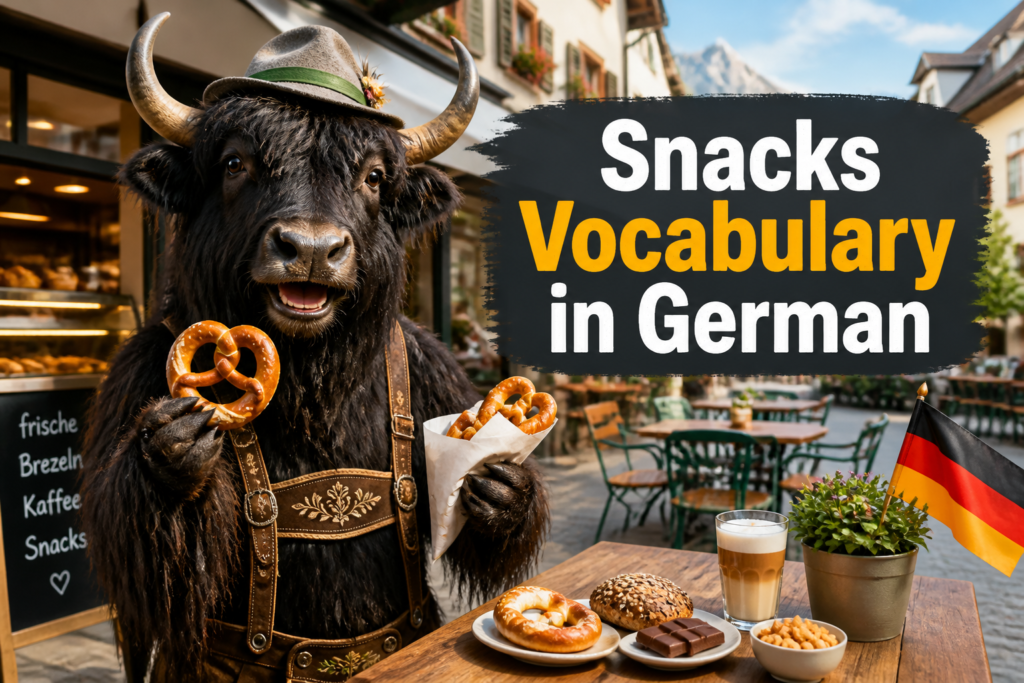
If you ever thought German snack vocabulary would be boring, congratulations: you have underestimated bread, sausage, and the nation’s deep emotional commitment to things you can eat with one hand. This guide gives you practical German words and phrases for ordering, buying, offering, and talking about snacks in real life.
For the broader learning path, visit our parent guide.
By the end, you’ll know how to ask for a quick bite, understand common snack names, and sound a lot less like someone reading a menu with panic in their eyes. For a tiny but useful side quest, you can also compare related food words in the condiments vocabulary guide and, if your snack run becomes a full evening, the beer vocabulary guide.
German snack talk is wonderfully practical. You do not need literary flair to survive a bakery, a kiosk, or a train station. You just need the right words, a little pronunciation help, and enough confidence to ask for something tasty before your blood sugar starts negotiating with you.
Quick Starter: The Most Useful Snack Words
| German | Pronunciation | Meaning | Example Sentence | Translation | Learner Note |
|---|---|---|---|---|---|
| der Snack | shnak | snack, light bite | Ich brauche einen Snack. | I need a snack. | Very common. In German, Snack is borrowed from English. |
| der Imbiss | IM-biss | snack stand, quick meal, snack bar | Wir gehen zum Imbiss. | We’re going to the snack stand. | Often means the place, not just the food. |
| der Happen | HA-pən | bite, mouthful | Nur noch ein Happen, dann bin ich fertig. | Just one more bite, then I’m done. | Useful for talking casually about eating. |
| knabbern | KNA-bun | to munch, nibble | Die Kinder knabbern an Karotten. | The children are munching on carrots. | Great for small crunchy snacks. |
| snacken | SHNA-ken | to snack | Ich snacked nicht gern spät abends. | I don’t like snacking late at night. | Very modern and common in spoken German. |
Common Snack Vocabulary
Here are the words you’ll actually hear in shops, cafés, canteens, and train stations. Notice how many snack words are simple, everyday nouns. German loves being practical. Shocking, really.
| German | Pronunciation | Meaning | Example Sentence | Translation | Learner Note |
|---|---|---|---|---|---|
| der Keks | kakes | cookie, biscuit | Ich nehme einen Keks zum Kaffee. | I’ll have a cookie with my coffee. | Plural: Kekse. |
| der Cracker | KREK-er | cracker | Die Cracker sind sehr salzig. | The crackers are very salty. | Borrowed word; usually understood without trouble. |
| die Chips | chips | potato chips, crisps | Die Chips liegen auf dem Tisch. | The chips are on the table. | In Germany, Chips usually means potato chips, not French fries. |
| die Salzstangen | ZALTSH-tan-gən | salt sticks, pretzel sticks | Magst du Salzstangen? | Do you like pretzel sticks? | Very common snack with drinks. |
| die Brezel | BRAY-tsəl | pretzel | Ich esse eine Brezel am Bahnhof. | I’m eating a pretzel at the train station. | In Bavaria, Brezn is also common in speech. |
| das Brötchen | BRURT-chən | bread roll, small roll | Ich möchte ein Brötchen mit Käse. | I’d like a bread roll with cheese. | Classic German bakery item. |
| das belegte Brötchen | beh-LEG-tə BRURT-chən | filled sandwich roll | Ein belegtes Brötchen bitte. | A filled sandwich roll, please. | Very useful at bakeries and stations. |
| das Sandwich | ZEN-dwitsch | sandwich | Ich nehme ein Sandwich to go. | I’ll take a sandwich to go. | Also written as Sandwich on many menus. |
| der Müsliriegel | MYOO-zli-REE-gəl | muesli bar, granola bar | Ich habe einen Müsliriegel im Rucksack. | I have a granola bar in my backpack. | Good travel word. |
| der Schokoriegel | SHO-ko-REE-gəl | chocolate bar | Sie isst einen Schokoriegel nach dem Sport. | She eats a chocolate bar after sport. | Good compound noun: Schoko + Riegel. |
More Snack Words You’ll Hear Often
| German | Pronunciation | Meaning | Example Sentence | Translation | Learner Note |
|---|---|---|---|---|---|
| die Nüsse | NOO-sə | nuts | Ich mag Nüsse als Snack. | I like nuts as a snack. | Singular: die Nuss. |
| die Erdnüsse | AIRT-noo-sə | peanuts | Die Erdnüsse sind geröstet. | The peanuts are roasted. | Not the same as Erdbeeren or other “earth” words. Germans do love compound nouns. |
| das Popcorn | POHP-korn | popcorn | Im Kino kaufe ich Popcorn. | At the cinema, I buy popcorn. | Usually neuter: das Popcorn. |
| das Eis | ice | ice cream | Im Sommer esse ich oft Eis. | In summer I often eat ice cream. | Watch out: das Eis can also mean ice in general. |
| der Joghurt | YOH-goort | yogurt | Ich esse einen Joghurt mit Obst. | I’m eating a yogurt with fruit. | Also spelled Joghurt or sometimes Jogurt. |
| das Obst | ohpst | fruit | Es gibt Obst als gesunden Snack. | There is fruit as a healthy snack. | Uncountable in German here. |
| die Banane | ba-NAH-nə | banana | Ich esse eine Banane unterwegs. | I eat a banana on the go. | Good simple snack word for beginners. |
| der Apfel | AP-fəl | apple | Ein Apfel ist schnell gegessen. | An apple is eaten quickly. | Very common in health and snack talk. |
| das Gemüse | geh-MYOO-zə | vegetables | Ich mag Gemüse als kleinen Snack. | I like vegetables as a small snack. | Plural-looking word, but singular in usage. |
| der Gemüsestick | geh-MYOO-zə-shtik | vegetable stick | Sie nimmt Gemüsesticks mit Dip. | She takes vegetable sticks with dip. | Often used in healthier snack contexts. |
Useful Snack Phrases For Real Life
These are the phrases that matter when you are hungry, slightly impatient, and trying not to overcomplicate life. German snack phrases are often short, direct, and refreshingly free of drama.
| German | Pronunciation | Meaning | Example Sentence | Translation | Learner Note |
|---|---|---|---|---|---|
| Ich habe Hunger. | ikh HAH-bə HOON-gər | I’m hungry. | Ich habe Hunger, also kaufen wir etwas zu essen. | I’m hungry, so let’s buy something to eat. | Very common and neutral. |
| Ich habe Lust auf etwas Süßes. | ikh HAH-bə loos tauf et-vas ZUES-səs | I feel like something sweet. | Ich habe Lust auf etwas Süßes nach dem Mittagessen. | I feel like something sweet after lunch. | Lust auf means “feel like” or “want.” |
| Hast du einen Snack? | hast doy-nen shnak | Do you have a snack? | Hast du einen Snack für unterwegs? | Do you have a snack for on the go? | Casual and very natural. |
| Kann ich etwas zum Mitnehmen bekommen? | kann ikh et-vas tsum MIT-neem-ən beh-KOH-men | Can I get something to take away? | Kann ich das Brötchen zum Mitnehmen bekommen? | Can I get the bread roll to take away? | Useful in bakeries, cafés, and kiosks. |
| Ich nehme das. | ikh NAY-mə dass | I’ll take that. | Ich nehme das und einen Kaffee. | I’ll take that and a coffee. | Handy when ordering. |
| Was empfehlen Sie? | vass emp-FAY-lən zee | What do you recommend? | Was empfehlen Sie als Snack? | What do you recommend as a snack? | Polite form with Sie. |
| Ich hätte gern einen kleinen Snack. | ikh HEH-tə gyarn i-nen KLY-nen shnak | I’d like a small snack, please. | Ich hätte gern einen kleinen Snack und Wasser. | I’d like a small snack and water. | Polite and very useful. hätte gern sounds softer than ich will. |
| Etwas Herzhaftes bitte. | et-vas HAIRT-zaf-tes BIT-tə | Something savory, please. | Ich möchte etwas Herzhaftes, kein Süßes. | I’d like something savory, not something sweet. | herzhaft = savory, hearty. |
| Etwas Süßes bitte. | et-vas ZUES-səs BIT-tə | Something sweet, please. | Etwas Süßes bitte, vielleicht einen Keks. | Something sweet, please, maybe a cookie. | Very useful in cafés and bakeries. |
| Nur zum Knabbern. | noor tsum KNA-bun | Just for nibbling / just as a small snack | Ich kaufe die Nüsse nur zum Knabbern. | I’m buying the nuts just for snacking. | Friendly, casual expression. |
| Das ist lecker. | dass ist LEK-ər | That’s tasty. | Die Brezel ist lecker. | The pretzel is tasty. | Simple praise word. Works for almost any snack. |
| Das schmeckt gut. | dass shmekt goot | That tastes good. | Der Joghurt schmeckt gut mit Honig. | The yogurt tastes good with honey. | Very common everyday phrase. |
Ordering Snacks In Shops And Cafés
German snack ordering often uses simple patterns. You do not need a giant speech. A polite request and a clear noun usually do the job. Miracles happen when people are fed.
| German | Pronunciation | Meaning | Example Sentence | Translation | Learner Note |
|---|---|---|---|---|---|
| Ich möchte bitte ein Brötchen. | ikh MÖKHT-ə BIT-tə ayn BRURT-chən | I would like a bread roll, please. | Ich möchte bitte ein Brötchen mit Käse. | I would like a bread roll with cheese, please. | möchte is polite and very common. |
| Ein belegtes Brötchen, bitte. | ayn beh-LEG-təs BRURT-chən BIT-tə | A filled bread roll, please. | Ein belegtes Brötchen mit Schinken, bitte. | A filled bread roll with ham, please. | Nice and efficient. |
| Haben Sie auch etwas Vegetarisches? | HAH-ben zee owkh et-vas veh-gay-tah-REE-shəs | Do you also have something vegetarian? | Haben Sie auch etwas Vegetarisches für unterwegs? | Do you also have something vegetarian for on the go? | Polite and practical. |
| Ich nehme zwei Käsestangen. | ikh NAY-mə tsvay KAY-zə-shtan-gen | I’ll take two cheese sticks. | Ich nehme zwei Käsestangen und einen Tee. | I’ll take two cheese sticks and a tea. | Good for bakeries and snack counters. |
| Kann ich das hier essen? | kann ikh dass hee-ər ESS-en | Can I eat this here? | Kann ich die Brezel hier essen? | Can I eat the pretzel here? | Useful when you are not sure about dine-in rules. |
| Ist das zum Mitnehmen? | ist dass tsum MIT-neem-ən | Is that to take away? | Ist das Sandwich zum Mitnehmen? | Is the sandwich to take away? | Common question at counters. |
| Ich hätte gern noch einen Snack. | ikh HEH-tə gyarn nokh ayn-ən shnak | I’d like one more snack. | Ich hätte gern noch einen Snack für später. | I’d like one more snack for later. | noch can mean “another” or “still.” |
| Was kostet das? | vass KOS-tet dass | How much does that cost? | Was kostet das belegte Brötchen? | How much does the filled roll cost? | Easy and useful everywhere. |
Snack Types And What They Usually Mean
German snack words often tell you what kind of snack you’re getting. The noun may look simple, but the meaning can shift a little depending on context. A bakery order is not always the same as a cinema snack, which is deeply unfair but unavoidable.
| German | Pronunciation | Meaning | Example Sentence | Translation | Learner Note |
|---|---|---|---|---|---|
| das süße Gebäck | dass ZUES-sə gə-BECK | sweet pastry, sweet baked snack | Das süße Gebäck liegt in der Vitrine. | The sweet pastry is in the display case. | Useful in bakeries. |
| das salzige Gebäck | dass ZALTSH-gə gə-BECK | savory pastry / salty baked snack | Ich mag salziges Gebäck lieber als Kuchen. | I prefer savory pastry to cake. | Good contrast word. |
| die Knabberei | kna-bə-RAY | snack food, nibbling food | Das ist nur eine kleine Knabberei. | That’s just a little snack food. | Slightly playful, common enough to recognize. |
| der Snackriegel | shnak-REE-gəl | snack bar | Ich habe einen Snackriegel im Auto. | I have a snack bar in the car. | Often used on packaging. |
| die Kleinigkeit | KLY-neek-kite | small thing, light snack | Willst du eine Kleinigkeit essen? | Do you want to eat a little something? | Very natural for casual offers. |
| der Hühnernugget | HYOO-ner-nug-get | chicken nugget | Die Kinder essen gerne Hühnernuggets. | The children like eating chicken nuggets. | Borrowed food word. Plural is common in speech. |
| die Pommes | poh-məs | fries | Ich nehme Pommes als Snack. | I’ll take fries as a snack. | Plural-only in everyday use. In Germany this is a classic snack. |
| die Currywurst | KUR-ee-voorst | sausage with curry sauce | Eine Currywurst ist ein typischer Snack. | A currywurst is a typical snack. | Very German, very filling. |
| die Waffel | VAH-fəl | waffle | Im Park esse ich eine Waffel. | In the park I eat a waffle. | Sweet snack, often with sugar or fruit. |
| die Schokolade | sho-ko-LAH-də | chocolate | Ich kaufe Schokolade für den Filmabend. | I’m buying chocolate for movie night. | Can mean chocolate in general, not just candy bars. |
Handy Snack Verbs
Verbs make your snack vocabulary more useful because they help you say what you are doing with the food. German snack verbs are usually straightforward, but a few are worth learning as chunks.
| German | Pronunciation | Meaning | Example Sentence | Translation | Learner Note |
|---|---|---|---|---|---|
| essen | ESS-en | to eat | Wir essen jetzt einen Snack. | We’re eating a snack now. | One of the first verbs to learn. |
| trinken | TRINK-en | to drink | Zu dem Snack trinken wir Wasser. | We drink water with the snack. | Often paired with snack talk. |
| kaufen | KOW-fən | to buy | Ich kaufe mir einen Müsliriegel. | I’m buying myself a granola bar. | mir here means “for myself.” |
| holen | HOH-lən | to get, fetch | Ich hole schnell einen Snack. | I’m quickly getting a snack. | Very common in speech. |
| mitbringen | MIT-bring-en | to bring along | Kannst du Snacks mitbringen? | Can you bring snacks? | Separable verb. In a sentence, mit and bringen split. |
| naschen | NASH-en | to snack, nibble sweets | Ich nasche gern Schokolade. | I like nibbling chocolate. | Usually for sweets, and often a little indulgent. |
| knabbern | KNA-bun | to nibble, crunch | Sie knabbert an einem Apfel. | She is nibbling on an apple. | Good for crunchy snacks. |
| teilen | TY-lən | to share | Wir teilen uns die Chips. | We’re sharing the chips. | Useful social snack verb. |
Pronunciation Notes That Actually Help
German snack words often contain sounds that English speakers trip over in predictable ways. Nothing dramatic. Just a few tiny landmines hidden in innocent-looking syllables.
| Sound / Word | How To Say It | Example | Meaning | Learner Note |
|---|---|---|---|---|
| ch | soft hiss in ich, harsher in Buch | Ich möchte einen Snack. | I would like a snack. | Don’t say the English “k” unless you want to sound very non-German very fast. |
| ei | “eye” | eine Brezel | a pretzel | ei is almost always “eye.” |
| ie | “ee” | Riegel | bar | Long ee sound. Easy once you stop fighting it. |
| z | “ts” | Zum Mitnehmen | to take away | z sounds like ts, not z in English. |
| sp | “shp” at the beginning of a word | Speisekarte | menu | Not a snack word itself, but useful in ordering. |
| st | “sht” at the beginning of a word | Stange | stick, bar | Common in snack compounds like Salzstangen. |
| ß | “ss” | heißen | to be called | In snack vocabulary you may see heiße drinks, heiße Brezeln, and spelling with ß. |
| final devoicing | final consonants sound hard | Salat | salad | At the end of a word, voiced sounds often become voiceless. German is stylish like that. |
Real-Life Mini Phrases
These short phrases are the kind you’ll actually use when standing in line, opening a cupboard, or asking a friend if the last cookie is emotionally available for sharing.
- Hast du noch einen Snack? — Do you have another snack?
- Ich brauche etwas zum Knabbern. — I need something to munch on.
- Hast du Lust auf Chips? — Do you feel like chips?
- Ich nehme nur eine Kleinigkeit. — I’ll just take a small bite/snack.
- Das ist perfekt für unterwegs. — That’s perfect for on the go.
- Kann ich das aufteilen? — Can I split/share that?
- Ich suche etwas Herzhaftes. — I’m looking for something savory.
- Ich suche etwas Süßes. — I’m looking for something sweet.
- Das passt gut zum Kaffee. — That goes well with coffee.
- Ich nehme es zum Mitnehmen. — I’ll take it to go.
Germany, Austria, And Switzerland: Small Differences
Most snack words above work across the German-speaking world, but a few regional differences are worth knowing. These are not giant obstacles, just tiny cultural potholes.
| Expression | Germany | Austria | Switzerland | Note |
|---|---|---|---|---|
| Brezel | very common | also common | understood, less central | In Bavaria and Austria, regional forms like Brezn or Brezn-style pronunciations may appear. |
| Joghurt | very common | very common | very common | Spelling may vary slightly on packaging, but everyone understands it. |
| Chips | potato chips | potato chips | potato chips | In German, this is usually the snack, not French fries. |
| Pommes | fries | fries | fries | Universally useful. No need to overthink it. |
| Imbiss | snack stand | snack stand | snack place / takeaway | Very widely understood. |
Snack vocabulary is one of the easiest ways to sound useful fast: you do not need perfect grammar to buy a pretzel, but you do need the right noun.
Quick Practice
Try these quick drills. Tiny practice now, less confusion later. That’s the dream.
| Task | German | English | Answer Hint |
|---|---|---|---|
| Choose the right word for “pretzel.” | Brezel / Riegel / Keks | pretzel / bar / cookie | Brezel |
| Translate “I’d like a snack, please.” | Ich hätte gern einen Snack, bitte. | — | Use hätte gern for politeness. |
| Fill the blank: Ich ______ einen Müsliriegel. | kaufe / esse / trinke | I buy / eat / drink a granola bar. | kaufe fits best here. |
| Choose the correct meaning of “Imbiss.” | snack stand / spoon / napkin | — | snack stand |
| Translate “Something savory, please.” | Etwas Herzhaftes, bitte. | — | herzhaft = savory/hearty. |
| Complete the sentence: Wir teilen uns die ______. | Chips / Apfel / Wasser | We’re sharing the ______. | Chips is the natural fit. |
Common Mistakes And Easy Fixes
- Mistake: Using Snacke as a German noun.
Fix: Use der Snack. The borrowed word is standard and simple. - Mistake: Saying Ich will einen Snack in a polite situation.
Fix: Use Ich möchte or Ich hätte gern for a softer, more polite tone. - Mistake: Thinking Chips means fries.
Fix: In German, Chips usually means potato chips. For fries, say Pommes. - Mistake: Ignoring noun gender.
Fix: Learn the article with the noun: der Keks, die Brezel, das Brötchen. - Mistake: Forgetting that Brötchen is neuter.
Fix: Say ein Brötchen, not eine Brötchen. - Mistake: Overcomplicating snack orders.
Fix: Short phrases work well: Ein belegtes Brötchen, bitte. - Mistake: Pronouncing z like English “z.”
Fix: Make it ts, as in Zum. - Mistake: Assuming every snack word needs fancy grammar.
Fix: Start with simple nouns and polite requests. Your stomach does not care about your adjective endings.
Extra Note On Word Choice
There is a small but important difference between snacken, knabbern, and naschen. They overlap, but they are not identical. snacken is the general modern word for snacking. knabbern suggests crunching or nibbling, often with salty snacks or small bites. naschen is often used for sweet snacks and can sound a little playful or indulgent.
If you want a boringly reliable source for checking forms and meanings, the Duden is always there, quietly doing its job like a very serious snack shelf.
Quick Reference Summary
- Snack = snack
- Imbiss = snack stand / quick meal place
- Brezel = pretzel
- Brötchen = bread roll
- Chips = potato chips
- Pommes = fries
- Keks = cookie / biscuit
- Riegel = bar
- naschen = to nibble sweets
- knabbern = to munch / nibble
- Ich hätte gern … = I’d like … please
- zum Mitnehmen = to take away
Snacks vocabulary in German is wonderfully useful because it shows up in the bakery, at the kiosk, on the train, at the office, and in every moment when “just one small bite” becomes a whole plan. Learn the common words first, keep the polite phrases ready, and the snack world opens up with very little drama. Yak takeaway: if you can order a pretzel, you are already making German life easier.