If you want to talk about hobbies in German, good news: this is one of the easiest ways to sound natural fast. People love talking about what they do in their free time, and German is full of simple, useful hobby words that show up in real conversations, texts, and small talk. Very handy. Very unglamorous. Very effective.
For the broader learning path, visit our parent guide.
In German, hobbies are usually discussed with haben (to have), machen (to do/make), or gern (to like doing something). That means you can build a lot of practical sentences without needing fancy grammar gymnastics. Which is nice, because nobody asked for grammar gymnastics.
By the end of this guide, you’ll know how to name common hobbies, say what you like doing, and ask other people about their free-time activities in natural German.
For extra practice with everyday German, you may also want Essential German Words & Phrases, Conversational German, and Common German Adjectives.
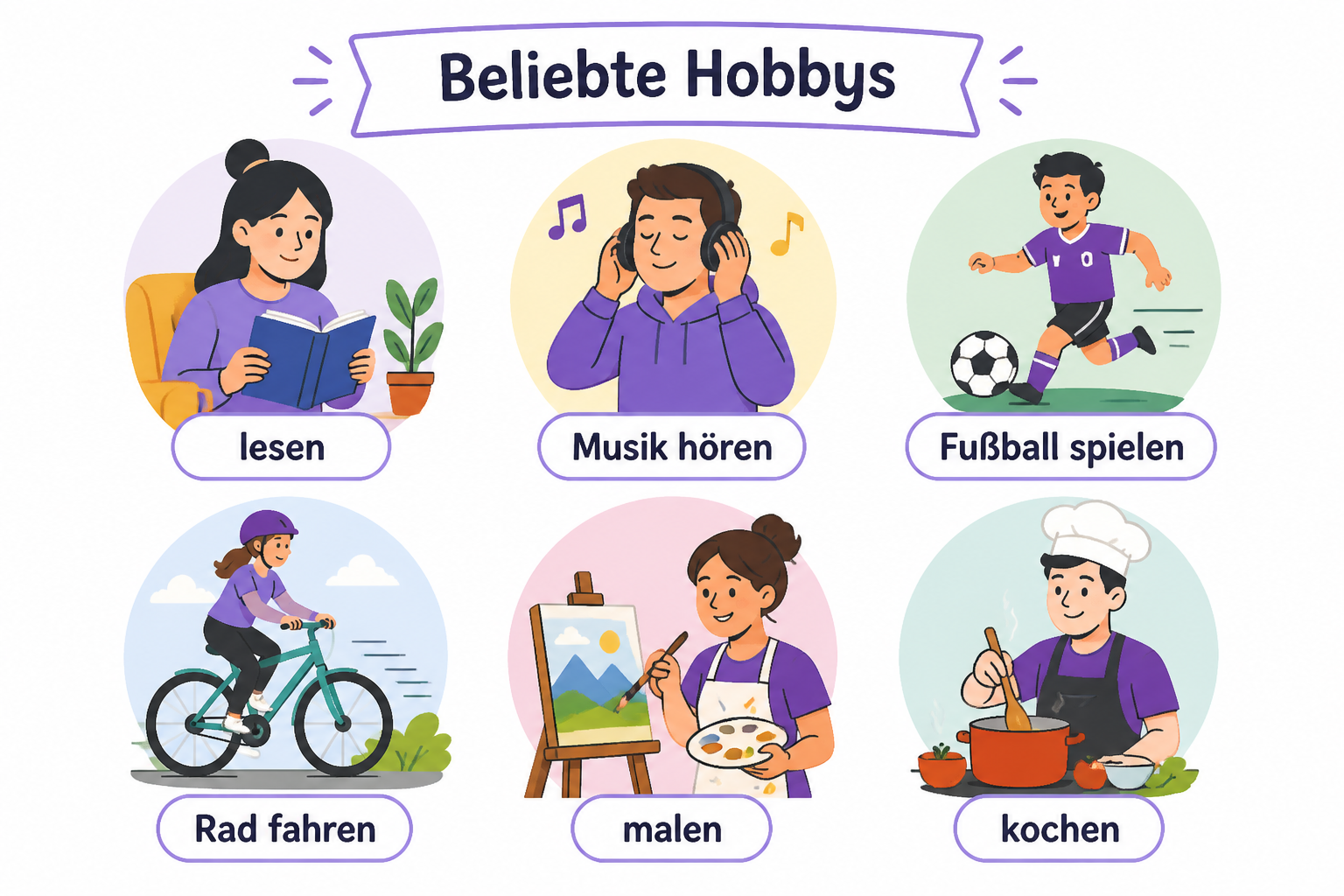
The Most Useful Way To Talk About Hobbies
The most common pattern is:
Ich habe Hobbys. = I have hobbies.
But in real life, Germans often say what they enjoy more directly:
| Pattern | Meaning | German Example | English Translation | Learner Note |
|---|---|---|---|---|
| Ich höre gern Musik. | I like listening to music. | Ich höre gern Musik. | I like listening to music. | gern = with pleasure / like doing. Very common. |
| Ich spiele Fußball. | I play football/soccer. | Ich spiele Fußball. | I play football/soccer. | Many hobbies use simple verb + object. |
| Ich gehe joggen. | I go jogging. | Ich gehe joggen. | I go jogging. | Infinitive after gehen is common for activities. |
| Ich interessiere mich für Fotografie. | I’m interested in photography. | Ich interessiere mich für Fotografie. | I’m interested in photography. | Reflexive verb: mich + für + accusative. |
One small but useful detail: in German, nouns are capitalized, so Musik, Fotografie, and Fußball all get a capital letter. German loves capital letters almost as much as it loves rules.
Useful Hobbies Vocabulary
Here are practical hobby words you’ll actually use in real life. These are standard German forms used across Germany.
| German | Pronunciation | Meaning | Example Sentence | Translation | Learner Note |
|---|---|---|---|---|---|
| das Hobby | HOB-ee | hobby | Mein Hobby ist Lesen. | My hobby is reading. | Plural: die Hobbys or die Hobbies. Hobbys is more common. |
| die Freizeit | FRY-tsайт | free time, leisure | In meiner Freizeit höre ich Musik. | In my free time, I listen to music. | Very common phrase: in meiner Freizeit. |
| lesen | LAY-zen | to read | Ich lese gern Bücher. | I like reading books. | Use with books, news, articles, or messages. |
| schreiben | SHRY-bən | to write | Sie schreibt gern Tagebuch. | She likes writing a diary. | Can mean writing by hand or typing, depending on context. |
| malen | MAH-lən | to paint, to draw | Er malt gern Landschaften. | He likes painting landscapes. | malen is painting; zeichnen is drawing. |
| zeichnen | TSY-nen | to draw | Ich zeichne Comics. | I draw comics. | Often used for sketching, cartoons, technical drawing. |
| fotografieren | foh-toh-gra-FEE-ren | to take photos, photograph | Wir fotografieren oft in der Stadt. | We often take photos in the city. | Useful for travel and social media. |
| kochen | KOH-khən | to cook | Ich koche gern italienisch. | I like cooking Italian food. | Can also mean “to boil” in some contexts. |
| backen | BAH-kən | to bake | Meine Oma backt am Wochenende. | My grandma bakes on the weekend. | Strong verb: backt, not *backt? Yes, that one is correct. German keeps you awake. |
| Sport machen | shport MAH-khən | to do sports | Ich mache viel Sport. | I do a lot of sports. | Very common, natural phrase. |
| Fußball spielen | FOOS-bahl shpee-lən | to play soccer/football | Die Kinder spielen Fußball im Park. | The children play soccer in the park. | In Germany, Fußball usually means soccer. |
| joggen | JOG-gən | to jog | Am Morgen jogge ich im Park. | In the morning, I jog in the park. | Common borrowed verb; sounds natural and modern. |
| wandern | VAHN-dern | to hike | Wir wandern gern in den Bergen. | We like hiking in the mountains. | Very popular in German-speaking countries. |
| schwimmen | SHVIM-men | to swim | Im Sommer schwimme ich oft. | In summer I swim often. | Double m is normal in the infinitive. |
| Rad fahren | RAHT fah-ren | to ride a bike | Ich fahre gern Rad. | I like biking. | Also common: mit dem Fahrrad fahren. |
| tanzen | TAHN-tsən | to dance | Sie tanzt gerne auf Partys. | She likes dancing at parties. | gerne and gern mean the same thing. |
| Musik hören | moo-ZEEK HUH-ren | to listen to music | Ich höre im Bus Musik. | I listen to music on the bus. | Very common everyday phrase. |
How To Say What You Like Doing
The easiest pattern is gern with a verb. It means you like doing something. You’ll hear this constantly.
| German | Pronunciation | Meaning | Example Sentence | Translation | Learner Note |
|---|---|---|---|---|---|
| Ich lese gern. | ikh LAY-zə gern | I like reading. | Ich lese gern abends. | I like reading in the evening. | gern usually comes after the verb in simple sentences. |
| Wir spielen gern Brettspiele. | vear SHPEE-lən gern BRET-shpee-lə | We like playing board games. | Wir spielen gern Brettspiele. | We like playing board games. | Brettspiele = board games, literally “board games.” |
| Er kocht gern. | air KOHKT gern | He likes cooking. | Er kocht gern für Freunde. | He likes cooking for friends. | You can add für + noun for purpose. |
| Ich höre gern Podcasts. | ikh HUH-re gern PODE-kasts | I like listening to podcasts. | Ich höre gern Podcasts beim Spazierengehen. | I like listening to podcasts while walking. | beim = while doing something, short for bei dem. |
| Sie malt gern. | zee MAHLT gern | She likes painting. | Sie malt gern am Wochenende. | She likes painting on the weekend. | Simple and very natural. |
For a slightly stronger idea of enjoyment, you can also use lieben or mögen.
| German | Pronunciation | Meaning | Example Sentence | Translation | Learner Note |
|---|---|---|---|---|---|
| Ich liebe es zu lesen. | ikh LEE-bə es tsoo LAY-zən | I love reading. | Ich liebe es zu lesen, wenn es regnet. | I love reading when it rains. | lieben sounds stronger than gern. |
| Ich mag Tanzen. | ikh mahk TAHN-tsən | I like dancing. | Ich mag Tanzen, aber nicht in großen Clubs. | I like dancing, but not in big clubs. | mögen can be followed by a noun or a noun-like activity. |
| Ich mag Musik. | ikh mahk moo-ZEEK | I like music. | Ich mag klassische Musik. | I like classical music. | Very flexible and common. |
Quick Yak Tip: If you remember only one hobby pattern, make it Ich … gern. It works for a lot of daily-life sentences and sounds natural fast.
10+ Handy Hobby Phrases For Real Conversations
These are the kinds of phrases people actually use when chatting about free time, weekends, and interests. Some are broad; some are specific. All are useful.
| German | Pronunciation | Meaning | Example Sentence | Translation | Learner Note |
|---|---|---|---|---|---|
| Was sind deine Hobbys? | vahs zint DY-nə HOB-bis | What are your hobbies? | Was sind deine Hobbys? | What are your hobbies? | Very common casual question with du. |
| Was machen Sie gern in Ihrer Freizeit? | vahs MAH-khən zee gern in EE-rer FRY-tsайт | What do you like to do in your free time? | Was machen Sie gern in Ihrer Freizeit? | What do you like to do in your free time? | Polite/formal with Sie. |
| Ich habe viele Hobbys. | ikh HAH-bə FEE-lə HOB-bis | I have many hobbies. | Ich habe viele Hobbys. | I have many hobbies. | viele for countable nouns. |
| Ich habe nicht viel Freizeit. | ikh HAH-bə nikht feel FRY-tsайт | I don’t have much free time. | Ich habe nicht viel Freizeit unter der Woche. | I don’t have much free time during the week. | nicht viel = not much. |
| In meiner Freizeit … | in MY-ner FRY-tsайт | In my free time … | In meiner Freizeit lese ich gern. | In my free time, I like reading. | Great sentence starter. |
| Am Wochenende … | ahm VOH-khən-en-də | On the weekend … | Am Wochenende gehe ich schwimmen. | On the weekend I go swimming. | Very common in Germany. |
| Ich interessiere mich für Fotografie. | ikh in-te-ress-EE-re mikh fur foh-toh-gra-FEE | I’m interested in photography. | Ich interessiere mich für Fotografie. | I’m interested in photography. | Use für + accusative: für Musik, für Kunst. |
| Ich sammle … | ikh ZAHM-lə | I collect … | Ich sammle alte Postkarten. | I collect old postcards. | sammeln is a classic hobby verb. |
| Ich treffe mich mit Freunden. | ikh TREE-fə mikh mit FROYn-dən | I meet up with friends. | Ich treffe mich mit Freunden im Café. | I meet up with friends in the café. | mich treffen is reflexive here. |
| Ich gehe ins Fitnessstudio. | ikh GAY-ə ins FIT-ness-shtu-dee-oh | I go to the gym. | Ich gehe zweimal pro Woche ins Fitnessstudio. | I go to the gym twice a week. | ins = in das. |
| Ich spiele ein Instrument. | ikh SHPEE-lə ayn in-stroo-MENT | I play an instrument. | Ich spiele seit drei Jahren ein Instrument. | I’ve been playing an instrument for three years. | Use with Klavier, Gitarre, Geige, etc. |
| Ich höre gern Live-Musik. | ikh HUH-re gern layv moo-ZEEK | I like live music. | Ich höre gern Live-Musik in kleinen Clubs. | I like listening to live music in small clubs. | Hyphenated compound is normal: Live-Musik. |
Common Hobbies And What To Say About Them
Sometimes the hobby itself is the whole conversation starter. Here are common hobbies with natural German ways to talk about them.
| German | Pronunciation | Meaning | Example Sentence | Translation | Learner Note |
|---|---|---|---|---|---|
| das Lesen | das LAY-zen | reading | Lesen entspannt mich. | Reading relaxes me. | Nominalized verb; capitalized. |
| das Kochen | das KOH-khən | cooking | Kochen macht mir Spaß. | Cooking is fun for me. | macht mir Spaß = is fun/enjoyable. |
| das Fotografieren | das foh-toh-gra-FEE-ren | photography / taking photos | Fotografieren ist mein Hobby. | Photography is my hobby. | Verb turned into noun with das. |
| das Wandern | das VAHN-dern | hiking | Wandern ist im Herbst besonders schön. | Hiking is especially nice in autumn. | Very common in German-speaking countries. |
| das Schwimmen | das SHVIM-men | swimming | Schwimmen hält mich fit. | Swimming keeps me fit. | halten … fit = keep … fit. |
| das Tanzen | das TAHN-tsən | dancing | Tanzen ist nicht nur für Partys. | Dancing is not just for parties. | Useful if you want to sound a little less like a dictionary. |
| das Gärtnern | das GERT-nern | gardening | Gärtnern ist sehr entspannend. | Gardening is very relaxing. | Common but a bit more specific. |
| das Basteln | das BAS-teln | crafting, DIY making | Meine Kinder lieben Basteln. | My children love crafting. | Often used for crafts, projects, and handmade things. |
| das Musizieren | das moo-tsee-TSEE-ren | making music, playing music | Musizieren macht ihm Spaß. | Making music is fun for him. | More formal than everyday Musik machen. |
| das Gaming | das GAY-ming | gaming | Gaming ist bei vielen Jugendlichen beliebt. | Gaming is popular with many teenagers. | Borrowed English word; common in modern speech. |
Asking Someone About Their Hobbies
If you want to keep a conversation going, these questions are gold. Or at least helpful enough to earn you a polite nod and maybe an actual answer.
| German | Pronunciation | Meaning | Example Sentence | Translation | Learner Note |
|---|---|---|---|---|---|
| Was machst du gern in deiner Freizeit? | vahs MAKHST doo gern in DY-ner FRY-tsайт | What do you like to do in your free time? | Was machst du gern in deiner Freizeit? | What do you like to do in your free time? | Very natural and common. |
<More German to explore |