This A2 Elementary retelling of Baron Münchhausen reitet auf der Kanonenkugel keeps the plot clear for learners while still giving the story some atmosphere and momentum. Einmal war Baron Münchhausen in einem großen Krieg. Er stand mit seiner Armee vor einer hohen Stadtmauer.
This version teaches German through English and includes clickable word help inside the story, full story audio, and lesson notes after the reading. It is free to use on Yak Yacker and is designed to feel natural, readable, and manageable for learners.
Einmal war Baron Münchhausen in einem großen Krieg. Er stand mit seiner Armee vor einer hohen Stadtmauer. Die Feinde waren in der Stadt. Der Baron wollte wissen: Wie viele Feinde sind da drinnen? Aber die Tore waren geschlossen.
Plötzlich sah er eine . Da hatte er eine . Er rief: 'Ich auf einer Kanonenkugel in die Stadt!' Seine Soldaten riefen: 'Nein, Baron! Das ist viel zu !' Aber der Baron lachte nur.
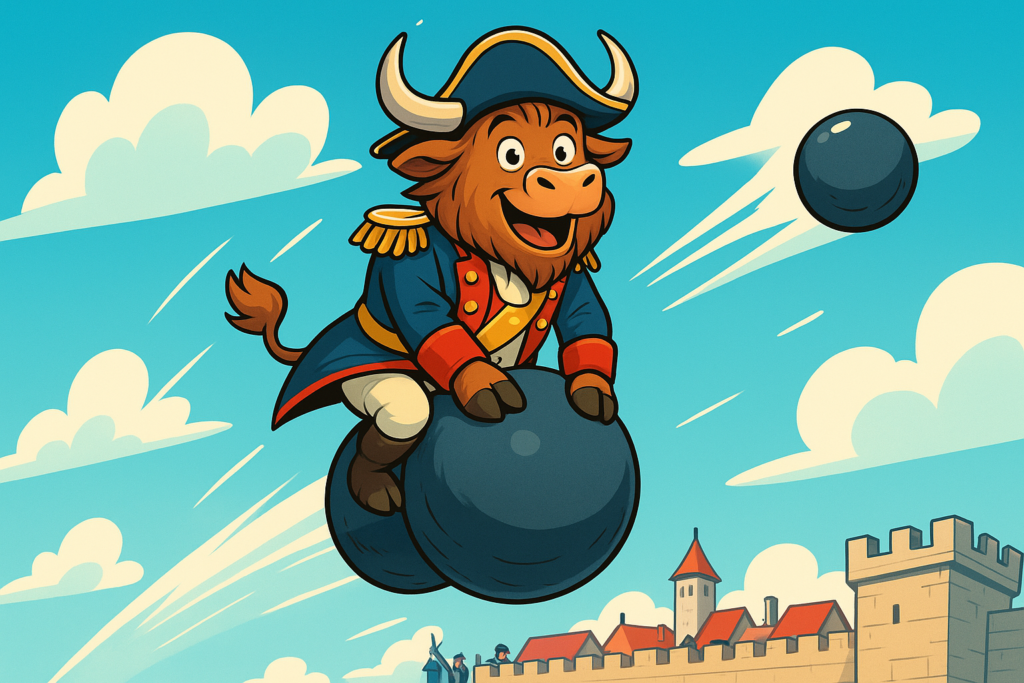
Also er mutig auf eine Kanonenkugel. Ein Soldat die Kanone an. PENG! Die Kugel flog in die Luft – mit dem Baron oben drauf. Der Wind pfiff, aber der Baron hielt sich fest.
Während des Fluges sah er die Stadt unter sich. Er die Feinde: 'Eins, zwei, drei … oh, es sind sehr viele!' Dann dachte er: 'Hoppla! Wie komme ich jetzt zurück zu meinen Freunden?'
Genau in diesem Moment flog eine andere Kanonenkugel an ihm vorbei. Sie kam von den Feinden. Der Baron von seiner Kugel auf die andere Kugel. So flog er zurück über die Mauer.
Er landete sicher bei seinen Soldaten. Alle waren sehr überrascht. Ein Soldat rief: 'Baron, wie haben Sie das gemacht?' Der Baron lächelte und sagte: 'Ach, das war nichts. Ich reite oft auf Kanonenkugeln!'
Die Soldaten lachten und klatschten. Später trank der Baron eine Tasse Tee und erzählte noch mehr Geschichten. War es wirklich wahr? Vielleicht. Vielleicht auch nicht. Aber es war ein lustiges Abenteuer.
Once Baron Münchhausen was in a great war. He stood with his army before a high city wall. The enemies were in the city. The Baron wanted to know: How many enemies are in there? But the gates were closed.
Suddenly he saw a large cannon. Then he had a crazy idea. He shouted: 'I'll fly into the city on a cannonball!' His soldiers shouted: 'No, Baron! That's much too dangerous!' But the Baron just laughed.
So he bravely climbed onto a cannonball. A soldier lit the cannon. BANG! The ball flew into the air - with the Baron on top. The wind whistled, but the Baron held on tight.
During the flight he saw the city below him. He counted the enemies: 'One, two, three ... oh, there are very many!' Then he thought: 'Oops! How do I get back to my friends now?'
Exactly at that moment another cannonball flew past him. It came from the enemies. The Baron quickly jumped from his ball onto the other ball. So he flew back over the wall.
He landed safely with his soldiers. Everyone was very surprised. A soldier shouted: 'Baron, how did you do that?' The Baron smiled and said: 'Oh, that was nothing. I often ride on cannonballs!'
The soldiers laughed and clapped. Later the Baron drank a cup of tea and told more stories. Was it really true? Maybe. Maybe not. But it was a funny adventure.
Baron Münchhausen’s ride introduces some handy German words for talking about battles, castles, and crazy ideas. Here are the most important ones from the story.
Pay attention to the articles – they tell you the gender. For example, die Kanonenkugel (the cannonball) is feminine, while der Soldat (the soldier) is masculine.
- die Kanonenkugel – cannonball
- die Stadtmauer – city wall
- der Feind / die Feinde – enemy / enemies
- mutig – brave, courageous
- Hoppla! – Oops! / Whoops!
- sicher landen – to land safely
The story is full of dramatic moments. Let’s look at some phrases that show confidence, warning, and astonishment.
When the soldiers shout 'Das ist viel zu gefährlich!' they are not just being cautious – zu + adjective means 'too (adjective)'. So gefährlich (dangerous) becomes 'far too dangerous'.
- Das ist (viel zu) gefährlich! – That’s (far too) dangerous!
- Ich fliege auf einer Kanonenkugel! – I’m flying on a cannonball! (declaring a daring plan)
- Wie haben Sie das gemacht? – How did you do that? (expressing surprise)
- Ach, das war nichts. – Oh, that was nothing. (downplaying a feat)
German stories and reports often use the Präteritum (simple past). You saw it throughout this tale: war (was), sah (saw), rief (shouted), flog (flew).
For regular verbs at A2, you might already know machte (made) or spielte (played). But this story uses many irregular verbs – notice how the vowel changes: fliegen → flog, sehen → sah. Don’t worry about memorizing all forms now; just enjoy recognizing them!
- er stand – he stood (from stehen)
- er sah – he saw (from sehen)
- er rief – he shouted (from rufen)
- sie flog – it flew (from fliegen)
- er sprang – he jumped (from springen)
- er landete – he landed (regular, so easy!)
Now you have some words and phrases to create your own unlikely adventure. What would you ride – a rocket? A giant eagle? How would you describe it?
- Start with: 'Einmal …' (Once upon a time …)
- Add a crazy idea: 'Ich fliege auf …' (I’ll fly on …)
- End with a relaxed hero: 'Ach, das war nichts.'
Baron Münchhausen reitet auf der Kanonenkugel comes from an older public-domain story tradition and is best known as a public_domain_story_retelling. This Yak Yacker article is an original learner retelling based on public-domain source material, so the wording here is simplified for modern learners rather than copied from one old edition.
Older printings, translations, and retellings of this story can vary quite a bit. This version is adapted for A2 Elementary learners studying German.
If you want to keep going, browse more in our German section and review the Goethe A2 German Vocabulary. After that, try Essential German Grammar Words for another useful next step.