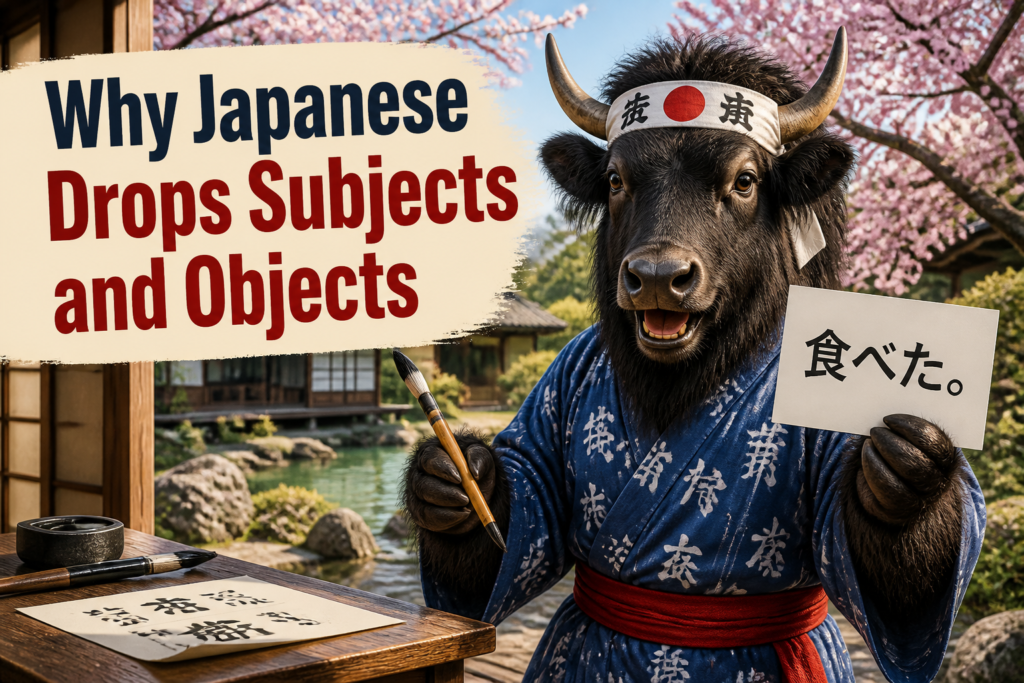
Japanese loves silence. Not the dramatic, “I have a secret” kind. More the practical kind where the subject and object just vanish because the sentence already makes sense without them. For beginners, this feels rude at first. English is like, “I, you, we, they, the sandwich, the whole timeline.” Japanese often just shrugs and says, “Context. Use it.”
For the broader learning path, visit our parent guide.
That’s why a sentence like 食べました
tabemashita
“(I/he/she/they) ate” can be perfectly complete. No subject. No object. No drama. If you want a useful overview of Japanese structure, the Learn Japanese pillar page is a good starting point, but this article is here for the part that makes people stare at the page and whisper, “Wait… who did what to whom?”
The short answer: Japanese drops subjects and objects when they are clear from context. The longer answer: Japanese does this a lot, and beginners need time to stop expecting every sentence to act like English. Annoying? A little. Normal? Extremely.
The Big Idea: Context Does The Heavy Lifting
In English, we usually keep the subject and object visible:
- I ate the apple.
- She called me.
- They bought tickets.
In Japanese, these parts are often dropped when the listener already knows them from the situation, previous sentences, or shared knowledge.
りんごを食べました
Ringo o tabemashita
Ate the apple.
And sometimes even the object disappears:
食べました
Tabemashita
Ate it / ate (something)
Yes, that is legal Japanese. No, the sentence is not broken. It is just trusting the listener, which feels suspiciously modern for a language rule.
Core Reason 1: The Subject Is Often Already Obvious
Japanese speakers usually avoid repeating “I,” “you,” “he,” or “she” unless they really need to clarify. The conversation already tells you who is involved.
| Japanese | Rōmaji | Meaning | Example |
|---|---|---|---|
| 行きます | Ikimasu | (I / you / they) will go | 行きます。 Ikimasu. I will go. |
| 知っています | Shitte imasu | (I / you / they) know | 知っています。 Shitte imasu. I know. |
| 疲れました | Tukaremashita | (I / he / she / they) got tired | 疲れました。 Tsukaremashita. I got tired. |
Notice how the sentence still works. Japanese does not need to say who every time if the situation is clear. In fact, repeating “I” over and over can sound heavy or unnatural.
Example:
昨日、映画を見ました。
Kinō, eiga o mimashita.
Yesterday, (I) watched a movie.
The subject “I” is missing, but the meaning is obvious. Context is doing the work. Quietly. Efficiently. A bit smugly.
Core Reason 2: The Object Can Be Dropped Too
Japanese also drops objects when they are understood. If you already know what is being talked about, there is no need to say it again.
| Japanese | Rōmaji | Meaning | Example |
|---|---|---|---|
| 食べました | Tabemashita | Ate it / ate something | ケーキを食べました。 Kēki o tabemashita. I ate cake. |
| 読みました | Yomimashita | Read it | 本を読みました。 Hon o yomimashita. I read a book. |
| 買いました | Kaimashita | Bought it | それを買いました。 Sore o kaimashita. I bought that. |
Once the object has been mentioned, Japanese speakers often leave it out the next time. That keeps conversation smooth and avoids repeating the same nouns like a broken robot.
Mini example:
パンを買いました。食べました。
Pan o kaimashita. Tabemashita.
I bought bread. I ate it.
The second sentence has no object, but it clearly refers to the bread. English usually wants “it,” while Japanese is fine with a little mystery.
Useful Phrases For Missing Subjects And Objects
These are the kinds of short, real-life phrases that often appear with dropped subjects or objects. Each one includes the Japanese, Rōmaji, and a simple meaning.
| Japanese | Rōmaji | English Meaning | Example Sentence |
|---|---|---|---|
| わかりました | Wakarimashita | I understood / Got it | わかりました。 Wakarimashita. Got it. |
| 見ました | Mimashita | I saw / watched it | テレビを見ました。 Terebi o mimashita. I watched TV. |
| 行きました | Ikimashita | I went | 学校に行きました。 Gakkō ni ikimashita. I went to school. |
| 来ました | Kimashita | I came | 友だちが来ました。 Tomodachi ga kimashita. My friend came. |
| あります | Arimasu | There is / I have | 時間があります。 Jikan ga arimasu. I have time. |
| ありません | Arimasen | There is not / I do not have | お金がありません。 Okane ga arimasen. I do not have money. |
| 欲しいです | Hoshii desu | I want it | 水が欲しいです。 Mizu ga hoshii desu. I want water. |
| 見つけました | Mitsukemashita | I found it | 鍵を見つけました。 Kagi o mitsukemashita. I found the key. |
| 忘れました | Wasuremashita | I forgot it | 名前を忘れました。 Namae o wasuremashita. I forgot the name. |
| 聞きました | Kikimashita | I heard / asked | 先生に聞きました。 Sensei ni kikimashita. I asked the teacher. |
| 話しました | Hanashimashita | I spoke / talked | 日本語で話しました。 Nihongo de hanashimashita. I spoke in Japanese. |
| 送りました | Okurimashita | I sent it | メールを送りました。 Mēru o okurimashita. I sent an email. |
Common Sentence Patterns Where Drops Happen
Here are a few patterns that beginners see all the time. The point is not to memorize every possible sentence. The point is to notice the shape.
| Pattern | Meaning | Example | Rōmaji | English |
|---|---|---|---|---|
| [Object] を + verb | Object may be dropped later | 本を読みました。 | Hon o yomimashita. | I read a book. |
| [Subject] は + topic | Topic can stay; subject often implied | 私は行きます。 | Watashi wa ikimasu. | I will go. |
| [Context] + verb | Context replaces subject/object | 食べました。 | Tabemashita. | (I/you/he/she) ate. |
| [Thing] が + adjective | Focus is on the thing, not the doer | 水が欲しいです。 | Mizu ga hoshii desu. | I want water. |
| [Place] に + verb | Subject often omitted | 学校に行きました。 | Gakkō ni ikimashita. | I went to school. |
That second column matters. Japanese is not hiding information to be difficult. It is letting the sentence focus on what is important. The doer? Sometimes not the star of the show.
Why This Confuses Beginners
Beginners usually want every sentence to tell them exactly who did what. Japanese politely refuses. That creates three common problems:
- You do not know who the subject is.
- You do not know what the object is.
- You try to translate word-for-word and the sentence sounds broken in English.
For example:
見ました。
Mimashita.
Saw it / watched it.
If you try to force English grammar onto that sentence, you might panic: “Who saw what?” But in real conversation, the answer is often already obvious. Maybe the speaker was talking about a movie. Maybe they were asked, “Did you watch it?” So the sentence is complete.
Japanese often says less than English, but it rarely means less.
That little difference is where a lot of beginner confusion lives rent-free.
How To Read Dropped Elements Without Panic
- Look at the previous sentence.
- Look at the topic of the conversation.
- Check the particles like は
wa
topic marker and を
o
object marker. - Ask yourself what would make sense in this situation.
- Do not force a subject into every sentence if Japanese did not bother to include one.
Example with context:
昨日、映画を見ました。面白かったです。
Kinō, eiga o mimashita. Omoshirokatta desu.
Yesterday, I watched a movie. It was interesting.
“It” is not written in Japanese, but the movie is clearly still the topic. Japanese prefers this kind of flow. English needs a small bridge word; Japanese often just keeps walking.
Useful Words That Help You Spot Missing Parts
| Kanji | Rōmaji | Meaning | Example | Rōmaji | Translation |
|---|---|---|---|---|---|
| それ | sore | that / it | それをください。 | Sore o kudasai. | Please give me that. |
| これ | kore | this / it | これは本です。 | Kore wa hon desu. | This is a book. |
| あれ | are | that over there / it | あれを見てください。 | Are o mite kudasai. | Please look at that. |
| 人 | hito | person | あの人は来ました。 | Ano hito wa kimashita. | That person came. |
| 友だち | tomodachi | friend | 友だちに会いました。 | Tomodachi ni aimashita. | I met a friend. |
| 先生 | sensei | teacher | 先生に聞きました。 | Sensei ni kikimashita. | I asked the teacher. |
| 本 | hon | book | 本を読みました。 | Hon o yomimashita. | I read a book. |
| 時間 | jikan | time | 時間があります。 | Jikan ga arimasu. | I have time. |
Particles Still Matter A Lot
Even when subjects and objects disappear, particles often leave clues behind. That is why learning particles is not optional. It is the map. Without it, everything becomes a guessing game with extra confidence and poor results.
Important ones here are:
- は
wa
topic marker - が
ga
subject marker / focus marker - を
o
object marker - に
ni
destination, time, indirect object, and more
If this still feels slippery, the lesson on Japanese Ending Particles can help you understand how Japanese adds meaning without spelling everything out.
Example:
本を読みました。
Hon o yomimashita.
I read a book.
Even if the subject is missing, を tells you what the object is. That little particle is doing a lot of unpaid labor.
Short Practice: Guess The Missing Part
Try filling in the likely missing subject or object from context. Then check the answer underneath. No shame if you have to squint a little. That is basically the beginner experience.
- 食べました。
Tabemashita.
Hint: The subject is probably “I,” and the object depends on context. - 本を読みました。
Hon o yomimashita.
Hint: The subject is probably “I.” - それを見ました。
Sore o mimashita.
Hint: The subject is probably “I.” The object is “that.” - 行きました。
Ikimashita.
Hint: Subject is usually “I” unless the situation says otherwise. - 忘れました。
Wasuremashita.
Hint: Forgot what? Look at the previous sentence.
Now the answers:
- 食べました。 → I ate (something).
- 本を読みました。 → I read a book.
- それを見ました。 → I saw that.
- 行きました。 → I went.
- 忘れました。 → I forgot it.
Common Mistakes And Fixes
| Mistake | Why It Happens | Better Approach |
|---|---|---|
| Trying to translate every sentence word-for-word | English habit | Translate the meaning, not the missing grammar |
| Adding “I” to every Japanese sentence | English wants a subject | Only add it in English when needed |
| Thinking the sentence is incomplete | Missing subject/object feels wrong | Check context and particles first |
| Ignoring previous sentences | Focus on the current line only | Read the whole exchange, not one sentence in isolation |
| Forgetting that Japanese is context-heavy | Different language logic | Train yourself to expect omission |
If you want more practice with recognition and reading speed, the Japanese Vocabulary Test and Japanese Placement Test JLPT are both useful ways to check whether your brain is actually catching the clues or just nodding politely.
Why Japanese Can Sound Vague, But Usually Is Not
Sometimes beginners hear a Japanese sentence and think it sounds vague. But the language is often not vague at all. It is simply shared, compressed, and context-rich.
That said, Japanese can also be intentionally vague when the speaker wants to be polite, indirect, or careful. This is where related expressions like Reasons in Japanese become useful, because Japanese often explains things gently instead of bluntly spelling out every detail.
Example:
今日は行けません。
Kyō wa ikemasen.
I cannot go today.
The subject is missing again, but the meaning is clear. The speaker is the one who cannot go. Japanese trusts the listener to figure that out. Sometimes that trust is sweet. Sometimes it is mildly irritating. Both can be true.
Quick Reference Summary
- Japanese often drops subjects when they are obvious.
- Japanese also drops objects when the context already tells you what is meant.
- Particles like は
wa
, が
ga
, and を
o
help you find the structure. - Do not force English-style subjects into every sentence.
- Look at the previous sentence and the situation before guessing.
- Missing words are often implied, not lost.
If you remember one thing, make it this: Japanese is not broken when it leaves things out. It is doing exactly what it wants to do, and it expects you to keep up. Rude? A little. Efficient? Very.
In Japanese, what is unsaid is often still there. You just have to listen for it.
When that clicks, sentences stop feeling like puzzles with missing pieces and start feeling like conversations with more breathing room. And yes, once your ear adjusts, the “missing” subject becomes one of the easiest things to notice. Strange, but true. Japanese does that.
For a closer look at how Japanese handles short expressive lines and emotional nuance, try Quote in Japanese. It pairs nicely with this idea, because Japanese often says a lot with very few words. The language is basically the world’s most efficient overachiever.