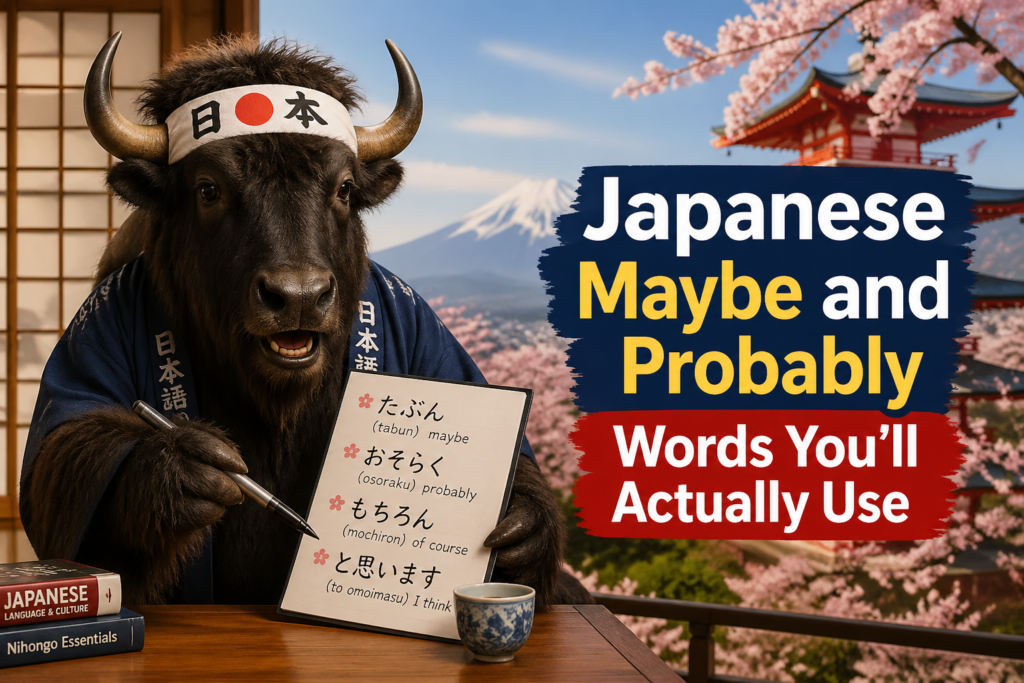
Japanese has a lovely habit of sounding soft even when the meaning is not soft at all. That is especially true with words like maybe, probably, of course, and I think. English speakers often toss these in without thinking. Japanese does too, just with different tools and a bit more nuance. Tiny nuance, huge consequences. Naturally.
If you want to sound more natural, these words are worth learning early. They show confidence, hesitation, politeness, and agreement without turning every sentence into a dramatic speech. For a broader study path, the Japanese grammar lessons at Learn Japanese are a good place to keep going after this one.
A small story: many learners first hear 多分 tabun and think it means “maybe.” It often does, but it can also mean “probably.” Then someone hears でしょう deshō and assumes it means “maybe” too. Not quite. Japanese loves context. The words are polite little shape-shifters.
Quick Meaning Map
| Japanese | Rōmaji | English Meaning |
|---|---|---|
| 多分 | tabun | maybe, probably |
| かもしれない | kamoshirenai | might, may, perhaps |
| でしょう | deshō | probably, likely, I suppose |
| もちろん | mochiron | of course, certainly |
| と思う | to omou | I think, I believe |
| 〜かな | ~ kana | I wonder, maybe, I guess |
Maybe And Probably: The Words You’ll Hear All The Time
Let’s start with the two words that cause the most friendly confusion: 多分 tabun and かもしれない kamoshirenai. Both can mean “maybe,” but they do not feel exactly the same.
| Japanese | Rōmaji | Meaning | Example | Rōmaji | Translation |
|---|---|---|---|---|---|
| 多分 | tabun | maybe, probably | 多分 行きます。 | Tabun ikimasu. | Maybe I’ll go. / Probably I’ll go. |
| かもしれない | kamoshirenai | might, may, perhaps | 雨が 降るかもしれない。 | Ame ga furu kamoshirenai. | It might rain. |
| でしょう | deshō | probably, likely | 明日は 忙しいでしょう。 | Ashita wa isogashii deshō. | Tomorrow will probably be busy. |
| たぶん | tabun | probably | 彼は もう 着いたたぶん。 | Kare wa mō tsuita tabun. | He probably already arrived. |
多分 tabun is the everyday, flexible one. It often means “probably,” but in casual conversation it can also mean “maybe.” If you want a safe, useful word, this is one of the first to learn.
かもしれない kamoshirenai is stronger for “might” or “may.” It sounds like you are leaving room for uncertainty. Very handy when you do not want to sound too sure. Which, honestly, is most of human life.
でしょう deshō is often used for a likely guess. It can mean “probably” or “I suppose.” In conversation, it sounds smoother and more natural than a blunt translation would suggest.
Of Course And Obviously: Agreement Without The Drama
Now for the easy one. Or at least, the one that feels easy until you notice there are a few versions.
| Japanese | Rōmaji | Meaning | Example | Rōmaji | Translation |
|---|---|---|---|---|---|
| もちろん | mochiron | of course, certainly | もちろん です。 | Mochiron desu. | Of course. |
| 当たり前 | atarimae | of course, natural, obvious | それは 当たり前 です。 | Sore wa atarimae desu. | That is obvious. |
| はい | hai | yes, sure, of course | はい、 いいです。 | Hai, ii desu. | Yes, that’s fine. |
| ええ | ee | yes, yeah, sure | ええ、 大丈夫です。 | Ee, daijōbu desu. | Yes, it’s okay. |
もちろん mochiron is the cleanest “of course.” Use it when something is clearly accepted or expected.
当たり前 atarimae means “natural” or “obvious,” so it can feel stronger. It is good for stating that something is common sense. A little more edge, a little less sugar.
はい hai can mean “yes,” but in many situations it works like “sure” or even “of course.” If someone asks whether you want water, はい is a very normal answer. Clean, polite, uncomplicated. Rare in daily life, honestly.
I Think And I Guess: Saying It Softly
Japanese often softens opinions with little add-ons. That way, you can sound thoughtful instead of overly certain. A very useful one is と思う to omou.
| Japanese | Rōmaji | Meaning | Example | Rōmaji | Translation |
|---|---|---|---|---|---|
| と思う | to omou | I think | 行けると思う。 | Ikeru to omou. | I think I can go. |
| かな | kana | I wonder, maybe | 彼は 来るかな。 | Kare wa kuru kana. | I wonder if he’ll come. |
| 気がする | kiga suru | I feel like, I think | 今日は 寒い気がする。 | Kyō wa samui kiga suru. | I feel like today is cold. |
| ようだ | yō da | it seems like | 電車が 遅れるようだ。 | Densha ga okureru yō da. | It seems the train will be late. |
と思う to omou is one of the most common ways to say “I think.”
行くと思う iku to omou. I think I’ll go.
Notice how this keeps the sentence polite and flexible. Japanese speakers often prefer this over sounding too direct.
かな kana is useful when you are wondering to yourself. It is casual and often sounds a little reflective.
来るかな kuru kana. I wonder if he’ll come.
気がする kiga suru is like “I get the feeling” or “I think.” It can sound a bit more intuitive than logical.
ようだ yō da means “it seems like.” It often shows you are making an observation, not a hard claim.
Useful Real-Life Phrases
| Japanese | Rōmaji | English Meaning | Example Sentence | Rōmaji | Translation |
|---|---|---|---|---|---|
| 多分 そうです。 | Tabun sō desu. | Probably so. | 多分 そうです。 | Tabun sō desu. | Probably so. |
| かもしれません。 | kamoshiremasen. | It may be / might be. | 雨が 降る かもしれません。 | Ame ga furu kamoshiremasen. | It might rain. |
| もちろん です。 | mochiron desu. | Of course. | もちろん です。 | Mochiron desu. | Of course. |
| そう だと思います。 | Sō da to omoimasu. | I think so. | そう だと思います。 | Sō da to omoimasu. | I think so. |
| 行ける と思います。 | Ikeru to omoimasu. | I think I can go. | 行ける と思います。 | Ikeru to omoimasu. | I think I can go. |
| 来る かな。 | Kuru kana. | I wonder if they’ll come. | 来る かな。 | Kuru kana. | I wonder if they’ll come. |
| 大丈夫 でしょう。 | Daijōbu deshō. | It will probably be fine. | 大丈夫 でしょう。 | Daijōbu deshō. | It will probably be fine. |
| そう ですね。 | Sō desu ne. | That’s right / I think so. | そう ですね。 | Sō desu ne. | That’s right / I think so. |
| 行く かもしれない。 | Iku kamoshirenai. | I may go. | 行く かもしれない。 | Iku kamoshirenai. | I may go. |
| そう だね。 | Sō da ne. | Yeah, I think so. | そう だね。 | Sō da ne. | Yeah, I think so. |
What’s The Difference Between Maybe And Probably?
This is the part where learners usually squint at the page and think, “Surely there is one perfect word.” Japanese, being extremely unhelpful in a charming way, says: not always.
| Word | Use It When… | Strength | Example |
|---|---|---|---|
| 多分 tabun | you are making a likely guess | medium | 多分 来ます。 |
| かもしれない kamoshirenai | something might happen, but you are not sure | soft | 遅れるかもしれない。 |
| でしょう deshō | you think something is probably true | confident | 高いでしょう。 |
Simple rule:
- 多分 tabun = maybe / probably in everyday speech
- かもしれない kamoshirenai = might / may / perhaps
- でしょう deshō = probably, with more confidence
So if you want to say “Maybe I’ll go,” you can say 多分 行きます Tabun ikimasu. If you want “I might go,” use 行く かもしれない Iku kamoshirenai. If you want “I probably will go,” 行く でしょう Iku deshō fits better.
Simple Practice
Try swapping the English idea with the best Japanese option. No panic. This is practice, not a courtroom.
- Maybe it will rain. → 雨が 降る かもしれない。 Ame ga furu kamoshirenai.
- Probably he is busy. → 彼は 忙しい でしょう。 Kare wa isogashii deshō.
- Of course I know. → もちろん 知っています。 Mochiron shitte imasu.
- I think it is okay. → 大丈夫 だと思います。 Daijōbu da to omoimasu.
- I wonder if she’ll come. → 彼女は 来る かな。 Kanojo wa kuru kana.
Now try the same idea with a softer or stronger tone:
- 多分 is softer than でしょう in many everyday situations.
- かもしれない leaves more uncertainty than 多分.
- もちろん is the cleanest way to say “of course.”
- と思う is your safest “I think” phrase.
Common Mistakes And Easy Fixes
| Common Mistake | Better Version | Why |
|---|---|---|
| Using 多分 for every kind of uncertainty | Choose かもしれない or でしょう when needed | Japanese makes small differences in certainty |
| Using もちろん when you mean “maybe” | Use 多分 or かもしれない | もちろん means “of course,” not doubt |
| Saying only 思う in a random sentence | Use と思う | The little particle と matters |
| Making かもしれない too direct in casual speech | Use かも in very casual speech | かも is a shortened casual form |
A tiny nuance note: in casual conversation, people sometimes shorten かもしれない to かも kamo. So 行くかも Iku kamo means “I might go.” Shorter, softer, very common.
| Japanese | Rōmaji | Meaning | Example | Rōmaji | Translation |
|---|---|---|---|---|---|
| 行く かも。 | Iku kamo. | Might go. | 行く かも。 | Iku kamo. | Might go. |
| たぶん 大丈夫。 | Tabun daijōbu. | Probably okay. | たぶん 大丈夫。 | Tabun daijōbu. | Probably okay. |
| もちろん いいです。 | Mochiron ii desu. | Of course, it’s fine. | もちろん いいです。 | Mochiron ii desu. | Of course, it’s fine. |
| そう だと思います。 | Sō da to omoimasu. | I think so. | そう だと思います。 | Sō da to omoimasu. | I think so. |
Quick Reference Summary
- 多分 tabun = maybe, probably
- かもしれない kamoshirenai = might, may, perhaps
- でしょう deshō = probably, likely
- もちろん mochiron = of course
- と思う to omou = I think
- かな kana = I wonder, maybe
- 気がする kiga suru = I feel like, I think
- 当たり前 atarimae = obvious, natural, of course
Japanese does not always shout certainty. It often smiles, tilts its head, and says “probably.” That is not vague. That is strategy.
If you remember just four basics, make them these: 多分 tabun, かもしれない kamoshirenai, もちろん mochiron, and と思う to omou. They will carry you through a surprising number of real conversations, from chatting with friends to sounding politely unsure instead of accidentally sounding like a robot with strong opinions.
Keep listening for how native speakers soften guesses and state opinions. That little layer of uncertainty is a very Japanese skill, and once it clicks, your speech starts sounding much more natural. Annoyingly useful, really.