


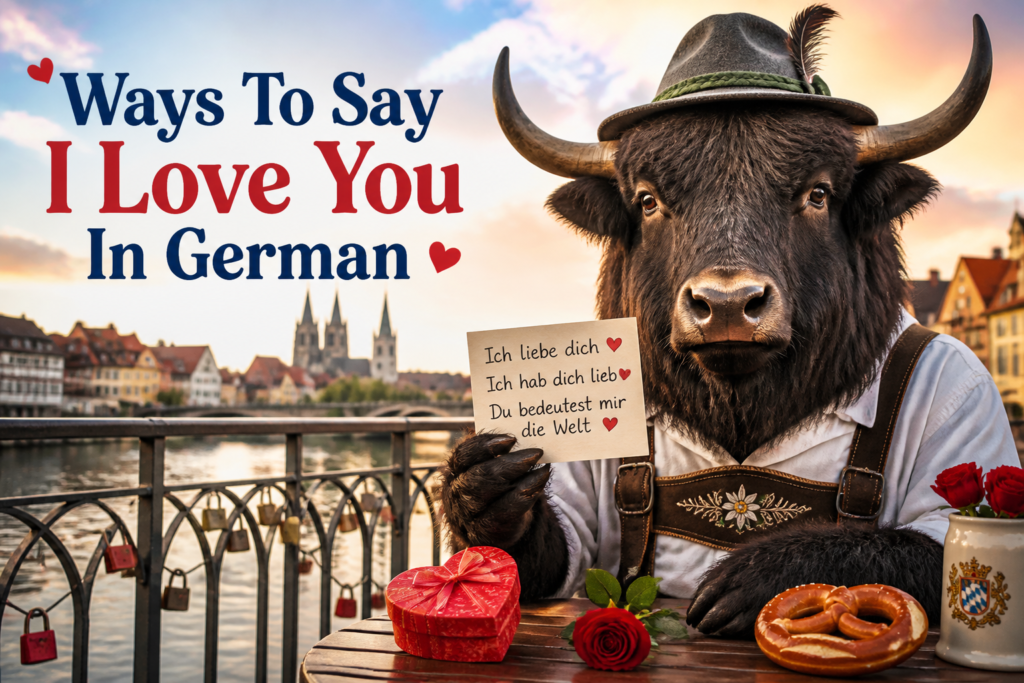
Quick memory trick: Ich liebe dich = strong romantic love. Ich hab dich lieb = soft affection. One is a thunderbolt. The other is a warm blanket.
Extra Cute And Romantic Words To Explore
If you want nicknames, pet names, and more sweet expressions, there are plenty of options. Some are classic, some are playful, and some are so sugary they may require a glass of water.
For more affectionate nicknames, see Cute Funny Nicknames In German. For more lovely everyday words, try Beautiful Cool German Words.
Quick Reference Summary
- Ich liebe dich = I love you, strongly and romantically.
- Ich hab dich lieb = I love/care about you, softly and warmly.
- Ich bin in dich verliebt = I’m in love with you.
- Du bedeutest mir viel = You mean a lot to me.
- Ich mag dich sehr = I like you very much / I care a lot about you.
- Du bist mir wichtig = You are important to me.
- Ich bin total verrückt nach dir = I’m crazy about you.
- Ich habe Gefühle für dich = I have feelings for you.
- Ich könnte dich knutschen = I could kiss you.
- If you want to say I love you in German, there is more than one way to do it. Good news: German does not require a poetry degree or a candlelit panic attack. You can be sweet, romantic, casual, or deeply serious, depending on the situation.
For the broader learning path, visit our parent guide.
The most important phrase is Ich liebe dich. But Germans also use softer, more playful, and more natural expressions in real life. Some are perfect for a partner, some work better in texts, and some are the kind of thing you save for when you really mean it.
There is also a small cultural twist: English speakers often say “I love you” very freely, while German speakers can be a bit more careful with ich liebe dich. That does not mean Germans are emotionally made of brick. It just means the phrase can feel stronger, so people often use other loving expressions too.
The Main Ways To Say It
Here are the most useful German phrases for saying you care, you adore someone, or you are fully, dramatically, and perhaps a little dangerously in love.
German Pronunciation Meaning Example Sentence Translation Learner Note Ich liebe dich ikh LEE-buh dikh I love you Ich liebe dich. I love you. The classic. Use it for real romantic love, not just for pizza. Ich hab dich lieb ikh hahp dikh leep I care about you / I love you dearly Ich hab dich lieb, Mama. I love you / care about you, Mom. Warmer and softer than Ich liebe dich. Often used with family, close friends, or in gentle romantic contexts. Ich bin in dich verliebt ikh bin in dikh fer-LEEPT I’m in love with you Seit Monaten bin ich in dich verliebt. I’ve been in love with you for months. More about being in love than saying love directly. Very useful and very human. Du bedeutest mir viel doo beh-DOY-tust meer feel You mean a lot to me Du bedeutest mir viel. You mean a lot to me. Sincere, warm, and less intense than Ich liebe dich. Ich mag dich sehr ikh mahk dikh zehr I like you very much Ich mag dich sehr. I like you very much. Can be romantic or friendly, depending on the situation. Context is doing the heavy lifting. Du bist mir wichtig doo bihst meer VISH-tikh You are important to me Du bist mir wichtig. You are important to me. Excellent when you want to be heartfelt without sounding over-the-top. Ich bin total verrückt nach dir ikh bin to-TAL fer-RUEKT nakh deer I’m crazy about you Ich bin total verrückt nach dir. I’m crazy about you. More playful and intense. Literally “crazy after you,” because German loves being dramatic in a very organized way. Ich habe Gefühle für dich ikh HAH-buh guh-FUE-luh fuer dikh I have feelings for you Ich habe Gefühle für dich. I have feelings for you. Good for confessing feelings. Sounds thoughtful and slightly serious. Du bist meine große Liebe doo bihst MY-nuh GROH-suh LEE-buh You are my great love Du bist meine große Liebe. You are my great love. Very romantic, a little poetic, and stronger than everyday chat. Ich hab dich zum Fressen gern ikh hahp dikh tsum FREH-sen gehrn I adore you / I could eat you up Ich hab dich zum Fressen gern, du kleiner Schatz. I adore you / I could eat you up, you little sweetheart. Playful and affectionate. Often sounds cute rather than romantic. Ich könnte dich knutschen ikh KEN-tuh dikh KNOOT-shen I could kiss you Ich könnte dich knutschen. I could kiss you. Casual, flirty, and common in speech. Ich hab dich mega lieb ikh hahp dikh MAY-gah leep I really, really love you / care about you Ich hab dich mega lieb. I love you a lot / care about you a lot. Very casual and affectionate. Often used with family, close friends, or a partner in relaxed speech. Which Phrase Should You Use?
Here is the part that saves you from accidental emotional chaos: not every “I love you” phrase in German fits every relationship. German speakers often choose a phrase based on how strong, casual, or romantic they want to sound.
Situation Best Phrase Why It Works Deep romantic love Ich liebe dich Strong, direct, and unmistakably romantic. Family affection Ich hab dich lieb Warm and loving without sounding too intense. Confessing feelings Ich bin in dich verliebt Clear, emotional, and natural. Trying to sound sweet and soft Du bedeutest mir viel Gentle and sincere. Flirty texting Ich könnte dich knutschen Light, playful, and a little cheeky. Strong but less formal affection Ich hab dich mega lieb Casual, modern, and very common in everyday speech. Yak wisdom: In German, love can be said softly. Not every feeling needs fireworks, although a few do enjoy the drama.
Useful Words For Love And Affection
If you want more variety, these words help you build your own sweet sentences. They also show up everywhere in texts, captions, songs, and those suspiciously sentimental cards near the checkout line.
German Pronunciation Meaning Example Sentence Translation Learner Note die Liebe DEE LEE-buh love Liebe ist wichtig. Love is important. Noun with capital L because German nouns are always capitalized. lieb leep kind; sweet; lovely Das ist sehr lieb von dir. That is very sweet of you. Very useful word. It can describe people, actions, or gestures. der Schatz shats sweetheart; treasure Gute Nacht, Schatz. Good night, sweetheart. Common pet name. Gendered as a noun, but used for any gender as a nickname. der Liebling LEE-bling darling; favorite Du bist mein Liebling. You are my darling. Sweet and a little old-fashioned, but still widely understood. verliebt fer-LEEPT in love Ich bin in dich verliebt. I’m in love with you. Past participle used as an adjective here. Very common. das Herz herts heart Du hast mein Herz. You have my heart. Great in romantic phrases and idioms. die Umarmung oom-AR-mung hug Ich brauche eine Umarmung. I need a hug. Useful and very practical on emotionally complicated days. küssen KUESS-en to kiss Er will sie küssen. He wants to kiss her. Infinitive verb. Watch the ü sound. umarmen oom-AR-men to hug Ich möchte dich umarmen. I want to hug you. Good for warm, affectionate language. trauen TROW-en to dare; to trust Ich traue mich nicht zu sagen, wie ich fühle. I don’t dare to say how I feel. Handy for emotional or shy confession sentences. Grammar Notes That Actually Matter
The most famous phrase, Ich liebe dich, gives you a nice little grammar snapshot too. German word order usually puts the verb in second position in a normal statement. So the pattern is:
Pattern Meaning German Example English Translation Learner Note Ich + verb + dich I + verb + you Ich liebe dich. I love you. Subject first, verb second. Nice and neat. Ich habe dich lieb I have you dear Ich habe dich lieb. I love/care about you. lieb here is not a verb. It is part of the affectionate expression. Ich bin in dich verliebt I am in you in-love Ich bin in dich verliebt. I’m in love with you. verliebt sein in + accusative is the pattern. Yes, German likes prepositions with attitude. Du bedeutest mir viel You mean to me a lot Du bedeutest mir viel. You mean a lot to me. mir is dative here. It means “to me.” Ich liebe nur dich I love only you Ich liebe nur dich. I love only you. nur means “only.” Handy, dramatic, and useful in songs. One tiny pronunciation note: in dich, the ch sound is soft and airy, not like English “k.” It is one of those sounds that German insists on having just to keep learners humble.
How To Sound Natural
- Use “Ich liebe dich” for strong romantic love. Do not throw it around for every nice person you meet.
- Use “Ich hab dich lieb” for softer affection. This is often safer with family or close relationships.
- Use “Du bedeutest mir viel” if you want warmth without overdoing it.
- Use “Ich bin in dich verliebt” when you want to confess a crush or growing love.
- Use “Schatz” or “Liebling” carefully. They can be lovely, but the tone matters a lot.
- Do not translate English too literally. “I am loving you” is not the normal German way to say it.
- Watch the pronouns. dich is the informal “you” here. With Sie, romantic language becomes much less common and much more unusual.
Examples In Real Life
Here are some mini scenes so the phrases feel less like textbook confetti and more like actual human speech.
German Pronunciation Meaning Example Sentence Translation Learner Note Ich liebe dich. ikh LEE-buh dikh I love you. Nach dem Abendessen sagt sie: Ich liebe dich. After dinner, she says: I love you. Simple, direct, and deeply romantic. Ich hab dich lieb. ikh hahp dikh leep I love/care about you. Er schreibt seiner Mutter: Ich hab dich lieb. He texts his mother: I love you. Common in family messages. Du bedeutest mir viel. doo beh-DOY-tust meer feel You mean a lot to me. Sie sagt leise: Du bedeutest mir viel. She says quietly: You mean a lot to me. Soft, sincere, and very usable. Ich bin in dich verliebt. ikh bin in dikh fer-LEEPT I’m in love with you. Er gesteht: Ich bin in dich verliebt. He confesses: I’m in love with you. Good for a confession scene or a serious text. Ich könnte dich knutschen. ikh KEN-tuh dikh KNOOT-shen I could kiss you. Nach dem Geschenk sagt sie: Ich könnte dich knutschen. After the gift, she says: I could kiss you. Playful gratitude plus affection. Very common in speech. Du bist meine große Liebe. doo bihst MY-nuh GROH-suh LEE-buh You are my great love. In der Rede sagt er: Du bist meine große Liebe. In the speech, he says: You are my great love. Big emotional language. Save it for when you mean it. 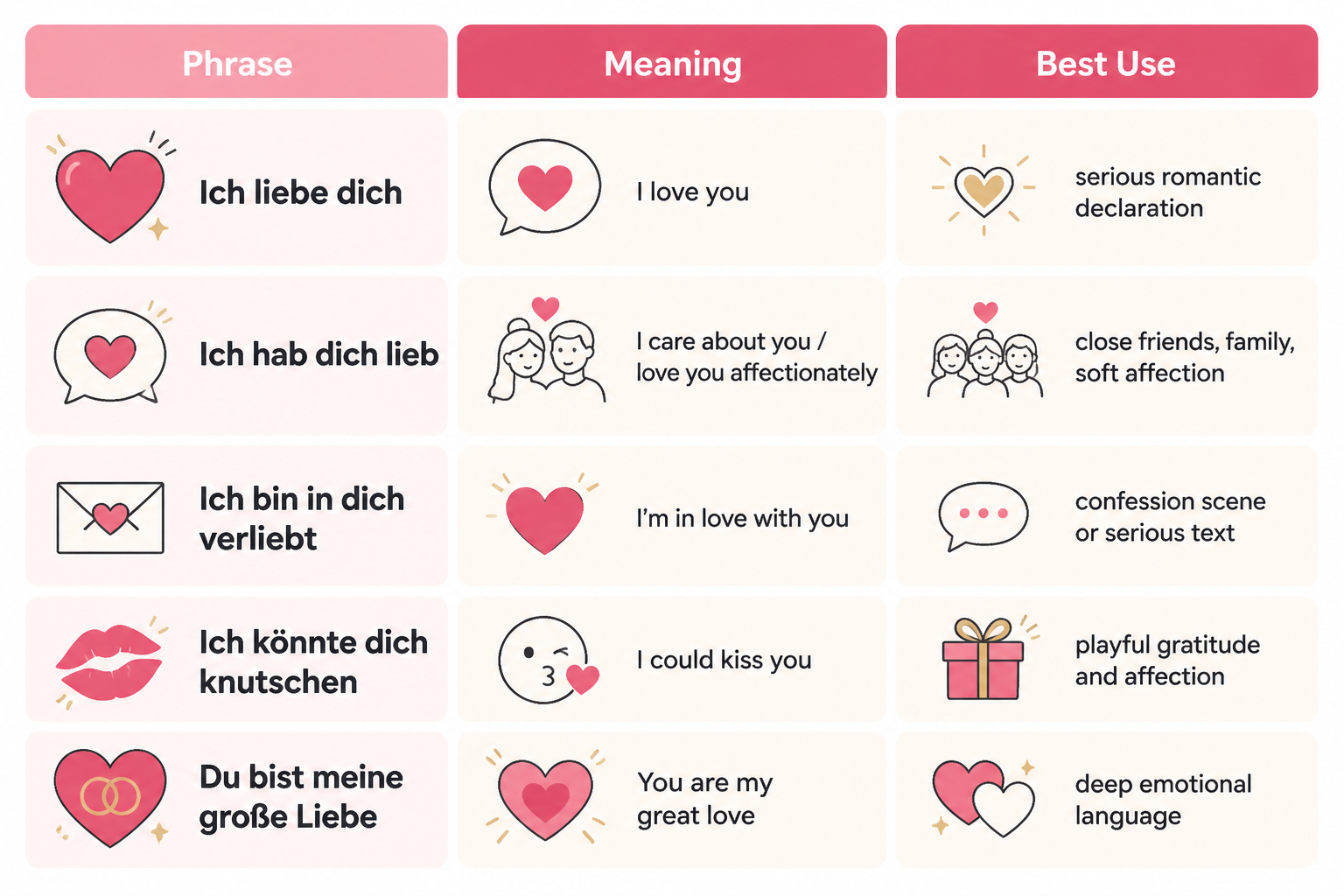
Common Mistakes And Easy Fixes
Mistake Better Version Why Ich liebe du Ich liebe dich dich is the correct object form of “you” here. Ich liebe Sie as a romantic line Ich liebe dich Sie is formal “you” and usually not used for romantic declarations. Ich bin verliebt mit dir Ich bin in dich verliebt The verb pattern is in + accusative, not mit. Ich habe dich Liebe Ich hab dich lieb Here the adjective is lieb, not the noun Liebe. Ich liebe du sehr Ich liebe dich sehr Again, object pronoun matters. Ich mag dich when you mean deep love Ich liebe dich or Ich hab dich lieb Ich mag dich is usually lighter and less intense. Pronunciation Tips For Lovers Of German Drama
A few sounds matter more than you might think. Fortunately, none of them are impossible. Annoying, yes. Impossible, no.
- ch in dich, ich, liebe ich is soft and breathy.
- ie in liebe sounds like a long “ee.”
- ei in mein sounds like “myne.”
- ü in fühlen or küssen is not an English sound. Round your lips and keep the tongue like “ee.”
- r often sounds soft or throat-based in modern standard German, not rolled like in many English learners’ imaginations.
- final consonants are often a bit devoiced, so lieb can sound closer to “leep” than “leeb.”
Quick memory trick: Ich liebe dich = strong romantic love. Ich hab dich lieb = soft affection. One is a thunderbolt. The other is a warm blanket.
Extra Cute And Romantic Words To Explore
If you want nicknames, pet names, and more sweet expressions, there are plenty of options. Some are classic, some are playful, and some are so sugary they may require a glass of water.
For more affectionate nicknames, see Cute Funny Nicknames In German. For more lovely everyday words, try Beautiful Cool German Words.
Quick Reference Summary
- Ich liebe dich = I love you, strongly and romantically.
- Ich hab dich lieb = I love/care about you, softly and warmly.
- Ich bin in dich verliebt = I’m in love with you.
- Du bedeutest mir viel = You mean a lot to me.
- Ich mag dich sehr = I like you very much / I care a lot about you.
- Du bist mir wichtig = You are important to me.
- Ich bin total verrückt nach dir = I’m crazy about you.
- Ich habe Gefühle für dich = I have feelings for you.
- Ich könnte dich knutschen = I could kiss you.
- More German to explore