
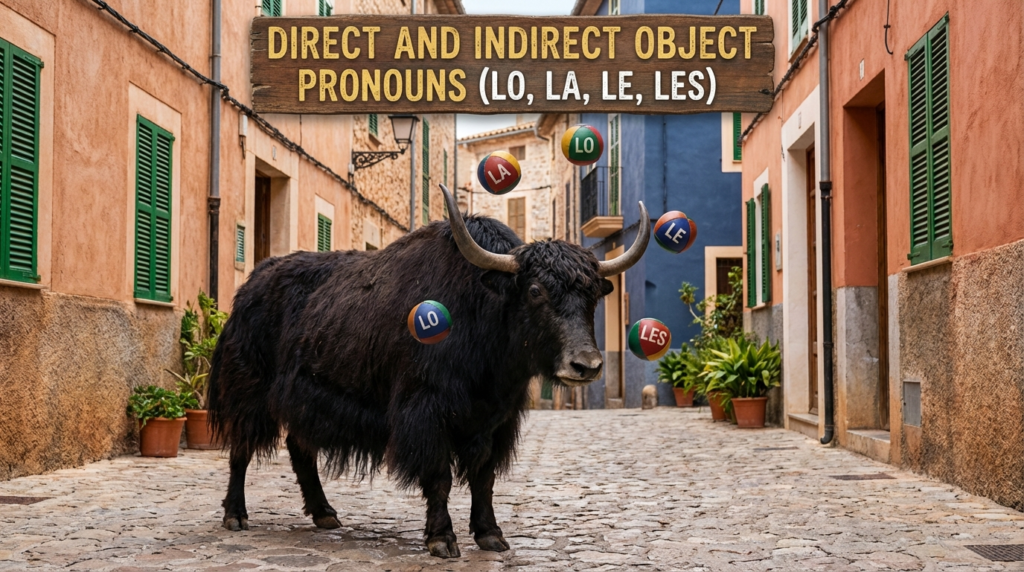
Spanish object pronouns are the little workhorses that keep your sentences from getting clunky. Instead of repeating el libro three times in one breath, you let lo do the heavy lifting. Direct and indirect object pronouns-words like me, te, lo, la, le, nos, os, los, las, les, and the ever-tricky se-make your Spanish flow more naturally, and they show up in practically every real conversation.
This list rounds up around 63 of the most useful object pronouns, so you can stop second‑guessing yourself when someone says se lo di or te la compré. We kept it practical: no dusty textbook charts, just the forms you’ll actually hear at a café, in a group chat, or when a friend tells you a story. Each entry gives you a straightforward meaning and a natural example sentence, so you see exactly how the pronoun behaves in real Spanish-not a translation you’ll forget by tomorrow.
Ready to give those little pronouns a workout? Scroll to the bottom of the article for the free printable Spanish direct and indirect object pronouns vocabulary list PDF and the free downloadable printable Spanish direct and indirect object pronouns flashcards.
If this topic helped, explore more in our Spanish learning section. it’s the easiest way to keep building related vocabulary without jumping around the web.
Quick Quiz
Think you’ve got me and te nailed, and can spot a se when it pops up? Give the quick quiz below a try-no pressure, just a friendly check to see which pronouns might need a little more love.
Keep building your Spanish
Choose a practical next step when you are ready.
Browse the Full List
| Word | Type | Meaning | Example | Audio |
|---|---|---|---|---|
| tuya | pronoun | yours, feminine | La mochila es tuya. | |
| tuyo | possessive pronoun | yours | La mochila es tuya. | |
| tuyo | pronoun | yours | ¿Es tuyo este bolígrafo? | |
| usted | pronoun | you (formal singular) | ¿Usted habla inglés? | |
| usted | pronoun | you (formal singular) | ¿Usted habla inglés? | |
| ustedes | pronoun | you all; you (plural) | ¿Ustedes viven aquí? | |
| ustedes | pronoun | you all; you (plural) | Ustedes son bienvenidos. | |
| varios | pronoun | several | Tengo varios libros. | |
| vosotras | pronoun | you all, feminine informal | Vosotras estáis listas. | |
| vosotros | pronoun | you all | Vosotros habláis muy rápido. | |
| vosotros | pronoun | you all | Vosotros vivís en Madrid. | |
| yo | pronoun | I | Yo estudio español. | |
| yo | pronoun | I | Yo estudio español. |