



German Food And Dishes is one of those topics that starts with sausages and somehow ends with twelve kinds of potatoes, three kinds of bread, and a deeply serious debate about whether dinner should be warm or cold. Useful, comforting, and a little bit gloriously specific — very German, really.
For the broader learning path, visit our parent guide.
In this guide, you’ll learn practical German food vocabulary, common dishes, restaurant phrases, and a few grammar and pronunciation notes that help things make sense in real life. By the end, you should be able to talk about meals, order food, and recognize the names of common German dishes without pretending every long compound noun is a personal attack.
If you want a quick grammar refresher alongside this topic, it helps to know that German nouns are capitalized and usually come with an article like der, die, or das. If that still feels slippery, a friendly detour through German articles explained and German cases explained can save future frustration.
For more core words that turn up everywhere from menus to markets, you can also keep Essential German Words & Phrases nearby.
Everyday German Food Words
These are the basics you’ll see in shops, cafés, bakeries, and restaurant menus. Start here, because “I would like something edible” is a charming goal, but it helps to know the words first.
| German | Pronunciation | Meaning | Example Sentence | Translation | Learner Note |
|---|---|---|---|---|---|
| das Essen | ESS-en | food; meal | Das Essen ist heute sehr gut. | The food is very good today. | Neutral and very common. |
| das Getränk | guh-TRENK | drink | Welches Getränk möchten Sie? | Which drink would you like? | Polite and useful in restaurants. |
| das Brot | brot | bread | Ich esse gern frisches Brot. | I like eating fresh bread. | Germany takes bread seriously. Very seriously. |
| die Wurst | voorst | sausage | Die Wurst ist warm. | The sausage is warm. | Common in many German meals. |
| das Fleisch | flysh | meat | Ich esse wenig Fleisch. | I eat little meat. | Also useful in dietary conversations. |
| das Gemüse | geh-MYOO-zeh | vegetables | Sie isst viel Gemüse. | She eats a lot of vegetables. | Plural-looking noun, but singular in German. |
| der Salat | zah-LAHT | salad | Ich nehme einen Salat. | I’ll take a salad. | Accusative einen after nehmen. |
| der Käse | KAY-zuh | cheese | Ich mag Käse sehr gern. | I really like cheese. | The ä sound is like “eh” with rounded lips. |
| die Kartoffel | kar-TOF-fel | potato | Die Kartoffel ist kalt. | The potato is cold. | Plural: Kartoffeln. |
| das Ei | eye | egg | Ich möchte ein Ei, bitte. | I’d like an egg, please. | Very handy at breakfast. |
Mini pronunciation note: German ei usually sounds like “eye,” while ie sounds like “ee.” So Ei and Wiese are not the same animal at all.
Common German Dishes
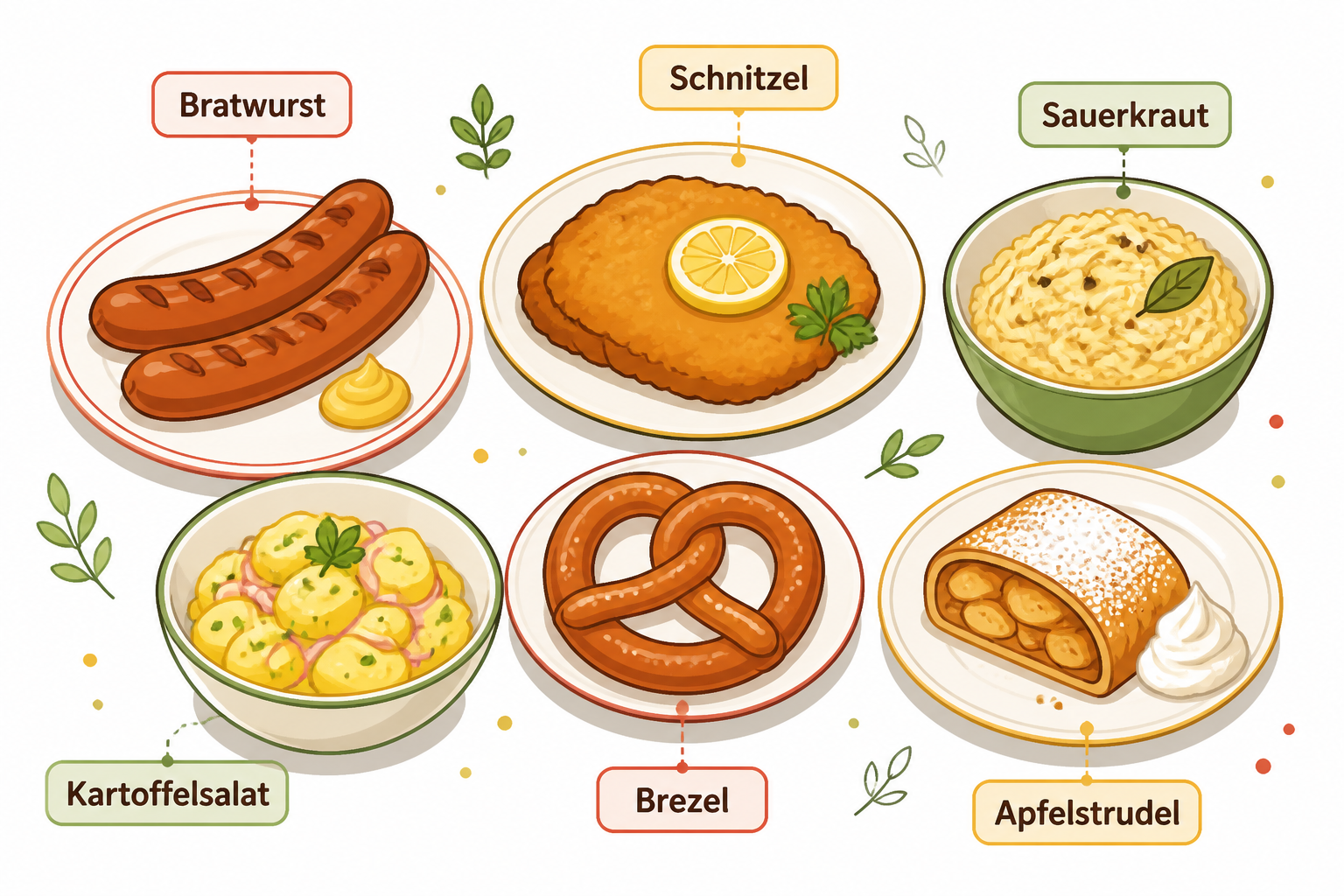
German cuisine is more regional than many learners expect. Still, some dishes show up almost everywhere, especially in restaurants, beer halls, Christmas markets, and family kitchens that consider gravy a personality trait.
| German | Pronunciation | Meaning | Example Sentence | Translation | Learner Note |
|---|---|---|---|---|---|
| die Bratwurst | BRAHT-voorst | fried/grilled sausage | Ich hätte gern eine Bratwurst. | I’d like a bratwurst. | Very common at markets and snack stands. |
| das Schnitzel | SHTS-nit-sel | breaded cutlet | Das Schnitzel schmeckt toll. | The schnitzel tastes great. | Pronounce sch like “sh.” |
| das Sauerkraut | SOW-er-kraut | sour cabbage | Ich esse das Schnitzel mit Sauerkraut. | I eat the schnitzel with sauerkraut. | Classic side dish; the noun is neuter. |
| der Kartoffelsalat | kar-TOF-fel-zah-LAHT | potato salad | Zum Grillen gibt es Kartoffelsalat. | There is potato salad for the barbecue. | Compound noun: Kartoffel + Salat. |
| die Currywurst | KER-ree-voorst | sausage with curry sauce | In Berlin esse ich gern Currywurst. | In Berlin I like to eat currywurst. | Very German, very snack-friendly. |
| der Döner | DUH-ner | doner kebab sandwich | Ich nehme einen Döner. | I’ll take a doner kebab. | Extremely popular in Germany. |
| die Suppe | ZOOP-uh | soup | Die Suppe ist noch heiß. | The soup is still hot. | Notice the final e is soft, not silent. |
| die Knödel | KNUH-del | dumplings | Zu dem Fleisch gibt es Knödel. | There are dumplings with the meat. | Common in southern German cooking. |
| der Eintopf | EYE-ntopf | one-pot stew | Ein Eintopf ist praktisch im Winter. | A stew is practical in winter. | Literally “one pot.” Very efficient. |
| der Apfelstrudel | AP-fel-SHTROO-del | apple strudel | Zum Nachtisch gibt es Apfelstrudel. | There is apple strudel for dessert. | Also common in Austria. |
Useful Restaurant Phrases
These phrases help when you want to order food without pointing at the menu like a stressed squirrel. Most are neutral and practical.
| German | Pronunciation | Meaning | Example Sentence | Translation | Learner Note |
|---|---|---|---|---|---|
| Ich hätte gern … | ikh HET-uh gern | I’d like … | Ich hätte gern eine Suppe. | I’d like a soup. | Polite and natural for ordering. |
| Ich nehme … | ikh NAY-muh | I’ll have … | Ich nehme das Schnitzel. | I’ll have the schnitzel. | Simple, direct, and very common. |
| Für mich bitte … | fyur mikh BIT-teh | For me, please … | Für mich bitte ein Wasser. | For me, please, a water. | Casual but polite enough in many places. |
| Was empfehlen Sie? | vahs emp-FEY-len zee | What do you recommend? | Was empfehlen Sie heute? | What do you recommend today? | Use Sie for polite “you.” |
| Ich bin allergisch gegen … | ikh bin ah-ler-GISH gay-gen | I’m allergic to … | Ich bin allergisch gegen Nüsse. | I’m allergic to nuts. | Important for safe eating. |
| Ohne … bitte. | OH-nuh … BIT-teh | Without … please. | Ohne Zwiebeln, bitte. | Without onions, please. | Useful for dietary requests. |
| Die Rechnung, bitte. | dee REKH-noong BIT-teh | The bill, please. | Die Rechnung, bitte. | The bill, please. | Very standard; no need to overthink it. |
| Kann ich mit Karte zahlen? | kan ikh mit KAR-teh TSAH-len | Can I pay by card? | Kann ich mit Karte zahlen? | Can I pay by card? | Good question in smaller places. |
| Ist das vegetarisch? | ist das veh-guh-TAH-rish | Is that vegetarian? | Ist die Suppe vegetarisch? | Is the soup vegetarian? | Vegetarian labels are useful in menus. |
| Wir nehmen zwei … | veer NAY-men tsvy | We’ll take two … | Wir nehmen zwei Brezeln. | We’ll take two pretzels. | Handy for sharing snacks. |
Bakery Words You’ll Actually Use
German bakeries are an institution. If you’ve ever entered one before 9 a.m. and seen people discussing bread rolls with the intensity of a parliamentary committee, now you know why.
| German | Pronunciation | Meaning | Example Sentence | Translation | Learner Note |
|---|---|---|---|---|---|
| die Brezel | BREH-tsel | pretzel | Ich kaufe eine Brezel. | I’m buying a pretzel. | Very common snack. |
| das Brötchen | BROYT-chen | bread roll | Zum Frühstück esse ich ein Brötchen. | For breakfast I eat a bread roll. | Diminutive ending -chen makes it neuter. |
| das Croissant | krwah-SAHN | croissant | Ich nehme ein Croissant und Kaffee. | I’ll take a croissant and coffee. | Borrowed word, but common in German cafés. |
| der Kuchen | KOO-khen | cake | Der Kuchen ist frisch gebacken. | The cake is freshly baked. | ch is a soft “kh” sound. |
| das Gebäck | guh-BEHK | pastry, baked goods | Das Gebäck ist noch warm. | The pastry is still warm. | Handy general word for bakery items. |
Breakfast, Lunch, And Dinner
Meal words are useful because Germans talk about food a lot, and because “What do you want for dinner?” is somehow always the most important conversation of the day.
| German | Pronunciation | Meaning | Example Sentence | Translation | Learner Note |
|---|---|---|---|---|---|
| das Frühstück | FRYOO-shtyook | breakfast | Das Frühstück ist um acht Uhr. | Breakfast is at eight o’clock. | Notice ü: rounded lips, “ee” tongue. |
| das Mittagessen | MIT-tahk-ESS-en | lunch | Zum Mittagessen gibt es Suppe. | There is soup for lunch. | Compound noun: midday + eating. |
| das Abendessen | AH-bent-ESS-en | dinner | Wir essen das Abendessen spät. | We eat dinner late. | Often a warm evening meal. |
| das Dessert | deh-ZER | dessert | Zum Dessert möchte ich Eis. | For dessert I’d like ice cream. | French borrowing, common in menus. |
| der Snack | snekk | snack | Ich brauche einen Snack. | I need a snack. | Very modern everyday word. |
Shopping And Market Vocabulary
At markets and supermarkets, small food words do a lot of heavy lifting. This is where grammar suddenly becomes useful instead of decorative.
| German | Pronunciation | Meaning | Example Sentence | Translation | Learner Note |
|---|---|---|---|---|---|
| der Supermarkt | ZOO-per-markt | supermarket | Ich gehe zum Supermarkt. | I’m going to the supermarket. | Very standard German. |
| der Markt | markt | market | Frisches Gemüse gibt es auf dem Markt. | Fresh vegetables are available at the market. | Good with auf dem + dative. |
| die Milch | milkh | milk | Ich kaufe Milch und Brot. | I’m buying milk and bread. | Final ch is soft, not “k.” |
| die Butter | BOO-ter | butter | Haben Sie Butter? | Do you have butter? | Question form with haben. |
| das Mehl | mayl | flour | Ich brauche Mehl für den Kuchen. | I need flour for the cake. | Useful for baking vocabulary. |
| der Zucker | TSOO-ker | sugar | Wie viel Zucker möchten Sie? | How much sugar would you like? | z sounds like “ts.” |
| das Salz | zalts | salt | Das Salz steht dort. | The salt is over there. | Final consonants are often devoiced. |
| die Eier | eye-er | eggs | Ich brauche sechs Eier. | I need six eggs. | Plural of das Ei. |
| das Obst | ohpst | fruit | Obst ist gesund. | Fruit is healthy. | Collected fruit word, often singular. |
| das Gemüsefach | geh-MYOO-zeh-fakh | vegetable drawer | Das Gemüse liegt im Gemüsefach. | The vegetables are in the vegetable drawer. | Long compound noun, but logical once split apart. |
Real-Life Phrases For Talking About Food
These are the phrases that make conversations sound real instead of textbook-perfect-and-slightly-robotic. That’s the sweet spot.
| German | Pronunciation | Meaning | Example Sentence | Translation | Learner Note |
|---|---|---|---|---|---|
| Es schmeckt gut. | es shmeckt goot | It tastes good. | Die Suppe schmeckt gut. | The soup tastes good. | schmecken = to taste. |
| Es ist lecker. | es ist LEK-ker | It is tasty. | Der Kuchen ist lecker. | The cake is tasty. | Very common and friendly. |
| Ich habe Hunger. | ikh HAH-beh HUN-ger | I’m hungry. | Ich habe großen Hunger. | I’m very hungry. | Useful before meals. |
| Ich habe Durst. | ikh HAH-beh doorst | I’m thirsty. | Ich habe nach dem Spaziergang Durst. | I’m thirsty after the walk. | Handy in cafés and restaurants. |
| Ich bin satt. | ikh bin zat | I’m full. | Danke, ich bin satt. | Thanks, I’m full. | Important at grandma’s house everywhere. |
| Das ist mein Lieblingsessen. | das ist myn LEE-blings-ESS-en | That’s my favorite food/meal. | Pizza ist mein Lieblingsessen. | Pizza is my favorite food. | Compound noun: favorite + food. |
| Ich koche gern. | ikh KOH-khe gern | I like cooking. | Am Wochenende koche ich gern. | On weekends I like cooking. | kochen has the “kh” sound. |
| Ich esse lieber … | ikh ESS-uh LEE-ber | I prefer to eat … | Ich esse lieber vegetarisch. | I prefer to eat vegetarian. | lieber = rather / preferably. |
| Das gefällt mir nicht. | das guh-FEHLT meer nikht | I don’t like that. | Das Gericht gefällt mir nicht. | I don’t like the dish.More German to explore How to Type German Characters on Any Device Best graded readers for German The Golden Goose: A2 Elementary German Story with Audio Learn German with Struwwelpeter: Shock-Headed Peter Story & Audio (A1 Beginner) |