


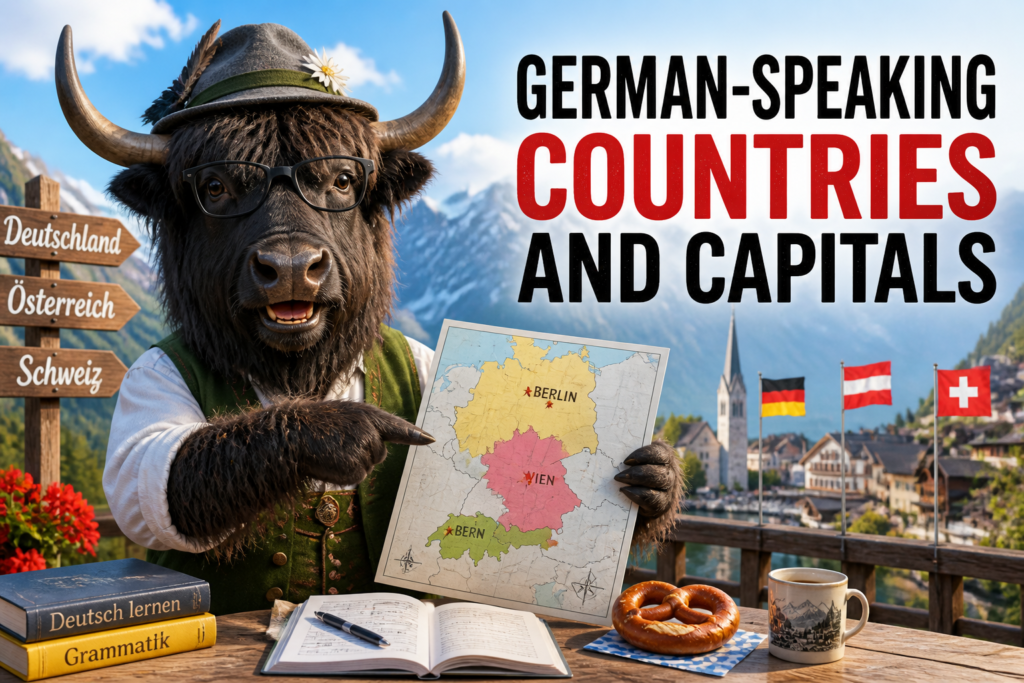
If you ever mix up Austria and Australia, congratulations: you are not alone, and geography is apparently a hobby with a sense of humor. The good news is that the German-speaking world is small enough to learn without losing your mind, but varied enough to be genuinely useful.
For the broader learning path, visit our parent guide.
By the end of this guide, you will know the main German-speaking countries, their capitals, and the everyday German words people actually use for them. You will also pick up some related geography vocabulary, because learning country names without the basic map words is a bit like packing for a trip with only one sock.
We’ll focus on standard German used in Germany, and where it matters, we’ll point out Austrian and Swiss differences too. For a broader vocabulary base, you can also compare this guide with Countries and Nationalities in German and Geography Vocabulary in German.
The German-Speaking World At A Glance
When English speakers say “German-speaking countries,” they usually mean countries where German is an official language or widely spoken. The core ones are Germany, Austria, Switzerland, Liechtenstein, and Luxembourg. German is also an official language in Belgium and Italy in small regions, and it is spoken in parts of other countries too.
A tiny but useful note: in German, country names are capitalized because all nouns are capitalized. Yes, even the boring ones. German loves rules almost as much as it loves compound nouns.
Main German-Speaking Countries And Their Capitals
| German | Pronunciation | Meaning | Capital | Learner Note |
|---|---|---|---|---|
| Deutschland | DOYT-sch-land | Germany | Berlin | Most common country name you will need. |
| Österreich | UR-stair-ikh | Austria | Wien | Start with an umlaut: Ö. Not “Oesterreich” in modern standard spelling. |
| die Schweiz | shvites | Switzerland | Bern | Country names are usually feminine in German, so you say die Schweiz. |
| Liechtenstein | LIKH-ten-shtine | Liechtenstein | Vaduz | The ch sound is soft and breathy, not like English “k.” |
| Luxemburg | LOOKS-em-boorg | Luxembourg | Luxemburg | The capital has the same name as the country in German. |
For a quick, boring, reliable reference on spelling and country names, Duden is the kind of source that will never surprise you, which is exactly why it’s useful.
Useful Country Phrases You Will Actually Hear
Here are practical phrases for talking about countries, capitals, and where people come from. These are the phrases that show up in classes, travel talk, and those awkward “So, where are you from?” moments.
| German | Pronunciation | Meaning | Example Sentence | Translation | Learner Note |
|---|---|---|---|---|---|
| die Hauptstadt | HOUPT-shtat | capital city | Berlin ist die Hauptstadt von Deutschland. | Berlin is the capital of Germany. | die because Stadt is feminine. |
| das Land | lant | country; land | Deutschland ist ein großes Land. | Germany is a big country. | Can mean “country” or “land” depending on context. |
| die Grenze | GREN-tseh | border | Die Grenze zwischen Deutschland und Österreich ist lang. | The border between Germany and Austria is long. | zwischen takes dative when used with two things. |
| im Norden | im NOR-den | in the north | Hamburg liegt im Norden Deutschlands. | Hamburg is in the north of Germany. | im = in dem, a useful contraction. |
| im Süden | im ZOO-den | in the south | München liegt im Süden Deutschlands. | Munich is in the south of Germany. | ü is not “oo”; it’s more like a tight “ee” with rounded lips. |
| im Osten | im OSS-ten | in the east | Dresden liegt im Osten Deutschlands. | Dresden is in the east of Germany. | st at the start of a syllable sounds like sht. |
| im Westen | im VESS-ten | in the west | Köln liegt im Westen Deutschlands. | Cologne is in the west of Germany. | ö in Köln is a rounded front vowel; don’t flatten it into “coal.” |
| die Einwohnerzahl | IN-voy-ner-tsowl | population | Die Einwohnerzahl von Berlin ist sehr hoch. | Berlin’s population is very high. | Long compound noun, very German, very proud of itself. |
| die Karte | KAR-tuh | map | Ich schaue mir die Karte von Europa an. | I’m looking at the map of Europe. | anschauen is separable: an goes to the end. |
| die Nachbarländer | NAKH-bar-len-der | neighboring countries | Deutschland hat viele Nachbarländer. | Germany has many neighboring countries. | Plural of das Nachbarland; note the -er plural ending. |
| Wo liegt …? | voh leegt | Where is … located? | Wo liegt Bern? | Where is Bern located? | Good for asking about places on a map. |
| Es liegt in … | ess leegt in | It is in … | Wien liegt in Österreich. | Vienna is in Austria. | Use this to answer location questions simply. |
Core Countries And Capitals In More Detail
Let’s look at the main German-speaking countries one by one. This is the part that helps the names stick in your head instead of bouncing off like a cheap supermarket tomato.
| German | Pronunciation | Meaning | Example Sentence | Translation | Learner Note |
|---|---|---|---|---|---|
| Deutschland | DOYT-sch-land | Germany | Ich lerne Deutsch in Deutschland. | I am learning German in Germany. | Deutsch means German language or German as an adjective. |
| Berlin | ber-LEEN | Berlin | Berlin ist die Hauptstadt von Deutschland. | Berlin is the capital of Germany. | Stress is on the second syllable. |
| Österreich | UR-stair-ikh | Austria | Wien ist die Hauptstadt von Österreich. | Vienna is the capital of Austria. | The ö sound is important. Don’t turn it into a plain “o.” |
| Wien | VEEN | Vienna | Wien ist eine sehr schöne Stadt. | Vienna is a very beautiful city. | In German, the capital of Austria is Wien, not “Vienna” in everyday local use. |
| die Schweiz | shvites | Switzerland | Bern ist die Hauptstadt der Schweiz. | Bern is the capital of Switzerland. | der Schweiz is genitive in this sentence. |
| Bern | bern | Bern | Bern liegt in der Schweiz. | Bern is in Switzerland. | Spelled like the English word “burn” minus the vowel drama. |
| Liechtenstein | LIKH-ten-shtine | Liechtenstein | Vaduz ist die Hauptstadt von Liechtenstein. | Vaduz is the capital of Liechtenstein. | Small country, very easy to forget, annoyingly useful for quizzes. |
| Vaduz | vah-DOOTS | Vaduz | Vaduz ist klein, aber wichtig. | Vaduz is small, but important. | The z sounds like ts. |
| Luxemburg | LOOKS-em-boorg | Luxembourg | Luxemburg ist ein mehrsprachiges Land. | Luxembourg is a multilingual country. | German is one of the official languages there. |
| Luxemburg | LOOKS-em-boorg | Luxembourg City | Luxemburg ist auch die Hauptstadt von Luxemburg. | Luxembourg is also the capital of Luxembourg. | Same spelling for country and capital in German. |
What About German-Speaking Regions Outside The Main Five?
German is also official in smaller regions of other countries. You do not need to memorize every local administration unit on day one unless your hobby is mildly terrifying trivia.
| German | Pronunciation | Meaning | Example Sentence | Translation | Learner Note |
|---|---|---|---|---|---|
| Belgien | BEL-gee-en | Belgium | Deutsch ist eine Amtssprache in Belgien. | German is an official language in Belgium. | Amtssprache means official language. |
| Italien | ee-TAH-lee-en | Italy | In Südtirol spricht man auch Deutsch. | In South Tyrol, people also speak German. | South Tyrol is in northern Italy. |
| die deutschsprachige Schweiz | DOYTCH-shpra-khee-guh shvites | German-speaking Switzerland | Die deutschsprachige Schweiz ist nur ein Teil der Schweiz. | German-speaking Switzerland is only one part of Switzerland. | Switzerland has several language regions. |
| das Fürstentum Liechtenstein | FOOR-sten-toom LIKH-ten-shtine | the Principality of Liechtenstein | Liechtenstein ist ein Fürstentum. | Liechtenstein is a principality. | das Fürstentum is a useful formal word. |
Mini Grammar Notes That Save Confusion
German country names can behave differently from English. The biggest thing to notice is the article and preposition structure. German likes to be specific, even when it could maybe relax for five minutes.
| Pattern | Meaning | German Example | English Translation | Learner Note |
|---|---|---|---|---|
| in + dative | in / inside / in the country of | Ich wohne in Deutschland. | I live in Germany. | Deutschland does not take an article here. |
| aus + dative | from; out of | Er kommt aus Österreich. | He comes from Austria. | Use aus for origin. |
| aus der Schweiz | from Switzerland | Sie kommt aus der Schweiz. | She comes from Switzerland. | die Schweiz takes der after aus. |
| nach + country name | to a country | Wir fahren nach Deutschland. | We are going to Germany. | Use nach with many country names, but not all. |
| in die Stadt / ins Land | to a place | Wir fahren in die Schweiz. | We are going to Switzerland. | With places that take an article, use in + accusative. |
Quick reminder: the names Deutschland, Österreich, and Liechtenstein usually do not need articles in everyday speech. But die Schweiz does. That one likes the article. A bit of diva behavior, but fine.
Pronunciation Tips For The Tricky Names
Some of these names are straightforward, and some are classic German “surprise, here is a sound your mouth has not trained for” moments.
| Sound | Example | Simple Help | Learner Note |
|---|---|---|---|
| eu / äu | Deutschland | Sounds like “oy” | Say DOYT-sch-land, not “dootchland.” |
| ö | Österreich, Köln | Like “eh” with rounded lips | It is not English “o.” Lip rounding matters. |
| ch | Deutschland, Liechtenstein | Breathy sound, not English “k” | In ich-type words, it is softer; after a, o, u, it is deeper. |
| w | Wien | Sounds like English “v” | Say Veen, not “Ween.” |
| z | Vaduz | Sounds like “ts” | German z is not English z. |
| final consonants | Bern, Luxemburg | Often devoice at the end | German final consonants can sound sharper than in English. |
If you want to hear how native speakers say the country names, the DW Learn German site is a solid, practical place to check pronunciation and everyday usage.
Real-Life Sentences With Countries And Capitals
These are the kinds of sentences that show up in introductions, classroom exercises, travel chats, and basic map descriptions.
| German | Pronunciation | Meaning | Example Sentence | Translation | Learner Note |
|---|---|---|---|---|---|
| Woher kommst du? | vo-HAIR komst doo | Where are you from? | Woher kommst du? — Ich komme aus Deutschland. | Where are you from? — I’m from Germany. | woher asks about origin. |
| Ich komme aus … | ikh KOM-uh ous | I come from … | Ich komme aus Österreich. | I’m from Austria. | Very common and natural in introductions. |
| Ich lebe in … | ikh LAY-buh in | I live in … | Ich lebe in der Schweiz. | I live in Switzerland. | Use in der with die Schweiz. |
| Die Hauptstadt von … ist … | dee HOUPT-shtat fon | The capital of … is … | Die Hauptstadt von Deutschland ist Berlin. | The capital of Germany is Berlin. | Good basic sentence pattern to memorize. |
| Welches Land ist das? | VEL-khes lant ist das | Which country is that? | Welches Land ist das? — Das ist Liechtenstein. | Which country is that? — That is Liechtenstein. | welches changes with gender and case, but here this form is common. |
| Ich lerne die Länder in Europa. | ikh LER-nuh dee LEN-der in oy-ROO-pah | I’m learning the countries in Europe. | Ich lerne die Länder in Europa. | I’m learning the countries in Europe. | die Länder is plural of das Land. |
| Sie liegt in … | zee leegt in | It is located in … | Bern liegt in der Schweiz. | Bern is in Switzerland. | sie here means “it” for a feminine noun like die Stadt. |
| Er ist aus Luxemburg. | air ist ous LOOKS-em-boorg | He is from Luxembourg. | Er ist aus Luxemburg. | He is from Luxembourg. | Simple and very useful for nationality practice. |
Germany Vs Austria Vs Switzerland: Tiny But Helpful Differences
For capital names, standard German is the same across the three main countries, but everyday usage can differ a little. Nothing dramatic. Just enough to keep learners honest.
| Topic | Germany | Austria | Switzerland | Learner Note |
|---|---|---|---|---|
| Capital of the country | Berlin | Wien | Bern | These are the standard forms in all three countries. |
| Word for “border” | die Grenze | die Grenze | die Grenze | No major difference in standard German. |
| Word for “city” | die Stadt | die Stadt | die Stadt | Again, standard German stays standard. Annoyingly reasonable. |
| “Train station” | der Bahnhof | der Bahnhof | der Bahnhof | Useful if you’re mapping capitals by transport hubs. |
| Street name forms | standard German spelling | standard German spelling | standard German spelling | Spelling is generally the same, though local usage may vary. |
Switzerland is the one people most often forget because German there is only one of several official languages. Still, when you hear die Schweiz, remember: feminine article, same country, and Bern is the capital.
Quick Practice
Try these out loud or in writing. A little repetition now saves you from embarrassing map-quiz silence later.
- Say: Germany in German.
- Say: Austria in German.
- Say: Switzerland in German.
- Match each country with its capital.
- Use Ich komme aus … with two country names.
- Use Die Hauptstadt von … ist … with two country names.
- Say which country is in the north, south, east, or west of Germany.
- Translate: “Berlin is the capital of Germany.”
- Translate: “I live in Switzerland.”
- Translate: “Vaduz is the capital of Liechtenstein.”
Answers: Deutschland, Österreich, die Schweiz, Berlin, Wien, Bern, Vaduz, Luxemburg.
Common Mistakes And Easy Fixes
| Mistake | Better German | Why | Learner Note |
|---|---|---|---|
| der Schweiz | die Schweiz | Schweiz is feminine. | Remember the article. This one trips up many learners. |
| Ich komme von Deutschland. | Ich komme aus Deutschland. | aus is used for origin. | von usually means “from” in other contexts, but not for nationality origin. |
| Ich gehe in Deutschland. | Ich gehe nach Deutschland. | nach is used for going to many countries. | Think of movement toward a country. |
| Wien is the capital… | Wien ist die Hauptstadt… | German sentence structure uses ist, not “is.” | Basic, but surprisingly easy to forget when switching languages. |
| Osterreich | Österreich | The umlaut changes spelling and pronunciation. | Umlauts are not optional decoration. |
| Deutchland | Deutschland | The correct spelling is Deutsch + -land. | That extra l matters. |
Quick Reference Summary
- Deutschland — capital: Berlin
- Österreich — capital: Wien
- die Schweiz — capital: Bern
- Liechtenstein — capital: Vaduz
- Luxemburg — capital: Luxemburg
- Use aus for where someone is from.
- Use nach for going to many countries.
- Remember: die Schweiz, not der Schweiz.
- ö is common in Austrian-related spelling and pronunciation.
- German nouns are capitalized, because of course they are.
If you want to keep building your geography vocabulary, the next useful step is learning country adjectives and nationalities. That way you can say not just where someone is from, but what language they speak and how to describe places properly. Tiny grammar, big payoff.
Yak takeaway: Learn the countries, learn the capitals, and don’t let die Schweiz trick you with the wrong article. Geography gets a lot easier once German stops pretending every noun is a little VIP.