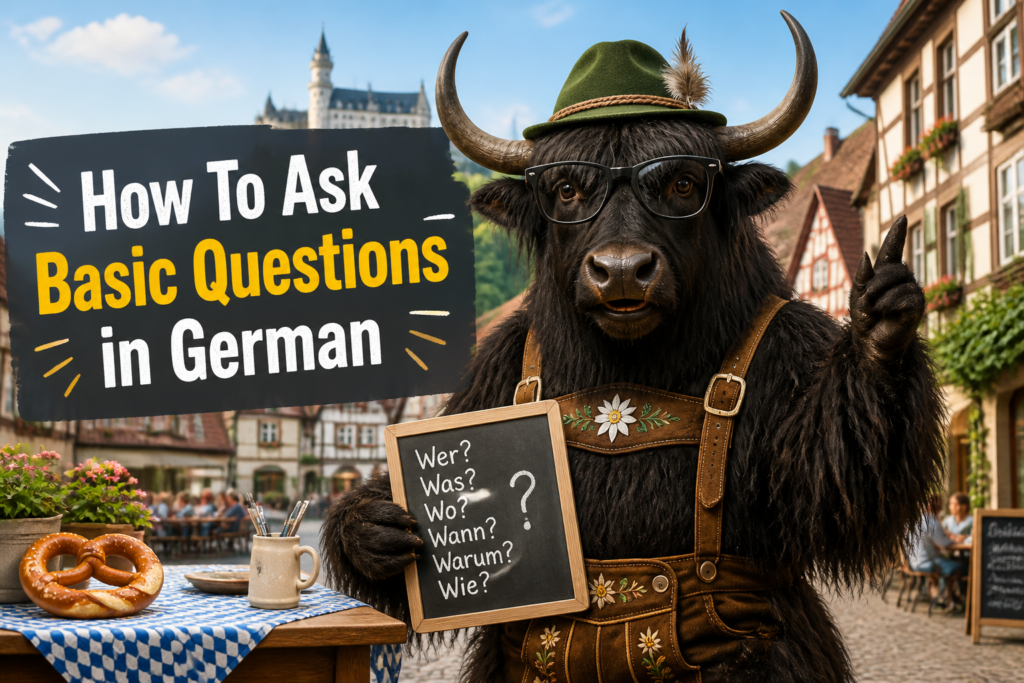
If you can ask basic questions in German, you can start real conversations fast. Not perfect conversations. Real ones. The kind where you ask for a coffee, find a train platform, or figure out whether someone is looking for the same bus you are. Tiny victory, big usefulness.
German questions are usually quite friendly once you know the few building blocks: question words like was and wo, yes-no questions with the verb first, and a handful of polite starters that save you from awkward silence. German is very happy to be direct. You can be too.
By the end of this guide, you’ll know how to form basic questions, say them naturally, and avoid the classic beginner traps that make German sound a bit robotic or accidentally bossy.
German learning basics and useful German greetings go nicely with this guide if you want to build a fuller survival set.
The Two Main Ways To Ask Questions
German questions usually fall into two friendly piles:
- Yes-no questions — questions you can answer with yes or no.
- Question-word questions — questions that begin with words like wer, was, wo, wann, or wie.
| Pattern | Meaning | German Example | English Translation | Learner Note |
|---|---|---|---|---|
| Hast du Zeit? | Yes-no question | Hast du Zeit? | Do you have time? | Verb comes first. No helper words needed. |
| Wann kommst du? | Question-word question | Wann kommst du? | When are you coming? | The question word stays at the front. |
The good news: German is not trying to trick you here. It usually just wants the verb in the right place and a question word up front when needed. Very considerate, for a language with three genders and a mild obsession with compound nouns.
Essential Question Words
These are the starters you’ll use constantly. Learn them early and life gets easier very quickly.
| German | Pronunciation | Meaning | Example Sentence | Translation | Learner Note |
|---|---|---|---|---|---|
| wer | vair | who | Wer ist das? | Who is that? | Used for people. |
| was | vass | what | Was ist das? | What is that? | Very common and very useful. |
| wo | voh | where | Wo ist der Bahnhof? | Where is the train station? | Use for location. |
| wann | vahn | when | Wann beginnt der Kurs? | When does the class start? | Great for times and dates. |
| wie | vee | how | Wie heißt du? | What is your name? | Also used for “how much,” “how old,” and more. |
| warum | vah-room | why | Warum lernst du Deutsch? | Why are you learning German? | Can sound direct, but that is normal in German. |
| welcher / welche / welches | VEL-cher / VEL-che / VEL-ches | which | Welchen Zug nimmst du? | Which train are you taking? | Changes with gender and case. Beginners can learn it later, but it’s very common. |
German question words deserve their own deep dive, because once you know these, your questions stop feeling like random sound effects.
Yes-No Questions: Put The Verb First
For yes-no questions, German usually starts with the verb. That’s the big rule. No drama, no extra helper words, just the verb jumping to the front like it owns the place.
| Pattern | Meaning | German Example | English Translation | Learner Note |
|---|---|---|---|---|
| Hast du Hunger? | Do you have hunger? | Hast du Hunger? | Are you hungry? | Literal German is “have hunger.” |
| Kann ich helfen? | Can I help? | Kann ich helfen? | Can I help? | Very natural in shops, cafés, and service situations. |
| Sprichst du Englisch? | Do you speak English? | Sprichst du Englisch? | Do you speak English? | The verb comes before the subject. |
| Ist das richtig? | Is that correct? | Ist das richtig? | Is that correct? | Handy for checking understanding. |
Notice the structure: Verb + subject + rest. In statements, German often has the subject first. In questions, the verb gets first place. It’s a small change, but it matters.
Yak tip: If you can move the verb to the front, you can already ask a lot of practical questions in German. Not glamorous. Extremely useful.
Polite Starters That Make Questions Sound Natural
English speakers often say “Can I…?” or “Could you…?” to sound polite. German does this too, but usually with direct, simple wording. A little bitte also goes a long way. Miracles happen.
| German | Pronunciation | Meaning | Example Sentence | Translation | Learner Note |
|---|---|---|---|---|---|
| Entschuldigung, wo ist …? | ent-SHOOL-di-goong, voh ist | Excuse me, where is …? | Entschuldigung, wo ist die Toilette? | Excuse me, where is the restroom? | Very common and polite. |
| Können Sie …? | KER-nen zee | Can you …? (formal) | Können Sie mir helfen? | Can you help me? | Use with strangers, staff, and formal situations. |
| Kannst du …? | kahnst doo | Can you …? (informal) | Kannst du das wiederholen? | Can you repeat that? | Use with friends, classmates, and people who said du is fine. |
| Haben Sie …? | HAH-ben zee | Do you have …? (formal) | Haben Sie einen Stift? | Do you have a pen? | Very useful in shops, offices, and classrooms. |
| Hast du …? | hahst doo | Do you have …? (informal) | Hast du kurz Zeit? | Do you have a moment? | kurz here means “a quick moment.” |
| Wie bitte? | vee BIT-te | Pardon? / Come again? | Wie bitte? Ich habe dich nicht verstanden. | Pardon? I didn’t understand you. | Useful when you need someone to repeat. |
The formal Sie is capitalized in German. That’s not a typo. It’s the polite “you.” The informal du is for friends, children, and people who have invited you to use it. German likes boundaries. Very efficient, honestly.
Everyday Questions You’ll Actually Use
Here are the questions that show up in real life, not just in textbook fantasy land where everyone speaks in perfect full sentences while standing in a line.
| German | Pronunciation | Meaning | Example Sentence | Translation | Learner Note |
|---|---|---|---|---|---|
| Wie heißt du? | vee hists doo | What is your name? / What are you called? | Wie heißt du? | What is your name? | Literally “How are you called?” Very normal. |
| Wie heißen Sie? | vee HY-sen zee | What is your name? (formal) | Wie heißen Sie? | What is your name? | Use this with strangers or in formal settings. |
| Woher kommst du? | voh-hair koomst doo | Where are you from? | Woher kommst du? | Where are you from? | woher = from where. |
| Wo wohnst du? | voh vohnst doo | Where do you live? | Wo wohnst du? | Where do you live? | Uses the verb wohnen = to live. |
| Was machst du? | vass mahkst doo | What do you do? | Was machst du heute? | What are you doing today? | Good for conversation starters. |
| Was kostet das? | vass KOS-tet dahs | How much does that cost? | Was kostet das? | How much is that? | Very common in shops and cafés. |
| Wo ist …? | voh ist | Where is …? | Wo ist der Eingang? | Where is the entrance? | Excellent travel question. |
| Wann geht der Zug? | vahn gayt dair tsoog | When does the train leave? | Wann geht der Zug? | When does the train leave? | gehen can mean “go” or “leave” with transport. |
| Wie viel kostet das? | vee feel KOS-tet dahs | How much does that cost? | Wie viel kostet das Brot? | How much does the bread cost? | Very common with items and quantities. |
| Wie spät ist es? | vee shpayt ist ess | What time is it? | Wie spät ist es? | What time is it? | The classic time question. |
| Kann ich mit Karte zahlen? | kann ikh mit KAR-te TSAL-en | Can I pay by card? | Kann ich mit Karte zahlen? | Can I pay by card? | Useful because card payment is not always assumed everywhere. |
| Kann ich ein Glas Wasser haben? | kann ikh ayn glas VAH-ser HAH-ben | Can I have a glass of water? | Kann ich ein Glas Wasser haben? | Can I have a glass of water? | Sounds natural in cafés and restaurants. |
One thing that surprises learners: German often uses haben for “have” in questions, but the everyday meaning can feel a little different from English. Hast du …? is often just the practical way to ask if someone has something or if they have time.
Question Words With Prepositions: The Sneaky Good Stuff
Some of the most useful German questions start with a preposition glued to a question word. They look small, but they do heavy lifting.
| German | Pronunciation | Meaning | Example Sentence | Translation | Learner Note |
|---|---|---|---|---|---|
| Worauf wartest du? | voh-ROWF VAR-test doo | What are you waiting for? | Worauf wartest du? | What are you waiting for? | auf + was becomes worauf. |
| Womit fährst du? | voh-MIT fairst doo | What are you traveling by? | Womit fährst du zur Arbeit? | How do you get to work? | mit + was becomes womit. |
| Woran denkst du? | voh-RAHN denkst doo | What are you thinking about? | Woran denkst du gerade? | What are you thinking about right now? | Common in conversation. |
| Worüber sprichst du? | voh-RUE-ber shprikhst doo | What are you talking about? | Worüber sprecht ihr? | What are you all talking about? | Very useful, even if it looks a bit scary at first glance. |
These forms come from combining a preposition with was. Don’t panic if they look strange. German enjoys little word mergers the way some people enjoy organizing cables.
Question Word Order: The Simple Rule
German question word order is usually simple:
- Question word + verb + subject + rest
- Verb + subject + rest for yes-no questions
| Pattern | Meaning | German Example | English Translation | Learner Note |
|---|---|---|---|---|
| Wann kommst du? | When are you coming? | Wann kommst du? | When are you coming? | Question word first. |
| Kommt er morgen? | Is he coming tomorrow? | Kommt er morgen? | Is he coming tomorrow? | Verb first for yes-no questions. |
| Warum lernst du Deutsch? | Why are you learning German? | Warum lernst du Deutsch? | Why are you learning German? | The subject stays after the verb. |
| Wo arbeiten Sie? | Where do you work? | Wo arbeiten Sie? | Where do you work? | Formal version with Sie. |
Remember this tiny engine: question word first, then the verb. Once you’ve got that, the rest usually falls into place. German sentence order is less random than it looks. A little bossy, yes. Random, no.
Mini Dialogue: Basic Questions In Real Life
Here’s a small real-world exchange. Nothing fancy. Just useful German doing useful German things.
Entschuldigung, wo ist der Bahnhof? Excuse me, where is the train station? Der Bahnhof ist dort drüben. The train station is over there. Kann ich zu Fuß gehen? Can I walk there? Ja, das ist nicht weit. Yes, it’s not far.
zu Fuß means “on foot.” It comes up a lot in travel situations, and yes, it sounds a bit more literal than English. German often does that. No big mystery, just practical wording.
Common Mistakes And Easy Fixes
| Common Mistake | Better Version | Why It Matters |
|---|---|---|
| Du hast Zeit? | Hast du Zeit? | Questions usually start with the verb, not the subject. |
| Was ist dein Name? | Wie heißt du? | The natural German way to ask for a name is Wie heißt du? |
| Wo du wohnst? | Wo wohnst du? | Verb-second order still matters in questions with question words. |
| Wie viel ist das kostet? | Wie viel kostet das? | Only one main verb is needed here. |
| Kannst Sie helfen? | Können Sie mir helfen? | Match the formal pronoun with the formal verb form. |
| Woher bist du? | Woher kommst du? | For origin, kommen aus is usually the natural choice. |
| Ich verstehe nicht said too quietly | Entschuldigung, ich verstehe nicht. | Polite framing helps in real conversations. |
A tiny pronunciation note: in wie, the ie sounds like a long ee. In was, the w sounds like English v. In wo, the w is also v. German spelling likes to keep learners alert. Rude, but consistent.
Quick Practice
Try turning these statements into questions. Don’t overthink it. German loves muscle memory more than heroic theory.
| Statement | Question | English |
|---|---|---|
| Du kommst morgen. | ________________? | Are you coming tomorrow? |
| Sie sprechen Englisch. | ________________? | Do you speak English? |
| Du hast einen Stift. | ________________? | Do you have a pen? |
| Der Bahnhof ist hier. | ________________? | Is the train station here? |
Answers:
- Kommst du morgen?
- Sprechen Sie Englisch?
- Hast du einen Stift?
- Ist der Bahnhof hier?
Now try translating these into German:
- Where is the hotel?
- How much does it cost?
- Can you help me?
- What is your name?
- When does the train leave?
Suggested answers:
- Wo ist das Hotel?
- Was kostet das?
- Kannst du mir helfen? / Können Sie mir helfen?
- Wie heißt du? / Wie heißen Sie?
- Wann geht der Zug?
Fast Reference Summary
| What You Need | German Pattern | Example |
|---|---|---|
| Yes-no question | Verb first | Hast du Zeit? |
| Question word question | Question word + verb | Wann kommst du? |
| Polite request | Entschuldigung + question | Entschuldigung, wo ist …? |
| Formal “you” | Sie | Können Sie mir helfen? |
| Ask for name | Wie heißt du? | Wie heißt du? |
If you want more practice with the structure itself, the companion guide at How To Ask Basic Questions In German is a good next stop, and German question words will help you stop reaching for was like it’s the only tool in the box.
For a more boring-but-useful source, Duden is a solid place to check spellings and standard usage when you want the language police in a cardigan.
Yak takeaway: In German, basic questions are mostly about two things: put the verb first, or put the question word first. Once those two moves feel natural, you can ask for help, directions, prices, names, and times without freezing like a confused tourist statue.