This A2 Elementary retelling of Till Eulenspiegel trickst die Stadt keeps the plot clear for learners while still giving the story some atmosphere and momentum. Till Eulenspiegel kommt in eine kleine Stadt. Ihr Bürgermeister ist sehr streng und hat nie ein Lächeln im Gesicht.
This version teaches German through English and includes clickable word help inside the story, full story audio, and lesson notes after the reading. It is free to use on Yak Yacker and is designed to feel natural, readable, and manageable for learners.
Till Eulenspiegel kommt in eine kleine Stadt. Die Leute sind traurig. Ihr Bürgermeister ist sehr streng und hat nie ein Lächeln im Gesicht.
Till hat eine . Er geht zum Bürgermeister und sagt: „Ich kann dem Esel das ."
Der Bürgermeister lacht nicht. Er und sagt: „Wenn du das schaffst, gebe ich dir fünfzig Goldstücke. Aber wenn du , musst du ins !"
Till bekommt das Geld und viel Futter. Er bringt den Esel in eine alte . Dort hat das Tier viel .
Jeden Morgen legt Till ein großes Buch vor den Esel. Unter eine Seite legt er ein Stück Brot. Der Esel das Brot und die Seite mit der Nase. Dann er das Brot. Till macht das jeden Tag.
Nach einem Monat kann der Esel die Seiten ganz allein . Till freut sich. Er ruft alle Leute: „Kommt auf den ! Der Esel kann lesen!"
Alle Leute kommen. Sie . Till legt ein auf den Boden und der Esel steht davor.
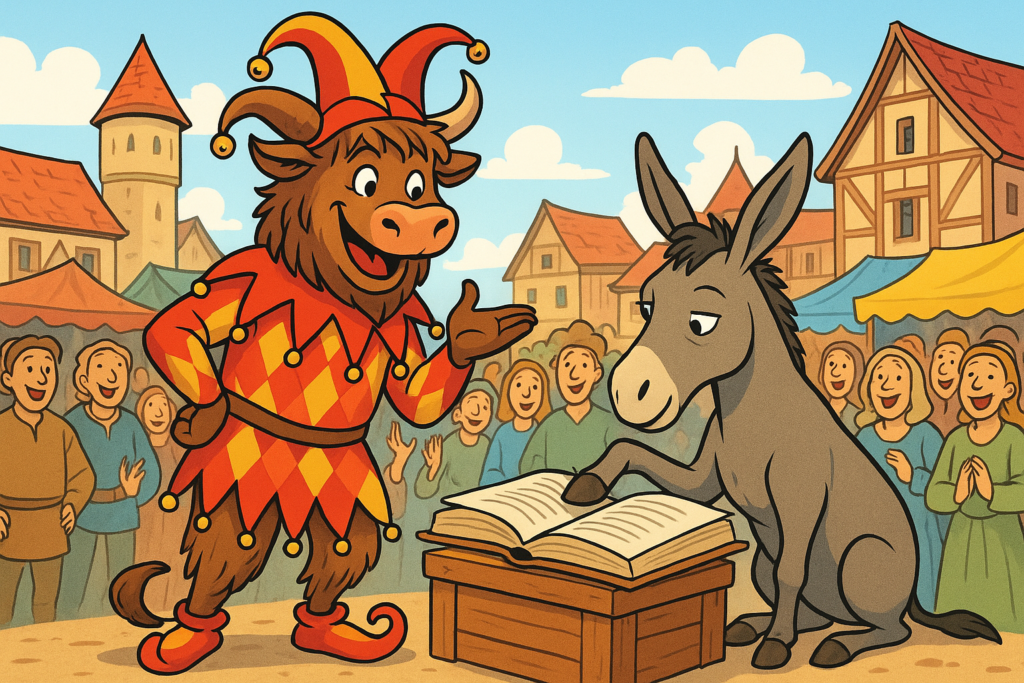
Der Esel schaut das Buch an. Dann er langsam eine Seite um. Die Leute rufen: „Oh! Er !" Der Bürgermeister ist .
Till lacht und sagt: „Ihr seht, er kann lesen. Aber sprechen – das habe ich nie versprochen!" Er nimmt sein Gold, und geht aus der Stadt.
Till Eulenspiegel arrives in a small town. The people are sad. Their mayor is very strict and never has a smile on his face.
Till has a funny idea. He goes to the mayor and says, "I can teach the donkey to read."
The mayor does not laugh. He thinks briefly and says, "If you manage that, I'll give you fifty gold pieces. But if you lie, you must go to prison!"
Till gets the money and a lot of feed. He takes the donkey to an old barn. There the animal has plenty of space.
Every morning Till places a big book in front of the donkey. Under one page he puts a piece of bread. The donkey smells the bread and lifts the page with his nose. Then he eats the bread. Till does this every day.
After a month, the donkey can turn the pages all by himself. Till is happy. He calls all the people: "Come to the marketplace! The donkey can read!"
All the people come. They gather in a circle. Till puts a thick book on the ground and the donkey stands in front of it.
The donkey looks at the book. Then he slowly turns a page. The people shout: "Oh! He really reads!" The mayor is speechless.
Till laughs and says, "You see, he can read. But speaking - I never promised that!" He takes his gold, waves, and leaves the town.
This story is full of useful German words. Let's pick out some playful ones you'll want to keep. The bold trickster Till meets a strict mayor and a "reading" donkey - perfect for building your everyday vocabulary.
- der Bürgermeister (mayor) - a serious town leader
- der Esel (donkey) - the star of the trick
- umblättern (to turn a page) - a handy verb for books
- streng (strict) vs. lustig (funny) - two sides of the story
Modal verbs like können (can) are essential in German. In the story, Till says: „Ich kann dem Esel das Lesen beibringen" (I can teach the donkey to read). Notice how können pushes the main verb to the end of the sentence. This structure is used again when Till boasts: „Der Esel kann lesen!" Practice making your own can-do sentences.
- Kann ich … ? (Can I … ?)
- Du kannst … (You can …)
- Er kann … (He can …)
- Wir können … (We can …)
The cleverest moment comes when Till says: „Ihr seht, er kann lesen. Aber sprechen - das habe ich nie versprochen!" (You see, he can read. But speaking - I never promised that!). This is a perfect example of the Perfekt tense used for past promises. The phrase "das habe ich nie versprochen" is a handy one for playful denials. Try using it when you want to joke that you only agreed to one part of a deal - just like Till!
- versprechen (to promise) → Ich habe versprochen (I promised)
- nie (never) → Ich habe nie … (I have never …)
- Das habe ich nie gesagt. (I never said that.)
You've met Till and his mischievous donkey. Re-read the story out loud, pretending you're telling it to a friend. Notice how the simple past (e.g., kam, sagte) gives it that old-fairy-tale feel. Try swapping the verbs into the present tense for extra practice. And if you ever visit a German-speaking town, ask if they have their own Eulenspiegel - many do!
Till Eulenspiegel trickst die Stadt comes from the German / Till Eulenspiegel tradition and is best known as a public_domain_story_retelling. This Yak Yacker article is an original learner retelling based on public-domain source material, so the wording here is simplified for modern learners rather than copied from one old edition.
Older printings, translations, and retellings of this story can vary quite a bit. This version is adapted for A2 Elementary learners studying German.
If you want to keep going, browse more in our German section and review the Goethe A2 German Vocabulary. After that, try Essential German Grammar Words for another useful next step.