


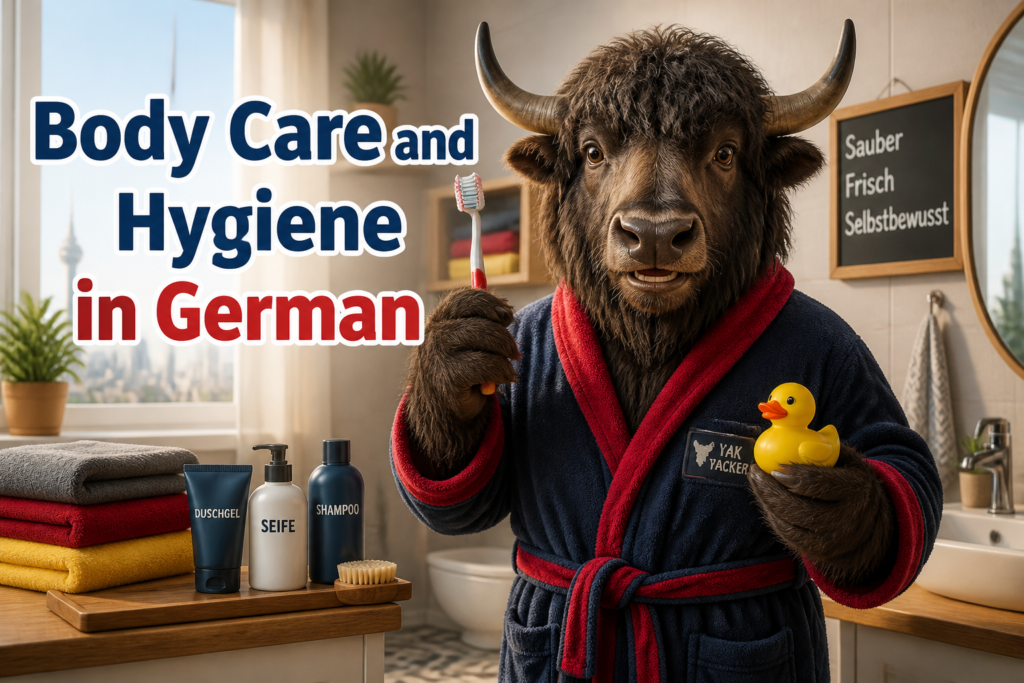
German for body care and hygiene is one of those topics that looks simple until you actually need to say, “Where is the shampoo?” or “Do you have a towel?” Then suddenly your brain goes on a holiday. This guide gives you the everyday German you’ll actually hear in bathrooms, hotels, gyms, pharmacies, and at the hairdresser’s.
We’ll keep it practical: common vocabulary, useful phrases, simple grammar patterns, and pronunciation help for the words people really use. No museum-piece German. Just the useful stuff that helps you wash, trim, brush, rinse, and survive polite small talk in the bathroom.
German also loves compound nouns, so body-care words often look like tiny word trains. Once you learn the pieces, the rest starts behaving itself. Mostly.
For extra practice, you can also connect this topic with the related guide on body actions and gestures in German, because hands, faces, and habits tend to show up together in real life.
And if you want a broader German-learning base, the main hub is here: Learn German.
Useful Body Care Words
Here are the most useful words first. They cover everyday hygiene, personal care, and the little things you ask for at home, in a hotel, or at the pharmacy.
| German | Pronunciation | Meaning | Example Sentence | Translation | Learner Note |
|---|---|---|---|---|---|
| waschen | VAH-shən | to wash | Ich wasche mir die Hände. | I wash my hands. | Common reflexive use: sich waschen or etwas waschen. |
| duschen | DOO-shən | to shower | Ich dusche jeden Morgen. | I shower every morning. | Very common daily routine verb. |
| baden | BAH-dən | to bathe | Das Kind badet heute Abend. | The child is bathing tonight. | Usually for baths, not showers. |
| zähneputzen | TSEH-nə-poot-tsən | to brush teeth | Ich putze mir die Zähne. | I brush my teeth. | Literally “to brush the teeth.” Very common reflexive idea. |
| rasieren | rah-zee-REN | to shave | Er rasiert sich jeden zweiten Tag. | He shaves every second day. | Can be reflexive: sich rasieren. |
| kämmen | KEM-en | to comb | Sie kämmt sich schnell die Haare. | She quickly combs her hair. | Often with hair; also used for fur in a casual way. |
| trocknen | TROK-nən | to dry | Ich trockne mir das Gesicht ab. | I dry my face. | Also common in the phrase sich abtrocknen. |
| eincremen | EIN-kreh-mən | to put on cream/lotion | Ich creme mir die Hände ein. | I put cream on my hands. | Separable verb: creme … ein in some structures. |
| schminken | SHMINK-en | to put on makeup | Sie schminkt sich vor dem Spiegel. | She puts on makeup in front of the mirror. | Usually reflexive: sich schminken. |
| deodorant | deh-oh-do-rant | deodorant | Hast du ein Deodorant dabei? | Do you have deodorant with you? | Often shortened to Deo. |
| Zahnbürste | toothbrush | Meine Zahnbürste ist blau. | My toothbrush is blue. | die Zahnbürste; plural: Zahnbürsten. | |
| Zahnpasta | TSahn-PAHS-tah | toothpaste | Die Zahnpasta ist fast leer. | The toothpaste is almost empty. | Usually feminine: die Zahnpasta. |
| Shampoo | sham-POO | shampoo | Hast du Shampoo gekauft? | Did you buy shampoo? | Used like English; noun is usually neutral: das Shampoo. |
| Duschgel | DOO-sh-gel | shower gel | Ich brauche noch Duschgel. | I still need shower gel. | Very common in shops and hotels. |
| Seife | ZY-fə | soap | Die Seife riecht gut. | The soap smells good. | Feminine: die Seife. |
| German | Pronunciation | Meaning | Example Sentence | Translation | Learner Note |
|---|---|---|---|---|---|
| Handtuch | HANT-hookh | towel | Kann ich ein Handtuch haben? | Can I have a towel? | Neutral noun: das Handtuch; plural Handtücher. |
| Waschlappen | VASH-lah-pən | washcloth | Wo ist der Waschlappen? | Where is the washcloth? | More common in home life than in casual travel talk. |
| Kamm | kam | comb | Ich suche meinen Kamm. | I’m looking for my comb. | Short, useful, and easy to miss in hotel bathrooms. |
| Bürste | BOOR-steh | brush | Die Bürste liegt auf dem Regal. | The brush is on the shelf. | Also used for cleaning brushes, not only hair. |
| Rasierapparat | rah-zee-er-ap-pa-RAHT | electric shaver | Mein Rasierapparat ist kaputt. | My electric shaver is broken. | Long compound noun, because German likes those with a passion. |
| Rasierklinge | rah-zee-er-KLING-ə | razor blade | Ich brauche neue Rasierklingen. | I need new razor blades. | Plural often used in shopping contexts. |
| Feuchtigkeitscreme | FOYKH-tig-keets-kreh-mə | moisturizer | Ich benutze jeden Morgen Feuchtigkeitscreme. | I use moisturizer every morning. | Very common in skincare and pharmacy conversations. |
| Handcreme | HANT-kreh-mə | hand cream | Hast du Handcreme dabei? | Do you have hand cream with you? | Useful in winter. Germany’s dry air can be rude to skin. |
| Haarbürste | HAR-boor-steh | hairbrush | Die Haarbürste ist im Bad. | The hairbrush is in the bathroom. | Separate from Bürste when clarity matters. |
| Föhn | furn | hair dryer | Kann ich den Föhn benutzen? | Can I use the hair dryer? | Pronounced with ö-like sound; not “foon.” |
| Spiegel | SPEE-gəl | mirror | Ich schaue in den Spiegel. | I look in the mirror. | Common in bathroom and grooming phrases. |
| Waschbecken | VASH-bek-en | sink / washbasin | Das Waschbecken ist verstopft. | The sink is clogged. | Useful in hotels, apartments, and repairs. |
Everyday Phrases For The Bathroom
These are the phrases people actually need. Not dramatic poetry. Just normal life with soap.
| German | Pronunciation | Meaning | Example Sentence | Translation | Learner Note |
|---|---|---|---|---|---|
| Ich dusche. | ikh DOO-shə | I’m showering / I shower | Ich dusche morgens. | I shower in the morning. | Simple present tense for routine. |
| Ich wasche mir die Hände. | ikh VAH-shə meer dee HEN-də | I wash my hands | Vor dem Essen wasche ich mir die Hände. | Before eating, I wash my hands. | mir shows “to myself” in reflexive use. |
| Ich putze mir die Zähne. | ikh POOT-sə meer dee TSEH-nə | I brush my teeth | Abends putze ich mir die Zähne. | In the evening, I brush my teeth. | Very common daily habit phrase. |
| Ich creme mich ein. | ikh KREH-mə mikh EYN | I put on cream | Im Winter creme ich mich oft ein. | In winter, I often put on cream. | Reflexive verb: mich because the subject is “I.” |
| Ich rasiere mich. | ikh rah-ZEE-reh mikh | I shave | Mein Bruder rasiert sich morgens. | My brother shaves in the morning. | Reflexive and very common. |
| Ich kämme mir die Haare. | ikh KEM-mə meer dee HAH-rə | I comb my hair | Ich kämme mir die Haare vor dem Ausgehen. | I comb my hair before going out. | Hair is usually plural in German: die Haare. |
| Ich wasche mir die Haare. | ikh VAH-shə meer dee HAH-rə | I wash my hair | Ich wasche mir heute Abend die Haare. | I’m washing my hair this evening. | Often with mir in everyday German. |
| Hast du Seife? | hast doo ZY-fə | Do you have soap? | Hast du Seife für die Hände? | Do you have soap for the hands? | Friendly, casual question. |
| Ich brauche ein Handtuch. | ikh BRAW-khə ayn HANT-hookh | I need a towel | Kannst du mir ein Handtuch geben? | Can you give me a towel? | Useful in hotels, gyms, and at friends’ places. |
| Wo ist das Waschbecken? | voh ist das VASH-bek-en | Where is the sink? | Entschuldigung, wo ist das Waschbecken? | Excuse me, where is the sink? | Polite and practical. |
| Ich trockne mich ab. | ikh TROK-nə mikh ap | I dry myself off | Nach dem Duschen trockne ich mich ab. | After showering, I dry myself off. | Nice example of a separable verb: abtrocknen. |
| Kann ich den Föhn benutzen? | kan ikh den furn bə-ZOO-khen | Can I use the hair dryer? | Kann ich Ihren Föhn benutzen? | Can I use your hair dryer? | More polite with Ihren in formal situations. |
Body Parts You Hear In Hygiene Talk
You do not need every body part at once, but these show up constantly in grooming, medical, and daily-care conversations.
| German | Pronunciation | Meaning | Example Sentence | Translation | Learner Note |
|---|---|---|---|---|---|
| das Haar / die Haare | das HAHR / dee HAH-rə | hair / hairs | Meine Haare sind heute trocken. | My hair is dry today. | German often uses plural die Haare for hair on the head. |
| das Gesicht | das gə-ZIKHT | face | Ich wasche mir das Gesicht. | I wash my face. | Neutral noun: das Gesicht. |
| die Hand | dee hant | hand | Ich wasche mir die Hände. | I wash my hands. | Plural changes vowel: Hand → Hände. |
| der Finger | der FING-er | finger | Meine Finger sind kalt. | My fingers are cold. | Plural: Finger stays the same. |
| der Arm | der arm | arm | Ich creme mir die Arme ein. | I put cream on my arms. | Plural: Arme. |
| das Bein | das bine | leg | Ich rasiere mir die Beine. | I shave my legs. | Plural: Beine. |
| der Rücken | der RYUK-en | back | Mein Rücken tut weh. | My back hurts. | Very useful in health and body-care contexts. |
| der Hals | der hals | neck / throat | Ich wasche mir den Hals nicht mit Seife. | I don’t wash my neck with soap. | Also means “throat” in many contexts. |
| der Mund | der moont | mouth | Mach den Mund auf. | Open your mouth. | Useful in dental or medical situations. |
| das Ohr | das ohr | ear | Ich reinige mir die Ohren vorsichtig. | I clean my ears carefully. | Plural: Ohren. |
| die Haut | dee howt | skin | Meine Haut ist trocken. | My skin is dry. | Very common in skincare and pharmacy language. |
Toiletries And Bathroom Items
German bathroom nouns are often straightforward, but the articles matter. Yes, articles again. German is loyal to its articles in a deeply committed, slightly exhausting way.
| German | Pronunciation | Meaning | Example Sentence | Translation | Learner Note |
|---|---|---|---|---|---|
| die Zahnbürste | dee TSahn-boor-steh | toothbrush | Meine Zahnbürste ist neu. | My toothbrush is new. | Feminine noun. Plural: Zahnbürsten. |
| die Zahnpasta | dee TSahn-PAHS-tah | toothpaste | Wir brauchen neue Zahnpasta. | We need new toothpaste. | Usually uncountable in everyday use. |
| das Shampoo | das sham-POO | shampoo | Das Shampoo riecht nach Kokos. | The shampoo smells like coconut. | Loanword; easy to recognize. |
| das Duschgel | das DOO-sh-gel | shower gel | Ich kaufe Duschgel und Seife. | I’m buying shower gel and soap. | Common in drugstores. |
| die Seife | dee ZY-fə | soap | Bitte nimm die Seife nicht weg. | Please don’t take away the soap. | Also used in the phrase Handseife for hand soap. |
| das Handtuch | das HANT-hookh | towel | Das Handtuch ist noch nass. | The towel is still wet. | Plural: Handtücher with umlaut. |
| der Rasierer | der rah-zee-ER-er | razor | Wo ist mein Rasierer? | Where is my razor? | Used for manual razors; electric shaver is different. |
| die Rasierklinge | dee rah-zee-ER-KLING-ə | razor blade | Die Rasierklinge ist stumpf. | The razor blade is dull. | stumpf means not sharp. |
| das Deo | das DEH-oh | deodorant | Hast du Deo dabei? | Do you have deodorant with you? | Very common short form of Deodorant. |
| die Bürste | dee BOOR-steh | brush | Ich suche eine Bürste für die Haare. | I’m looking for a brush for the hair. | Context matters: hairbrush or cleaning brush. |
| die Lotion | dee loh-TSYON | lotion | Ich benutze im Winter Lotion für die Haut. | I use lotion for the skin in winter. | Often used like English in beauty shops and pharmacies. |
Common Verbs For Personal Care
These verbs show up in daily routines, instructions, and polite conversation. Learn them once and they keep paying rent.
| German | Pronunciation | Meaning | Example Sentence | Translation | Learner Note |
|---|---|---|---|---|---|
| sich waschen | zikh VAH-shən | to wash oneself | Ich wasche mich vor dem Frühstück. | I wash before breakfast. | Reflexive verb. The pronoun changes: mich, dich, sich. |
| sich duschen | zikh DOO-shən | to shower | Sie duscht sich jeden Abend. | She showers every evening. | Often used like English “to shower,” but reflexive. |
| sich rasieren | zikh rah-ZEE-ren | to shave oneself | Er rasiert sich im Bad. | He shaves in the bathroom. | Normal everyday phrasing. |
| sich kämmen | zikh KEM-en | to comb one’s hair | Ich kämme mich schnell. | I comb my hair quickly. | Less common than die Haare kämmen, but perfectly natural. |
| sich abtrocknen | zikh AP-trok-nən | to dry oneself off | Nach dem Schwimmen trockne ich mich ab. | After swimming, I dry myself off. | Separable verb: ab + trocknen. |
| sich eincremen | zikh EYN-kreh-mən | to put cream on oneself | Im Sommer creme ich mich mit Sonnencreme ein. | In summer I put sunscreen on myself. | Word order matters with separable verbs. |
| sich schminken | zikh SHMINK-en | to put on makeup | Sie schminkt sich vor der Party. | She puts on makeup before the party. | Common in everyday and beauty contexts. |
| etwas benutzen | ET-vahs bə-NOO-tsən | to use something | Kann ich Ihr Handtuch benutzen? | Can I use your towel? | Polite and very flexible. Great general verb. |
| etwas brauchen | BRAW-khən | to need something | Ich brauche noch Seife. | I still need soap. | One of the most useful verbs in daily life. |
| etwas kaufen | KOW-fən | to buy something | Ich kaufe Shampoo im Drogeriemarkt. | I buy shampoo at the drugstore. | Drogeriemarkt is common in Germany for toiletries. |
Useful Sentences In Real Life
These short sentences help in hotels, shared apartments, gyms, and everyday routines. They also show how German often puts the reflexive pronoun in a very normal place, as if there were never any question it belonged there.
- Ich gehe duschen. — I’m going to shower.
- Ich habe keine Seife. — I don’t have any soap.
- Kann ich dein Handtuch benutzen? — Can I use your towel?
- Wo kann ich mich waschen? — Where can I wash myself?
- Ich muss mir die Hände waschen. — I need to wash my hands.
- Hast du ein Deo dabei? — Do you have deodorant with you?
- Ich brauche eine Bürste. — I need a brush.
- Meine Haut ist trocken. — My skin is dry.
- Ich creme mir das Gesicht ein. — I put cream on my face.
- Die Zahnpasta ist fast leer. — The toothpaste is almost empty.
- Das Waschbecken ist kaputt. — The sink is broken.
- Ich habe mein Shampoo vergessen. — I forgot my shampoo.
Notice how often German uses simple, direct wording here. No need to sound fancy when you just want soap and survival.
Grammar Notes That Actually Help
Body-care German is a great place to learn reflexive verbs, articles, and a bit of word order without getting buried alive in grammar jargon.
| Pattern | Meaning | German Example | English Translation | Learner Note |
|---|---|---|---|---|
| sich + verb | reflexive action | Ich wasche mich. | I wash myself. | mich = me; dich = you; sich = himself/herself/itself/themselves. |
| verb-second | main clause word order | Heute wasche ich mir die Haare. | Today I wash my hair. | The verb still stays in second position, even when the sentence starts with a time word. |
| separable verb | prefix often moves to the end | Ich trockne mich ab. | I dry myself off. | In normal present tense, the prefix goes to the end. |
| article + noun | gender matters | die Seife, das Shampoo, der Föhn | the soap, the shampoo, the hair dryer | Learn the article with the noun. German nouns are not shy about their genders. |
| accusative | direct object | Ich brauche ein Handtuch. | I need a towel. | After many common verbs, the thing you want is in accusative. With ein, it often stays the same for neuter nouns. |
| dative reflexive | used with body parts | Ich wasche mir die Hände. | I wash my hands. | German often uses mir/dir when a body part is involved. |
Rule of thumb: when you talk about your own body part in German, you often say something like Ich wasche mir die Hände instead of the more direct English-style phrasing. It feels a bit extra at first, then suddenly becomes normal and your brain stops arguing.
Pronunciation Tips For Common Hygiene Words
German body-care words are usually friendly to learners, but a few sounds are worth a closer look. Nothing scary. Just enough to keep you from sounding like a confused shampoo commercial.
- ch in Wasch-: often a soft, back-of-the-throat sound, not “k.”
- z in Zahnbürste: sounds like ts.
- sch in Shampoo and Seife words with s clusters: make it smooth, not overly English.
- ie in rasiert: usually a long “ee” sound.
- ö in Föhn: round your lips a bit; it is not “foon.”
- ü in words like Handtücher: also rounded lips, but keep the tongue in front.
- Final consonants may sound a little harder at the end: baden keeps its ending, but Handtuch ends with a firm ch.
If you want a boring-but-useful dictionary check for tricky spellings, Duden is a solid place to look up standard German forms.
Yak wisdom: If you can ask for soap, towel, toothpaste, and a mirror in German, you are already doing better than half the bathroom panic in the world.
Germany, Austria, And Switzerland Notes
Most of the words in this guide are standard German and work across German-speaking countries. Still, a few small differences pop up, because of course they do.
| Meaning | Germany | Austria | Switzerland | Note |
|---|---|---|---|---|
| shower | duschen | duschen | dusche / duschen | The verb is widely understood everywhere. |
| toilet paper | Toilettenpapier | Toilettenpapier | WC-Papier sometimes heard | Hotel or store language may vary a bit. |
| deodorant | Deo | Deo | Deo | Short form is common across the German-speaking world. |
| towel | Handtuch | Handtuch | Badetuch can also be heard | Both are understandable; Handtuch is standard and safest. |
For standard usage in dictionaries and learning resources, a good neutral reference is the Goethe-Institut language learning material and vocabulary pages like Wiktionary’s German body-care terms when you want to browse related words without drama.
Mini Practice
Quick practice helps these words stick. Tiny drills. No guilt. No musical chairs.
1) Fill In The Blank
- Ich wasche mir die ________. (hands)
- Hast du ________ dabei? (soap)
- Ich brauche ein ________. (towel)
- Sie kämmt sich die ________. (hair)
- Mein ________ ist leer. (toothpaste)
2) Translate Into German
- I shower every morning.
- I brush my teeth.
- Where is the sink?
- Can I use your towel?
- I need deodorant.
3) Correct The Sentence
- Ich wasche die Hände. → Ich wasche mir die Hände.
- Ich trockne ab mich. → Ich trockne mich ab.
- Wo ist Handtuch? → Wo ist das Handtuch?
- Ich brauche Seife die. → Ich brauche die Seife.
4) Match The Word To The Meaning
- Föhn = hair dryer
- Haut = skin
- Rasierklinge = razor blade
- Waschbecken = sink
- Zahnbürste = toothbrush
Common Mistakes And Easy Fixes
| Common Mistake | Better German | Why It Matters |
|---|---|---|
| Ich wasche die Hände. | Ich wasche mir die Hände. | German often uses the reflexive dative with body parts. |
| Ich putze meine Zähne. | Ich putze mir die Zähne. | The reflexive version is more natural in everyday German. |
| Ich trockne mich. | Ich trockne mich ab. | You usually need the separable prefix ab for “dry off.” |
| das Seife | die Seife | Seife is feminine. |
| ein Handtuch as plural | Handtücher | Plural changes the vowel: u becomes ü. |
| Foon | Föhn | The vowel is not English “oo.” Round your lips more. |
One more tiny trap: in German, nouns are capitalized, so die Seife, das Shampoo, and der Föhn all get a capital letter even when they show up in the middle of a sentence. German nouns like being noticed.
Quick Reference Summary
- Most useful verbs: waschen, duschen, rasieren, kämmen, trocknen, eincremen, schminken
- Most useful nouns: Seife, Shampoo, Duschgel, Handtuch, Zahnbürste, Zahnpasta, Spiegel, Waschbecken
- Most useful body parts: Hände, Haare, Gesicht, Haut, Rücken, Mund
- Key grammar idea: reflexive verbs are very common in body-care German
- Key pattern: German often says mir die Hände, mir die Haare, and similar body-part phrases
- Pronunciation to remember: z = “ts,” sch = “sh,” ö/ü need rounded lips
If you can say Ich brauche Seife, Wo ist das Waschbecken?, and Kann ich den Föhn benutzen?, you already have a very practical body-care toolkit. That’s the kind of German that quietly saves your day.
Yak takeaway: body-care German is mostly about everyday nouns, reflexive verbs, and a few very useful bathroom questions. Learn the core words, repeat the sentence patterns, and German bathroom life stops feeling like a mystery with a soap dispenser.